
- Education
- Diamond Shapes
- Round Diamond Cuts: The Round Brilliant Family Explained (Round, Star and Portuguese)
Diamond shapes
Round Diamond Cuts: The Round Brilliant Family Explained (Round, Star and Portuguese)
Round diamond cuts can look quite different depending on how the facets are arranged. This guide groups the round brilliant, star and Portuguese cuts as one family, so you can see what they share, where they differ and which one suits you.
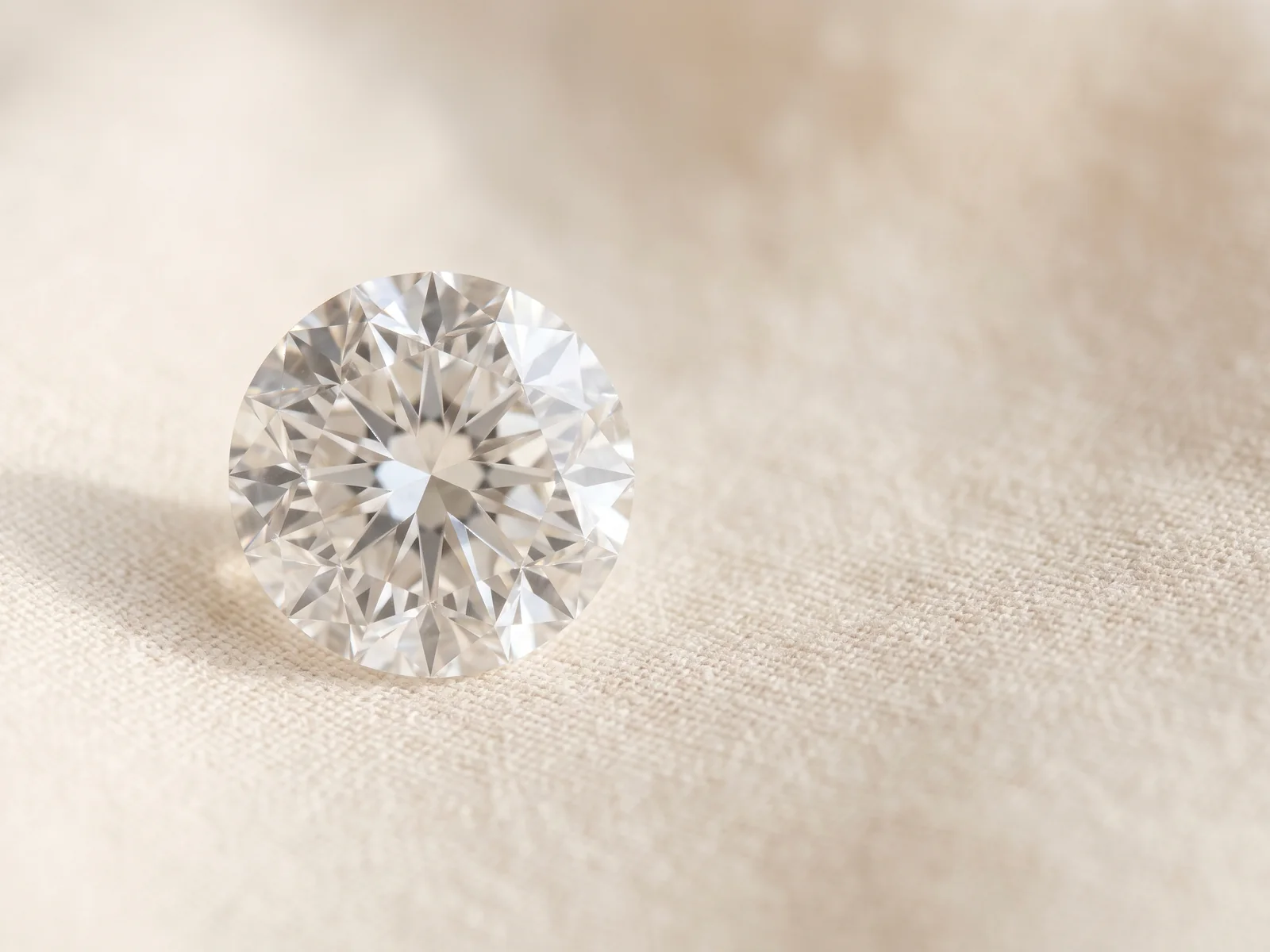
 Reviewed by Raj Sood, Graduate Gemologist (GIA), AJP (GIA)Master jeweller and Graduate Gemologist (GIA) · reviewed 4 November 2026
Quick answer
The round brilliant family covers round diamond cuts that share brilliant facets radiating from the centre. The round brilliant has 57–58 facets and the most even sparkle; the Portuguese cut keeps the round outline but adds extra tiers for finer, busier sparkle; the star cut puts brilliant facets into a pointed star outline, mostly in small sizes.
What are the round diamond cuts in the round brilliant family?
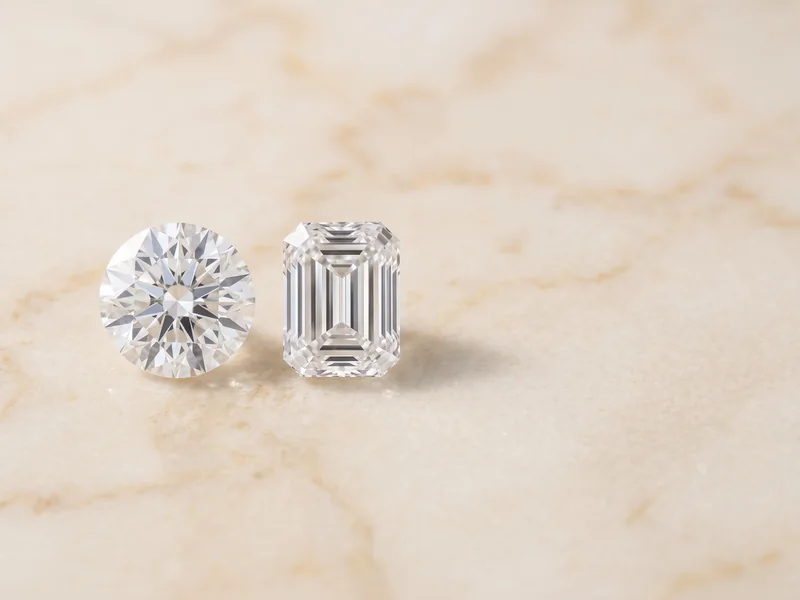
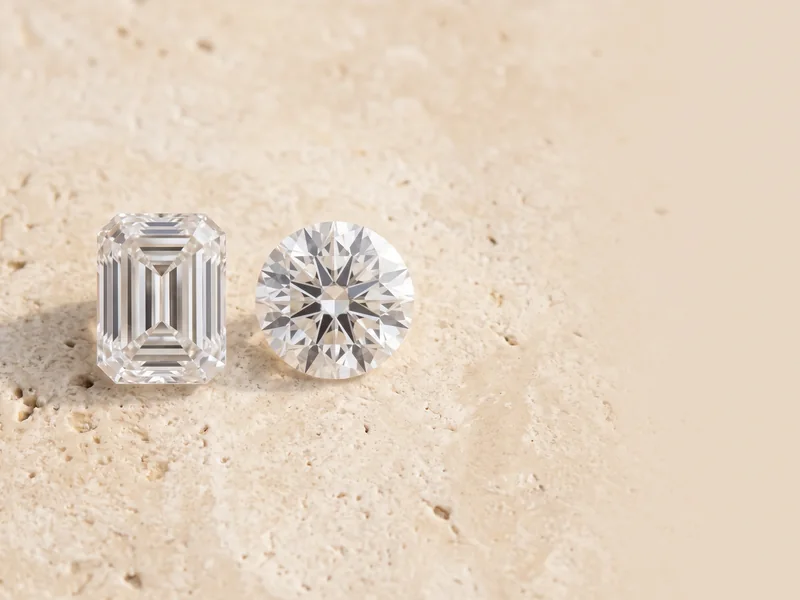
A cut family is a group of diamond cuts that are built on the same idea. In the round brilliant family, that idea is simple: the facets (the small flat polished surfaces) start at the centre of the stone and fan outwards like the spokes of a wheel. That radial layout is what gives these round diamond cuts their bright, lively sparkle, and it is the opposite of the long parallel facets you see in emerald or Asscher cuts. If that difference is new to you, our explainer on how step cuts and brilliant cuts handle light is a good place to start.
There are three members in this family:
- Round brilliant: the standard 57 or 58 facet round, and the most widely sold diamond shape.
- Portuguese cut: a round outline with extra rows of facets, often well over 100 in total, for a finer, busier sparkle.
- Star cut: brilliant-style facets arranged in a star outline, usually five or six points, and mostly cut in small sizes.
These are three of the shapes covered in our guide to every one of the 34 diamond cuts, explained and compared. If you are still deciding on a shape at all, our introduction to how diamond shapes differ sets out the main options first. Any term on this page you have not met before is defined in the GemTrove jewellery glossary.
What do round, star and Portuguese cuts have in common?
All three cuts share the same basic anatomy. From the top down, there is the table (the large flat facet on top), the crown (the sloping upper part), the girdle (the thin edge around the widest point), the pavilion (the cone-shaped lower part) and, sometimes, a culet (a tiny flat facet at the very bottom, usually absent or graded "none" in modern cuts).
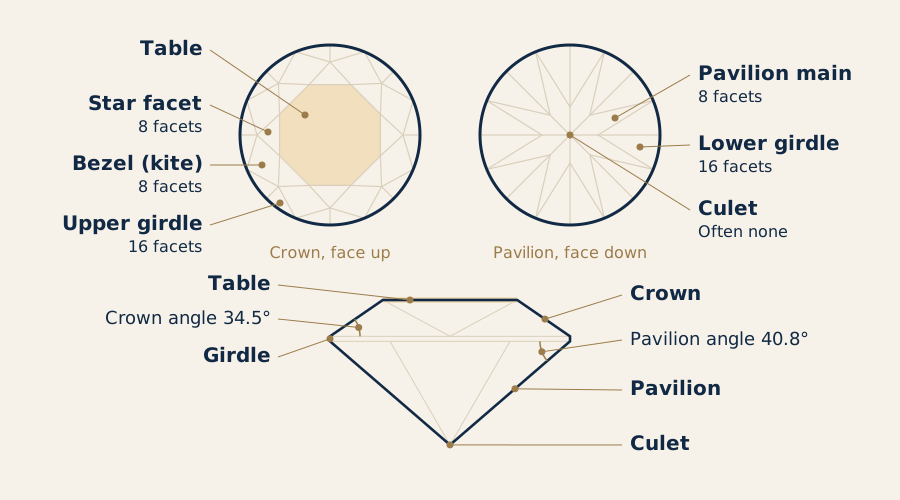
They also rely on the same physics. Diamond has a refractive index of about 2.42, which means it bends light strongly, and a dispersion of about 0.044, which is how much it splits white light into colours. A well-proportioned pavilion acts like a set of angled mirrors: light enters through the crown, bounces off the pavilion facets and returns up through the top. Brilliant faceting is designed to send as much of that light back to your eye as possible, which is why all three cuts look brighter than a step cut of the same size.
Finally, they are all diamond, with the same hardness (10 on the Mohs scale) whether natural or laboratory-grown. Hardness is resistance to scratching, not resistance to knocks, so thin edges and points still need protection. That matters most for the star cut.
What is a round brilliant cut diamond?
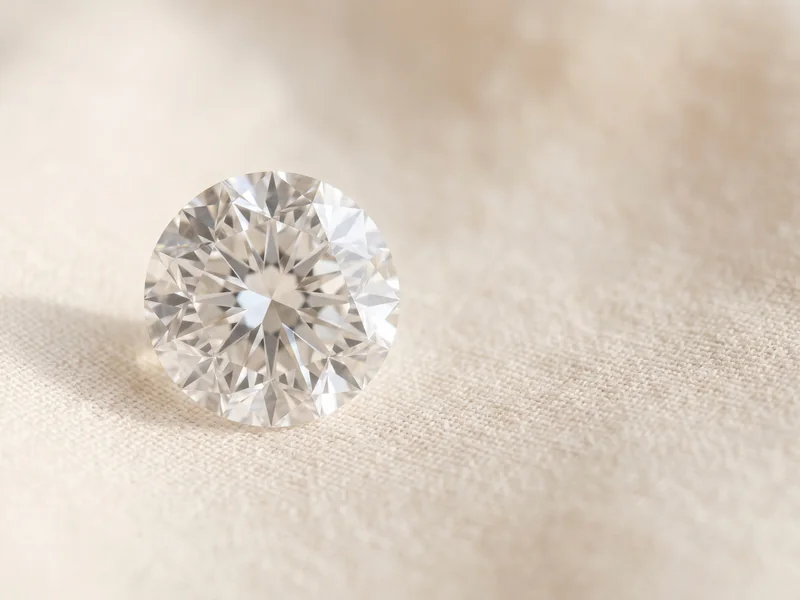
The round brilliant cut diamond is the reference point for every other cut. Its modern form is usually traced to Marcel Tolkowsky's 1919 calculations, later refined by cutters and grading labs. A standard round has 33 facets on the crown (the table, 8 star facets, 8 bezel or kite facets and 16 upper girdle facets) and 24 on the pavilion (8 pavilion mains and 16 lower girdle facets). That makes 57, or 58 if the stone has a culet. The full detail is in our complete round brilliant diamond guide.
Note the name clash: the star facets on a round brilliant are the eight small triangles around the table. They have nothing to do with the star cut, which is a different shape.
The round is also the only shape that GIA gives an overall cut grade for, from Excellent down to Poor. That grade is built from proportions like these:
| Proportion | Typical range in a well-cut round | What it affects |
|---|---|---|
| Table | about 53–58% | Balance of brightness and fire |
| Total depth | about 59–62.5% | Face-up size and light return |
| Crown angle | about 34–35° | Fire (flashes of colour) |
| Pavilion angle | about 40.6–41° | Brightness; too steep or shallow leaks light |
| Girdle | thin to slightly thick | Durability of the edge |
| Culet | none or pointed | A large culet shows as a dark dot |
Two rounds with the same grade can still look different, which is why we wrote about reading round proportions beyond the cut grade. Some rounds are cut with a larger table and greater depth, like the 60/60 round compared with classic proportions. Others are cut too steep and deep to save weight, which can make the centre look dark; see why steep-deep rounds lose light. Cutters also adjust the girdle facets in ways called painting and digging out, explained in our guide to how painting and digging out change a round's look.
The round brilliant grew out of earlier rounds such as the Old European cut, which has a smaller table, a higher crown and an open culet. If you like antique jewellery, our page on the modern round versus the Old European cut shows how the two differ.
What is a star cut diamond?
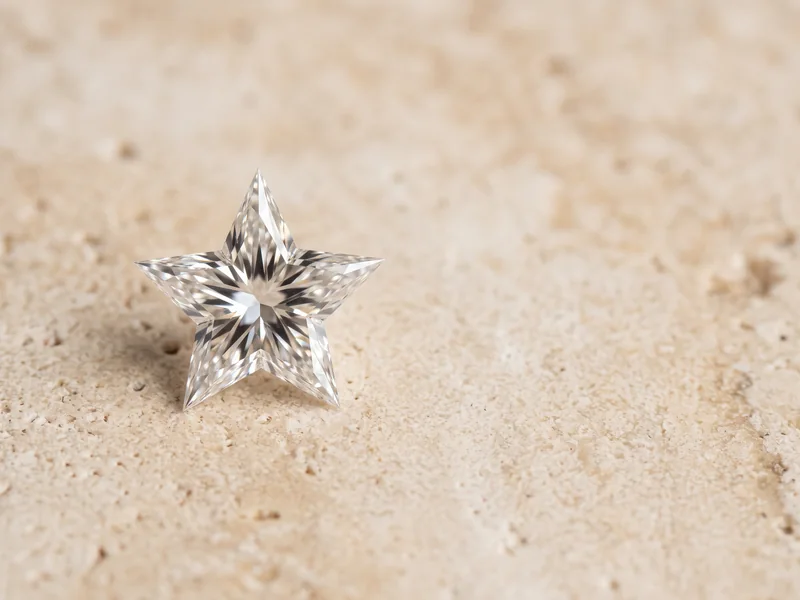
A star cut diamond has a star-shaped outline, most often with five points, sometimes six. Inside that outline the facets are brilliant-style and radiate from the centre, which is why it sits in the round brilliant family rather than with the angular step-cut shapes. The name is used loosely in the trade, so always check the grading report and photos rather than relying on the word "star" alone. Our dedicated star cut diamond guide goes into the variations.
Three things set the star apart from its round relatives:
- Points and notches: each point is thin and exposed, and the inward notches between points are hard to polish cleanly. Both are more vulnerable to chipping than a round's smooth girdle.
- Uneven light return: the points leak more light than the body, so a star tends to look brightest in the centre and darker at the tips.
- Size: cutting a star from rough wastes a lot of material, so most stars are small, often well under half a carat, and used in pendants, earrings, accent stones and novelty pieces.
GIA does not give star cuts an overall cut grade, only polish and symmetry grades, so judge the stone by eye: points of equal length, evenly spaced, with crisp notches and no chips at the tips. If you like pointed outlines, the star is closely related to the geometric diamond cuts such as shield, kite and hexagon, though those are usually step-faceted.
Not sure which one is right?
Send us the stones you are looking at and our gemologist will tell you which to choose and why.
What is a Portuguese cut diamond?
A Portuguese cut diamond keeps the round outline of a round brilliant but adds extra tiers of facets on the crown and the pavilion. Instead of one ring of kite facets and one ring of pavilion mains, it has several stacked rows, so the total facet count often climbs well past 100. The exact number varies from cutter to cutter. Grading reports usually describe it as a round modified brilliant, sometimes with the cut name added in the comments. Our full Portuguese cut diamond guide covers the variations.
More facets means smaller facets, and that changes the look. A round brilliant gives a mix of bold flashes and finer sparkle. A Portuguese cut breaks light into many more, smaller points, a busy, glittering effect that some people describe as "crushed ice" or pinfire sparkle. This kind of sparkle is called scintillation: the pattern of light and dark flashes as the stone or the viewer moves.
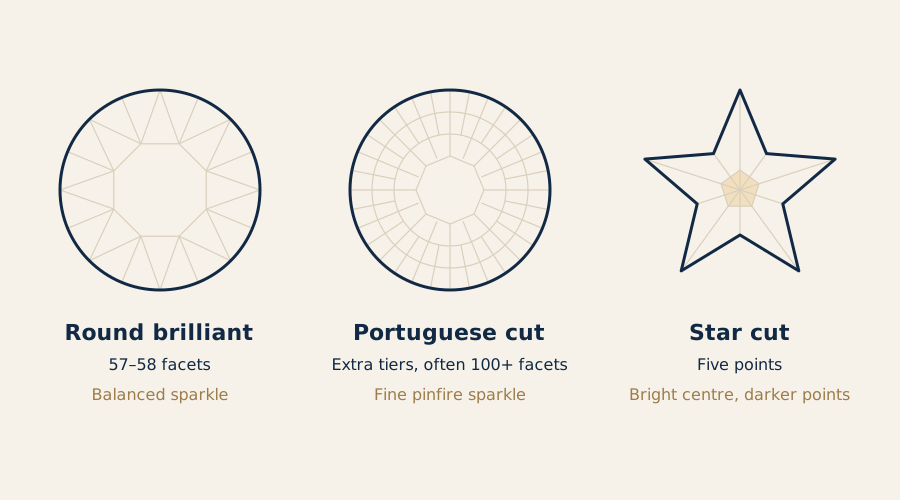
Because each facet must line up across several tiers, a Portuguese cut takes longer to polish and shows poor symmetry quickly. Like the star, it does not receive a GIA cut grade, so a 360° video and Excellent or Very Good polish and symmetry grades matter more than usual.
How do round diamond cuts compare side by side?
This is the chart at the heart of this page: the three types of round diamond cuts, compared on the points that actually change how they look and wear.
| Round brilliant | Portuguese cut | Star cut | |
|---|---|---|---|
| Outline | Circle | Circle | Five or six-pointed star |
| Facets | 57–58 | Often 100+ (varies) | Varies by design |
| Sparkle | Balanced: bold flashes and fine sparkle | Finer, busier pinfire sparkle | Bright centre, darker points |
| GIA cut grade | Yes (Excellent to Poor) | No; polish and symmetry only | No; polish and symmetry only |
| Fragile areas | None (smooth girdle) | None (smooth girdle) | Every point and notch |
| Typical sizes | 0.01 ct to several carats | Mostly 0.30 ct and up | Mostly small, under about 0.50 ct |
| Availability | Very wide | Limited | Rare |
| Common uses | Engagement rings, studs, bands | Engagement rings, pendants | Pendants, earrings, accents |
If none of the three feels quite right, compare the round with its nearest neighbours outside the family. An oval gives a similar brilliant sparkle in a longer outline, as our oval versus round comparison shows. A cushion gives softer, chunkier flashes in a rounded square; see round and cushion cuts side by side.
Related guideOval vs Round DiamondsHow big does each round cut look? Round diamond size chart
For a round, the diameter (in millimetres) tells you how big it looks face-up, meaning the size you see from above. These are typical diameters for well-proportioned round brilliants with a depth of about 60–62%:
| Carat weight | Typical diameter (round brilliant) |
|---|---|
| 0.25 ct | about 4.1 mm |
| 0.50 ct | about 5.1–5.2 mm |
| 0.75 ct | about 5.8–5.9 mm |
| 1.00 ct | about 6.4–6.5 mm |
| 1.50 ct | about 7.3–7.4 mm |
| 2.00 ct | about 8.1–8.2 mm |
A Portuguese cut of similar depth faces up at a similar diameter, but cutters sometimes give it more depth to fit the extra tiers, which hides weight underneath. Always compare the millimetre measurements on the report, not just the carat weight. A star is measured point to point, so its millimetre figure looks large while the actual area of diamond is much smaller than a round of the same width.
What setting suits each round diamond cut?
Rounds and Portuguese cuts have a smooth girdle with no points, so they suit almost every setting. The star needs more care. Typical choices:
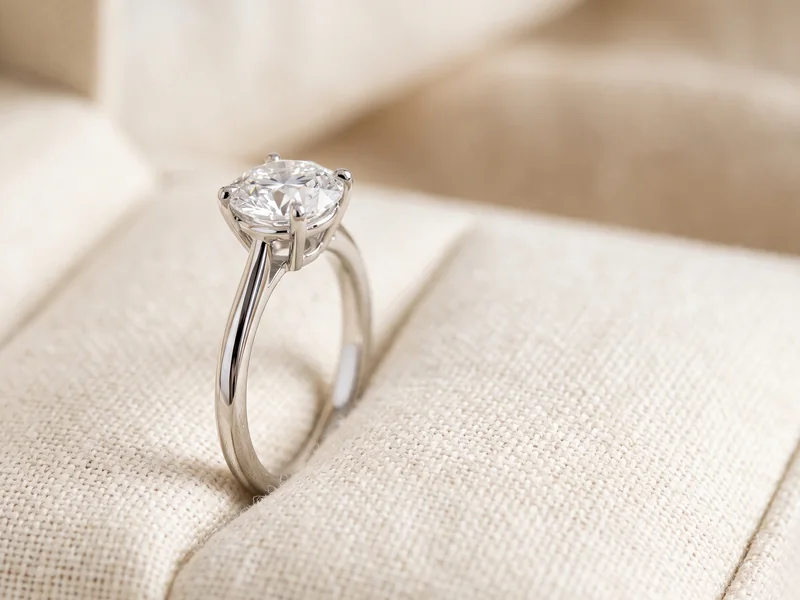
- Round brilliant: four or six claws, bezel, halo, pavé band or three-stone. Four claws show more diamond; six hold it more securely and look rounder.
- Portuguese cut: the same settings as a round. An open, high setting lets more light reach the extra facets, while a bezel slightly softens the sparkle.
- Star cut: a claw at the tip of every point, or a full bezel that follows the outline. In a pendant or earring the points are far less exposed than on a ring.
Our guide to setting styles that suit round diamonds has examples of each, and if you are planning a bridal set, see wedding bands that pair well with a round engagement ring.
How much do round diamond cuts cost in Australia, natural or lab-grown?
All three cuts are available in natural and laboratory-grown diamond. A lab-grown round diamond is real diamond, with the same hardness, refractive index and sparkle as a natural one; it is grown in a laboratory rather than mined, and it costs much less. Natural diamonds are rarer. Either way, ask for an independent grading report from a lab such as GIA or IGI, which states clearly whether the stone is natural or lab-grown.
| 1 ct, G–H colour, VS clarity | Approximate price range (AUD) |
|---|---|
| Round brilliant, lab-grown | about $1,000–$3,000 |
| Round brilliant, natural | about $7,000–$16,000 |
| Portuguese cut, lab-grown | about $1,000–$3,500 |
| Portuguese cut, natural | usually similar to a round of the same grades; limited supply |
| Star cut | mostly small stones, priced individually |
These are broad ranges only, and prices move with the market. For round diamond price in Australia, the biggest factors are carat, colour, clarity and cut grade, with an Excellent cut adding a premium. Portuguese prices depend more on how well the extra tiers are cut, and on scarcity, than on a cut grade.
Browse round and Portuguese cut diamonds: natural and lab-grown
How do you choose between round, star and Portuguese cuts?
- Decide on the sparkle you like. Balanced flashes point to a round brilliant; finer, glittering sparkle points to a Portuguese cut.
- Check the report. Confirm shape, measurements, colour, clarity, polish, symmetry and whether the diamond is natural or lab-grown.
- For a round, read the proportions. Look for a table of about 53–58%, depth about 59–62.5% and an Excellent or Very Good cut grade.
- For a Portuguese or star, judge symmetry by eye. With no cut grade, watch a 360° video for even facet tiers or matching points.
- Compare millimetres, not just carats. Use the diameter (or point-to-point width for a star) to judge face-up size.
- Match the setting to the cut. Any setting suits a round or Portuguese; protect every point of a star with claws or a bezel.
Free consultation
Talk to a gemologist
Compare stones in person or online with Raj Sood, Graduate Gemologist (GIA), AJP (GIA).
Book a consultationFAQ
Common questions
How many facets does a round brilliant cut diamond have?
A standard round brilliant has 57 facets, or 58 if it has a culet: 33 on the crown and 24 on the pavilion.
Is a Portuguese cut diamond more sparkly than a round brilliant?
It sparkles differently rather than more. Its extra facets give many small, busy flashes, while a round brilliant gives a balance of larger flashes and fine sparkle.
Does GIA give a cut grade to Portuguese or star cut diamonds?
No. GIA gives an overall cut grade only to standard round brilliants; Portuguese and star cuts receive polish and symmetry grades, so you judge the cut by eye.
Are star cut diamonds suitable for engagement rings?
They can be, but every point is thin and exposed, so the stone needs a claw on each point or a bezel. Most star cuts are small and are more often used in pendants and earrings.
Can you get a lab-grown round diamond in a Portuguese cut?
Yes. Lab-grown diamonds are cut in round, Portuguese and other shapes, and the grading report will state that the stone is laboratory-grown.
What size is a 1 carat round diamond?
A well-proportioned 1 carat round brilliant is usually about 6.4–6.5 mm across. A deeper cut can measure smaller for the same weight.

Ask a gemologist
Not sure which diamond to choose?
Raj Sood is a Graduate Gemologist (GIA) and master jeweller. Bring the stones you are considering, or send the reports, and he will tell you honestly which one is better and why.
Keep learning
Related guides
 Diamond ShapesRound Brilliant Diamonds
 Diamond ShapesPortuguese Cut Diamonds
 Diamond ShapesStar Cut Diamonds
 Diamond ShapesAll 34 Diamond Cuts: Every Shape Explained and ComparedDiamond ShapesUnderstanding Diamond Shapes
 Diamond ShapesStep Cuts vs Brilliant Cuts ExplainedDiamond ShapesOval vs Round Diamonds
 Engagement Rings & SettingsBest Settings for Round Diamonds
Explore more
More guides on this topic
Education