
- Education
- Engagement Rings & Settings
- Best Settings for Round Diamonds: Claws, Bezels, Halos and Bands
Engagement Rings & Settings
Best Settings for Round Diamonds: Claws, Bezels, Halos and Bands
A round diamond suits more setting styles than any other shape, which makes the choice harder, not easier. Here is how the best settings for round diamonds compare on look, security, height and the wedding band that sits beside them.
 Reviewed by Raj Sood, Graduate Gemologist (GIA), AJP (GIA)Master jeweller and Graduate Gemologist (GIA) · reviewed 4 November 2026
Quick answer
The best settings for round diamonds are a four- or six-claw solitaire, a bezel, or a halo. Four claws show the most diamond; six claws hold it more securely and look rounder; a bezel suits active hands. Set the stone low to medium, about 5–7 mm above the finger, and pair it with a band that sits flush.
What are the best settings for round diamonds?
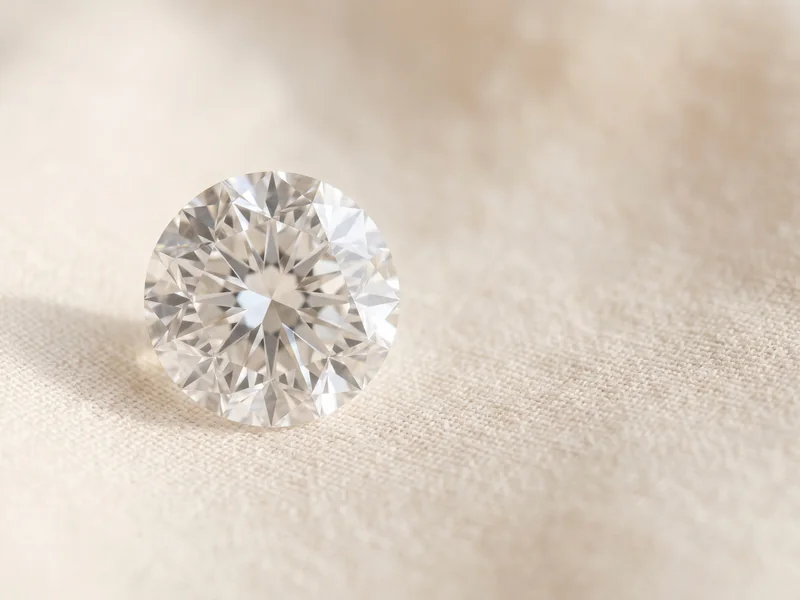
A round brilliant is the most forgiving shape to set. It has no points or corners to protect, its outline is perfectly even, and its 57 or 58 facets return so much light that almost any setting style works. That is why round diamond engagement ring settings cover the widest range of any shape, from a plain four-claw solitaire to a halo with a pavé band. For background on the cut itself, start with our guide to round brilliant diamonds.
The right setting for you depends on three things: how much of the diamond you want to see, how hard your hands work, and what kind of wedding band you want beside it. The table below sums up the main options, and each one gets its own section further down. For every setting style across all shapes, see the complete guide to engagement ring setting styles.
| Setting | Look | Security | Suits |
|---|---|---|---|
| Four-claw solitaire | Most diamond visible, outline can look slightly squared | Good; losing one claw can free the stone | A classic look and easy cleaning |
| Six-claw solitaire | Rounder outline, a little more metal | Very good; the stone stays held if one claw fails | Everyday wear, stones 1 ct and above |
| Bezel (full or half) | Clean rim of metal, modern | Excellent; protects the whole edge | Active hands and hands-on jobs |
| Halo | Ring of small diamonds, looks larger | Good for the centre; small stones need regular checks | A bigger face-up look for the carat weight |
| Three-stone | Centre flanked by two side stones | Good | A wider look across the finger |
| Pavé or side-stone band | Sparkle down the band | Good; small stones can loosen over time | Extra sparkle without a halo |
Close relatives of the round, such as the star and Portuguese cuts, set in much the same way; see the round brilliant family: round, star and Portuguese cuts. If a word such as gallery, shank or girdle is new to you, it is explained in our plain-English jewellery glossary.
Should a round diamond have four or six claws?
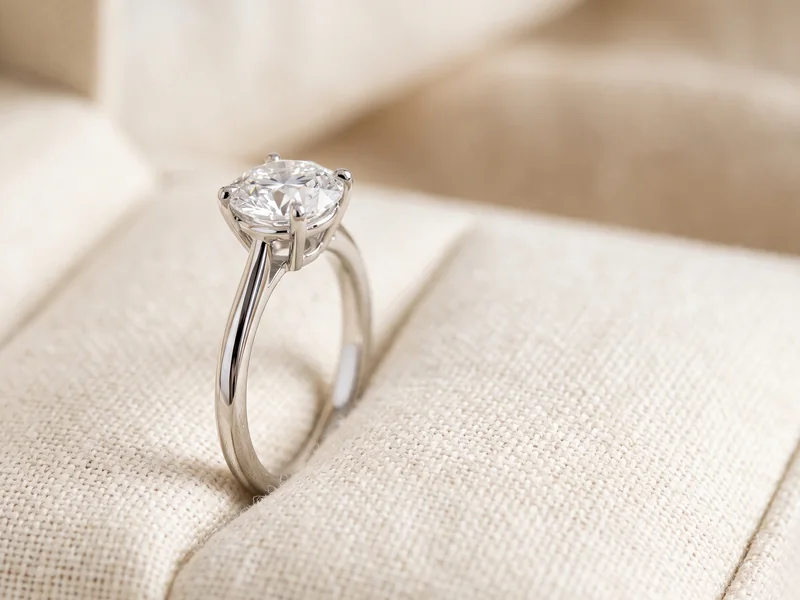
A claw (called a prong in the US) is a thin post of metal bent over the edge of the diamond to hold it in place. On a round, the choice is mostly between four and six claws, and where those claws sit changes the look more than most people expect. This is the heart of the 4 claw vs 6 claw round diamond question.
| Feature | Four claws | Six claws |
|---|---|---|
| Diamond visible | More; less metal over the edge | Slightly less |
| Face-up outline | Can look a touch square | Looks rounder |
| Security | Each claw carries a quarter of the load | Stone stays held if one claw breaks |
| Cleaning | Easier to clean under the stone | A little more fiddly |
| Typical use | Up to about 1 ct, or larger with sturdy claws | 1 ct and above, and everyday wear |
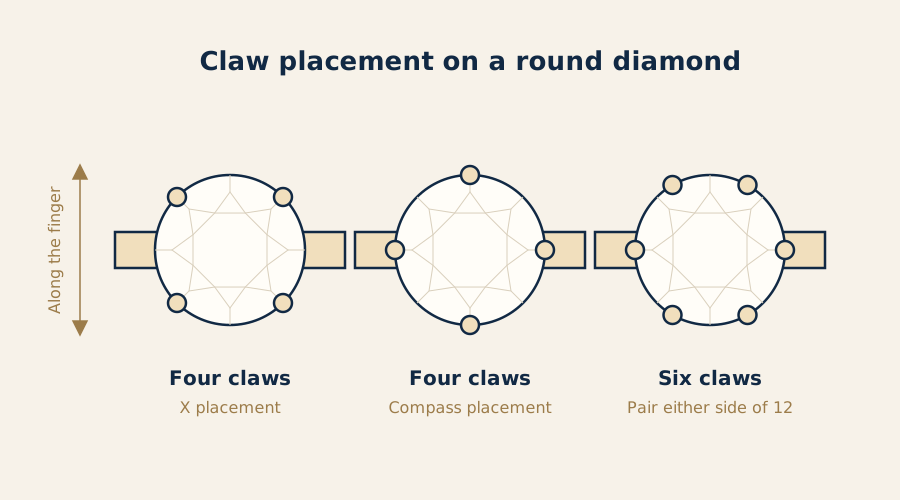
With four claws, the usual claw placement for a round diamond is an X: claws at roughly 45° to the band, midway between 12, 3, 6 and 9 o'clock. This lines up neatly with the shoulders of the ring. Compass placement puts the claws at 12, 3, 6 and 9 o'clock, pointing along and across the finger, which gives a distinctive, slightly geometric look. With six claws, you choose between one claw at 12 o'clock or a pair either side of it; a pair at the top gives a flatter, more even edge to the person looking at your hand.
The shape of the claw tip matters too. Round claws are the most common. Eagle claws are pointed like a talon and cover less of the stone. Tab claws are flat and suit a modern look. Double claws put two thin claws side by side at each position, giving eight points of contact while still looking light. Our page on round, eagle, tab, V-prong and double claws shows each one up close. Rounds do not need V-claws, because there is no point or corner to protect.
Claws wear down with daily use. On a 1 ct round, claws are commonly about 1.2–1.5 mm thick at the tip when new. Once they wear thin or flat, a jeweller adds new metal to the top, called re-tipping. Having them checked every 6–12 months catches wear before a stone works loose.
Is a bezel setting good for a round diamond?
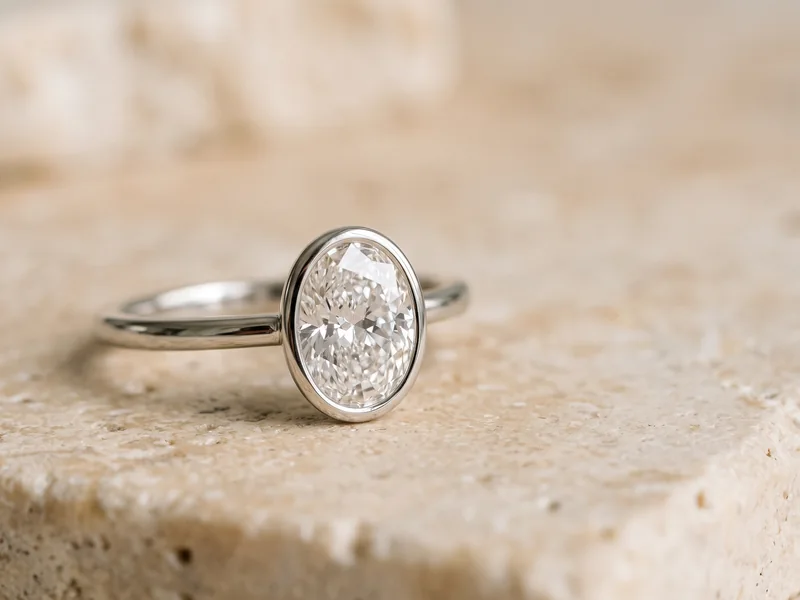
A bezel is a continuous rim of metal around the girdle, the thin outer edge of the diamond. A full bezel wraps the whole circle; a half-bezel holds the stone on two sides and leaves the others open. Because a round has an even edge with no corners, it is the easiest shape to bezel set neatly, and a bezel setting round diamond ring is one of the most practical choices for everyday wear.
- Security: the strongest everyday setting. The metal protects the girdle from chips, and there is nothing to catch on jumpers, hair or gloves.
- Look: clean and modern. The stone can read slightly smaller, because about 0.3–0.5 mm of the edge sits under metal all the way round.
- Light: a closed bezel lets less light in from the side, and an open-backed bezel helps. Most of a round's sparkle comes through the top, so the difference is smaller than many people fear.
- Colour: a yellow gold bezel reflects warmth into the diamond; white metal keeps a G or H colour looking white.
- Repairs: a bezel is harder to adjust or reset than a claw, so it is worth getting the fit right the first time.
Bezels suit people who use their hands all day: nurses, chefs, tradies, gardeners and anyone at the gym. A half-bezel is a good middle ground if you want more of the diamond on show. We compare these and other low, snag-free options in ring settings that stand up to active hands.
Does a halo setting make a round diamond look bigger?
Yes. A halo is a ring of small diamonds, called melee (pronounced mel-ay), set around the centre stone. Rounds suit halos well because the circle is easy to follow evenly. With melee of about 1.1–1.3 mm and a thin metal rim, a single halo adds roughly 2.5–3 mm to the overall width, so the ring reads noticeably larger from across a room.
| Centre carat | Round diameter | Outline with a single halo (approx.) |
|---|---|---|
| 0.50 ct | about 5.1–5.2 mm | about 7.5–8.0 mm |
| 0.75 ct | about 5.8–5.9 mm | about 8.3–8.8 mm |
| 1.00 ct | about 6.4–6.5 mm | about 9.0–9.5 mm |
| 1.50 ct | about 7.3–7.4 mm | about 10.0–10.5 mm |
| 2.00 ct | about 8.0–8.2 mm | about 10.7–11.2 mm |
Before you choose a halo setting for a round diamond, weigh three things. First, the melee are tiny and held by tiny claws or beads of metal, so they need checking more often than a solitaire. Second, the colour should match: a G centre surrounded by H–I melee can look warmer at the edge. Third, a halo is wider at the base, which makes it harder for a straight wedding band to sit flush.
A hidden halo sits under the girdle, so it adds sparkle when the ring is seen from the side without changing the face-up look. It is a popular choice for people who like a clean solitaire from the top but want a detail only they will notice. A halo can also make a smaller centre stone look fuller, but it will not fix a poorly cut diamond; a well-cut centre still matters most.
Not sure which one is right?
Send us the stones you are looking at and our gemologist will tell you which to choose and why.
How high should a round diamond sit in its setting?
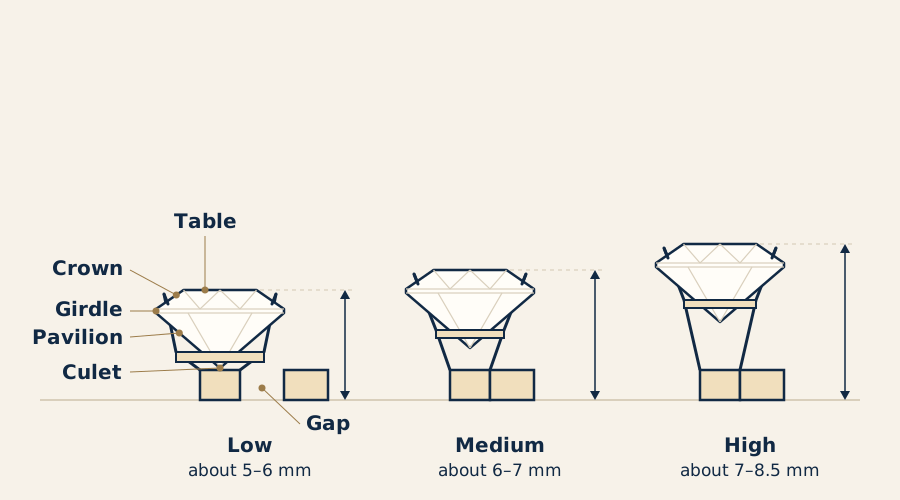
Setting height is how far the top of the diamond sits above your finger. A round brilliant cut to good proportions has a total depth of about 59–62.5% of its diameter, so a 1 ct stone is about 3.9–4.0 mm deep from the table (the large flat top facet) to the culet (the very bottom). The setting has to fit all of that depth, plus the gallery underneath and the band, which is why even a low profile round diamond setting still sits a few millimetres off the finger.
| Profile | Approx. height (1 ct) | Pros | Watch for |
|---|---|---|---|
| Low-set | about 5–6 mm | Snags less, suits active hands | A straight band may not slide underneath |
| Medium | about 6–7 mm | A good balance; most bands sit flush | Few drawbacks for everyday wear |
| High or cathedral | about 7–8.5 mm | Shows the stone, lots of room for a band | Catches more often and puts more leverage on the claws |
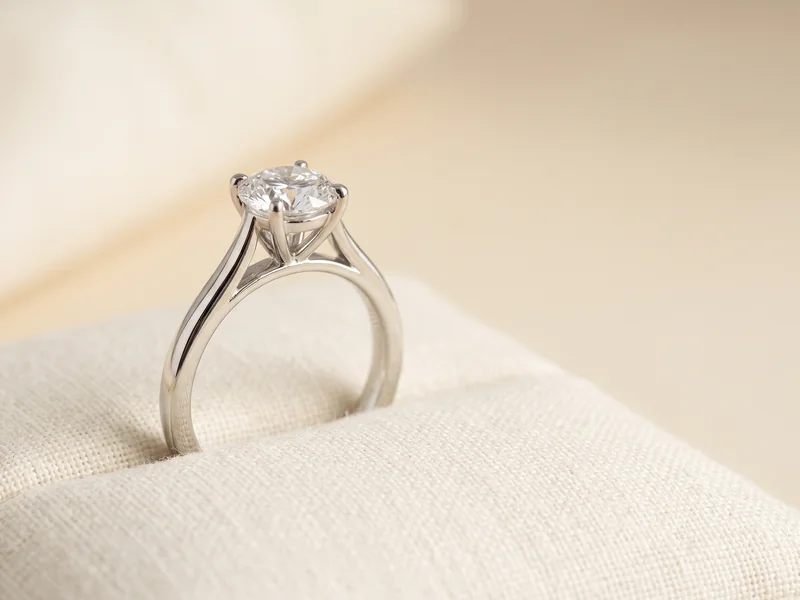
The structure under the stone changes the look from the side. A cathedral setting has arches of metal rising from the band to hold the head. A basket joins the claws with a horizontal wire rail, which adds strength. A trellis crosses the claws over each other as they rise. All three work with a round; a basket is the sturdiest at a low height.
Deeper stones need more room. A round cut deeper than about 63% carries more weight underneath, looks smaller face-up and needs a taller head; our page on why steep-deep round diamonds sit taller and look smaller explains the trade-off. Antique cuts differ too: an Old European cut usually has a taller crown and smaller table, so the head should be made to its measured depth. Our comparison of the modern round brilliant and the Old European cut sets out the differences.
Which side stones suit a round centre, and how do other shapes compare?
A three-stone ring flanks the round with two smaller stones. A common balance is side stones of about a third to half the centre's weight each, for example a 1 ct centre with 0.30–0.50 ct sides. Round side stones give a continuous, even line. Pear side stones, pointing in towards the centre, widen the look and soften it; our setting advice for pear diamonds covers how their points are protected. Tapered baguettes give crisp step-cut lines that lead the eye to the centre.
- Pavé band: rows of melee about 1.0–1.5 mm, held by tiny beads of metal, along the top of the band.
- Channel set: small stones held between two walls of metal, smoother and less likely to catch.
- Split shank: the band divides into two as it meets the head, making a 1 ct round look wider set.
- Plain band: a slim, plain shank makes the centre stone look larger by contrast.
Rounds are the simplest shape to set, and comparing them with other shapes shows why.
| Shape | Weak points | Usual claws | Setting note |
|---|---|---|---|
| Round | None, only the girdle | 4 or 6 round or eagle claws | Almost any style works |
| Princess | Four sharp corners | V-claws at each corner | Corners must be covered |
| Cushion | Soft corners | 4 claws or double claws | Claw placement sets square or rounded look |
| Pear | One point | V-claw at the point | Point faces down the finger |
| Asscher | Cut corners | 4 claws or V-claws | Step facets show metal more |
For shape-specific advice, see the claw and bezel options for princess diamonds, our guide to setting a cushion diamond and the setting choices for Asscher cut diamonds. If you are still deciding on the shape, the oval and round diamonds compared and our round vs cushion cut comparison put the stones side by side.
Which metal suits a round diamond solitaire setting?
The metal changes both how the claws wear and how white the diamond looks. A round diamond solitaire setting can be made in one metal throughout, or with white claws on a yellow or rose gold band, which keeps the diamond looking white while the band stays warm.
| Metal | Colour | How claws wear | Notes |
|---|---|---|---|
| Platinum (950) | Naturally white | Metal moves rather than wears away; claws hold well | Heavier and usually costs more |
| 18ct white gold | White, usually rhodium-plated | Harder surface, loses metal slowly | Replate about every 12–24 months |
| 18ct yellow gold | Warm yellow | Softer; check claws regularly | Masks warmth in I–J colours |
| 18ct rose gold | Pink | Similar to yellow gold | Copper in the alloy gives the colour |
Before any metal is cast, a CAD (computer-aided design) model can show the same round diamond in a four-claw, six-claw, bezel and halo head at actual size, so you can compare the claws, height and profile on screen rather than guessing from photos of different stones.
What wedding band suits a round engagement ring?
The wedding band is half the finished look. With a round solitaire on a medium head, a straight band usually slides under the stone and sits flush, meaning the two rings touch along their length with no gap. Halos, low bezels and wide cathedral shoulders often need a contoured or notched band that curves around the head. Our guide to the wedding bands that sit neatly beside a round shows the common pairings.
- Straight band: suits medium and high solitaires; the cleanest look.
- Contoured band: curves under or around a halo or low head.
- Matching pavé band: pair melee of a similar size and colour to the engagement ring.
- Width: match or slightly vary the engagement ring's shank, commonly 2–2.5 mm.
Thickness matters as much as style. Very fine shanks, under about 1.8 mm wide or 1.4 mm deep, are more likely to bend out of shape over the years, and a bent shank can loosen the claws holding the diamond. Our page on why rings go out of round explains the warning signs.
Related guideBest Wedding Band for Round Engagement RingsDoes a natural or lab-grown round diamond change the setting?
No. Natural and laboratory-grown diamonds are both real diamond, 10 on the Mohs scale with a refractive index of about 2.42, and they are cut to the same round brilliant proportions. A setting holds them in exactly the same way. Both should come with an independent grading report from a lab such as GIA or IGI, which states whether the stone is natural or lab-grown.
What changes is usually the size. Lab-grown diamonds cost much less than natural diamonds, so many people choose a larger lab-grown round. As a broad guide, a 1 ct G–H, VS round with an excellent cut might be about AUD $1,000–$2,500 lab-grown and about $8,000–$16,000 natural, though prices move with the market and the exact grades. A larger stone is heavier and sits higher, so a 2 ct round of about 8.0–8.2 mm is usually better held by six claws or a sturdier four-claw head.
Shop round diamonds: natural and lab-grown
How do you choose the best settings for round diamonds? Step by step
- Start with your hands. If you work with your hands or play sport, lean towards a bezel, half-bezel or low six-claw setting.
- Choose four or six claws. Four shows more diamond; six looks rounder and holds the stone if one claw fails.
- Decide on claw placement and tips. X or compass for four claws; round, eagle, tab or double tips.
- Pick a height. Low for snag-free wear, medium for most bands, high to show the stone; check the head suits the stone's measured depth.
- Decide on a halo or side stones. Add a halo for extra face-up size, or a three-stone or pavé band for width and sparkle.
- Plan the wedding band now. Make sure it will sit flush, or choose a contoured band, and keep the shank at least about 1.8 mm wide.
- Compare the options at actual size. Look at a CAD render or try on sample heads with the same diamond before the ring is made.
Free consultation
Talk to a gemologist
Compare stones in person or online with Raj Sood, Graduate Gemologist (GIA), AJP (GIA).
Book a consultationFAQ
Common questions
Is 4 or 6 claws better for a round diamond?
Neither is better for everyone. Four claws show more of the diamond and are easier to clean, while six claws look rounder and keep the stone held if one claw breaks, which suits stones of 1 ct and above and everyday wear.
What is the most secure setting for a round diamond?
A full bezel, because a continuous rim of metal protects the whole edge and has nothing to catch. A half-bezel or a low six-claw setting with a basket are the next most secure.
Does a halo make a round diamond look bigger?
Yes. A single halo adds roughly 2.5–3 mm to the outline, so a 1 ct round of about 6.5 mm reads at about 9–9.5 mm across. The halo stones need checking more often than a solitaire.
Will a straight wedding band sit flush with a round engagement ring?
Usually, if the round sits in a medium or high solitaire head. Halos, low bezels and wide cathedral shoulders often need a contoured or notched band.
How often should the claws on a round diamond ring be checked?
Every 6–12 months, or straight away if the stone moves or a claw catches on fabric. Worn claws can be re-tipped with new metal before the stone works loose.
What is the best setting for a round diamond if I have active hands?
A bezel or half-bezel, or a low six-claw setting, set at about 5–6 mm high. These snag less and protect the girdle from knocks.

Ask a gemologist
Not sure which diamond to choose?
Raj Sood is a Graduate Gemologist (GIA) and master jeweller. Bring the stones you are considering, or send the reports, and he will tell you honestly which one is better and why.
Keep learning
Related guides
 Engagement Rings & SettingsClaw Types: Round, Eagle, Tab, V-Prong, Double
 Wedding Bands & EternityBest Wedding Band for Round Engagement RingsEngagement Rings & SettingsEngagement Ring Setting Styles Guide
 Engagement Rings & SettingsBest Engagement Ring Settings for Active Hands
 Diamond ShapesRound Brilliant Diamonds
 Diamond ShapesRound Brilliant Family: Round, Star and Portuguese CutsDiamond ShapesOval vs Round Diamonds
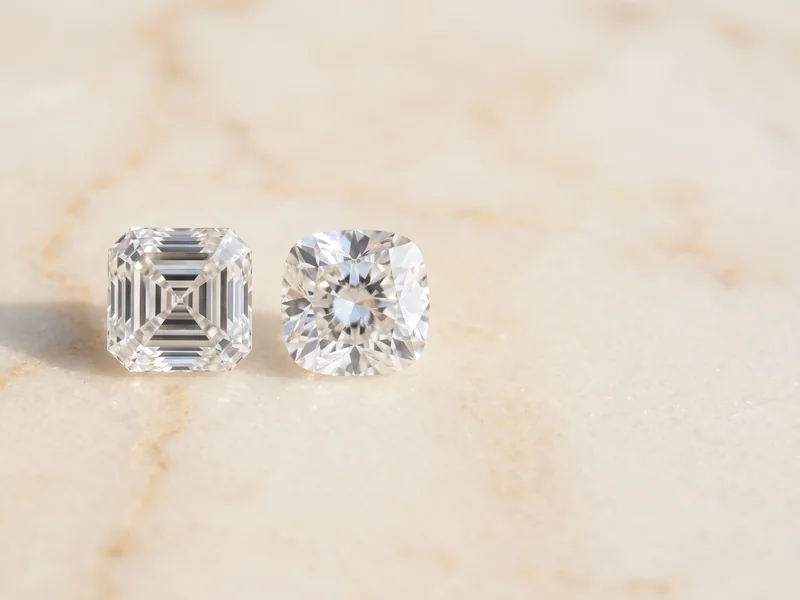 Diamond ShapesRound vs Cushion Cut Diamonds
Explore more
More guides on this topic
Education