
- Education
- Diamond Shapes
- Round Brilliant Cut Diamond: The Complete Australian Guide
Diamond shapes
Round Brilliant Cut Diamond: The Complete Australian Guide
The round brilliant cut diamond is the shape almost everyone pictures, and the one cutters understand best. Here is how its facets work, where the design came from, and which proportions make it bright.
 Reviewed by Raj Sood, Graduate Gemologist (GIA), AJP (GIA)Master jeweller and Graduate Gemologist (GIA) · reviewed 4 November 2026
Quick answer
A round brilliant cut diamond is a circular diamond with 57 or 58 facets (58 when it has a culet) arranged to return the most light. Refined by Marcel Tolkowsky in 1919, it is the only shape GIA gives an overall cut grade. Aim for Excellent cut, a table of about 54–58% and depth of 59.5–62.5%.
What is a round brilliant cut diamond?
A round brilliant cut diamond is a circular diamond cut with 57 or 58 facets, the flat polished surfaces on a gem. It is the shape most people picture when they hear the word diamond, and it is the most common centre stone in engagement rings. The name comes from the brilliant style of faceting: triangular and kite-shaped facets radiating from the centre, angled to send light back up through the top of the stone.
Round is also the benchmark for every other shape. Ovals, pears, hearts and cushions are modified brilliants: they borrow the round's facet pattern and stretch or reshape it. To see where the round sits among them, start with every diamond shape compared or the full list of 34 diamond cuts and how they differ.
Every round brilliant has five parts:
- Table: the large flat facet on top, the window into the stone.
- Crown: the sloping upper section between the table and the girdle. Its facets break light into flashes of colour, called fire.
- Girdle: the thin outer edge where the claws hold the stone.
- Pavilion: the cone-shaped lower section that acts like a set of mirrors, reflecting light back up.
- Culet: the tip at the very bottom, either a sharp point or a tiny polished facet.
The round is part of a small family of round brilliant styles that includes the star cut and the many-faceted Portuguese cut. Both keep the circular outline but change the number and layout of facets, which changes the look of the sparkle.
Why do round brilliant cut diamonds have 58 facets?
A standard round brilliant has 33 facets on the crown and 24 on the pavilion, which makes 57. If the cutter polishes a tiny flat facet at the tip, the culet, that counts as the 58th. Most modern rounds have no culet (the report says None), so strictly they have 57 facets, but 58 is still the figure most people quote.
| Part | Facet type | Number | What it does |
|---|---|---|---|
| Crown | Table | 1 | Lets light in and out; the main window |
| Crown | Star facets | 8 | Small triangles around the table; add scintillation |
| Crown | Bezel (kite) facets | 8 | Large kite shapes; the main source of fire |
| Crown | Upper girdle facets | 16 | Thin triangles at the edge; spread light across the crown |
| Pavilion | Pavilion main facets | 8 | Do most of the reflecting back to your eye |
| Pavilion | Lower girdle facets | 16 | Break up the reflections into smaller flashes |
| Pavilion | Culet | 0 or 1 | Protects the tip if present; best kept small or none |
| Total | 57 or 58 |
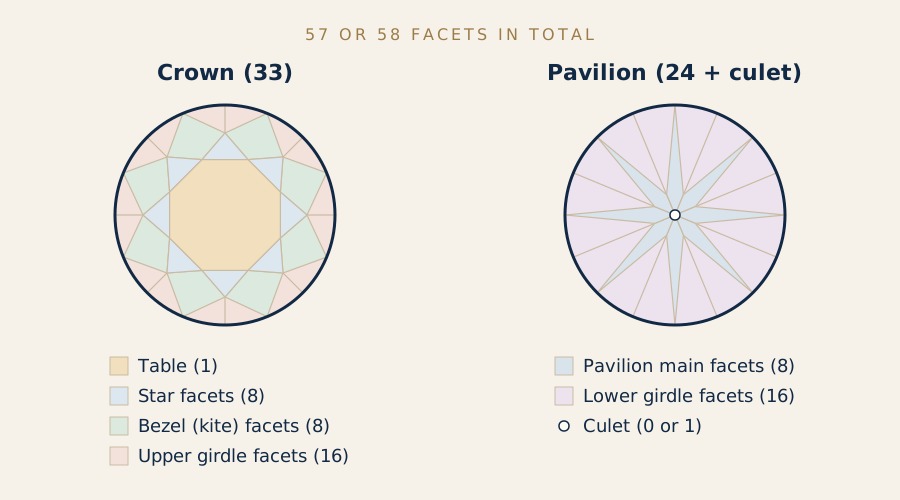
Some cutters also polish the girdle into dozens of tiny facets, called a faceted girdle. These are not counted in the 57 or 58. The arrangement matters more than the count: the brilliant pattern gives crisp, distinct flashes, unlike the flat, mirror-like glow of a rose cut (see rose cut vs brilliant cut) or the broken, glittery look explained in our guide to crushed-ice and brilliant facet patterns.
The facets work because of diamond's physics. Diamond has a refractive index of about 2.42, which means it bends light strongly, and a critical angle of about 24.4°. Light striking the pavilion at more than that angle from the perpendicular reflects back inside instead of escaping. A round's pavilion angles are set so that most light hits at the right angle twice and comes back out through the crown. Its dispersion of 0.044 is what splits white light into colour, and at 10 on the Mohs scale of hardness, diamond holds sharp facet edges for a lifetime.
What is the history of the round brilliant cut diamond?
The modern round took about six centuries to arrive. Each step came from better tools, not just better ideas: cutters could only make what their wheels and saws allowed.
| Era (approx.) | Cut | What changed |
|---|---|---|
| 1300s–1400s | Point cut | Natural octahedral crystal faces simply polished |
| 1400s–1500s | Table cut | Top point ground flat to make a table |
| 1600s | Single cut and Mazarin | Single cut around 17–18 facets, Mazarin around 34; first steps towards a brilliant pattern |
| Late 1600s | Peruzzi (triple cut) | Around 58 facets on a cushion-like outline |
| 1700s–1800s | Old mine cut | Squarish cushion outline, high crown, small table, large culet |
| c. 1870s–1930s | Old European cut | Truly round outline thanks to bruting machines; small table, open culet |
| 1919 | Tolkowsky's design | Angles calculated for a balance of brilliance and fire |
| 1950s–today | Modern round brilliant | Larger tables, precise angles, scanning and laser planning; GIA cut grade from 2006 |
The turning point was the mechanical bruting machine in the late 1800s, which grinds two diamonds against each other to form a circular girdle. For the first time a cutter could make a genuinely round outline, and the old European cut followed. Our guide to the old European cut compared with the modern round shows how different the two look side by side: the older stone has broad, chunky flashes and a visible culet; the modern one has finer, faster sparkle.
In 1919 Marcel Tolkowsky, from an Antwerp family of diamond cutters, published Diamond Design. Using the optics of diamond, he calculated a pavilion angle of about 40.75°, a crown angle of about 34.5° and a table of about 53% of the diameter. Modern rounds usually have slightly larger tables and a proper girdle rather than his knife edge, but his angles are still close to what top cutters aim for today.
In the 1980s, Japanese buyers popularised hearts and arrows rounds, cut with such precise optical symmetry that a viewer shows eight arrows from above and eight hearts from below. In 2006 GIA introduced its overall cut grade for round brilliants, which is why you now see Excellent, Very Good and so on printed on the report.
What are the ideal proportions for a round brilliant diamond?
Proportions are the measurements that decide how a round handles light. They are all expressed as a percentage of the diameter or as an angle, so they apply to a 0.30 carat stone and a 3 carat stone alike. The table below shows the ranges many gemmologists treat as the sweet spot; diamonds outside them can still look good, but need checking.
| Measurement | What it is | Commonly preferred range |
|---|---|---|
| Table % | Width of the table vs the diameter | 54–58% |
| Total depth % | Height from table to culet vs the diameter | 59.5–62.5% |
| Crown angle | Slope of the bezel facets | 34–35° |
| Pavilion angle | Slope of the pavilion mains | 40.6–41.0° |
| Girdle | Thickness of the edge | Thin to slightly thick |
| Culet | Size of the tip | None or very small |
| Star length | How far the stars reach towards the edge | 45–55% |
| Lower girdle length | How far the lower halves reach towards the culet | 75–80% |
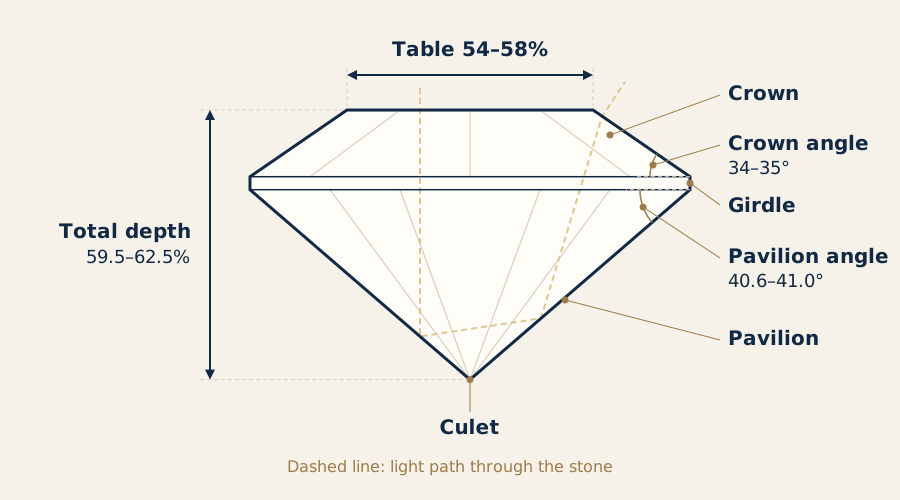
The crown and pavilion angles work as a pair. A shallow pavilion lets light leak out the bottom, which shows as a glassy or dark ring; a steep pavilion with a steep crown makes the centre look dark, explained in why steep-deep rounds look dull. A slightly shallower stone carries less weight below the girdle and faces up larger, which is the trade-off covered in shallow rounds and face-up spread.
Some buyers deliberately choose a 60/60 stone, with a 60% table and 60% depth, for broader flashes; compare it in 60/60 rounds versus classic proportions. Two things to watch that the headline numbers hide: painting and digging out, small changes to the girdle facets that cutters use to save weight or push up a grade. Our guide to painting and digging out in rounds shows how to spot them.
Not sure which one is right?
Send us the stones you are looking at and our gemologist will tell you which to choose and why.
How is a round diamond's cut graded?
For round brilliants, GIA gives an overall cut grade on a five-step scale, based on how the proportions predict brightness (white light returned), fire and scintillation (the pattern of sparkle as the stone moves), plus the stone's weight relative to its diameter, durability, polish and symmetry.
| GIA cut grade | What it means in practice |
|---|---|
| Excellent | Even, bright pattern; the grade most buyers choose for a centre stone |
| Very Good | Slightly less bright or slightly off in one area; can be good value if checked by eye |
| Good | Noticeably less light return; often cut to save weight |
| Fair | Clearly dull or uneven areas |
| Poor | Large light leakage; rarely used in fine jewellery |
Other labs use their own systems. AGS uses a scale from 0 (Ideal) to 10, and IGI, which grades most laboratory-grown diamonds, uses Ideal, Excellent, Very Good and so on. Polish and symmetry are graded separately; for a round, Excellent or Very Good in both is normal at the top end. Because a grade covers a range of proportion combinations, our guide to round proportions beyond the cut grade explains how to narrow it down further.
Related guideRound Diamond Proportions Beyond the Cut GradeWhat size is a round brilliant diamond in millimetres?
Carat is a weight (0.2 grams), not a size, but for a well-proportioned round the two track closely. These are typical diameters for rounds cut around 61% depth.
| Carat weight | Typical diameter |
|---|---|
| 0.25 ct | about 4.0–4.1 mm |
| 0.50 ct | about 5.0–5.2 mm |
| 0.75 ct | about 5.7–5.9 mm |
| 1.00 ct | about 6.3–6.5 mm |
| 1.50 ct | about 7.3–7.5 mm |
| 2.00 ct | about 8.0–8.2 mm |
| 3.00 ct | about 9.1–9.4 mm |
A 1 carat round that measures only 6.2 mm is usually carrying extra weight in a thick girdle or deep pavilion, so it looks smaller than it should. A stone at 6.6 mm or more is often shallow, so check that it still returns light well. Note that doubling the carat weight adds only about 25% to the diameter, because the extra weight is spread through the depth as well as the width.
Round vs oval, cushion and old European: which suits you?
| Round brilliant | Oval | Cushion | Old European | |
|---|---|---|---|---|
| Outline | Circle | Elongated ellipse | Square or rectangle, rounded corners | Circle |
| Sparkle | Fine, even, bright | Bright, with possible bow-tie | Broader, chunkier flashes | Broad flashes, visible culet |
| Bow-tie | No | Common | Sometimes | No |
| GIA overall cut grade | Yes | No | No | No |
| Face-up size per carat | Benchmark | Looks larger | Looks smaller | Looks smaller |
| Price per carat | Highest | Usually lower | Usually lower | Varies; mostly natural |
Rounds cost more per carat than most fancy shapes, partly because demand is highest and partly because cutting a round from rough crystal loses more weight, often half or more of the original stone. An oval of the same weight looks longer and slightly larger on the hand; see oval or round for your ring. A cushion has a softer, more vintage look and larger flashes; our round and cushion comparison goes through the details.
What are the best settings for a round diamond?
The round is the easiest shape to set because it has no points or corners to protect. The main options:
- Four claws: shows the most diamond and makes the outline look slightly square from above.
- Six claws: more secure and keeps the outline looking perfectly round; a little more metal on show.
- Bezel: a smooth rim of metal around the girdle. Very secure for active hands.
- Halo: a ring of small diamonds that adds roughly 1.5–2.5 mm of visual width.
- Hidden halo: small diamonds under the girdle, seen only from the side.
- Three-stone: rounds or fancy shapes either side of the centre.
Our guide to settings that suit a round centre stone shows each option on the hand. The claw shape matters too, from round tips to sharp eagle claws, covered in claw types and how they wear. When you add a band later, wedding bands that sit flush with a round explains straight, curved and notched options, and why thin shanks go out of round is worth reading before you choose a very fine band.
Should you choose a natural or lab-grown round brilliant diamond?
Round brilliants are cut from both natural and laboratory-grown diamond. A lab-grown diamond is real diamond, made of carbon with the same hardness, refractive index and dispersion, grown by HPHT (high pressure, high temperature) or CVD (chemical vapour deposition) rather than formed underground. The two look identical to the eye; only lab testing tells them apart, and the report states which it is.
Lab-grown rounds cost much less than natural rounds of the same grade. As a rough guide, a 1 carat, G colour, VS2, Excellent cut natural round is commonly around AUD 8,000–16,000, while a comparable lab-grown round is often around AUD 1,000–3,000. Natural diamonds are rare and that rarity is a large part of their appeal; lab-grown rounds let you choose a larger or higher-grade stone for the same spend. Both should have an independent grading report from GIA, IGI or a similar lab.
Browse round diamonds: natural and lab-grown
How to choose a round brilliant cut diamond: step by step
- Set your priorities. Decide between natural and lab-grown, and roughly what size in millimetres you want on the hand.
- Start with cut. Shortlist Excellent (GIA) or Ideal (AGS/IGI) cut, with Excellent or Very Good polish and symmetry.
- Check the proportions. Table about 54–58%, depth 59.5–62.5%, crown 34–35°, pavilion 40.6–41.0°, culet none or very small.
- Compare diameter to weight. A 1 carat round should measure about 6.3–6.5 mm; smaller suggests hidden weight.
- Choose colour and clarity. Rounds hide colour and inclusions well; many people are happy with G–H colour and an eye-clean VS2 or SI1.
- Watch a 360° video. Look for even sparkle across the whole stone, with no dark centre or glassy ring.
- Match the setting. Pick claws or a bezel to suit your lifestyle; if a term on the report is unfamiliar, look it up in our jewellery terms explained.
Free consultation
Talk to a gemologist
Compare stones in person or online with Raj Sood, Graduate Gemologist (GIA), AJP (GIA).
Book a consultationFAQ
Common questions
How many facets does a round brilliant cut diamond have?
A round brilliant has 57 facets, or 58 if a small culet is polished at the tip. That is 33 on the crown and 24 on the pavilion, plus the culet.
Who invented the round brilliant cut?
No single person invented it; the cut evolved over centuries. Marcel Tolkowsky published the calculations behind the modern version in 1919, and those angles still guide cutters today.
Are round diamonds more expensive than other shapes?
Usually yes. Rounds cost more per carat than most fancy shapes because demand is highest and more of the rough crystal is lost when cutting them.
What is the best cut grade for a round diamond?
GIA Excellent or AGS Ideal is the top grade and the usual choice for a centre stone. Within that grade, check the crown and pavilion angles, because not all Excellent stones look the same.
How big is a 1 carat round diamond?
A well-cut 1 carat round is about 6.3–6.5 mm across. Stones narrower than that often carry extra weight in the girdle or pavilion.
Can you get lab-grown round brilliant diamonds?
Yes. Round is the most widely available lab-grown shape, usually graded on the same scales as natural diamonds (GIA now uses simpler descriptions for lab-grown) and costing much less for the same size and grade.

Ask a gemologist
Not sure which diamond to choose?
Raj Sood is a Graduate Gemologist (GIA) and master jeweller. Bring the stones you are considering, or send the reports, and he will tell you honestly which one is better and why.
Keep learning
Related guides
 Diamond ShapesRound Brilliant Family: Round, Star and Portuguese Cuts
 Diamond Anatomy & LightRound Diamond Proportions Beyond the Cut Grade
 Engagement Rings & SettingsBest Settings for Round Diamonds
 Diamond ShapesOval vs Round DiamondsDiamond ShapesUnderstanding Diamond Shapes
 Diamond ShapesAll 34 Diamond Cuts: Every Shape Explained and Compared
 Diamond ShapesStar Cut DiamondsDiamond ShapesPortuguese Cut Diamonds
Explore more
More guides on this topic
Education