
Gemstones
Chrysoprase (Australian Jade): Colour, Sources, Value and Care Guide
Chrysoprase is the apple-green gem sold for decades as 'Australian jade', and much of the world's supply comes from Australia. Here is what it really is, how to judge its colour, how to spot a dyed imitation and how to keep it looking fresh.
 Reviewed by Raj Sood, Graduate Gemologist (GIA), AJP (GIA)Master jeweller and Graduate Gemologist (GIA) · reviewed 4 November 2026
Quick answer
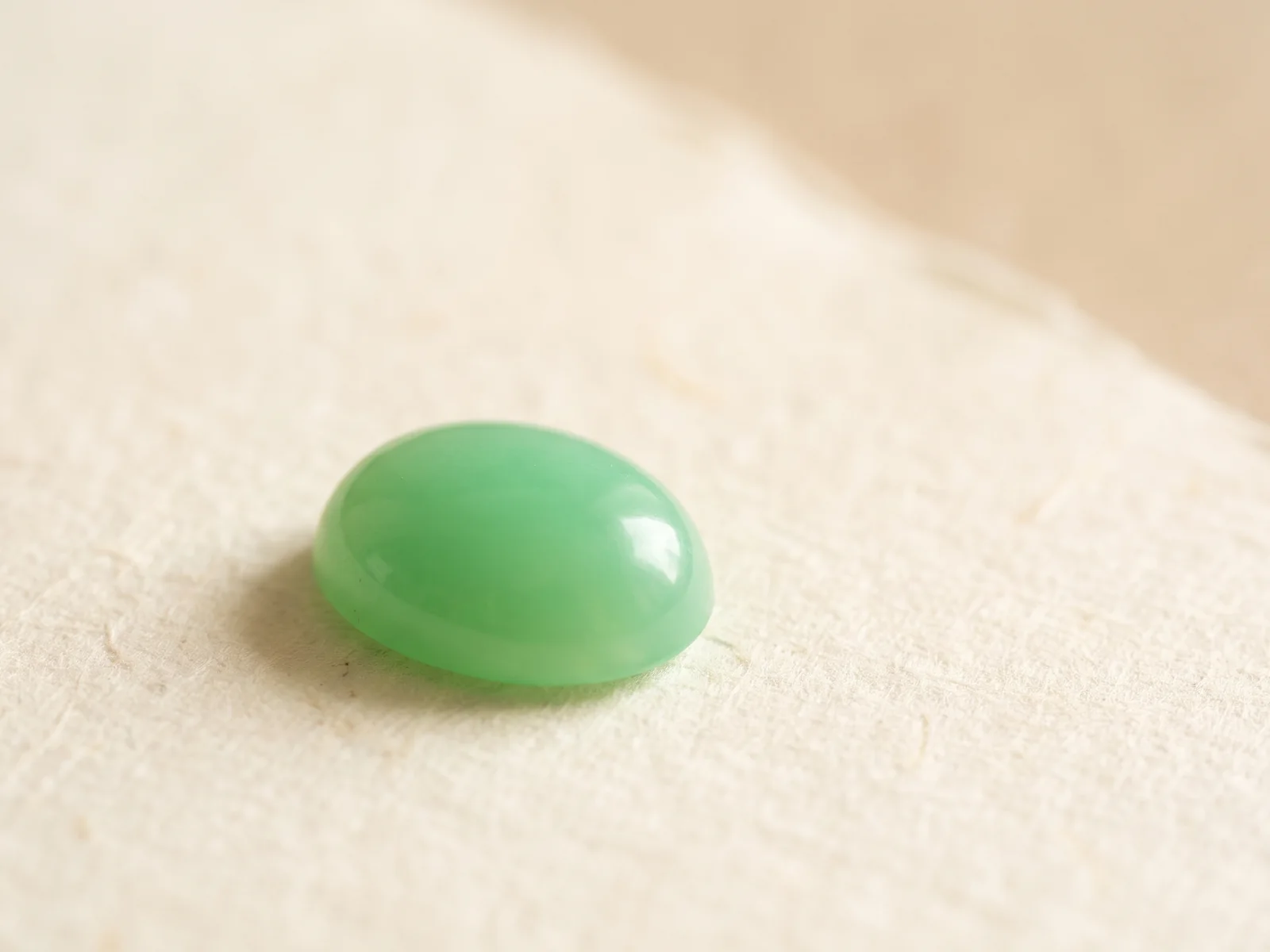
Chrysoprase is a green, translucent variety of chalcedony, a microcrystalline quartz, coloured by nickel. It is sold as 'Australian jade' because much of the world's supply comes from Queensland and Western Australia, but it is not jade. It rates 6.5–7 on the Mohs scale, suits pendants, earrings and protected rings, and can fade with prolonged heat or sunlight.
What is chrysoprase?
Chrysoprase (said KRIS-oh-prayz) is the green variety of chalcedony. Chalcedony is quartz, the same silicon dioxide (SiO2) as clear rock crystal, but instead of growing as one large crystal it is built from millions of quartz fibres and grains too small to see. Gemologists call this microcrystalline or cryptocrystalline quartz. Agate, carnelian and onyx belong to the same family; our overview of coloured gemstones shows where they all sit.
What makes chrysoprase different is nickel. Tiny particles of nickel-bearing silicate minerals are scattered through the quartz and give it a colour that ranges from pale mint to a vivid apple green. That is a different cause of colour from emerald (chromium and vanadium) or green tourmaline. The name comes from the Greek words chrysos, gold, and prason, leek, a nod to the slightly yellowish green of some stones. If any of these terms are new, our glossary of jewellery terms explains them in plain English.
| Property | Chrysoprase |
|---|---|
| Mineral family | Chalcedony (microcrystalline quartz) |
| Chemical formula | SiO2, with nickel-bearing inclusions |
| Mohs hardness | 6.5–7 |
| Refractive index | about 1.53–1.54 (usually a single 'spot' reading) |
| Specific gravity | about 2.58–2.64 |
| Lustre | Waxy to glassy |
| Transparency | Translucent to semi-opaque |
| Cleavage | None; breaks with a smooth, shell-like fracture |
Because the grains interlock, chrysoprase has no cleavage (no flat planes it splits along) and is reasonably tough for its hardness. Its main weaknesses are surface scratches from harder materials and, in some stones, a slow loss of colour with heat and strong sunlight. Both are covered below.
Is chrysoprase the same as jade?
No. 'Australian jade' is a trade name, not a mineral name. True jade is only two materials: jadeite, a pyroxene, and nephrite, an amphibole. Both are tough, matted aggregates of crystals with different chemistry, hardness and weight from chrysoprase. Our guide to how jadeite and nephrite differ goes through each one in detail.
The name stuck because fine Queensland chrysoprase has a glowing, even green that recalls top jadeite, and it was marketed heavily as 'Australian jade', particularly to buyers in Asia, once Australian production took off in the second half of the twentieth century. It is a fair description of the look and an inaccurate description of the material. A careful seller will describe the stone as chrysoprase first, with 'Australian jade' only as a nickname.
One more name to watch: lemon chrysoprase (also sold as citron chrysoprase) is not chrysoprase at all. It is usually nickel-bearing magnesite, a softer carbonate mineral around 3.5–4.5 on the Mohs scale, often with brown matrix veins, and much of it comes from Western Australia. It is attractive and inexpensive, but it needs gentler wear than true chrysoprase.
Where is chrysoprase found in Australia?
Chrysoprase forms where nickel-rich rocks such as serpentinite have weathered for millions of years under warm, wet conditions, leaving a deep, rusty soil called laterite. Silica dissolved in groundwater moves through the cracks, settles out as chalcedony and picks up nickel along the way. That is why chrysoprase is found in the same belts of country that are mined for nickel.
- Marlborough district, central Queensland: north-west of Rockhampton, the classic Australian source, known for bright, even, translucent green material.
- Western Australia: nickel laterite country in the Goldfields and surrounding regions produces chrysoprase as well as the magnesite sold as lemon chrysoprase.
- Overseas: historic deposits at Szklary in Poland, plus Tanzania, Kazakhstan, Brazil and the United States. Older European jewellery set with chrysoprase often used Polish material.
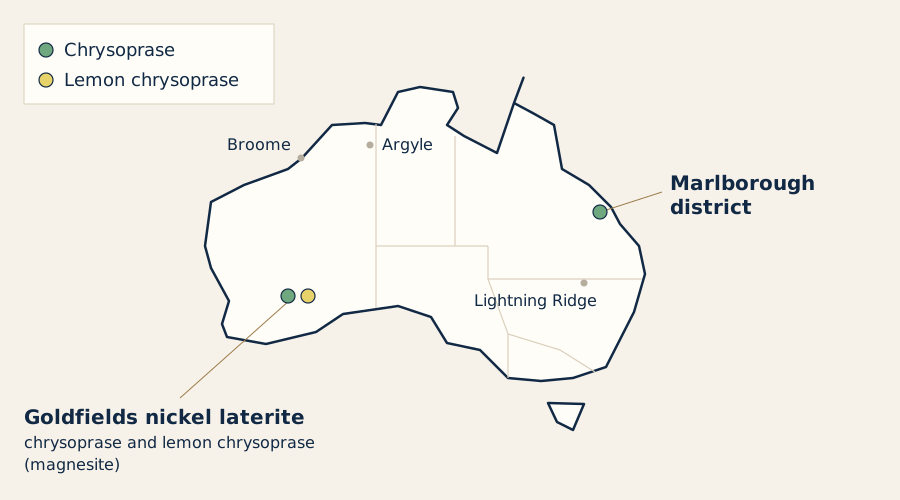
Chrysoprase is one of several gems that give Australia a strong place in the trade. Queensland also hosts the Anakie sapphire fields and New South Wales's Inverell lava plains, while our guide to opal fields from Lightning Ridge to Coober Pedy and Queensland boulder country covers the gem Australia is most famous for. In the north-west, the story of the Argyle diamond mine and Broome's South Sea pearls round out the picture.
How is chrysoprase quality judged?
There is no laboratory grading scale for chrysoprase the way there is for diamond colour and clarity. The trade judges it by eye on four things: colour, translucency (how much light passes into the stone), evenness and finish.
| Quality | Colour | Translucency | What you see |
|---|---|---|---|
| Fine | Vivid, saturated apple green, no yellow or grey | High; light glows from within | Even colour edge to edge, no visible matrix |
| Good | Medium green, slightly yellowish or bluish | Moderate | Small patches of lighter colour, clean surface |
| Commercial | Pale mint, greyish or yellow-green | Low to semi-opaque | Uneven colour, white streaks or brown matrix veins |
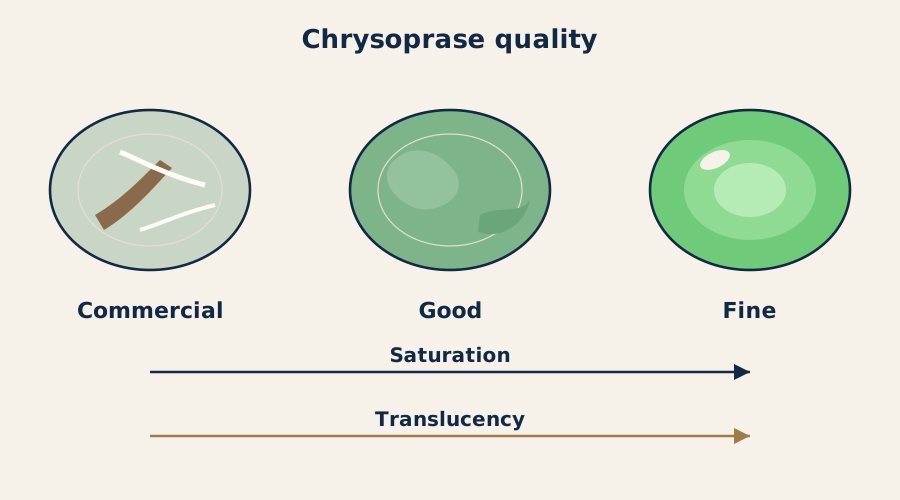
Colour comes first. The most sought-after material is an intense green that still lets light through, so the stone seems to glow. Paler stones can be pretty but read as mint rather than jade-green. Evenness matters because chrysoprase forms in veins, and many pieces show white chalcedony bands or brown iron-stained matrix (the host rock).
Chrysoprase is usually cut as a cabochon, a smooth domed stone with no facets, which shows off its glow. It is also made into beads, carvings and the occasional faceted stone. Typical cabochons run from about 8 × 6 mm for earrings to 20 mm or more for pendants; large, clean, evenly coloured pieces are much harder to find than small ones.
Not sure which one is right?
Send us the stones you are looking at and our gemologist will tell you which to choose and why.
Chrysoprase vs jade: how does it compare with other green stones?
Several green gems look alike as polished cabochons. A gemologist separates them mainly by refractive index (how strongly the stone bends light), specific gravity (weight for its size) and what shows under magnification.
| Stone | What it is | Mohs | Refractive index | Specific gravity | Tell-tale sign |
|---|---|---|---|---|---|
| Chrysoprase | Nickel-coloured chalcedony | 6.5–7 | about 1.53–1.54 | about 2.58–2.64 | Smooth, even glow; lighter in the hand |
| Jadeite jade | Pyroxene aggregate | 6.5–7 | about 1.66 | about 3.33 | Noticeably heavy; granular texture |
| Nephrite jade | Amphibole aggregate | 6–6.5 | about 1.61 | about 2.95 | Fibrous, very tough; often darker green |
| Prehnite | Calcium aluminium silicate | 6–6.5 | about 1.61–1.64 | about 2.80–2.95 | Yellow-green; often fibrous, bow-tie patterns |
| Green aventurine | Quartzite with mica | 6.5–7 | about 1.54–1.55 | about 2.64–2.69 | Glittering spangles of green mica |
| Dyed green chalcedony | Chalcedony with added dye | 6.5–7 | about 1.53–1.54 | about 2.58–2.64 | Colour pooled in cracks; may show red under a Chelsea filter |
In practice, chrysoprase is lighter in the hand than either true jade: a jadeite cabochon of the same size weighs roughly a quarter more. Price is the other big difference. Fine green jadeite is one of the most expensive gems in the world; fine chrysoprase gives a similar colour for a small fraction of the cost.
If green is not essential and you are weighing chrysoprase against other coloured stones for a ring, harder options include pink sapphire, at 9 on the Mohs scale and soft peach morganite (7.5–8), while violet-blue tanzanite, at about 6–7, is no harder; each guide covers durability and price.
How can you tell real chrysoprase from dyed chalcedony?
Because chalcedony is slightly porous, it takes dye easily, and dyed green chalcedony and agate are the most common substitutes. Glass and plastic turn up too. These are the checks a gemologist runs:
- Magnification: dye tends to concentrate along fine cracks and in banding, so the colour looks stronger in lines. Natural chrysoprase colour is spread through the body of the stone.
- Chelsea filter: a small colour filter that shows chromium. Stones dyed with chromium salts often glow pink or red; nickel-coloured chrysoprase stays green or greyish green.
- Refractometer and specific gravity: these separate chrysoprase from jadeite, nephrite, prehnite and most glass, but not from dyed chalcedony, which has the same readings.
- Bubbles and swirls: gas bubbles or flow lines under a loupe point to glass.
- Laboratory testing: spectroscopy can identify the colouring element when the simple tests are not conclusive.
A natural lookalike also exists: chrome chalcedony, from Zimbabwe and elsewhere, is coloured by chromium rather than nickel. It is natural and undyed, but it is not chrysoprase, and it reacts red under the Chelsea filter. Our page on the tools gemologists use, from the Chelsea filter to the refractometer explains how each instrument works.
Laboratory-created chrysoprase is not a significant product in the jewellery market, so the realistic risks are dyed chalcedony, glass and mislabelled lemon chrysoprase rather than a synthetic. Any treatment, such as dyeing, should be disclosed at sale.
Is chrysoprase good for an engagement ring or everyday ring?
Chrysoprase works well in pendants, earrings, brooches and dress rings. As an everyday ring it is possible with care, but it is not as forgiving as a sapphire or diamond. Ordinary dust contains quartz grains, which are 7 on the Mohs scale, the same as or slightly harder than chrysoprase, so over years of daily wear the polish will soften and small knocks can chip the edges. The good news is that a cabochon can be repolished by a lapidary.
| Ring stone | Mohs hardness | Everyday ring wear |
|---|---|---|
| Chrysoprase | 6.5–7 | Possible with a protective setting and some care |
| Opal | 5.5–6.5 | Needs care; protective setting essential |
| Aquamarine | 7.5–8 | Good |
| Alexandrite | 8.5 | Very good |
| Sapphire | 9 | Excellent |
If you are comparing ring stones, see how opal holds up as an everyday ring stone, Australian sapphire as a harder local alternative, aquamarine engagement rings and colour-change alexandrite rings.
- Bezel setting: a rim of metal around the whole edge, the most protective choice for a cabochon.
- Low dome: a lower-profile cabochon sits closer to the finger and takes fewer knocks than a tall one.
- Metal colour: yellow gold warms the green towards a classic 'jade' look; white gold and platinum give a cooler, minty contrast.
- Diamond halo: small diamonds around the stone frame the colour and help shield the edge.
How much does chrysoprase cost in Australia?
Chrysoprase is affordable compared with most green gems, and it is usually priced per stone rather than per carat. Colour and translucency move the price far more than size. These are broad, approximate ranges for loose cabochons only; the market varies and individual stones can fall outside them.
| Loose chrysoprase cabochon | Approximate price range (AUD) |
|---|---|
| Commercial, pale or uneven, about 10 × 8 mm | about $20–$80 |
| Good, medium green, clean, 10–15 mm | about $80–$300 |
| Fine, vivid and translucent, 15 mm or larger | about $300–$1,500 or more |
| Lemon chrysoprase (magnesite), any size | usually under $100 |
In finished jewellery the metal and the setting work often cost more than the stone itself, especially in 18 carat gold. Fine Marlborough material with a strong, even colour carries a premium, much as top colour does across Australian gems; our comparison of Australian opal types and how they are valued shows a similar pattern.
- Ask for the stone to be described as chrysoprase, with any treatment disclosed.
- Ask where it was mined if origin matters to you.
- View it in daylight and check the colour is even across the dome.
- Look at the back: a matrix-free back usually means cleaner material.
Browse natural gemstones
How do you care for chrysoprase? Step by step
- Clean gently. Use lukewarm water, a drop of mild dishwashing liquid and a soft toothbrush, then rinse and pat dry.
- Skip the machines. Avoid steam cleaners and heated ultrasonic baths; heat is what dulls chrysoprase colour.
- Keep it out of the heat and sun. Do not leave it on a windowsill, a car dashboard or near a heater, and take it off for saunas.
- Store it on its own. Keep it in a soft pouch, away from diamonds, sapphires and other harder gems that will scratch it.
- Take it off for hard work. Remove rings for gardening, the gym, cleaning with chemicals and swimming in chlorinated pools.
- Check the setting yearly. Have a jeweller look at the bezel or claws and repolish the cabochon if the surface has dulled.
If a stone has faded, some chrysoprase recovers part of its colour after time in a damp environment, because the colour is linked to water held in the structure. Results are unpredictable, so prevention is the reliable approach. Treat it a little more gently than a sapphire and it will keep its colour for decades.
Free consultation
Talk to a gemologist
Compare stones in person or online with Raj Sood, Graduate Gemologist (GIA), AJP (GIA).
Book a consultationShop this shape
FAQ
Common questions
Is chrysoprase real jade?
No. Chrysoprase is a green chalcedony (microcrystalline quartz) coloured by nickel, while true jade is only jadeite or nephrite. 'Australian jade' is a trade name for chrysoprase, describing its look rather than its mineral.
Why is chrysoprase called Australian jade?
Much of the world's fine chrysoprase comes from Queensland and Western Australia, and its glowing green resembles fine jadeite. It was marketed as 'Australian jade', and the nickname stuck.
Does chrysoprase fade?
It can. Prolonged heat and strong sunlight can dry the stone and make the green paler, so store it away from heat and avoid steam cleaning.
Is lemon chrysoprase the same as chrysoprase?
No. Lemon or citron chrysoprase is usually nickel-bearing magnesite, a softer carbonate mineral of about 3.5–4.5 on the Mohs scale, often with brown matrix. It needs gentler wear than true chrysoprase.
Can chrysoprase be worn every day in a ring?
Yes, with care. At 6.5–7 on the Mohs scale it will slowly lose polish and can chip if knocked, so a bezel setting and a low dome are sensible, and it can be repolished when needed.
How can I tell if chrysoprase is dyed?
Dyed chalcedony often shows colour concentrated along cracks and bands, and chromium-dyed stones can glow red under a Chelsea filter. A gemologist or laboratory can confirm it.

Ask a gemologist
Not sure which diamond to choose?
Raj Sood is a Graduate Gemologist (GIA) and master jeweller. Bring the stones you are considering, or send the reports, and he will tell you honestly which one is better and why.
Keep learning
Related guides
 GemstonesJade: Jadeite vs Nephrite
 GemstonesAustralian Sapphire Fields: Inverell, Anakie and the Lava Plains
 GemstonesAustralian Opal Fields: Lightning Ridge, Coober Pedy and Queensland BoulderGemstonesGemstones | Coloured Gemstones, Birthstones and Custom Jewellery
 GemstonesAustralian Sapphire Engagement RingsGemstonesAustralian Opal Engagement Rings: Wearability and Care
 GemstonesAustralian Opal Types Compared
 PearlsBroome South Sea Pearls (Australian)
Explore more
More guides on this topic
Education