
Gemstones
Australian Sapphire Fields: Inverell, Anakie and the Lava Plains
Australia has produced a large share of the world's sapphire, yet few buyers know where it comes from. This guide to the Australian sapphire fields explains how each field formed, what colours it yields and what to check before you choose a stone.
 Reviewed by Raj Sood, Graduate Gemologist (GIA), AJP (GIA)Master jeweller and Graduate Gemologist (GIA) · reviewed 4 November 2026
Quick answer
The main Australian sapphire fields are the New England fields around Inverell and Glen Innes in northern NSW, the Central Queensland gemfields at Anakie, Sapphire and Rubyvale, and the Lava Plains in far north Queensland. All three are linked to volcanic basalt, so their sapphires are iron-rich: deep blue, teal, green, yellow and parti-coloured.
Where are the Australian sapphire fields?
If you have asked where sapphires are found in Australia, the short answer is: along the volcanic spine of the east coast. Three areas account for almost all commercial production, and each has its own character.
- New England fields, NSW: the basalt country around Inverell, Glen Innes and Emmaville in the state's north, with localities such as Kings Plains, Frazers Creek and the village of Sapphire.
- Central Queensland gemfields: the towns of Anakie, Sapphire and Rubyvale and the Willows Gemfields, roughly 40–70 km west of Emerald. This is the field most people mean by "Anakie sapphire".
- Lava Plains, far north Queensland: a smaller, more remote field on the basalt plateau west of Ravenshoe, near Mount Garnet, south-west of Cairns.
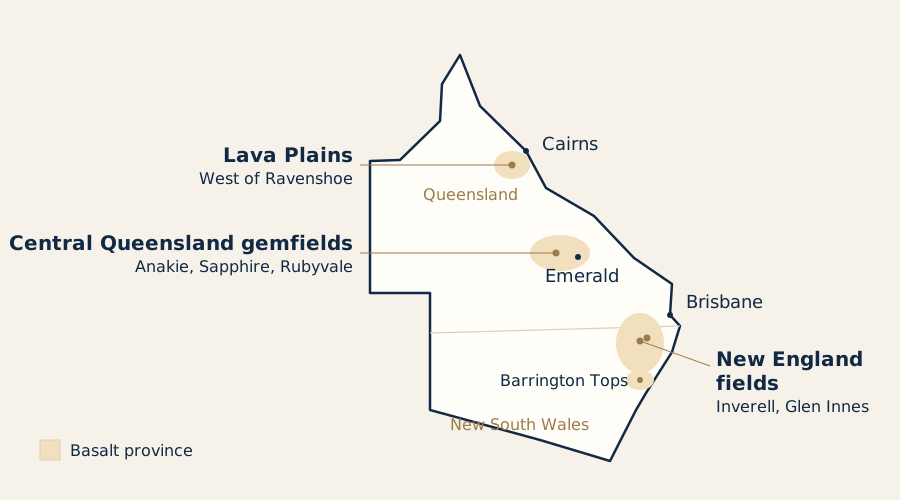
Smaller occurrences exist too. Barrington Tops in NSW yields pink, purple and red corundum, north-east Tasmania has produced sapphire alongside tin, and Victoria has minor finds near Beechworth. None has matched the three big fields for volume.
Sapphire is the gem variety of corundum, crystalline aluminium oxide (Al2O3). Our guide to sapphire as a gemstone covers the mineral itself; this page is about where Australian stones come from and why that matters. For other stones, start with our overview of coloured gemstones.
How did sapphires form in Australia's volcanic basalt?
Australian sapphires did not grow in the lava. They crystallised much earlier, deep in the lower crust or upper mantle, tens of kilometres down. Later, eruptions of alkali basalt (a runny, dark volcanic rock) tore fragments of that deep rock loose and carried sapphire crystals to the surface like passengers in a lift. Geologists call crystals carried this way xenocrysts, meaning "foreign crystals".
Eastern Australia's basalt fields erupted over a long span, very roughly the last 60 million years. Over that time rain and rivers weathered the basalt into rich soil. Sapphire is hard (Mohs 9) and heavy (specific gravity about 4.0, against about 2.65 for quartz sand), so it survived the weathering and settled in old creek beds and gravel layers. Miners call this sapphire-bearing gravel wash.
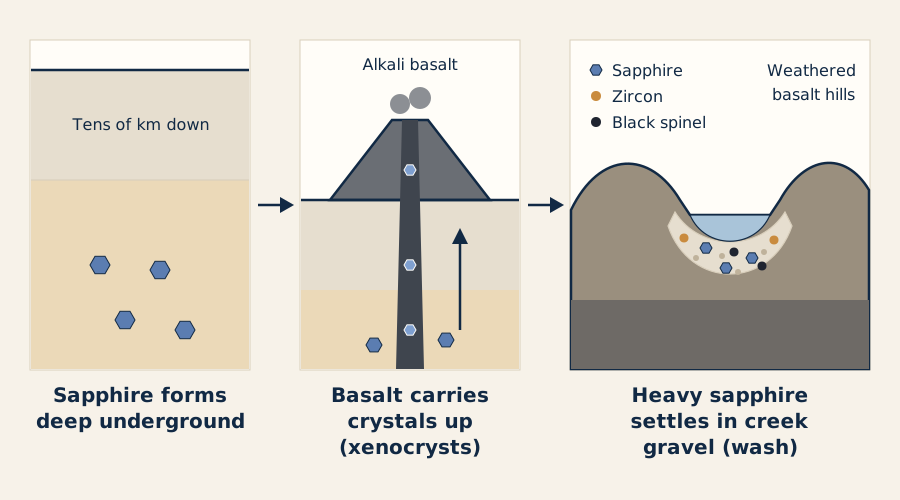
That is why Australian sapphire is mined from alluvial deposits rather than hard-rock tunnels. The wash is dug, screened, washed and sorted, by machine on commercial leases or by hand with a sieve and a hand-jig at the fossicking areas. Black spinel and zircon often turn up in the same gravels and are a sign the wash may carry sapphire. Unfamiliar terms are explained in our jewellery glossary.
The basalt origin has a practical effect on colour. Basalt-related sapphires carry more iron than sapphires from metamorphic rock (such as Sri Lanka or Madagascar). Iron deepens blue towards navy and pushes colour towards green and yellow. That single fact explains most of what makes Australian sapphire look Australian.
What are Inverell and New England sapphires like?
Inverell sapphires come from the New England tableland, where mechanised mining expanded in the 1960s and 1970s. For a period Australia supplied, by many estimates, the majority of the world's sapphire by volume, and much of it came from here and from Central Queensland. A great deal was exported as rough, cut and heated overseas, and sold without its Australian origin being mentioned.
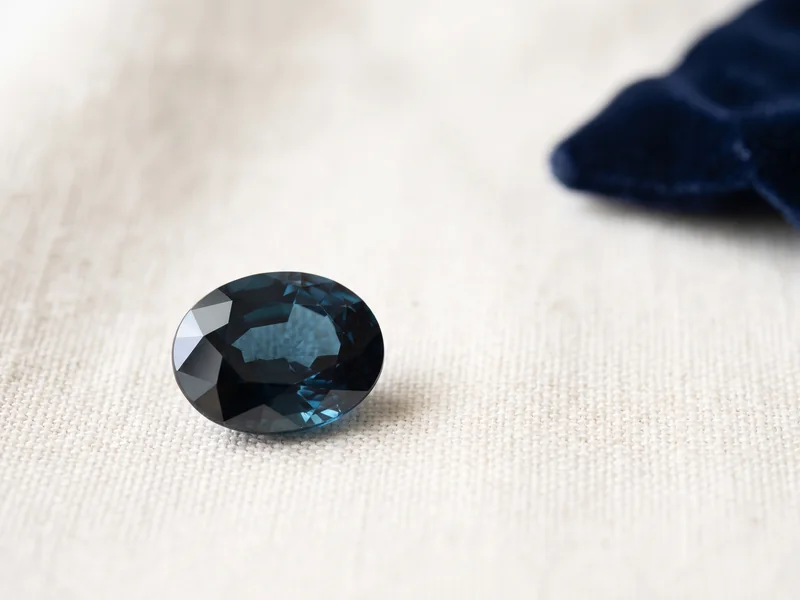
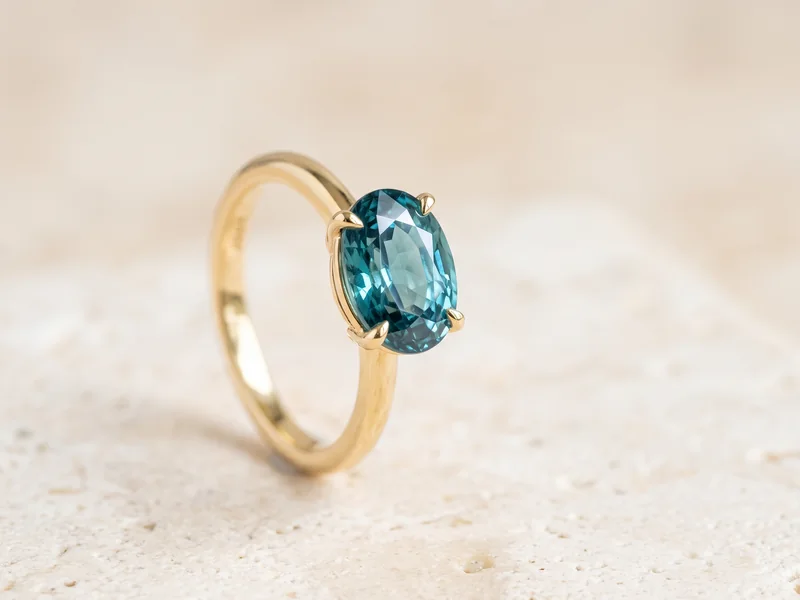
The classic New England stone is a deep, saturated blue, sometimes so dark it reads as inky in dim light. Lighter, brighter blues exist but are a smaller share. The fields also produce greens, yellows and the blue-green mixes now sold as teal, which have become popular for teal sapphire rings because no two look quite the same.
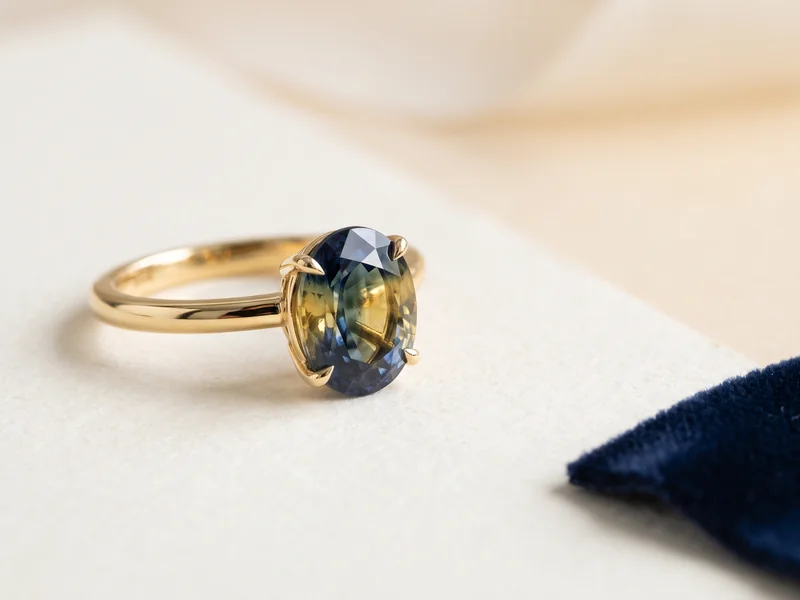
New England is also known for parti sapphire: a single crystal with distinct zones of two or more colours, usually blue, green and yellow. A well-cut Australian parti shows the zones as bands or patches across the face. Our page on parti-coloured sapphires explains how cutters orient them.
Commercial mining in the New England fields is much smaller than at its peak, and several operations have closed. Some areas still offer fossicking, but access rules change, so check with the local council or tourism office before you go.
What comes from the Anakie sapphire fields?
The Central Queensland gemfields around Anakie, Sapphire, Rubyvale and the Willows are often described as the largest sapphire field in the southern hemisphere. Sapphire was first recorded there in the 1870s, and small-scale miners and fossickers have worked the area ever since.
Anakie is known for its range of colour. Blues are common, as in New England, but the field has a strong reputation for yellow and golden stones and for greens. Our guides to yellow sapphire and green sapphire explain how those colours are graded, and the warmer stones overlap with the orange and golden tones of corundum.
The field is also famous for black star sapphire, an opaque to translucent stone that shows a six-rayed star when cut as a dome (a cabochon). The star comes from fine needle-like inclusions reflecting light. The best-known example is the Black Star of Queensland, a stone of over 700 carats reported to have been found near Anakie in the 1930s.
Queensland is one of the easier places to try fossicking yourself. You need a fossicking licence from the state government to fossick in the designated fossicking areas, and tourist parks at Sapphire and Rubyvale also sell buckets of wash you can sieve on site. Most finds are small, but plenty of visitors take home a stone large enough to cut.
Not sure which one is right?
Send us the stones you are looking at and our gemologist will tell you which to choose and why.
What are Lava Plains sapphires?
The Lava Plains field lies on the basalt plateau of far north Queensland, west of Ravenshoe near Mount Garnet. It is the least known of the three, partly because it is remote and partly because commercial mining there has been intermittent rather than continuous.
Lava Plains sapphires share the basalt family traits: blue, green, yellow and parti stones, with zircon in the same gravels. Some in the trade regard parts of the field as producing slightly brighter blues than the typical inky New England stone, though that varies from parcel to parcel and should be judged stone by stone, not by name.
Because output is small, you are less likely to see Lava Plains named on a stone. When it is, the claim usually rests on the miner's or dealer's records rather than a laboratory test, which is worth knowing if origin matters to you. Our guide to Australian sapphire engagement rings covers how locally sourced stones are traced.
How do the Australian sapphire fields compare?
Each field overlaps with the others, so treat this as a general picture rather than a rule. An individual stone can break any of these patterns.
| New England (Inverell, Glen Innes) | Central Queensland (Anakie) | Lava Plains (far north Qld) | |
|---|---|---|---|
| State | NSW | Queensland | Queensland |
| Geology | Alluvial gravels from weathered basalt | Alluvial gravels from weathered basalt | Alluvial gravels from weathered basalt |
| Typical colours | Deep blue, teal, green, parti | Blue, yellow, golden, green, parti, black star | Blue, green, yellow, parti |
| Known for | Dark blues and parti stones | Colour range and black star sapphire | Smaller output; some brighter blues |
| Scale today | Much reduced from 1970s–80s peak | Small-scale mining and active fossicking | Small and intermittent |
| Fossicking | Limited; check local rules | Licence required; tourist parks | Remote; check access and rules |
Australian fields rarely produce the colours most associated with other origins. True padparadscha, a delicate pinkish orange, comes mainly from Sri Lanka and Madagascar. Red corundum is ruby, and the small Barrington Tops field is one of the few Australian sources of it; our ruby versus sapphire guide explains where the line between the two sits. Barrington Tops also yields some purple sapphire and pink stones.
Are Australian sapphires good quality?
They can be excellent, but they have a distinct look, and the quality range is wide. Two things decide most of it: how dark the colour is, and how well the cutter handled pleochroism.
Pleochroism means a crystal shows different colours when viewed along different directions. Australian blue sapphire is strongly pleochroic: down one axis it looks a purer blue, from the side a greener blue. A skilled cutter orients the table (the large top facet) to show the better colour. A cutter trying to keep weight may not, which can leave a stone looking greenish or dull face-up.
| Property | Sapphire (corundum) | What it means for you |
|---|---|---|
| Mohs hardness | 9 | Among the hardest gems after diamond (10); suits everyday rings |
| Refractive index | 1.762–1.770 | Good brightness when well cut |
| Birefringence | 0.008–0.010 | Slight doubling, rarely visible to the eye |
| Specific gravity | about 4.00 | A sapphire looks smaller than a diamond of the same carat weight |
| Pleochroism | Moderate to strong in Australian blues | Orientation of the cut changes face-up colour |
Darkness is the other issue. A very dark blue can look almost black under indoor lighting, even if it is vivid in sunlight. Many lighter Australian blues and teals avoid that problem, which is part of why teal has become so sought after. The inline guide below compares the two directly.
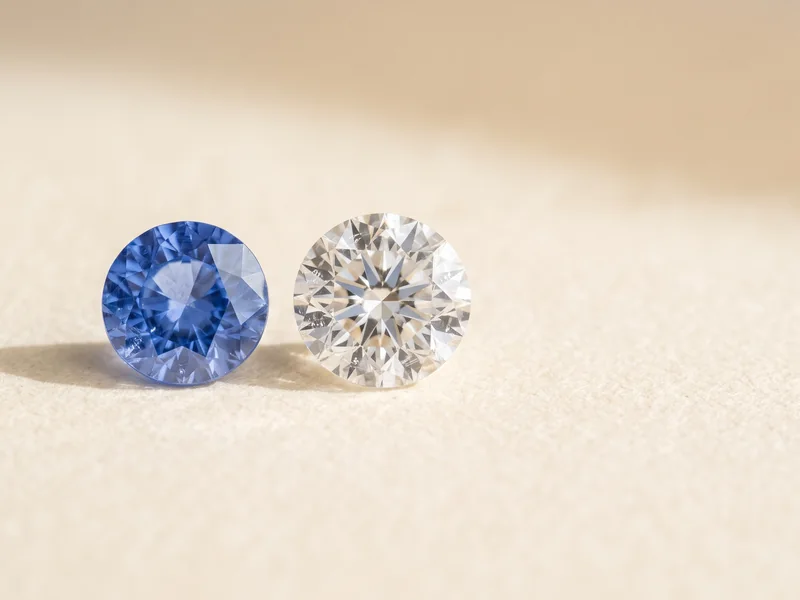
Related guideTeal Sapphire vs Blue Sapphire Engagement RingsAs a rough guide only, commercial Australian blue sapphire might sit around AUD 200–800 per carat, attractive teal and parti stones around AUD 500–2,500 per carat, and fine untreated stones in brighter colours higher again. Size, colour, clarity, cut and treatment all move the price. If you are weighing sapphire against diamond for a centre stone, see how sapphire compares with diamond.
How do you tell Australian, lab-created and treated sapphire apart?
Three separate questions often get mixed together: is it natural, has it been treated, and where was it mined?
- Natural or lab-created: lab-created (synthetic) sapphire has been made since the early 1900s and has the same chemistry and hardness as natural sapphire. It is not fake, but it is a different product and must be described as lab-created or synthetic. A gem laboratory can separate the two using inclusions and growth features.
- Treated or untreated: heating is common for basalt sapphire. It can lighten a dark blue or intensify yellow. Heating is a stable, accepted treatment, but it should be disclosed, and unheated stones usually cost more. Other treatments, such as beryllium diffusion or glass filling, are much less acceptable and must be disclosed.
- Origin: laboratories can sometimes give an origin opinion using trace elements and inclusions, but Australian sapphire is chemically close to basalt sapphire from Thailand, Cambodia and parts of Africa. Many Australian stones are sold on the strength of mine-to-market records rather than a lab origin report.
Natural sapphire from any field is valued for its rarity and character, and lab-created sapphire for its lower price and consistency. Both are genuine corundum. Ask for a report or written disclosure covering natural or lab-created status and any treatment.
Browse natural gemstones in our stock
How should an Australian sapphire be set?
At Mohs 9, sapphire handles daily wear far better than softer gems; our guide to emerald versus sapphire for everyday wear shows the difference. It can still chip on a hard knock, so protective claws or a bezel suit an active wearer.
Metal choice changes how an Australian stone reads. White gold and platinum keep a deep blue looking cool and crisp. Yellow and rose gold warm up teal, green and parti stones and soften the inkiness of a dark blue. A halo of small diamonds can lift a dark sapphire by adding brightness around the edge. See our range of sapphire engagement ring designs for examples.
How to choose an Australian sapphire: step by step
- Decide on colour first. Deep blue, teal, green, yellow or parti. If you are torn, our guide to choosing between teal and blue helps narrow it down.
- Judge it in more than one light. Look in daylight, under warm indoor light and in shade. Dark Australian blues change the most.
- Check the orientation. Compare the face-up colour with the side view; face-up should be the better colour.
- Ask about treatment. Heated, unheated, or anything else, in writing or on a laboratory report.
- Ask how origin is known. A lab origin opinion, mine records or a dealer's word carry different weight.
- Plan the setting and metal together. Choose the metal that flatters the colour and a setting that protects the edges.
Free consultation
Talk to a gemologist
Compare stones in person or online with Raj Sood, Graduate Gemologist (GIA), AJP (GIA).
Book a consultationShop this shape
FAQ
Common questions
Where are sapphires found in Australia?
Mainly in the New England fields around Inverell and Glen Innes in NSW, the Central Queensland gemfields around Anakie, Sapphire and Rubyvale, and the Lava Plains in far north Queensland. Smaller finds come from Barrington Tops, Tasmania and Victoria.
Why are Australian sapphires so dark?
They are linked to volcanic basalt and carry more iron than sapphires from metamorphic rock. Iron deepens blue towards navy and shifts colour towards green and yellow.
Are Australian sapphires good quality?
They range from commercial to very fine. Look for a colour that stays lively indoors, a cut oriented to show the best colour, and clear disclosure of any treatment.
Can you fossick for sapphires in Australia?
Yes. The Central Queensland gemfields have designated fossicking areas and tourist parks, and you need a Queensland fossicking licence. Rules differ in NSW, so check locally before you go.
Are Australian sapphires heat treated?
Many are, especially dark blues, which are heated to lighten the colour. Heating is a stable, accepted treatment but should always be disclosed, and unheated stones usually cost more.
What is an Australian parti sapphire?
A single sapphire crystal showing two or more colours, usually blue, green and yellow, in distinct zones. Australian fields, particularly New England and Anakie, are well known for them.

Ask a gemologist
Not sure which diamond to choose?
Raj Sood is a Graduate Gemologist (GIA) and master jeweller. Bring the stones you are considering, or send the reports, and he will tell you honestly which one is better and why.
Keep learning
Related guides
 GemstonesAustralian Sapphire Engagement Rings
 GemstonesSapphire Gemstones
 GemstonesParti Sapphire Engagement Rings
 GemstonesTeal Sapphire Engagement RingsGemstonesGemstones | Coloured Gemstones, Birthstones and Custom Jewellery
 GemstonesDiamond vs Sapphire Engagement Rings
 GemstonesSapphire Engagement Rings in Melbourne
 GemstonesTeal Sapphire vs Blue Sapphire Engagement Rings
Explore more
More guides on this topic
Education