
- Education
- Certificates & Valuations
- HRD Diamond Report Explained: What Each Line Means and How to Verify It
Certificates & Valuations
HRD Diamond Report Explained: What Each Line Means and How to Verify It
An HRD diamond report is less common in Australia than GIA or IGI paperwork, so many buyers see one for the first time across the counter. Here is what each line means, what it proves, what it leaves out and how to check it is genuine.
 Reviewed by Raj Sood, Graduate Gemologist (GIA), AJP (GIA)Master jeweller and Graduate Gemologist (GIA) · reviewed 4 November 2026
Quick answer
An HRD diamond report is an independent grading document from HRD Antwerp, a diamond laboratory in Belgium. It records carat weight, measurements, colour (D–Z), clarity (LC to P3), cut, proportions, symmetry, polish and fluorescence, plus a report number you can check online. It identifies and grades the diamond; it does not value it or prove origin.
What is an HRD diamond report?
An HRD diamond report is a grading document issued by HRD Antwerp, a diamond laboratory based in Antwerp, Belgium, one of the world's oldest diamond trading centres. HRD has graded diamonds since the 1970s, and its reports are most often seen on natural diamonds that have passed through the European trade. In Australia you will meet them less often than GIA or IGI reports, which is why they can look unfamiliar at first.
People often call it an "HRD certificate", but strictly it is a grading report: a record of what trained graders measured and observed on one specific diamond on one specific day. It is not a promise about the stone's future condition, a warranty or a valuation. If you are new to grading paperwork in general, start with our overview of how diamond certificates and jewellery reports work, and if you are weighing up a stone that has none, see what changes when a diamond has no report.
HRD follows the grading rules of the International Diamond Council (IDC), a set of standards agreed within the European trade. Those rules use the same broad ideas as GIA (the Gemological Institute of America) but some of the wording differs: the top clarity grade is LC rather than FL or IF, the lowest grades are P1–P3 rather than I1–I3, and colour grades carry descriptive names such as "Rare White". Any term on the report that is new to you is also defined in our jewellery glossary of grading terms.
How do you read an HRD diamond report line by line?
Layouts change from time to time, and HRD issues more than one format, from a full report with a clarity plot down to smaller card-style documents. The core lines are the same. Here is a sample round brilliant, with what each line tells you. The figures are illustrative, not taken from a real stone.
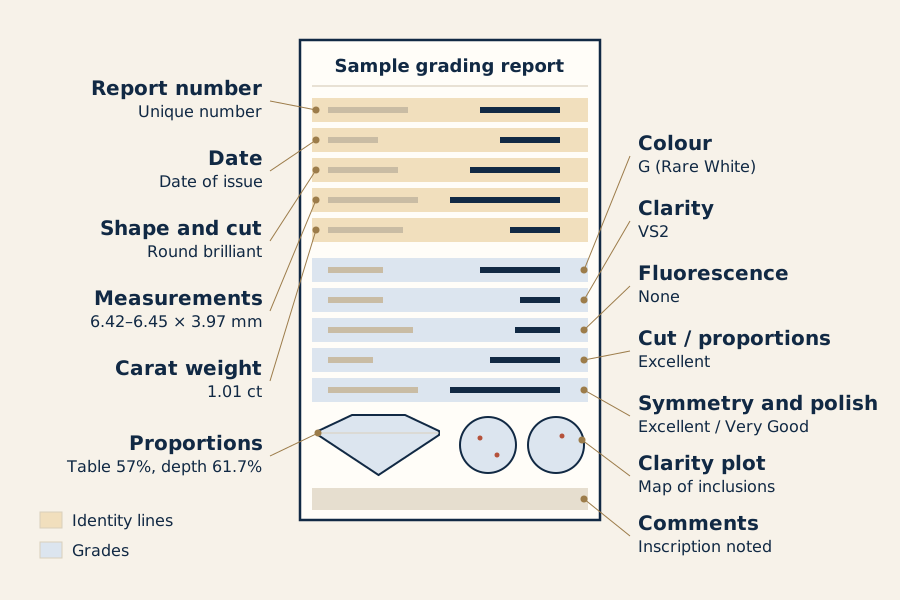
| Report line | Sample entry | What it means |
|---|---|---|
| Report number | A unique number | The key to the online record and usually the laser inscription on the girdle |
| Date | Date of issue | When the stone was graded; any later damage or treatment is not covered |
| Shape and cut | Round brilliant | Outline and faceting style |
| Measurements | 6.42–6.45 × 3.97 mm | Minimum and maximum diameter × depth, to 0.01 mm; the most useful identity check |
| Carat weight | 1.01 ct | Weight to 0.01 carat; 1 carat = 0.2 grams |
| Colour | G (Rare White) | Position on the D–Z scale, with HRD's descriptive name |
| Clarity | VS2 | Visibility of inclusions (internal features) and blemishes at 10× magnification |
| Fluorescence | None | Glow under ultraviolet light |
| Cut / proportions | Excellent | Grade for how the proportions are balanced (round brilliants) |
| Symmetry and polish | Excellent / Very Good | How precisely facets line up, and the finish on their surfaces |
| Proportions | Table 57%, depth 61.7% | Facet sizes and angles as percentages of the diameter |
| Plot and comments | Clarity diagram; inscription noted | A map of the inclusions, plus notes such as a girdle inscription |
Work out the depth percentage yourself as a check: 3.97 mm divided by the average diameter of 6.435 mm gives 61.7%, which matches. If the sums on a report do not line up, ask why. The same line-by-line approach applies to other labs, so it is worth comparing with our guides to reading a GIA report line by line and the IGI natural diamond report if you are choosing between stones graded by different labs.
How do HRD colour and clarity grades compare with GIA?
The letters and grade boundaries are broadly the same as GIA's, so a G VS2 from HRD is meant to describe a similar stone to a G VS2 from GIA. What differs is the wording. HRD's colour names come from the European (IDC and CIBJO) tradition, and its clarity scale merges GIA's top two grades into one.
| HRD grade | HRD wording | Closest GIA grade or group |
|---|---|---|
| D | Exceptional White + | D (colourless) |
| E | Exceptional White | E (colourless) |
| F | Rare White + | F (colourless) |
| G | Rare White | G (near colourless) |
| H | White | H (near colourless) |
| I–J | Slightly Tinted White | I–J (near colourless) |
| K–L | Tinted White | K–L (faint) |
| M–Z | Tinted Colour | M (faint) to Z (light) |
| LC | Loupe-clean | FL and IF |
| VVS1–VVS2 | Very very small inclusions | VVS1–VVS2 |
| VS1–VS2 | Very small inclusions | VS1–VS2 |
| SI1–SI2 | Small inclusions | SI1–SI2 |
| P1–P3 | Piqué | I1–I3 |
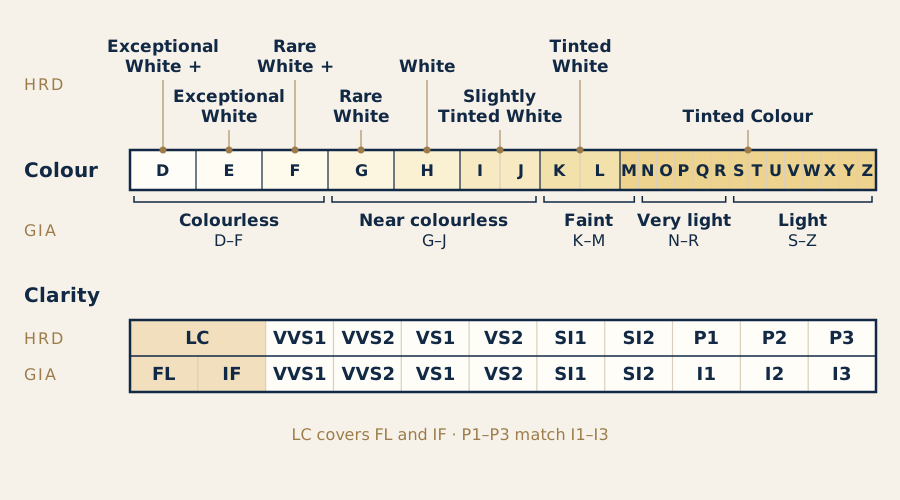
Loupe-clean (LC) means no inclusions are visible to a trained grader at 10× magnification. Under IDC rules, minor surface blemishes that could be removed by light repolishing can still fall within LC, which is why it groups GIA's Flawless and Internally Flawless together. Piqué (P) is the old European trade word for a diamond with inclusions that are obvious at 10× and, in the lower grades, easily visible without magnification.
In practice, for most buyers the useful question is not the label but whether the stone is eye-clean (no inclusions visible to the naked eye at normal viewing distance) and whether the colour looks white in the metal you have chosen. Our full comparison of GIA, IGI and HRD grading looks at how the three labs line up in practice.
How does HRD grade cut, proportions and fluorescence?
For round brilliants, an HRD diamond report gives a grade for proportions, plus separate grades for symmetry and polish, on a scale running Excellent, Very Good, Good, Fair and Poor. Fancy shapes such as ovals, pears and emeralds usually get symmetry and polish grades and a proportions record, but no overall cut grade, because there is no single agreed ideal for those shapes.
- Table %: the width of the large flat top facet as a percentage of the diameter. Many well-cut rounds sit at about 54–58%.
- Total depth %: depth divided by average diameter. Many well-cut rounds sit at about 59–63%.
- Crown height and pavilion depth: the top and bottom sections. Pavilion depth of about 42.5–43.5% is common in strong performers.
- Girdle: the thin edge around the widest point, described from very thin to very thick. Very thin girdles chip more easily.
- Culet: a tiny facet at the bottom point, usually listed as none or pointed on modern rounds.
Fluorescence is a glow, usually blue, that some natural diamonds show under ultraviolet light. The report records its strength, from none up to strong. Faint or medium blue fluorescence rarely changes how a diamond looks in daylight; strong fluorescence occasionally gives a hazy look in high-colour stones, which is something to check by eye rather than assume.
A proportions grade is still a calculation from measurements, not a direct measurement of sparkle. If light return matters to you, see our guide to light performance reports such as GCAL, and compare AGS reports and their 0 to 10 cut scale, which builds light performance into the cut grade.
Not sure which one is right?
Send us the stones you are looking at and our gemologist will tell you which to choose and why.
What does an HRD report prove, and what doesn't it?
A grading report is strong evidence about the stone's physical characteristics. It is not evidence about everything a buyer might care about. Here is the honest split.
- It does record: that the stone was examined as a diamond (10 on the Mohs hardness scale, refractive index about 2.42), whether it is natural or laboratory-grown, its weight, measurements, colour, clarity, cut-related grades and fluorescence on the date of grading.
- It does identify the stone: through the report number, the measurements to 0.01 mm, the weight to 0.01 carat, the inclusion plot and, where present, the girdle inscription.
- It does not give a value: there is no price on the report, and grades alone do not set one.
- It does not prove origin: a standard grading report does not say which mine or country a natural diamond came from.
- It does not cover later events: chips, wear, re-cutting or treatment after the grading date are not reflected.
- It does not judge beauty: how bright the stone looks, whether a fancy shape is well balanced, or how it will look in your setting.
For a longer look at the gaps, see the limits of any diamond report. If where a stone came from matters to you, diamond origin reports are a separate kind of document and are explained in their own guide.
Does HRD grade lab-grown diamonds?
Yes. HRD Antwerp grades both natural and laboratory-grown diamonds, and the report must make clear which one you are looking at. Lab-grown diamonds are real diamond, with the same hardness, refractive index and crystal structure as natural diamond, but grown in a laboratory by CVD (chemical vapour deposition) or HPHT (high pressure, high temperature) rather than formed in the earth. On a lab-grown report, the laboratory-grown identity should appear prominently, and any inscription usually includes a lab-grown marking too.
Under Australian Consumer Law, a seller must not mislead you about whether a diamond is natural or lab-grown, so the report wording and the seller's description should match exactly. In the Australian market, most lab-grown stones carry IGI reports, so an HRD lab-grown report is uncommon here. See how natural and lab-grown reports differ and our guide to IGI lab-grown diamond reports for the more common format.
The colour and clarity scales are the same for both. What a lab-grown report often adds is a note on post-growth treatment, for example HPHT processing to improve colour. Read the comments section carefully on either type.
Natural diamonds graded by HRD
Is an HRD report as good as GIA or IGI?
HRD is a well-established, independent laboratory, and within the trade it is generally regarded as fairly strict, in a similar bracket to GIA on colour and clarity. The practical differences for an Australian buyer are familiarity and availability, not whether the paper is genuine.
| HRD Antwerp | GIA | IGI | |
|---|---|---|---|
| Based | Antwerp, Belgium | United States, labs worldwide | Founded in Antwerp, labs worldwide |
| Top clarity grade | LC | FL, then IF | FL, then IF |
| Lowest clarity grades | P1–P3 | I1–I3 | I1–I3 |
| Colour wording | Letter plus name (e.g. Rare White) | Letter only | Letter only |
| Cut grade for rounds | Yes, with symmetry and polish | Yes, with symmetry and polish | Yes, with symmetry and polish |
| How often seen in Australia | Occasionally, mainly natural stones | Very often for natural | Very often, especially lab-grown |
| Online report check | Yes | Yes | Yes |
Not every lab grades to the same standard; some have historically graded more generously, which is why our guide to GSI and EGL reports exists. HRD is not usually put in that group. Within a single lab, the type of document matters too, as our page on the GIA Dossier versus the full grading report shows; with HRD, the fuller format with a clarity plot gives you more to check the stone against.
Related guideGIA vs IGI vs HRD Diamond CertificatesIs an HRD diamond report the same as an insurance valuation?
No, and this is one of the most common mix-ups we see. An HRD diamond report describes the diamond. A valuation puts a dollar figure on the finished piece of jewellery for a stated purpose, usually insurance. Australian insurers generally want a written valuation for jewellery above a certain value, and they insure to the figure on it.
- What the valuation covers: the whole item, including the metal, its weight and purity, the setting, any side stones and the centre diamond.
- How the report fits in: a good valuer will record the HRD report number and confirm that the stone in the ring matches it, by measurement and by the inscription or inclusions.
- Which value: most insurance valuations state a replacement value in AUD, meaning what it would cost to replace the item with one of similar quality from a retail jeweller. That is different from what you would get if you sold it.
- Keeping it current: prices for metal and diamonds move, so many valuers suggest updating every two to three years. Lab-grown prices in particular have fallen, so an old valuation may overstate what replacement now costs.
- Who writes it: a qualified valuer, ideally independent of the sale. In Australia, many valuers are registered with the National Council of Jewellery Valuers (NCJV).
Fees for a single-item valuation in Australia commonly run from about AUD 100 to 300, depending on the complexity of the piece. Always give your insurer the valuation, and keep the original HRD report with it.
How do you verify an HRD diamond report?
Verification takes about ten minutes with the report, a loupe and, ideally, a jeweller. The idea is simple: check that the paper is genuine, then check that the paper belongs to the diamond in front of you.
- Find the report number. It is printed near the top of the report and usually inscribed on the girdle.
- Check it on HRD's website. Enter the number in the report check on HRD Antwerp's official website and make sure every detail on screen matches the printed report.
- Compare the identity lines. Shape, measurements to 0.01 mm, carat weight to 0.01 ct, colour and clarity should all agree exactly.
- Read the inscription. Under a 10× loupe, find the number on the girdle and confirm it matches. Note that inscriptions can be polished off or added, so this is one check among several.
- Match the inclusions. Compare what you see under magnification with the clarity plot. The pattern of inclusions is the diamond's fingerprint.
- Measure the stone. A jeweller can measure a loose or set stone with a gauge; a difference of more than a few hundredths of a millimetre needs an explanation.
- Confirm natural or lab-grown. If anything looks off, ask for the stone to be tested on screening equipment.
- Store copies safely. Keep the original report, a digital scan and your valuation together for your insurer.
The same process applies across labs; for comparison, see checking a GIA report number online and our guide to verifying a lab-grown report and its inscription.
Free consultation
Talk to a gemologist
Compare stones in person or online with Raj Sood, Graduate Gemologist (GIA), AJP (GIA).
Book a consultationShop this shape
FAQ
Common questions
Is an HRD diamond report reliable?
HRD Antwerp is a long-established independent laboratory, and the trade generally regards its colour and clarity grading as fairly strict. As with any report, check the number online and confirm it matches the stone.
What does LC mean on an HRD report?
LC stands for loupe-clean: no inclusions visible to a trained grader at 10× magnification. It roughly covers GIA's Flawless and Internally Flawless grades together.
What is P1 clarity on an HRD report?
P stands for piqué, the European term for inclusions that are obvious at 10× and often visible to the naked eye. HRD's P1, P2 and P3 broadly match GIA's I1, I2 and I3.
How do I check an HRD report number?
Enter the report number into the report check on HRD Antwerp's official website and compare every detail with the printed report. Then match the girdle inscription, measurements and inclusions to the diamond itself.
Does an HRD report show the diamond's value?
No. A grading report describes the diamond but gives no price. For insurance in Australia you need a separate written valuation of the whole piece, usually stating a replacement value in AUD.
Can a lab-grown diamond have an HRD report?
Yes. HRD grades laboratory-grown diamonds as well as natural ones, and the report clearly states that the stone is lab-grown. In Australia, lab-grown diamonds more often carry IGI reports.

Ask a gemologist
Not sure which diamond to choose?
Raj Sood is a Graduate Gemologist (GIA) and master jeweller. Bring the stones you are considering, or send the reports, and he will tell you honestly which one is better and why.
Keep learning
Related guides
 Certificates & ValuationsGIA vs IGI vs HRD Diamond Certificates
 Certificates & ValuationsWhat a Diamond Report Doesn't Tell YouCertificates & ValuationsDiamond Certificates & Jewellery Reports
 Certificates & ValuationsHow to Read a GIA Diamond ReportCertificates & ValuationsDiamond Origin Reports Explained
 Certificates & ValuationsAGS Diamond Reports ExplainedCertificates & ValuationsGCAL and Light Performance ReportsCertificates & ValuationsGSI and EGL Diamond Reports: What to Know
Explore more
More guides on this topic
Education