
- Education
- Certificates & Valuations
- Estate Jewellery Valuation: Probate, Family Law and What the Report Means
Certificates & Valuations
Estate Jewellery Valuation: Probate, Family Law and What the Report Means
When a family member dies or a relationship ends, an estate jewellery valuation decides how rings, chains and heirlooms are counted and shared. Using the wrong kind of value, or an old insurance figure, can skew the whole division.
 Reviewed by Raj Sood, Graduate Gemologist (GIA), AJP (GIA)Master jeweller and Graduate Gemologist (GIA) · reviewed 4 November 2026
Quick answer
An estate jewellery valuation is a report by a qualified valuer that describes each piece and gives its market value, the price a willing buyer would pay a willing seller, at a set date. Executors and family lawyers use market value, not insurance replacement value, which is usually higher. It records description and value; it does not prove ownership.
What is an estate jewellery valuation?
An estate jewellery valuation is a report prepared by a qualified jewellery valuer. It identifies each piece, describes it in enough detail that someone else could recognise it, and states its value for a stated purpose on a stated date. In a deceased estate that purpose is usually the probate inventory, or sharing items fairly between beneficiaries. In family law it is the list of assets in a property settlement after separation.
It is not the same document as a diamond grading report. A lab such as GIA or IGI grades a loose diamond's colour, clarity, cut and carat weight, and says nothing about money. A valuer puts a dollar figure on the whole piece: metal, stones, workmanship and condition. Our page on how a valuation differs from a diamond certificate covers that split, and the wider guide to diamond certificates and jewellery reports explains every document you are likely to find tucked in a jewellery box.
Who should do it? Look for formal gemmological training, such as the Graduate Gemologist (GIA) diploma or the Gemmological Association of Australia's FGAA diploma, plus membership of a valuers' body such as the National Council of Jewellery Valuers. Just as important is independence: the valuer should be paid a fee for the report and should not be offering to buy the pieces. Any unfamiliar term in this guide is also defined in our plain-English jewellery glossary.
How is an estate jewellery valuation different from an insurance valuation?
The difference is the type of value. Jewellery has several honest values at once, and each answers a different question. An insurance valuation asks what it would cost to replace the piece new. An estate or family law valuation asks what the piece is worth today in the market where it would actually change hands.
| Value type | What it means | Typical use | Usual level |
|---|---|---|---|
| Replacement value | Cost to replace with a new item of like kind and quality from a retail jeweller, including GST | Insurance | Highest |
| Market value (fair market value) | Price agreed between a willing, informed buyer and seller, neither forced to act, in the market where such items normally sell | Probate, family law, capital gains tax, gifts | Often well below replacement |
| Resale or liquidation value | What a dealer or buyer would pay for a quick sale | Selling, worst-case planning | Lower again |
| Metal or scrap value | Metal weight × fineness × current spot price | Broken or unwanted gold and platinum | The floor |
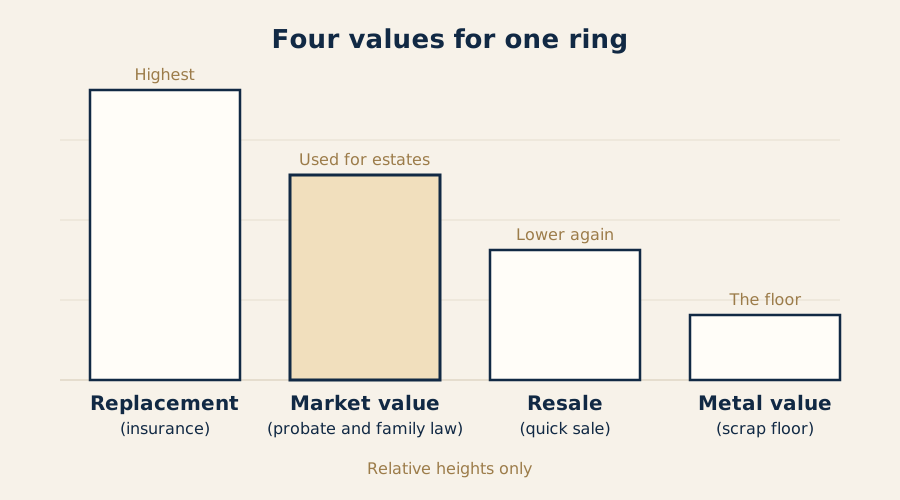
Why such a gap? A retail replacement figure includes the cost of making a new piece, the retailer's overheads and 10% GST. A second-hand piece, even a lovely one, sells into a market where buyers expect to pay less. As a rough guide, market value for ordinary modern jewellery often lands somewhere around a third to two-thirds of an insurance replacement figure, but signed, antique or high-quality pieces can sit much closer. Our explainer on why replacement and resale values differ works through examples.
So an insurance valuation found in a drawer is rarely suitable for an estate or a settlement. It uses the wrong value type, and it is probably years out of date. See what an insurance valuation actually covers and our advice on how often jewellery should be revalued.
Related guideReplacement Value vs Resale Value in JewelleryDo you need a jewellery valuation for probate in Australia?
Often, yes. When an executor applies for a grant of probate, the Supreme Court in each state and territory asks for a list of the deceased's assets and their values as at the date of death. In Victoria this is the inventory of assets and liabilities filed with the application. Low-value pieces are often grouped as personal effects, while anything significant, such as a diamond engagement ring, a heavy gold chain or a signed watch, is usually listed and valued individually. Your lawyer will tell you what the court and the estate need.
Australia has no inheritance tax or estate duty, so the figure is not there to calculate tax on death. It does three practical jobs:
- The court inventory: a fair, documented value for each significant asset.
- Fair shares: if one child takes the ring and another the brooch, a market value lets the executor balance the shares.
- Capital gains tax records: jewellery is a collectable for CGT. Collectables acquired for $500 or less are exempt. A beneficiary who later sells an inherited piece may need its cost base.
On that last point, the general ATO rule is that the transfer on death itself does not trigger CGT. If the deceased acquired the piece before 20 September 1985, the beneficiary's cost base is its market value at the date of death, which is exactly what a date-of-death valuation records. If it was acquired later, the beneficiary usually takes on the deceased's original cost base. Capital losses on collectables can only be offset against gains on collectables. Check your own situation with an accountant.
How is jewellery valued in a family law property settlement?
Under the Family Law Act 1975, the court looks at the whole property pool of both parties. Jewellery is part of that pool, usually at its current market value at the time the property is divided, not what it cost or what it is insured for. Sometimes lawyers also ask for a value at the date of separation, which a valuer can give as a retrospective valuation using prices from that time.
Most couples agree jewellery values between themselves or through their lawyers. Where there is a dispute, the Federal Circuit and Family Court of Australia generally expects expert evidence from a single expert witness, appointed jointly by both sides. That valuer's duty is to the court, not to whoever pays the invoice, and the report must answer the written instructions.
Whether a gift, such as an engagement ring, belongs to one person or forms part of the pool is a legal question for your lawyer, not the valuer. The valuer simply values what is in front of them. Good instructions to a valuer set out:
- The purpose: a family law property settlement.
- The value type: usually market value.
- The valuation date: today, the date of separation, or both.
- The items: a list, ideally with photos, and who currently holds each one.
- Access: whether stones may be unset to weigh them, which gives more accurate figures than estimates in the mount.
Not sure which one is right?
Send us the stones you are looking at and our gemologist will tell you which to choose and why.
What does each line of a jewellery valuation report mean?
Formats differ between valuers, but a sound estate or family law report contains the same core lines. Here is what each one tells you, and where its limits are.
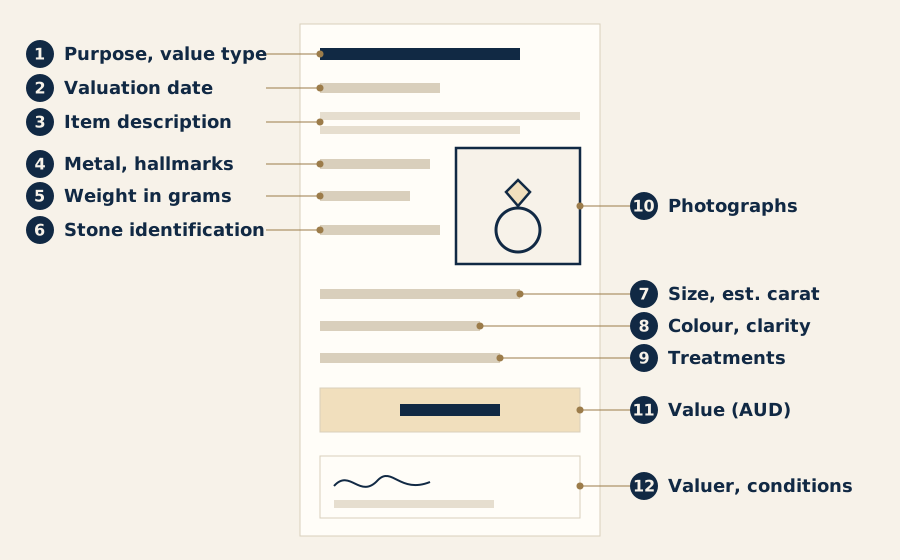
| Line on the report | What it means | What it does and doesn't prove |
|---|---|---|
| 1. Purpose and value type | For example, 'Market value for probate' | Tells you the figure suits an estate; an 'insurance replacement' line means it doesn't |
| 2. Valuation date | Date of death, separation or inspection | Value applies on that date only, not today |
| 3. Item description | Type, style, era, maker's marks | Lets anyone match the report to the piece |
| 4. Metal and hallmarks | 750 = 18ct (75% gold), 585 = 14ct, 375 = 9ct, 950 = platinum | A stamp is a claim; a good valuer tests the metal too |
| 5. Weight in grams | Total weight of the piece | Supports metal value; includes stones unless stated |
| 6. Stone identification | Diamond, natural or lab-grown, lab-created sapphire, simulant | States what testing was done, not origin or mine |
| 7. Measurements and estimated carat | Millimetres, then weight by formula if mounted | Estimated, not weighed, unless the stone was unset |
| 8. Colour and clarity | Graded in the mount by eye and loupe | An opinion, less precise than a lab grading |
| 9. Treatments | For example, heated sapphire, filled diamond | Only what is detectable with the valuer's equipment |
| 10. Photographs | Front, side and marks | Helps identify the piece; can't stop a stone swap later |
| 11. Value figure | The opinion of market value in AUD | An opinion on that date, not a sale price or offer |
| 12. Valuer and conditions | Name, qualifications, signature, limiting conditions | Shows who stands behind the report and its limits |
Mounted diamonds can't be placed on a scale, so valuers estimate weight from measurements. For a round brilliant the usual formula is diameter² × depth × 0.0061, with all figures in millimetres. A 6.4 mm round about 3.9 mm deep works out near 0.97 ct. Claws and setting hide part of the girdle, so treat any mounted estimate as roughly right, usually within a few points. If the stone has a lab report, the valuer should match it; our guide to reading a GIA diamond report line by line explains what those grades mean.
Workmanship also shows up in the description. A hand-made Edwardian platinum ring and a mass-produced cast ring with the same stones can carry quite different values, which is why valuers note construction. Our page on cast versus hand-fabricated jewellery explains how to tell them apart.
What does a jewellery valuation prove, and what doesn't it?
A valuation is an expert's documented observation and opinion. It is strong evidence of what a piece was and roughly what it was worth on one day. It is weaker evidence of anything else.
- It does record: what the valuer saw and tested, the condition on that date, and an opinion of value for a stated purpose.
- It does not prove ownership: who owns a piece is decided by the will, the law or the parties, not the report.
- It does not prove provenance: a family story that a ring came from a particular person or mine needs separate evidence.
- It is not an offer: nobody is bound to buy at the stated figure.
- It does not predict the future: values move with gold prices, diamond prices and fashion.
Identification deserves a special mention. Laboratory-grown diamonds have been sold widely for well over a decade, and lab-grown stones are now common in newer jewellery. Lab-created ruby and sapphire have been made since the early 1900s, so even a grandmother's ring can hold one. Simulants such as cubic zirconia and moissanite also turn up. A lab-grown diamond is real diamond, with the same hardness (10 on the Mohs scale) and refractive index (about 2.42) as a natural one, but its market value is much lower, so it matters that the report says which. A careful valuer states the testing used and, where they cannot be certain, recommends a lab report.
Old certificates in the box need context too. Grading standards vary between labs; our comparison of the major diamond grading labs and GIA, IGI and HRD side by side explain the differences, and some older reports, covered in what to know about GSI and EGL reports, were known for generous grades. If a stone has no paperwork at all, see how certified and uncertified diamonds compare.
How do you verify a diamond report or jewellery valuation?
For a diamond report, start with the number. Many modern GIA and IGI reports have a matching number laser-inscribed on the diamond's girdle (its thin outer edge), visible under 10× magnification. Enter the report number on the lab's online checker and compare every line: shape, measurements to the hundredth of a millimetre, carat, colour and clarity. Lab-specific guides explain each format: the IGI natural diamond report, the HRD report layout and AGS reports and their light-performance grades. Specialist documents such as GCAL light-performance reports can be checked the same way.
Then confirm the report belongs to this stone. A genuine report for a different diamond proves nothing. Measure the stone with a gauge and check the inscription, or ask a valuer to do it.
For a valuation, check that it names the valuer and their qualifications, gives contact details you can call, states the purpose, value type and date, and includes photographs. If the purpose says 'insurance', the figure is replacement value and should not go into a probate inventory or a settlement unchanged.
Can inherited jewellery be remodelled or divided after the valuation?
Yes. Once values are agreed, families often split a collection by value, or remodel pieces so more than one person can wear them. A single diamond from a ring can become the centre of a new engagement ring, while the gold is reused for bands or pendants. Our guide to giving a family diamond a new setting covers how stones are removed, checked for chips and reset.
Keep the valuation with the paperwork. If a remodelled piece later needs insuring, it will need a fresh replacement valuation, because the original estate figure no longer describes it.
Natural and lab-grown diamonds, and our valuation service
How do you get an estate jewellery valuation? Step by step
- Gather everything. Every piece, plus any old receipts, certificates, insurance valuations and family notes about where items came from.
- Get written instructions. From the executor or lawyers: the purpose, the value type (usually market value) and the valuation date.
- Choose an independent valuer. Check gemmological qualifications, valuer membership and that they are not offering to buy. In family law, both sides may need to agree on a single expert.
- Ask about fees up front. Many valuers charge per item or per hour; as a rough guide, expect about $100–$250 for a single piece, with estate lots quoted on the number of items.
- Attend the inspection if you can. Confirm photos are taken and note whether any stones are unset for weighing.
- Check the report. Purpose, value type, date, descriptions, identification and valuer signature, then compare it with any lab reports you hold.
- Store it safely. Keep copies with the executor, the lawyer and whoever ends up with each piece.
Free consultation
Talk to a gemologist
Compare stones in person or online with Raj Sood, Graduate Gemologist (GIA), AJP (GIA).
Book a consultationFAQ
Common questions
Can I use an old insurance valuation for probate?
Usually not. An insurance valuation gives replacement value, which is normally higher than market value, and it is probably out of date. Probate needs market value at the date of death.
Is inherited jewellery taxed in Australia?
There is no inheritance tax in Australia. Jewellery is a collectable for capital gains tax, so a beneficiary who later sells a piece may have a gain to report; collectables acquired for $500 or less are exempt. Ask an accountant about your situation.
Who pays for a jewellery valuation in a family law settlement?
That is usually agreed between the parties or their lawyers. When a single expert is jointly appointed, the cost is often shared.
Can a valuation be done for a past date?
Yes. A retrospective valuation estimates market value at an earlier date, such as the date of death or separation, using price information from that time.
Does a valuation tell me if a diamond is natural or lab-grown?
A good valuation states whether the diamond tested as natural or lab-grown and what equipment was used. Where results are inconclusive, the valuer should recommend a laboratory report.
How long is an estate jewellery valuation valid?
It is valid for its stated date and purpose. For a later sale, insurance or a new settlement date, you need a new valuation.

Ask a gemologist
Not sure which diamond to choose?
Raj Sood is a Graduate Gemologist (GIA) and master jeweller. Bring the stones you are considering, or send the reports, and he will tell you honestly which one is better and why.
Keep learning
Related guides
 Certificates & ValuationsJewellery and Diamond Valuation
 Certificates & ValuationsReplacement Value vs Resale Value in JewelleryCertificates & ValuationsInsurance Jewellery Valuation Explained
 Natural DiamondsReusing a Family DiamondCertificates & ValuationsDiamond Certificates & Jewellery Reports
 Wedding Bands & EternityA Jewellery Valuation and a Diamond Grading Report Are Not the Same ThingCertificates & ValuationsHow Often to Revalue Jewellery
 Certificates & ValuationsDiamond Grading Labs Compared
Explore more
More guides on this topic
Education