
- Education
- Diamond 4Cs & Grading
- 5 Carat Diamonds: A 5 Carat Engagement Ring by Size, Price and Grade
Diamond 4Cs & Grading
5 Carat Diamonds: A 5 Carat Engagement Ring by Size, Price and Grade
At 5 carats a diamond stops being a ring stone and becomes the whole ring, and every grading decision shows. Here is how big a 5 carat engagement ring really looks, what it costs in AUD, and which colour and clarity hold up at this size.
 Reviewed by Raj Sood, Graduate Gemologist (GIA), AJP (GIA)Master jeweller and Graduate Gemologist (GIA) · reviewed 4 November 2026
Quick answer
A 5 carat engagement ring holds a diamond weighing 1 gram. A well-cut round measures about 11.0–11.2 mm across, an oval about 14.5 × 10.0 mm. Choose G–H colour and VS clarity (VS1 or better for step cuts), a top cut grade and a six-claw or bezel setting. Lab-grown costs roughly AUD 4,000–12,000; natural usually from about AUD 120,000.
What is a 5 carat diamond?
Carat is a unit of weight, not size. One carat is 0.2 grams, so a 5 carat diamond weighs exactly 1 gram. Weight is only one of the four Cs of diamond grading, alongside cut, colour and clarity, and at this size every one of the other three is easier to see. Our guide to how carat weight is measured and priced explains the scale, from points (hundredths of a carat) upward.
A 5 carat engagement ring normally means a single centre diamond of 5.00 carats or a little more. Be careful with listings that say "5 ct TW" or "5 ctw". That is total weight, the sum of every diamond in the ring, and the centre stone could be 3 carats or less with the rest made up by a halo and side stones. Knowing the difference between ct, ctw and tcw stops you comparing two very different rings as if they were the same.
Diamond is 10 on the Mohs hardness scale with a refractive index of about 2.42, whether it is natural or lab-grown. Size does not change those properties, but it does change how visible everything is. A well-cut 5 carat round has a table (the large flat facet on top) about 6 mm wide, a window big enough to show body colour and inclusions that would disappear in a smaller stone. If a term here is new, our plain-English jewellery glossary explains it.
What size is a 5 carat diamond in mm?
Every shape spreads the same 1 gram differently. Elongated shapes such as oval, pear and marquise put more of the weight into length and face up larger. Square shapes such as the Asscher (a step cut) and princess (a brilliant cut) hold more weight deep in the stone and look smaller from above. These are typical measurements for well-proportioned stones:
| Shape (typical ratio) | Approximate size at 5 ct | How it faces up |
|---|---|---|
| Round brilliant (1.00) | 11.0–11.2 mm diameter | The reference point |
| Oval (1.35–1.45) | about 14.5 × 10.0 mm | Looks larger than a round |
| Pear (1.50–1.60) | about 15.5 × 10.0 mm | Long and large on the finger |
| Marquise (1.90–2.10) | about 19.0 × 9.5 mm | Largest face-up length |
| Cushion (1.00–1.10) | about 10.0 × 9.7 mm | Slightly smaller than a round |
| Radiant (1.20–1.30) | about 11.3 × 9.0 mm | Similar to a round |
| Emerald (1.40–1.50) | about 12.5 × 8.6 mm | Long, flat and open table |
| Princess (1.00) | about 9.2 × 9.2 mm | Smaller, weight sits deep |
| Asscher (1.00) | about 9.5 × 9.5 mm | Smaller, deep corners |
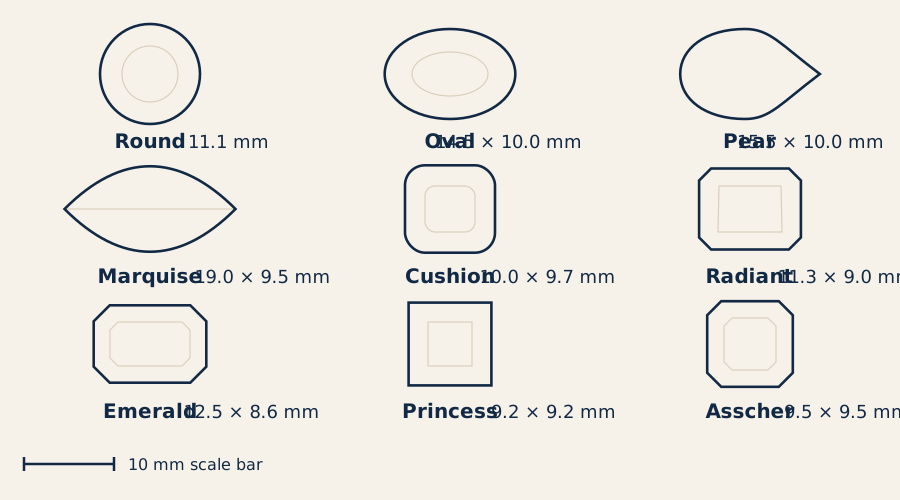
Cut proportions move these numbers. A round cut deep (a total depth above about 63%) can measure under 11 mm and look like a 4.5 carat stone, while one cut shallow spreads past 11.3 mm but tends to leak light and look glassy. To put 5 carats in perspective, a 1 carat round measures about 6.4 mm, so a 5 carat stone is five times the weight but only about 1.7 times the diameter. Our millimetre-to-carat chart for every shape covers the full range from tiny accent stones up.
How big is a 5 carat engagement ring on the finger?
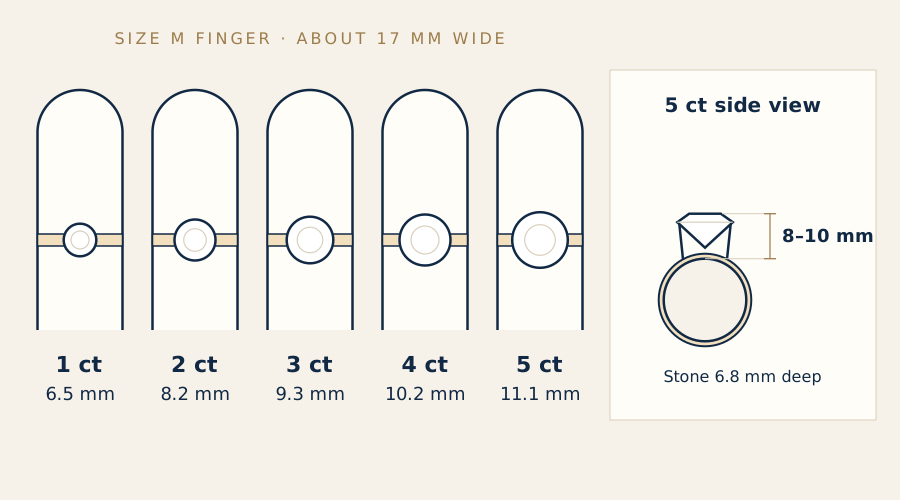
An average Australian ring size of around M to N has an inside diameter of about 16.5 mm, and the finger seen from above is roughly 16–18 mm wide. An 11 mm round covers about two-thirds of that width. An oval at 14.5 mm long runs most of the way from the base of the finger towards the knuckle, and a pear or marquise often reaches it. On a smaller finger, size H or I, a 5 carat round covers about three-quarters of the width.
| Round diamond | Typical diameter | Face-up area compared with 1 ct |
|---|---|---|
| 1.00 ct | 6.4–6.5 mm | 1.0× |
| 1.25 ct | 6.9 mm | about 1.1× |
| 2.00 ct | 8.1–8.2 mm | about 1.6× |
| 2.50 ct | 8.7–8.8 mm | about 1.9× |
| 3.00 ct | 9.3–9.4 mm | about 2.1× |
| 4.00 ct | 10.2–10.3 mm | about 2.5× |
| 5.00 ct | 11.0–11.2 mm | about 3.0× |
The table shows why the step up feels smaller than the number suggests. Going from a 4 carat diamond at about 10.2 mm to 5 carats adds less than a millimetre of diameter. Many people who start at 5 carats end up comparing it on the hand with 3 carat stones around 9.3 mm, or even 2 carat diamonds in a halo, which can face up close to 10 mm overall. The same pattern runs through the smaller sizes too, from a 1.25 carat round at about 6.9 mm to 2.5 carat diamonds just under 9 mm.
Height matters as much as width. A 5 carat round is about 6.8 mm deep from table to culet (the point at the bottom), so in a standard claw setting the top of the stone sits roughly 8–10 mm above the finger. That is noticeable: it catches on gloves, knitwear and hair more than a 1 carat ring does, and it is the main thing people tell us they had to get used to.
What colour and clarity suit a 5 carat diamond?
A bigger stone has a longer light path, so body colour (the faint yellow or brown tint in most white diamonds) shows more strongly at 5 carats than the same grade at 1 carat. Inclusions, the small internal features graded as clarity, are also larger in real terms. A pinpoint you could never find in a half-carat can be visible through a 6 mm table. That means the grades that work at 1 carat often need to move up one step here.
| Shape and metal | Colour | Clarity |
|---|---|---|
| Round, oval, cushion, pear in white gold or platinum | G–H | VS2 or better; an eye-clean SI1 is rare at this size |
| Brilliant shapes in yellow or rose gold | H–J | VS2 or better |
| Emerald or Asscher (step cuts) in any metal | F–G | VS1 or better |
| Lab-grown, any shape | D–F is within easy reach | VVS2–VS1 is within easy reach |
- Step cuts (emerald and Asscher) have long, flat facets that work like windows, so they show inclusions and colour more than brilliant cuts.
- Fluorescence (a glow under ultraviolet light) is graded None to Very Strong. Medium blue can make an I or J stone look a touch whiter; very strong fluorescence occasionally gives a hazy look, so view the stone in daylight.
- Inclusion position matters more than grade alone. A feather (a small internal crack) under the table is easy to see; one hidden near the girdle (the outer edge) often is not. Check the plotting diagram on the report.
Not sure which one is right?
Send us the stones you are looking at and our gemologist will tell you which to choose and why.
Does cut quality matter more at 5 carats?
Yes. A large, poorly cut diamond shows its faults on a large scale. In round brilliants, GIA gives an overall cut grade from Excellent to Poor, and at this size most people choose Excellent, or Ideal on reports from labs such as IGI. Fancy shapes have no overall cut grade, so you judge them by ratio, polish, symmetry and how they behave in a video.
- Bow-tie: the dark band across the middle of ovals, pears and marquise cuts grows with the stone. At 14–15 mm long, a strong bow-tie is obvious from across a room.
- Spread: compare millimetres, not just carats. Two 5.02 ct ovals can differ by more than 1 mm in length depending on depth.
- Magic weights: prices step up at round numbers. A 4.80–4.99 ct diamond can measure within about 0.1–0.2 mm of a 5.00 ct stone, which no one can see on the hand, yet it usually costs noticeably less per carat.
- Girdle thickness: a very thick girdle hides weight around the edge where it adds nothing to face-up size; medium to slightly thick is ideal.
Natural vs lab-grown 5 carat diamond: what is the difference?
Both are real diamond: the same carbon crystal, the same hardness and the same refractive index. A natural diamond formed deep in the earth over a very long time; natural rough large enough to cut a fine 5 carat stone is rare, which is why the price climbs so steeply at this weight. A lab-grown diamond is grown in a laboratory by either CVD (chemical vapour deposition) or HPHT (high pressure, high temperature). Lab-grown diamonds at 5 carats are now produced in quantity, so the price is a small fraction of natural.
- Treatment: many large CVD lab-grown diamonds are given a post-growth HPHT treatment to improve colour. It is permanent and the report should state it.
- Tint and strain: some large lab-grown stones show a faint brown or grey tint, or graining, that the colour grade alone does not fully describe. Video and in-person viewing matter.
- Reports: lab-grown diamonds are graded by labs such as IGI and GIA, and the report must clearly say laboratory-grown. Many are also laser-inscribed on the girdle.
- Resale: neither type reliably resells near its retail price, and lab-grown resale values are low. Choose either for how it looks and what it means to you.
Lab-grown pricing changes as you move up through the sizes; our guide to lab-grown carat sizes from 1 to 5 carats tracks it step by step, and what changes in lab-grown diamonds above 3 carats covers growth, treatment and quality checks at large sizes.
Related guideLab-Grown Diamond Carat Sizes: 1 to 5 CaratsHow much does a 5 carat engagement ring cost in Australia?
The centre diamond makes up most of the cost. The gap between natural and lab-grown is wider at 5 carats than at any smaller size, so the two belong in separate price bands:
| 5 ct diamond (loose) | Grades | Approximate price range (AUD) |
|---|---|---|
| Lab-grown round | G–H, VS | about $4,000–$12,000 |
| Lab-grown oval or other fancy shape | G–H, VS | about $3,500–$10,000 |
| Natural round | I–J, VS2–SI1 | about $120,000–$250,000 |
| Natural oval, cushion or pear | G–H, VS | about $180,000–$400,000 |
| Natural round | G–H, VS | about $250,000–$500,000 |
These are broad ranges only; they move with the market and the exact grades. In natural diamonds the price per carat rises with size, so a 5 carat costs far more than 3.3 times a 1.5 carat diamond of the same colour and clarity, and many times the per-carat price of a half-carat diamond or a three-quarter carat stone. Lab-grown prices rise much more gently with size. Fancy shapes usually cost less per carat than rounds, because more of the rough crystal is kept when they are cut.
Add the setting on top. A platinum or 18 carat gold solitaire built for a stone this size typically adds a few thousand dollars, more with a pavé band or halo. Plan for insurance too: a ring of this value needs a written valuation, and most insurers ask for it to be updated every few years.
Shop 5 carat diamonds: natural and lab-grown
What is the right setting for a 5 carat diamond ring?
A 1 gram diamond puts real load on the claws every time a hand is knocked or bumped. The setting has to be sturdy, sit as low as the stone allows and suit the shape:
- Six claws for a round, or double claws (two thin claws side by side at each corner). If one claw is damaged, the stone is still held.
- V-claws on the points of pears, marquise cuts and princess corners, which are the thinnest and most chip-prone areas.
- Bezel or half-bezel: a metal rim around the edge. The most secure option, and it lowers the profile, though it hides a little of the outline.
- Low-set basket or cathedral shoulders: bring the stone closer to the finger so it catches less, while leaving room for a wedding band beneath.
- Band width of about 2.2–3.0 mm: a very fine band under a 5 carat stone can bend and let the head roll to one side of the finger.
Platinum is dense and holds claws well under a heavy stone; 18 carat white or yellow gold is lighter and also a sound choice. Whatever the metal, have the claws checked about every six to twelve months. At this size, a worn claw is a much bigger risk than at 1 carat.
How do you choose a 5 carat diamond? Step by step
- Read the report. Confirm the weight is the centre stone alone, the shape and measurements, colour, clarity, cut, polish, symmetry, fluorescence, and whether it is natural or lab-grown and treated.
- Compare millimetres. Use the measurements, not the carat figure, to see which stone faces up larger.
- Set your colour and clarity floor. G–H and VS for brilliants, F–G and VS1 or better for emerald and Asscher cuts.
- Check the cut. Excellent or Ideal for rounds; for fancy shapes, watch a 360° video for a bow-tie and uneven light.
- Consider 4.80–4.99 ct. The size difference is invisible on the hand and the price per carat is usually lower.
- Try the size on. Look at the stone on your own finger, or a to-scale replica, and check the height in profile.
- Plan the setting and insurance. Six or double claws, V-tips or a bezel, a band of at least about 2.2 mm, and a written valuation before the ring is worn.
If 5 carats still feels like the beginning rather than the top of your range, our guide to 6 to 10 carat diamonds covers how sizing, grading and settings change again above this weight.
Free consultation
Talk to a gemologist
Compare stones in person or online with Raj Sood, Graduate Gemologist (GIA), AJP (GIA).
Book a consultationShop this shape
FAQ
Common questions
How big is a 5 carat diamond?
A well-cut 5 carat round measures about 11.0–11.2 mm across and about 6.8 mm deep. An oval of the same weight is about 14.5 × 10.0 mm, and an emerald cut about 12.5 × 8.6 mm.
How much is a 5 carat diamond ring in Australia?
A lab-grown 5 carat diamond is roughly AUD 4,000–12,000 loose, while a natural 5 carat usually starts from about AUD 120,000 and can exceed AUD 500,000 in high grades. The setting adds a few thousand dollars more.
Is a 5 carat engagement ring too big for everyday wear?
Many people wear one every day, but it sits 8–10 mm off the finger and catches more than a smaller stone. A low-set bezel or six-claw setting and regular claw checks make daily wear practical.
What colour and clarity should a 5 carat diamond be?
For brilliant shapes in white metal, most people choose G–H colour and VS2 or better clarity. Emerald and Asscher cuts show more, so F–G and VS1 or better is safer.
Is a lab-grown 5 carat diamond a real diamond?
Yes. A lab-grown diamond has the same crystal structure, hardness and sparkle as a natural diamond. The grading report states that it is laboratory-grown and whether it has been treated after growth.
Does a 4.9 carat diamond look smaller than 5 carats?
Not to the eye. A 4.90 ct round is typically within about 0.1 mm of a 5.00 ct stone, but it usually costs less per carat because it sits below the 5 carat price step.

Ask a gemologist
Not sure which diamond to choose?
Raj Sood is a Graduate Gemologist (GIA) and master jeweller. Bring the stones you are considering, or send the reports, and he will tell you honestly which one is better and why.
Keep learning
Related guides
 Diamond 4Cs & Grading4 Carat Diamonds
 Diamond 4Cs & Grading6 to 10 Carat DiamondsDiamond 4Cs & GradingDiamond MM to Carat Size Chart (All Shapes)Lab-Grown DiamondsLarge Lab-Grown Diamonds: What Changes Above 3 Carats?Diamond 4Cs & GradingDiamond 4Cs
 Diamond 4Cs & Grading1.5 Carat DiamondsDiamond 4Cs & Grading2.5 Carat DiamondsDiamond 4Cs & Grading0.5 Carat Diamonds
Explore more
More guides on this topic
Education