
- Education
- Diamond 4Cs & Grading
- 1 Carat Diamond Guide: Size, Price and How to Choose
Diamond 4Cs & Grading
1 Carat Diamond Guide: Size, Price and How to Choose
One carat is the size most Australians picture for an engagement ring, and it is the weight where prices jump. Here is what a 1 carat diamond really measures, how it looks on the hand, what it costs in AUD and where your money matters most.
 Reviewed by Raj Sood, Graduate Gemologist (GIA), AJP (GIA)Master jeweller and Graduate Gemologist (GIA) · reviewed 4 November 2026
Quick answer
A 1 carat diamond weighs 0.20 grams. A well-cut round measures about 6.4–6.5 mm across, while ovals, pears and marquises look larger face-up. In Australia a natural 1 carat costs roughly A$4,500–A$30,000 depending on grade; a lab-grown one roughly A$700–A$3,000. For balance, choose an excellent cut, G–H colour and eye-clean VS2–SI1 clarity.
What is a 1 carat diamond?
A carat is a unit of weight, not size. One carat equals 0.20 grams, or 200 milligrams, and it is divided into 100 points. So a 1 carat diamond is a '100-pointer', and a 0.75 carat stone is 75 points. Our guide to how diamond carat weight works covers the history of the unit and how labs weigh stones.
Carat is one of the four Cs of diamond grading, alongside colour, clarity and cut. It moves the price more than any other single factor, but on its own it tells you little about how big the stone looks. Two 1 carat diamonds can differ in face-up size by half a millimetre or more, depending on their shape and how deeply they are cut.
Grading labs record weight to two decimal places and round carefully. GIA, for example, only rounds up when the third decimal is a 9, so a stone weighing 0.998 ct is reported as 0.99 ct, not 1.00 ct. In the trade, a '1 carat' stone usually means anything from 1.00 to about 1.19 ct. If a term on a report is new to you, our plain-English jewellery glossary explains it.
How big is a 1 carat diamond in mm?
Because carat is weight, the millimetre size of a 1 carat diamond depends on its shape. Some shapes carry more of their weight below the girdle (the widest edge), so they look smaller from above. Others are long and shallow and spread their weight across a bigger face-up area. Typical measurements for well-proportioned 1.00 ct stones:
| Shape | Typical size at 1.00 ct | Typical ratio | Face-up look compared with a round |
|---|---|---|---|
| Round | 6.4–6.5 mm diameter | 1.00 | The baseline |
| Princess | about 5.5 × 5.5 mm | 1.00–1.05 | Looks smaller; more weight in the depth |
| Cushion | about 5.5 × 5.5 to 6.0 × 5.5 mm | 1.00–1.15 | Slightly smaller |
| Oval | about 7.7 × 5.7 mm | 1.30–1.40 | Looks larger and longer |
| Pear | about 8.5 × 5.5 mm | 1.50–1.60 | Looks larger |
| Marquise | about 10.0 × 5.0 mm | 1.90–2.00 | Largest-looking per carat |
| Emerald | about 7.0 × 5.0 mm | 1.35–1.45 | Similar length, flatter, glassier look |
| Asscher | about 5.5 × 5.5 mm | 1.00–1.05 | Smaller |
| Radiant | about 6.5 × 5.5 mm | 1.15–1.25 | Slightly smaller |
| Heart | about 6.8 × 6.3 mm (width × length) | 0.90–1.00 | About the same |
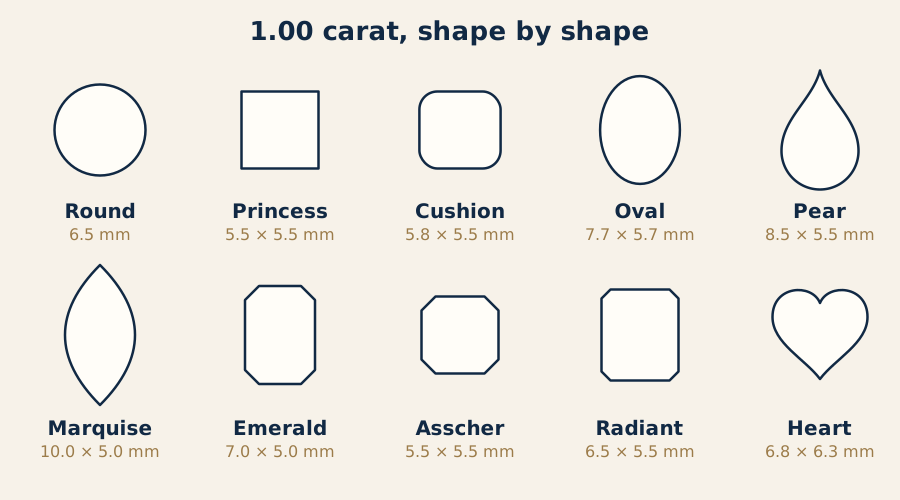
Treat these as typical figures: a real stone can sit 0.2–0.3 mm either side, depending on its depth and girdle thickness. For other weights and every shape in one place, use our mm to carat size chart for all shapes.
A 1 carat oval diamond is a good example of why shape matters. At about 7.7 mm long, it reads longer than a 6.5 mm round across the finger, and most people see it as the bigger stone, even though both weigh exactly the same.
What does a 1 carat diamond look like on a finger?
Many Australian women wear a ring size somewhere around L to N, which is a finger roughly 16–18 mm wide. On that hand, a 6.5 mm round covers a little over a third of the finger's width. It reads clearly as a solitaire from across a table without looking oversized. On a slim size H or J finger the same stone looks noticeably larger; on a size P or Q hand it looks more modest.
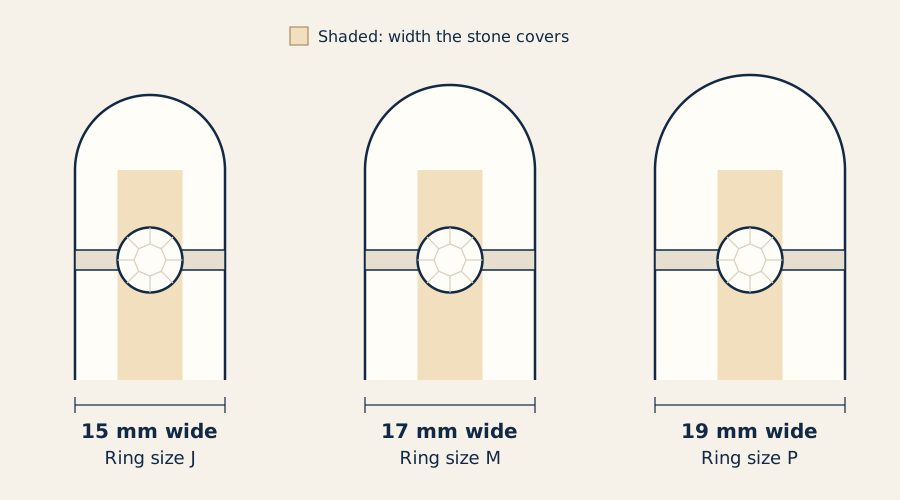
Several things change how big the stone looks once it is set:
- Band width: a fine band of about 1.8–2.2 mm makes the centre stone look larger than a 3 mm band does.
- Halo: a single row of small diamonds around a 1 carat round makes the top of the ring read at roughly 9–10 mm across.
- Claws: four claws show more of the diamond than six; thin claws hide less of the outline.
- Shape: elongated shapes, set north-south, lengthen the finger and cover more of it.
- Lighting and cut: a well-cut stone returns more light, and brighter stones tend to look bigger.
If you are weighing up a slightly smaller stone, compare the step down. A 0.75 carat round is about 5.8 mm, around 0.6 mm narrower, while a half-carat diamond is about 5.1 mm and reads as a delicate solitaire.
Is a 1 carat diamond big compared with other sizes?
One carat sits in the middle of what Australians usually choose for an engagement ring. Remember that weight grows faster than diameter: a diamond is three-dimensional, so doubling the carat weight does not double the width you see from above.
| Carat weight | Round diameter (typical) | Approx. face-up area |
|---|---|---|
| 0.50 ct | 5.1–5.2 mm | about 21 mm² |
| 0.75 ct | 5.8–5.9 mm | about 27 mm² |
| 1.00 ct | 6.4–6.5 mm | about 33 mm² |
| 1.25 ct | 6.8–6.9 mm | about 37 mm² |
| 1.50 ct | 7.3–7.4 mm | about 42 mm² |
| 2.00 ct | 8.0–8.2 mm | about 51 mm² |
| 2.50 ct | 8.7–8.8 mm | about 60 mm² |
| 3.00 ct | 9.2–9.4 mm | about 68 mm² |
| 4.00 ct | 10.1–10.3 mm | about 82 mm² |
| 5.00 ct | 11.0–11.2 mm | about 97 mm² |
A 2 carat round is only about 1.6 mm wider than a 1 carat, yet it has roughly one and a half times the face-up area. If you want a little more presence without a big jump, a 1.25 carat diamond adds about 0.4 mm, and a 1.5 carat stone about 0.9 mm.
Going further, our guides to 2 carat diamonds, 2.5 carat stones and 3 carat centre stones explain how colour and clarity become harder to hide as size grows. At the top end, 4 carat diamonds, 5 carat diamonds and very large 6 to 10 carat stones are mostly a different market, especially in natural diamond.
Not sure which one is right?
Send us the stones you are looking at and our gemologist will tell you which to choose and why.
How much does a 1 carat diamond cost in Australia?
Price per carat is not a straight line. It steps up at popular weights, and the biggest step most buyers notice is at 1.00 ct. Within that, colour and clarity decide most of the price, and the gap between natural and laboratory-grown diamonds is very large. Approximate ranges for a loose, well-cut round:
| Grade combination (round, excellent cut) | Natural 1 ct (approx. AUD) | Lab-grown 1 ct (approx. AUD) |
|---|---|---|
| I–J colour, SI1–SI2 clarity | A$4,500–A$7,500 | A$700–A$1,200 |
| G–H colour, VS2–SI1 clarity | A$7,000–A$12,000 | A$900–A$1,800 |
| E–F colour, VS1–VS2 clarity | A$11,000–A$18,000 | A$1,200–A$2,400 |
| D–E colour, IF–VVS clarity | A$18,000–A$30,000+ | A$1,500–A$3,000 |
These are loose-stone ranges only; the ring setting is extra. Prices move, especially for lab-grown diamonds, so check current stock for live figures rather than relying on any table.
Two things can bring the price of a natural 1 carat down without changing how it looks. First, buying just under the magic sizes: a 0.90–0.99 ct round usually costs noticeably less than a 1.00 ct, yet a 0.95 ct stone is only about 0.1 mm narrower, which nobody can see on the hand. Second, fancy shapes such as ovals, pears and cushions usually cost less per carat than a round of the same colour and clarity, partly because cutting a round loses more of the rough crystal.
What colour and clarity is best for a 1 carat diamond?
At 1 carat, the table (the flat top facet) is about 3.5–3.7 mm wide on a round, so inclusions are easier to spot than in a half-carat, and body colour is easier to see, particularly from the side. The goal is a stone that looks white in your chosen metal and is eye-clean, meaning no inclusions are visible at normal viewing distance without magnification.
| Combination | Why it works | Suits |
|---|---|---|
| H colour, SI1, excellent cut | Looks white face-up in most light; SI1 needs checking stone by stone for an eye-clean result | Value-focused buyers in white gold or platinum |
| G colour, VS2, excellent cut | Very few people can see colour; VS2 is almost always eye-clean at 1 ct | The balanced choice for most engagement rings |
| E–F colour, VS1, excellent cut | Icy white, inclusions only visible under magnification | Buyers sensitive to warmth, or platinum settings |
| I–J colour, VS2–SI1 | Yellow or rose gold warms the stone anyway, so lower colour looks the same | Yellow and rose gold rings |
| D–F colour, VS1 or better (lab-grown) | Top grades cost little more in lab-grown diamond | Lab-grown buyers who want a high-colour stone |
Shape changes the advice slightly. Step cuts such as emerald and Asscher have long open facets that show inclusions, so VS2 or better is the safer floor. Brilliant-style shapes such as round, oval and cushion hide small inclusions well, which is why a carefully chosen SI1 can work. Elongated shapes and cushions show colour more at the ends and corners, so going one colour grade higher than you would for a round is common.
Why does cut matter so much in a 1 carat diamond?
Cut decides how much light comes back to your eye, and it also decides the stone's spread (how big it looks for its weight). A 1 carat round cut too deep, with a depth of 64% or more, can measure only about 6.2 mm across and look like a 0.90 ct stone. One cut too shallow can look large but glassy, because light leaks out the bottom. For a round brilliant, these are sound targets:
- GIA cut grade: Excellent (or Ideal from labs that use that term).
- Depth: about 59–62.5% of the width.
- Table: about 54–58% of the width.
- Polish and symmetry: Excellent or Very Good.
- Fluorescence: none to medium is safe; strong blue fluorescence occasionally makes a stone look slightly hazy, so view it first.
Fancy shapes do not receive an overall GIA cut grade, so you judge them by eye and by the numbers: length-to-width ratio, depth, the size of any bow-tie (a dark band across the middle of ovals, pears and marquises) and an even outline. A 360° video tells you far more than a single photo.
Should you choose a natural or lab-grown 1 carat diamond?
Both are real diamond: pure carbon in the same crystal structure, 10 on the Mohs hardness scale, with a refractive index of about 2.42, so they bend light identically. A laboratory-grown diamond is made in weeks by the HPHT (high pressure, high temperature) or CVD (chemical vapour deposition) method; a natural diamond formed deep underground over a very long time. Neither can be told apart by eye. Grading reports state clearly whether a stone is natural or lab-grown, and lab-grown stones are usually laser-inscribed on the girdle to say so.
| Natural 1 ct | Lab-grown 1 ct | |
|---|---|---|
| Origin | Formed in the earth | Grown in a laboratory (HPHT or CVD) |
| Material and hardness | Diamond, Mohs 10 | Diamond, Mohs 10 |
| Typical price, G–H VS2–SI1 (approx.) | A$7,000–A$12,000 | A$900–A$1,800 |
| Top colour and clarity | Rare and priced accordingly | Widely available for a small premium |
| Grading | GIA, IGI and other labs | IGI, GIA and other labs, marked as lab-grown |
| Resale | Usually well below retail | Very little resale value |
Neither should be bought as an investment. Choose natural if its rarity and origin matter to you; choose lab-grown if you want a larger or higher-grade stone for the same budget. Our guide to lab-grown carat sizes from 1 to 5 carats shows how far a budget goes in laboratory-grown diamond, and what changes in lab-grown diamonds above 3 carats explains why some buyers move straight past 1 ct.
Browse 1 carat natural and lab-grown diamonds
Which ring settings suit a 1 carat diamond?
A 1 carat stone is large enough to stand on its own as a solitaire and small enough to sit comfortably in almost any style. The common options:
- Four-claw solitaire: shows the most diamond and suits rounds, ovals and cushions.
- Six-claw solitaire: a little more secure and makes a round look slightly rounder; the claws hide a touch more of the edge.
- Bezel: a thin rim of metal around the stone; very secure for active hands, though it frames the diamond so it reads slightly smaller.
- Halo: small diamonds around the centre make a 1 carat look closer to a 1.5–2 carat from a distance.
- Three-stone: side stones of about 0.25–0.50 ct each add width without changing the centre.
Setting height matters too. A low setting is practical for everyday wear and sits well beside a wedding band; a higher cathedral setting lifts the stone to catch more light but is more likely to knock. A protective V-claw is worth adding to any pointed shape, such as a pear, marquise or heart.
How to choose a 1 carat diamond: step by step
- Set your range. Decide on natural or lab-grown first, because the price gap is larger than any grade difference.
- Pick the shape. Check the millimetre size for that shape; an oval or pear looks larger than a round of the same weight.
- Consider the weight band. Compare 0.90–0.99 ct with 1.00–1.19 ct stones, and look at the carat weight on the report together with the measurements, not on its own.
- Prioritise cut. For rounds, an Excellent cut grade with depth around 59–62.5%; for fancy shapes, a good ratio and minimal bow-tie.
- Choose colour for your metal. G–H in white gold or platinum, I–J in yellow or rose gold.
- Confirm eye-clean clarity. VS2 is usually safe; SI1 can be, if you check the video or the stone itself.
- Read the report. Confirm the stone is natural or lab-grown, and match the report number to the girdle inscription.
- Plan the setting. Choose claws, bezel or halo to suit your hand and how you live.
Free consultation
Talk to a gemologist
Compare stones in person or online with Raj Sood, Graduate Gemologist (GIA), AJP (GIA).
Book a consultationShop this shape
FAQ
Common questions
How big is a 1 carat diamond in mm?
A well-cut 1 carat round measures about 6.4–6.5 mm across. Other shapes vary: a 1 carat oval is about 7.7 × 5.7 mm, a princess about 5.5 × 5.5 mm and a marquise about 10.0 × 5.0 mm.
How much is a 1 carat diamond in Australia?
A natural 1 carat round typically costs about A$4,500–A$30,000 depending on colour, clarity and cut, with many popular G–H, VS2–SI1 stones around A$7,000–A$12,000. A lab-grown 1 carat is usually about A$700–A$3,000. The ring setting is extra.
Is a 1 carat diamond big on the finger?
On an average finger of about ring size L to N, a 1 carat round covers a little over a third of the finger's width. It reads clearly as a solitaire without looking oversized, and looks larger on slim fingers.
What is the best colour and clarity for a 1 carat diamond?
For most people, G–H colour and VS2 or an eye-clean SI1 clarity with an excellent cut gives the best balance of look and price. In yellow or rose gold, I–J colour looks just as white.
Is a 0.90 carat diamond noticeably smaller than 1 carat?
No. A 0.90–0.99 ct round is only about 0.1–0.3 mm narrower than a 1.00 ct, which you cannot see on the hand, but it usually costs noticeably less.
Is a lab-grown 1 carat diamond a real diamond?
Yes. A lab-grown diamond is chemically, physically and optically the same as a natural diamond. It is always disclosed as lab-grown on its grading report and is usually laser-inscribed to say so.
Terms in this guide

Ask a gemologist
Not sure which diamond to choose?
Raj Sood is a Graduate Gemologist (GIA) and master jeweller. Bring the stones you are considering, or send the reports, and he will tell you honestly which one is better and why.
Keep learning
Related guides
 Diamond 4Cs & Grading1.25 Carat Diamonds
 Lab-Grown DiamondsChoosing a 1 Carat Lab-Grown DiamondDiamond 4Cs & GradingDiamond MM to Carat Size Chart (All Shapes)
 Diamond 4Cs & GradingDiamond Carat WeightDiamond 4Cs & GradingDiamond 4CsDiamond 4Cs & Grading1.5 Carat Diamonds
 Diamond 4Cs & Grading5 Carat DiamondsDiamond 4Cs & Grading4 Carat Diamonds
Explore more
More guides on this topic
Education