
- Education
- Diamond 4Cs & Grading
- 4 Carat Diamond Guide: Size in mm, Look on the Hand, Price and Grades
Diamond 4Cs & Grading
4 Carat Diamond Guide: Size in mm, Look on the Hand, Price and Grades
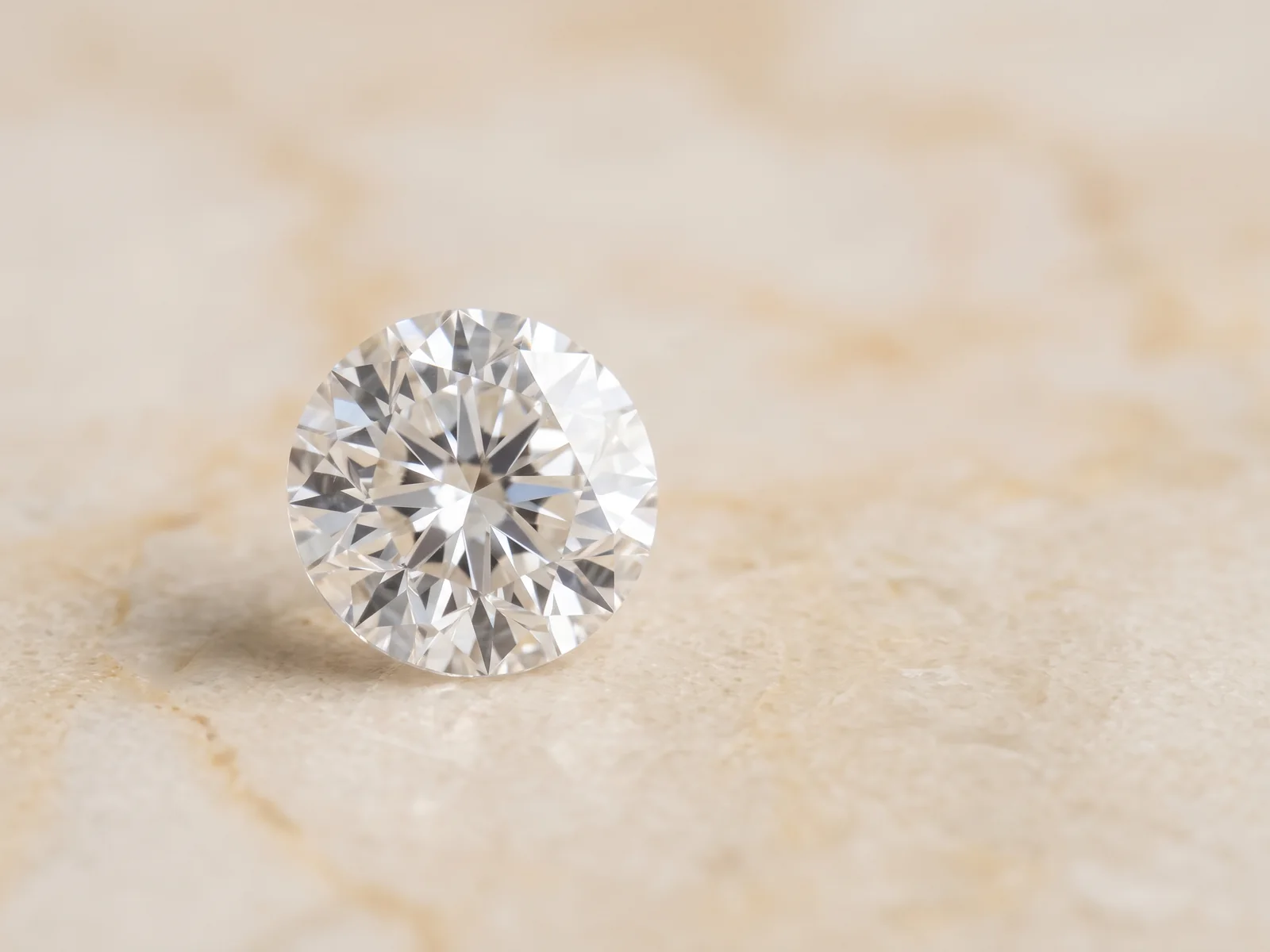
A 4 carat diamond is a true statement stone, and at this size every grading choice is easier to see. Here is what it measures, how it looks on the finger and what it costs in Australia, natural or lab-grown.
 Reviewed by Raj Sood, Graduate Gemologist (GIA), AJP (GIA)Master jeweller and Graduate Gemologist (GIA) · reviewed 4 November 2026
Quick answer
A 4 carat diamond weighs 0.80 grams. A well-cut round measures about 10.1–10.3 mm across, roughly two and a half times the face-up area of a 1 carat. In Australia, a lab-grown 4 carat costs roughly AUD $2,500–$9,000, and a natural one roughly $40,000 to well over $150,000. Aim for G–H colour, VS2 or better clarity and an excellent cut.
What is a 4 carat diamond?
A 4 carat diamond is any diamond weighing 4.00 carats, which is 0.80 grams. The carat is a unit of weight, not size: one carat is 0.2 grams, and it is split into 100 points, so a 4 carat stone is sometimes called a 400-pointer. Our guide to how carat weight is measured and recorded explains the scale in more detail, and carat is only one of the four grading factors covered in the 4Cs of colour, clarity, cut and carat.
Weight and size are linked but not locked together. Two 4 carat diamonds can face up (look from above, the way you see a stone in a ring) quite differently depending on their shape and how deeply they are cut. That is why this guide gives millimetres for every shape rather than just the carat figure.
At this size you are well past what most people choose for an engagement ring and into statement territory. Natural diamonds of 4 carats are rare, because only a small share of mined rough is large and clean enough to yield one. Laboratory-grown diamonds of the same weight are now common, because growers can produce large crystals to order. Both are real diamond, with a hardness of 10 on the Mohs scale and a refractive index of about 2.42, and both should come with an independent grading report that states clearly whether the stone is natural or lab-grown.
How big is a 4 carat diamond in mm?
The table below gives typical face-up measurements for a 4 carat diamond in each main shape, assuming sensible proportions. Elongated shapes such as ovals, pears and marquises spread their weight over a longer outline, so they look larger end to end than a round of the same weight. Square step cuts such as the Asscher carry more weight below the girdle (the thin outer edge) and face up smaller.
| Shape | Typical size at 4 ct | Typical length-to-width ratio |
|---|---|---|
| Round brilliant | about 10.1–10.3 mm diameter | 1.00 |
| Oval | about 12.2 × 8.6 mm | 1.35–1.45 |
| Cushion (square) | about 9.2 × 9.2 mm | 1.00–1.05 |
| Princess | about 8.8 × 8.8 mm | 1.00–1.05 |
| Emerald | about 11.0 × 8.0 mm | 1.35–1.50 |
| Asscher | about 8.8 × 8.8 mm | 1.00–1.05 |
| Radiant (rectangular) | about 10.3 × 8.5 mm | 1.20–1.30 |
| Pear | about 13.5 × 8.7 mm | 1.50–1.65 |
| Marquise | about 16.0 × 8.0 mm | 1.90–2.10 |
| Heart | about 10.8 wide × 10.0 mm long | 0.90–1.00 |
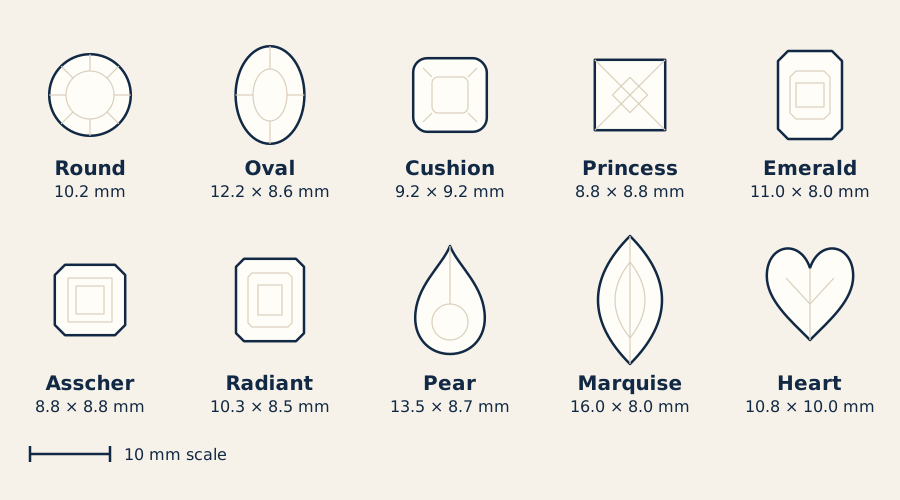
Proportions move these numbers more than people expect. A 4 carat round cut to about 61% total depth (the height of the stone divided by its width) spreads to roughly 10.2 mm. The same weight cut to 64% depth may only reach about 9.9 mm, because more of the weight is hidden underneath. A 4 carat oval at a ratio of 1.50 looks noticeably longer and slimmer than one at 1.30, even though both weigh the same.
If you are comparing shapes across several weights, our millimetre-to-carat chart covering every shape lets you look up any size from tiny accents to large centre stones. Always check the measurements printed on the grading report rather than relying on carat weight alone.
How much bigger is a 4 carat diamond than a 3 or 5 carat?
Carat weight tracks volume, and volume grows much faster than width. A 4 carat round weighs four times as much as a 1 carat, but its diameter is only about 1.6 times larger and its face-up area about 2.5 times larger. The table uses typical round brilliant sizes to show how this plays out across the common weights.
| Carat weight | Round diameter | Face-up area | Compared with 1 ct |
|---|---|---|---|
| 0.50 ct | about 5.1–5.2 mm | about 21 mm² | about 0.65× |
| 1.00 ct | about 6.4–6.5 mm | about 33 mm² | 1× |
| 1.50 ct | about 7.3–7.4 mm | about 42 mm² | about 1.3× |
| 2.00 ct | about 8.0–8.2 mm | about 52 mm² | about 1.6× |
| 2.50 ct | about 8.7–8.8 mm | about 60 mm² | about 1.8× |
| 3.00 ct | about 9.2–9.4 mm | about 68 mm² | about 2.1× |
| 4.00 ct | about 10.1–10.3 mm | about 82 mm² | about 2.5× |
| 5.00 ct | about 10.9–11.1 mm | about 95 mm² | about 2.9× |
The step from 3 to 4 carats adds roughly 0.9 mm to the diameter of a round and about a fifth more face-up area. The step from 4 to 5 carats adds a little less again, about 0.8 mm. In other words, each extra carat at this end of the scale buys a smaller visual jump than the one before, while the price of a natural stone keeps climbing steeply.
For a closer look at the neighbouring weights, see our pages on what a 3 carat diamond measures and costs and the jump up to a 5 carat stone. If you want a sense of scale from the other end, compare with the classic 1 carat engagement stone, the 2 carat size many people trade up to or the in-between 2.5 carat weight.
Related guide5 Carat DiamondsHow does a 4 carat diamond look on the finger?
A common women's ring size in Australia is around L to N, which is an inside diameter of roughly 16–17 mm. The visible width of the finger is similar, so a 10.2 mm round covers about 60% of the finger's width. That is enough to read as large from across a room, and it is why 4 carats is often described as the point where a solitaire stops looking traditional and starts looking bold.
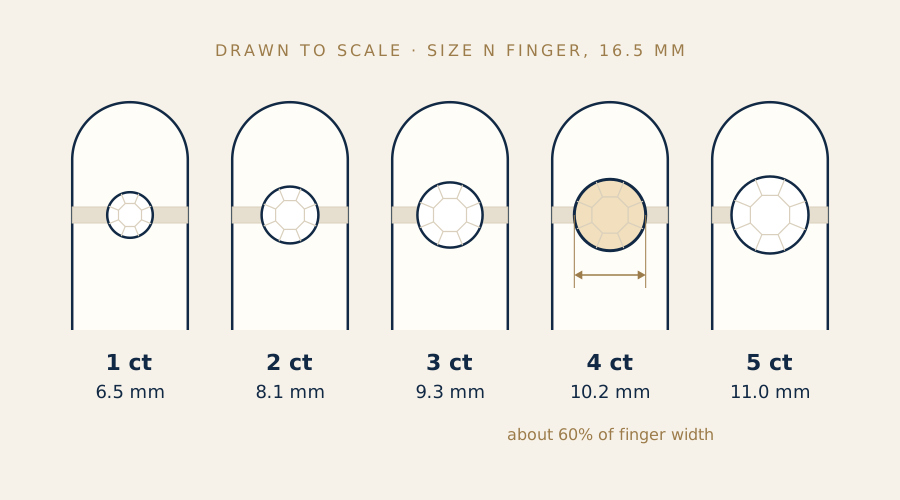
- Slim fingers (around size H–J): a 4 carat round can cover nearly two-thirds of the finger and look very large. An oval or emerald cut may sit more comfortably along the finger.
- Average fingers (around size L–N): most shapes work. A 4 carat oval diamond, at about 12 mm long, runs a good part of the way towards the knuckle and makes the finger look longer.
- Larger fingers (around size P and up): the same stone reads less dominant, and a round or cushion often looks balanced rather than oversized.
- Marquise and pear: at 13.5–16 mm long these are the most dramatic 4 carat outlines and can reach most of the way to the knuckle on a slender hand.
Height matters as much as width. A 4 carat round cut to about 61% depth stands roughly 6.2 mm tall, and once you add the claw basket the top of the stone often sits 8–10 mm above the finger. That catches on knitwear, gloves and hair more than a 1 carat ring does, so a lower setting is worth considering if you work with your hands. Above this size, our guide to 6 to 10 carat diamonds covers how very large stones are worn day to day.
Not sure which one is right?
Send us the stones you are looking at and our gemologist will tell you which to choose and why.
What colour and clarity should a 4 carat diamond have?
Bigger stones show more. Light travels further through a 4 carat diamond, so any faint yellow or brown body colour is easier to see than in a small stone of the same grade. The table facet (the large flat top) on a 4 carat round is also about 5.5–5.9 mm across, which is close to the full width of a 0.5 carat diamond. An inclusion (an internal feature such as a crystal or feather) sitting under that window is far easier to spot than the same inclusion in a half-carat stone or even a 1.5 carat diamond.
| Shape and metal | Colour | Clarity | Why |
|---|---|---|---|
| Round or brilliant cut, platinum or white gold | F–H | VS2; SI1 only if checked eye-clean | Brilliant faceting hides small inclusions, but white metal shows warmth |
| Round or brilliant cut, yellow or rose gold | H–J | VS2–SI1 eye-clean | Warm metal makes a slightly warm stone look whiter |
| Oval, pear, marquise | G–H in white metal | VS2 | Colour tends to gather at the ends and points |
| Cushion or radiant | G–H | VS2 | Crushed-ice style faceting masks inclusions well |
| Emerald or Asscher (step cuts) | F–G | VS1 or better | The open, mirror-like table shows inclusions and colour clearly |
| Lab-grown, any shape | E–G | VS1–VS2 | Higher grades cost little extra in lab-grown |
Eye-clean means no inclusion is visible without magnification at normal viewing distance. It is much harder to find an eye-clean SI1 at 4 carats than at 1 carat, so treat SI grades as a case-by-case decision based on photos, video and the report's plotting diagram (the map of where each inclusion sits).
Fluorescence (a glow under ultraviolet light) also matters more at this size. Medium to strong blue fluorescence can make an I–K stone look a touch whiter in daylight, while in a small number of stones strong fluorescence gives a hazy or oily look. If the report lists strong fluorescence, view the stone in daylight before deciding. Any unfamiliar grading term is explained in our plain-English jewellery glossary.
Why does cut quality matter more in a 4 carat diamond?
Large rough crystals are valuable, so cutters are tempted to keep as much weight as possible. That can mean a deep pavilion (the lower half of the stone), a thick girdle or a small table, all of which add carats without adding visible size or sparkle. A poorly cut 4 carat stone can face up like a well-cut 3.6 or 3.7 carat and look duller as well.
- Rounds: look for a GIA cut grade of Excellent (or IGI Ideal or Excellent), a total depth of about 59–62.5% and a table of about 54–58%.
- Fancy shapes: there is no overall GIA cut grade, so judge the spread (measurements for the weight), the ratio and the bow-tie (a dark band across the middle of ovals, pears and marquises).
- Girdle: thin to slightly thick is ideal; very thick hides weight in the edge.
- Polish and symmetry: Very Good or Excellent on both; at this size, small faults are easier to see.
Prices also step up at round weights, often called magic numbers. A diamond of 3.90–3.99 carats usually costs noticeably less per carat than one of 4.00 carats or more, yet the difference in diameter is only about 0.1 mm, which nobody can see on the hand. The same pattern appears at every popular weight, from three-quarter carat stones to 1.25 carat diamonds and beyond.
How much does a 4 carat diamond cost in Australia, natural or lab-grown?
At 4 carats the gap between natural and laboratory-grown diamond is at its widest. Lab-grown diamonds are real diamond, grown from a seed crystal by the CVD (chemical vapour deposition) or HPHT (high pressure, high temperature) method. They look identical to natural diamond and cost a small fraction of the price. Natural 4 carat stones are rare, and their price per carat rises sharply with colour and clarity.
| 4 carat diamond and grades | Approximate price range (AUD) |
|---|---|
| Lab-grown round, F–G, VS1–VS2, Excellent cut | about $3,000–$9,000 |
| Lab-grown fancy shape, G–H, VS | about $2,500–$8,000 |
| Natural round, I–J, SI1–SI2 | about $40,000–$80,000 |
| Natural round, G–H, VS1–VS2 | about $80,000–$160,000 |
| Natural round, D–F, VVS–IF | about $150,000–$350,000+ |
| Natural fancy shape, G–H, VS | about $55,000–$120,000 |
These are broad ranges only. Lab-grown prices have fallen a long way in recent years and are still moving, and natural prices change with the market and with small differences in grade. Natural fancy shapes such as ovals and cushions usually cost less per carat than rounds of the same grade, partly because more of the rough crystal can be kept when they are cut.
Some lab-grown diamonds are treated after growth to improve their colour; this must be disclosed on the report, and most reports also note a laser inscription on the girdle. Lab-grown diamonds have very limited resale value, and natural diamonds usually resell well below retail too, so choose a 4 carat diamond for wearing and enjoying rather than as a financial asset. Our guide to lab-grown diamond sizes from 1 to 5 carats compares lab-grown prices across the range.
Browse 4 carat diamonds: natural and lab-grown
What is the best setting for a 4 carat diamond ring?
A 4 carat diamond ring has to hold a heavier, taller stone securely for decades. The setting needs strong claws or a rim, a band thick enough not to twist, and a height that suits how you live. The usual options for a 4 carat engagement ring:
- Six claws: the most common choice for a large round. Six points of contact spread the load, and if one claw wears, the stone is still held.
- Four double claws: eight tips in four pairs give security with a cleaner, squarer look, and suit cushions and radiants.
- Bezel or half-bezel: a rim of metal around the girdle. Very secure and low-profile, good for active hands, though it hides a little of the outline.
- Low basket or cathedral: a low basket keeps the stone closer to the finger; a cathedral setting lifts it and lets a band sit flush beneath.
- Side stones and pavé: accent diamonds such as 0.25 to 0.4 carat side stones or a row of pavé add width to the band and balance a large centre.
For the band, most jewellers suggest at least about 2.2–3 mm wide and solid enough not to bend under the stone's weight. Platinum claws wear slowly and suit large stones; 18 carat gold is also durable if the claws are made thick enough. Have the claws checked every 6–12 months, and keep an up-to-date insurance valuation, as a ring of this size is costly to replace.
How do you choose a 4 carat diamond? Step by step
- Read the grading report. Confirm the weight, measurements, colour, clarity, cut, polish, symmetry and fluorescence, and whether the diamond is natural or laboratory-grown.
- Check the face-up size. Compare the millimetre measurements with the shape table above; a stone that is small for its weight is probably cut deep.
- Decide your shape and metal first. These set the colour and clarity you need: step cuts and white metal ask for higher grades.
- Look for an eye-clean stone. Use the plotting diagram, photos and a 360° video to see where inclusions sit, especially under the table.
- Consider just under 4 carats. A 3.90–3.99 carat diamond looks the same on the hand and usually costs less per carat.
- Plan the setting. Choose claws or a bezel that suit the stone's height and your daily life before committing to the diamond.
Free consultation
Talk to a gemologist
Compare stones in person or online with Raj Sood, Graduate Gemologist (GIA), AJP (GIA).
Book a consultationShop this shape
FAQ
Common questions
How big is a 4 carat diamond?
A well-cut 4 carat round measures about 10.1–10.3 mm across. A 4 carat oval is about 12.2 × 8.6 mm and a 4 carat emerald cut about 11.0 × 8.0 mm, depending on proportions.
How much does a 4 carat diamond cost in Australia?
As a broad guide, a lab-grown 4 carat diamond costs roughly AUD $2,500–$9,000. A natural 4 carat ranges from about $40,000 for lower colour and clarity to well over $150,000 for top grades.
Is a 4 carat diamond too big for an engagement ring?
Not if it suits your hand and lifestyle. On an average finger a 4 carat round covers about 60% of the width and sits tall, so a low setting or bezel can make it more practical for everyday wear.
What clarity do I need for a 4 carat diamond?
For brilliant cuts, VS2 is a sensible starting point, with SI1 only if you have confirmed it is eye-clean. For emerald and Asscher cuts, VS1 or better is safer because their open tables show inclusions clearly.
Is a 4 carat lab-grown diamond a real diamond?
Yes. A lab-grown diamond has the same chemical make-up, hardness and refractive index as a natural diamond. Its grading report must state that it is laboratory-grown, and it usually carries a laser inscription on the girdle.
Does a 4 carat diamond look much bigger than a 3 carat?
A little. A 4 carat round is about 0.9 mm wider than a 3 carat and has about a fifth more face-up area, which is noticeable side by side but less dramatic than the extra carat suggests.

Ask a gemologist
Not sure which diamond to choose?
Raj Sood is a Graduate Gemologist (GIA) and master jeweller. Bring the stones you are considering, or send the reports, and he will tell you honestly which one is better and why.
Keep learning
Related guides
 Diamond 4Cs & Grading3 Carat Diamonds
 Diamond 4Cs & Grading5 Carat Diamonds
 Diamond 4Cs & GradingDiamond MM to Carat Size Chart (All Shapes)
 Lab-Grown DiamondsLab-Grown Diamond Carat Sizes: 1 to 5 CaratsDiamond 4Cs & GradingDiamond 4CsDiamond 4Cs & Grading1 Carat Diamonds
 Diamond 4Cs & GradingDiamond Carat WeightDiamond 4Cs & Grading2 Carat Diamonds
Explore more
More guides on this topic
Education