
- Education
- Diamond 4Cs & Grading
- 3 Carat Diamonds: Size, Price and How to Choose a 3 Carat Diamond
Diamond 4Cs & Grading
3 Carat Diamonds: Size, Price and How to Choose a 3 Carat Diamond
A 3 carat diamond is a big step up. At about 9.3 mm across as a round, it covers much of the finger and shows every choice you make on cut, colour and clarity, so it pays to know what to expect before you look.
 Reviewed by Raj Sood, Graduate Gemologist (GIA), AJP (GIA)Master jeweller and Graduate Gemologist (GIA) · reviewed 4 November 2026
Quick answer
A 3 carat diamond weighs 0.6 grams and measures about 9.1–9.4 mm across as a round brilliant, or roughly 11.5 × 8.0 mm as an oval. Natural 3 carat diamonds usually cost tens of thousands of Australian dollars; lab-grown ones cost a small fraction. Aim for an excellent cut, G–H colour and eye-clean VS2–SI1 clarity.
What is a 3 carat diamond?
A carat is a unit of weight, not size: one carat is 0.2 grams, so a 3 carat diamond weighs 0.6 grams. Our guide to how carat weight is measured explains the scale, including the 100 points that make up each carat (a 3.05 ct stone is described as three carats and five points).
Carat is only one of the 4Cs of diamond grading, alongside cut, colour and clarity. At three carats the other three matter more than at smaller sizes. The facets are bigger, so inclusions are bigger. There is more diamond for light to travel through, so body colour is easier to see. And a poorly proportioned stone can hide a lot of its weight underneath, where you cannot see it.
Three carats is also where weight and size stop moving together in a way people expect. A 3 ct round weighs three times as much as a 1 ct round, but its diameter is only about 1.45 times larger, and its face-up area (the part you see from above) is roughly 2.1 times larger. If a word on this page is new to you, our jewellery glossary defines it in plain English.
How big is a 3 carat diamond in mm?
The size depends on the shape and on how the stone is cut. These are typical face-up measurements for well-proportioned 3 carat diamonds. Stones cut deep will measure smaller; stones cut shallow will measure larger but may lose brightness.
| Shape | Typical size at 3 ct | Common ratio |
|---|---|---|
| Round brilliant | 9.1–9.4 mm diameter | 1.00 |
| Oval | about 11.5 × 8.0 mm | 1.35–1.50 |
| Cushion | about 8.6 × 8.0 mm | 1.00–1.15 |
| Princess | about 7.8 × 7.8 mm | 1.00–1.05 |
| Emerald | about 10.3 × 7.4 mm | 1.35–1.50 |
| Asscher | about 8.0 × 8.0 mm | 1.00–1.05 |
| Radiant | about 9.2 × 7.4 mm | 1.20–1.30 |
| Pear | about 13.0 × 8.5 mm | 1.45–1.65 |
| Marquise | about 15.0 × 7.5 mm | 1.85–2.10 |
| Heart | about 9.8 × 9.1 mm (width × length) | 0.90–1.10 |
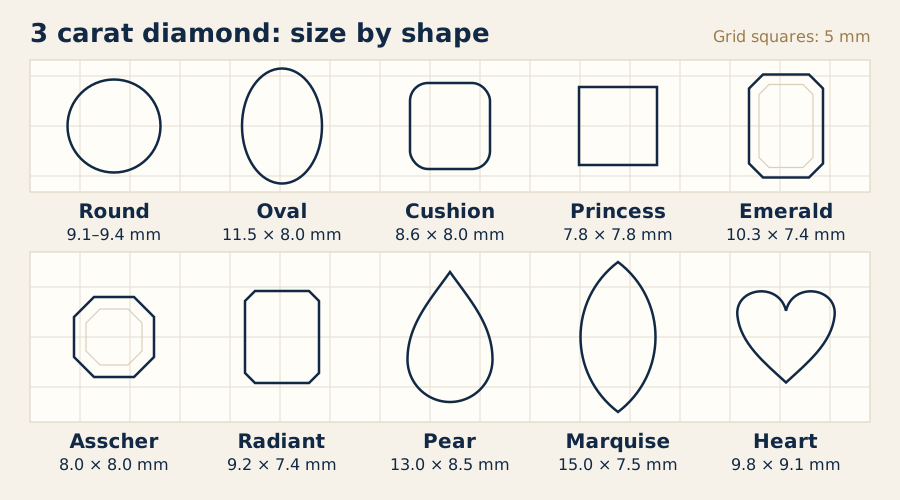
Notice the spread. A 3 ct marquise is about 15 mm long, while a 3 ct princess is under 8 mm across. Elongated shapes carry their weight in length, so they look bigger for the money; square cuts such as the princess and asscher are deeper and look smaller. For a sense of scale, a 1 carat round is about 6.4 mm across and 2 carat diamonds in a round are about 8.1 mm.
How does a 3 carat diamond look on the finger?
On a typical Australian ring finger (sizes K to O, roughly 15–18 mm across the top of the finger), a 9.3 mm round covers a little over half the width of the finger. It reads as a large stone from across a room, and it sits noticeably higher than smaller centre stones because a well-cut 3 ct round is about 5.6–5.8 mm deep.
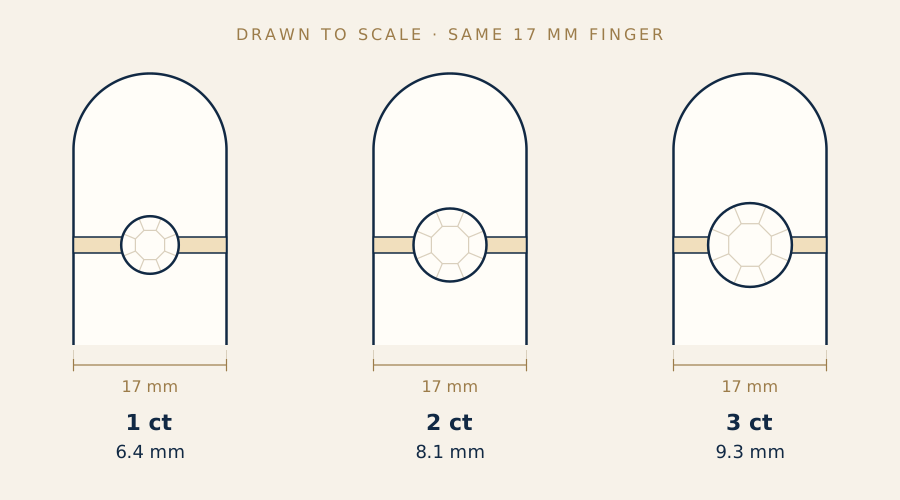
- Slim fingers make any 3 carat diamond look larger. An oval or pear lengthens the finger; a round covers well over half the width.
- Broader fingers carry the size easily; an oval, emerald or radiant at 3 ct still looks generous without overwhelming the hand.
- East-west settings (the stone turned sideways) make an oval or emerald look wider and more modern, but the stone covers more of the finger width.
- Everyday life: a stone this size catches on knitwear and gloves more than smaller stones, so the setting profile matters.
If 3 ct feels like a lot once you try it on, the difference to 2.5 carat stones is only about 0.6 mm in a round, at a noticeably lower price. At the other end, people upgrading from a 1.5 carat diamond usually notice the change immediately: the diameter goes from about 7.4 mm to 9.3 mm.
How much does a 3 carat diamond cost in Australia?
Price per carat climbs steeply with size in natural diamonds, because large rough is rarer. A natural 3 carat diamond costs far more than three 1 carat stones of the same grades. Lab-grown prices behave differently: they rise much more gently with size, and they have fallen over recent years as production has grown.
| Type and grades (round, well cut) | Approximate AUD range |
|---|---|
| Natural, D–F colour, VVS–VS1 | about $110,000–$200,000+ |
| Natural, G–H colour, VS2–SI1 | about $60,000–$120,000 |
| Natural, I–J colour, SI1–SI2 | about $35,000–$70,000 |
| Lab-grown, D–F colour, VVS–VS | about $3,000–$9,000 |
| Lab-grown, G–H colour, VS–SI | about $2,000–$6,000 |
These are broad loose-stone ranges, not quotes, and they move with the market. Fancy shapes such as ovals, pears and cushions usually cost less per carat than a round of the same grades, because cutting a round wastes more of the rough. Fluorescence, the report lab and the precise cut quality can each shift the price within a band. Our overview of lab-grown sizes from 1 to 5 carats shows how the curve flattens in laboratory-grown stones.
Two pricing habits are worth knowing. First, magic sizes: prices jump at 3.00 ct, so a well-cut stone at 2.90–2.99 ct can cost noticeably less while looking almost identical, only about 0.1 mm smaller across. Second, the jump from 3 to 4 carats is another steep step in natural diamonds.
Browse 3 carat diamonds in our stock
Not sure which one is right?
Send us the stones you are looking at and our gemologist will tell you which to choose and why.
Natural or lab-grown 3 carat diamond: what is the difference?
A natural diamond formed in the earth over millions to billions of years. A lab-grown (laboratory-grown) diamond is grown in weeks by either the CVD (chemical vapour deposition) or HPHT (high pressure, high temperature) method. Both are real diamond, with the same hardness (10 on the Mohs scale), refractive index (2.42) and sparkle. You cannot tell them apart by eye; a gemmological lab tells them apart with specialised equipment.
At three carats the choice usually comes down to budget and what the stone means to you. A natural 3 carat diamond is genuinely rare and priced that way. A lab-grown 3 carat diamond lets you choose top colour and clarity for a small fraction of the cost. Neither should be bought as an investment: diamond resale values are well below retail for both, and much further below for lab-grown.
Lab-grown stones above three carats have their own checks. Some CVD stones are treated after growth to improve colour, and larger crystals can show graining or a faint brown or grey tint. Our guide to what changes in lab-grown diamonds above 3 carats explains what to look for, and choosing a 3 carat lab-grown stone walks through the report line by line.
Related guideChoosing a 3 Carat Lab-Grown DiamondWhat colour and clarity should a 3 carat diamond be?
Large diamonds show colour and inclusions more than small ones. That does not mean you need D and Flawless; it means you need to choose the combination that looks right at this size. These are the combinations most people end up with:
| Setting metal / shape | Colour | Clarity | Why it works |
|---|---|---|---|
| White gold or platinum, round | G–H | VS2 or eye-clean SI1 | Brilliant faceting hides small inclusions; H still faces up white |
| White gold or platinum, oval or cushion | F–H | VS2 | Elongated and cushion shapes hold colour in the ends and corners |
| Emerald or asscher, any metal | F–H | VS1 or better | Open step-cut facets act like a window, so inclusions are easy to see |
| Yellow or rose gold, any shape | I–J | VS2–SI1 | Warm metal makes a slightly warmer diamond look white |
| Lab-grown, any metal | D–G | VS1 or better | The price gap between grades is small, so top grades cost little more |
Clarity is the one to watch. In a 1 carat round, an SI1 is very often eye-clean (no inclusions visible to the naked eye from about 25–30 cm). At 3 carats the same grade can show a dark crystal under the table, so every SI stone needs to be checked on video or in person. SI2 is rarely eye-clean at this size, and almost never in step cuts.
Colour is easier to see because light travels through more diamond. If you are sensitive to warmth, step up one grade from what you would choose at 1 carat. Fluorescence (a glow under UV light) is usually harmless and can lower the price of a natural stone; very strong blue fluorescence occasionally makes a stone look slightly hazy, so look before you decide.
Why cut matters more in a 3 carat diamond
Cut decides how much of that weight you actually see and how bright the stone looks. Two 3.00 ct rounds can differ by 0.3–0.4 mm in diameter purely because of their proportions.
- Depth: for a round, a total depth of about 59–62.5% keeps the stone bright and spread well. A 3 ct round at 64% depth may measure around 9.0 mm and face up like a smaller stone.
- Table: about 54–58% of the diameter for a round. A very large table can look glassy rather than lively.
- Spread: the face-up size you get for the weight. Compare measurements, not just carat, when you shortlist stones.
- Bow-tie: ovals, pears and marquises can show a dark band across the middle. At 3 carats the band is bigger, so watch a 360° video.
- Girdle: avoid extremely thick girdles, which add hidden weight, and extremely thin ones, which chip more easily.
For rounds, choose an Excellent (GIA) or Ideal (IGI) cut grade. Fancy shapes have no overall cut grade from GIA, so judge them on proportions, symmetry and how they look moving.
Which setting suits a 3 carat diamond ring?
A 3 carat diamond is heavy enough, and sits high enough, that security comes first. The common choices:
- Six claws: extra security for a large round and a softer, rounder outline. If one claw lifts, five still hold the stone.
- Four claws: show more of the diamond and make a round look slightly square; best if you check the claws regularly.
- Double or V-claws: for pears, marquises and hearts, to protect the points.
- Bezel: a rim of metal around the stone; very secure and lower-catching, though it covers a sliver of the edge.
- Low profile or hidden halo: brings the stone closer to the finger or adds a line of sparkle under it, without making the ring look taller.
- Three-stone: side stones of about 0.5–1.0 ct each balance a 3 ct centre without competing with it.
A band of about 1.8–2.5 mm usually balances a 3 ct centre; very fine bands can look out of proportion and bend over time. Have the claws checked every 6–12 months, and keep the ring insured and valued.
How does 3 carats compare with other diamond sizes?
| Carat | Round diameter | Oval (approx.) | How it reads on the hand |
|---|---|---|---|
| 0.50 ct | about 5.1 mm | 6.1 × 4.4 mm | Delicate |
| 1.00 ct | about 6.4 mm | 7.7 × 5.7 mm | Classic engagement size |
| 2.00 ct | about 8.1 mm | 10.0 × 7.0 mm | Clearly large |
| 2.50 ct | about 8.7 mm | 10.8 × 7.6 mm | Large |
| 3.00 ct | about 9.3 mm | 11.5 × 8.0 mm | Statement stone |
| 4.00 ct | about 10.2 mm | 12.6 × 8.8 mm | Very large |
| 5.00 ct | about 11.0 mm | 13.5 × 9.5 mm | Covers most of a slim finger |
Each step up in weight adds less diameter than you might expect. From 3 to 4 carat diamonds adds only about 0.9 mm in a round, and 5 carat sizes add about 1.7 mm over three carats, while the price of natural stones rises steeply at each step. Above that, stones from 6 to 10 carats are usually chosen as true statement pieces.
For smaller stones the same rule runs the other way: a 1.25 carat round is about 6.9 mm, a 0.75 carat diamond about 5.8 mm and a half-carat diamond about 5.1 mm. Three carats is roughly where face-up area doubles compared with a 1 carat stone.
How to choose a 3 carat diamond: step by step
- Decide natural or lab-grown first. It changes the budget by a factor of ten or more, and with it the grades you can choose.
- Pick the shape. Use the size table above; elongated shapes look larger for the weight, square step cuts look smaller.
- Consider 2.90–2.99 ct. Staying just under the magic size can save a meaningful amount for a difference of about 0.1 mm. Our page on carat weight and price jumps explains why.
- Set colour and clarity for the metal and shape. G–H and VS2 in white metal, VS1 or better for emerald and asscher cuts, I–J in yellow or rose gold.
- Check cut and measurements. Excellent or Ideal cut for rounds; compare millimetres, not just carat.
- Read the report. GIA or IGI, matching the laser inscription, with any lab-grown origin and post-growth treatment disclosed.
- Watch a 360° video or see it in person. Look for inclusions under the table, bow-ties in fancy shapes and colour in natural light.
- Choose a secure setting. Six claws, double claws or a bezel, with a band wide enough to carry the stone.
Free consultation
Talk to a gemologist
Compare stones in person or online with Raj Sood, Graduate Gemologist (GIA), AJP (GIA).
Book a consultationShop this shape
FAQ
Common questions
How big is a 3 carat diamond in mm?
A well-cut 3 carat round measures about 9.1–9.4 mm across. A 3 ct oval is about 11.5 × 8.0 mm, and a 3 ct princess about 7.8 mm square.
How much is a 3 carat diamond in Australia?
A natural 3 carat diamond usually costs from about AUD 35,000 to well over AUD 150,000 depending on colour, clarity and cut. A lab-grown 3 carat diamond is typically about AUD 2,000–9,000.
Is a 3 carat diamond too big for an engagement ring?
Not if you like the look and choose a secure, lower-profile setting. On slim fingers it can cover more than half the finger width, so try a similar size on before deciding.
What clarity do you need for a 3 carat diamond to be eye-clean?
VS2 is usually eye-clean in a round, oval or cushion at this size, and some SI1 stones are too if the inclusions are small and off-centre. Emerald and asscher cuts generally need VS1 or better.
Can you tell a lab-grown 3 carat diamond from a natural one?
Not by eye. Both are real diamond with the same hardness and sparkle; a gemmological lab identifies the origin, and the report and laser inscription disclose a lab-grown stone.
Is a 2.9 carat diamond noticeably smaller than a 3 carat?
No. A 2.90 ct round is only about 0.1 mm smaller across, which you cannot see on the hand, but it usually costs noticeably less because it sits below the 3.00 ct price step.

Ask a gemologist
Not sure which diamond to choose?
Raj Sood is a Graduate Gemologist (GIA) and master jeweller. Bring the stones you are considering, or send the reports, and he will tell you honestly which one is better and why.
Keep learning
Related guides
 Diamond 4Cs & Grading2 Carat Diamonds
 Diamond 4Cs & Grading4 Carat Diamonds
 Lab-Grown DiamondsChoosing a 3 Carat Lab-Grown DiamondDiamond 4Cs & GradingDiamond Carat WeightDiamond 4Cs & GradingDiamond 4Cs
 Diamond 4Cs & Grading1 Carat Diamonds
 Diamond 4Cs & Grading5 Carat DiamondsDiamond 4Cs & Grading1.5 Carat Diamonds
Explore more
More guides on this topic
Education