
- Education
- Lab-Grown Diamonds
- Type IIa Diamonds Explained: Natural, Lab-Grown and What the Report Says
Lab-Grown Diamonds
Type IIa Diamonds Explained: Natural, Lab-Grown and What the Report Says
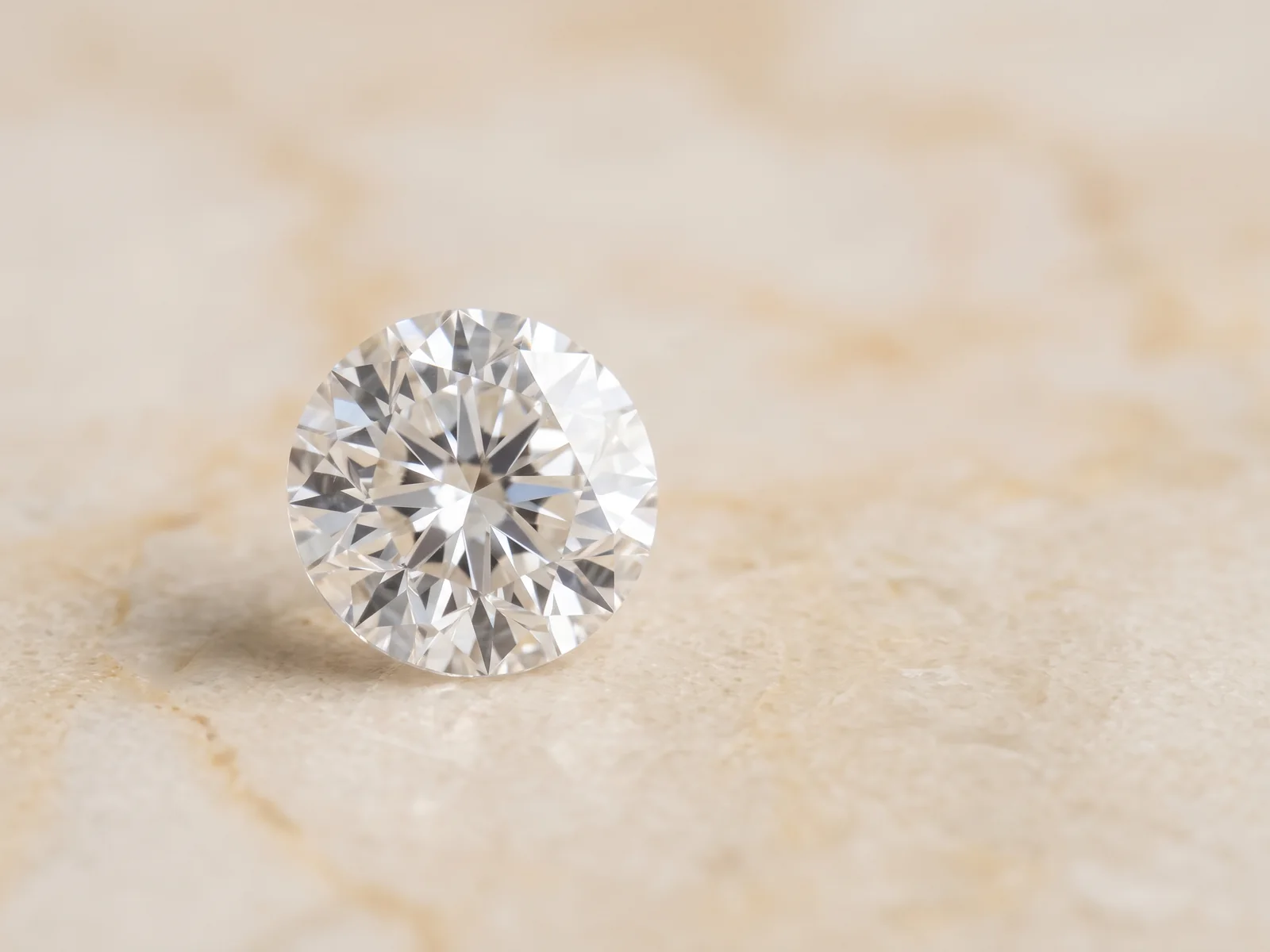
Type IIa diamond is a phrase that turns up on lab-grown reports and in natural diamond sales pitches alike. Here is what it means, why it says nothing on its own about where a diamond came from, and how to read it honestly.
 Reviewed by Raj Sood, Graduate Gemologist (GIA), AJP (GIA)Master jeweller and Graduate Gemologist (GIA) · reviewed 4 November 2026
Quick answer
A Type IIa diamond is a diamond with almost no measurable nitrogen, so it can be exceptionally colourless and transmits shortwave ultraviolet light. Only about 1–2% of natural diamonds are Type IIa, but most colourless lab-grown diamonds are too, so 'Type IIa' alone tells you nothing about origin. The report's natural or laboratory-grown statement does.
What is a type IIa diamond?
Diamond is carbon atoms locked into a tight, repeating cubic lattice. Almost every diamond also holds a few stray atoms of other elements, and the most common one is nitrogen. Gemmologists and physicists sort diamonds into types according to how much nitrogen or boron sits in that lattice and how it is arranged. A Type IIa diamond has so little nitrogen that infrared spectroscopy (a test that reads which wavelengths of infrared light a stone absorbs) cannot pick it up, and no measurable boron either.
That matters because nitrogen is what gives most natural diamonds their faint yellow tint. Remove it and a diamond can be chemically very pure, which is why many of the whitest D-colour diamonds ever found are Type IIa. But diamond type is not a grade. It is a scientific category, a bit like a blood type. It does not tell you the colour, clarity or cut of a particular stone, and it does not tell you whether the diamond came out of the ground or out of a growth chamber.
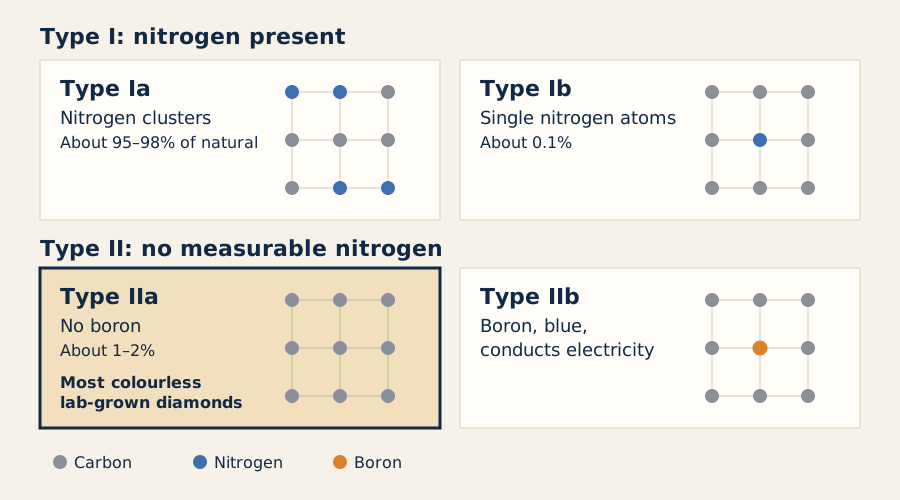
Our full breakdown of diamond types Ia, Ib, IIa and IIb goes further into the physics. This page focuses on what Type IIa means when you are actually choosing a stone, and on the wording you should expect to see. Any term that is new to you is also explained in our plain-English jewellery glossary.
How does a Type IIa diamond compare with Type Ia, Ib and IIb?
Type I diamonds contain measurable nitrogen; Type II diamonds do not. Each group is then split by what the impurities are doing in the lattice. The table sets the four side by side.
| Type | What is in the lattice | Share of natural diamonds | Typical colour | In lab-grown diamonds |
|---|---|---|---|---|
| Ia | Nitrogen in clusters (pairs and larger groups) | about 95–98% | Colourless to faint yellow ('cape' tint) | Rare |
| Ib | Single, scattered nitrogen atoms | about 0.1% | Strong yellow to orange-yellow | Common in as-grown yellow HPHT stones |
| IIa | No measurable nitrogen or boron | about 1–2% | Colourless; also brown or pink | Most colourless CVD and HPHT stones |
| IIb | Boron, no measurable nitrogen | about 0.1% or less | Blue to grey | Some HPHT blues; trace boron in some colourless stones |
The everyday properties are the same across all four types. Every diamond is 10 on the Mohs hardness scale, has a refractive index (how strongly it bends light) of about 2.42 and a density of about 3.52. A Type IIa diamond does not sparkle more than a Type Ia of the same cut, and it is no tougher or harder in everyday wear.
Two physical differences do matter. First, Type IIa diamonds let shortwave ultraviolet light pass through, while the nitrogen in Type Ia stones absorbs it. That single difference is the basis of most diamond screening machines, covered below. Second, the boron in Type IIb diamonds makes them conduct electricity, which no other diamond type does. That is why some testers mistake Type IIb diamonds for moissanite: many combined testers use electrical conductivity to flag moissanite.
How rare are natural type IIa diamonds?
Natural Type IIa diamonds make up only about 1–2% of mined diamonds, yet they include some of the most famous stones in history. The Cullinan, found at South Africa's Premier mine in 1905, weighed 3,106 carats as rough and is the largest gem diamond ever found. It was cut into the Cullinan I (about 530 ct) and Cullinan II (about 317 ct), both in the British Crown Jewels. The Koh-i-Noor is widely believed to be Type IIa, as are many of the historic 'Golconda' diamonds from India, prized for their water-clear look. More recently, the 1,109 ct Lesedi La Rona came from Botswana's Karowe mine in 2015.
GIA researchers found in 2016 that many of these large, very pure stones belong to a group they called CLIPPIR diamonds (Cullinan-like, large, inclusion-poor, pure, irregular and resorbed). Tiny metallic inclusions in them suggest they formed far deeper in the Earth than most diamonds, possibly 360–750 kilometres down. Natural Type IIa rough also tends to be irregular in shape rather than a neat octahedron.
Not every natural Type IIa is colourless. Many are brown, because the lattice was bent and stressed as the crystal travelled to the surface (called plastic deformation). Some natural pink diamonds are also Type IIa. So a natural Type IIa is a genuine geological rarity, but rarity in the ground is not the same as a better stone in the ring. Graders still judge it on colour, clarity, cut and carat like any other diamond.
Are lab-grown diamonds Type IIa?
Most colourless lab-grown diamonds are Type IIa, and that follows from how they are made. Our comparison of how HPHT and CVD growth differ covers the methods in detail; in short:
- CVD (chemical vapour deposition): a thin diamond seed plate sits in a vacuum chamber filled with methane and hydrogen. Microwave energy breaks the gas apart and carbon builds up on the seed layer by layer. Growers keep nitrogen in the chamber to a minimum because it causes brown colour and defects, so most CVD diamonds come out Type IIa.
- HPHT (high pressure, high temperature): carbon is dissolved in molten metal under roughly 5–6 gigapascals and 1,300–1,600 °C, then crystallises on a seed. To grow colourless stones, makers add 'nitrogen getters' such as titanium or aluminium that trap nitrogen, leaving a Type IIa crystal. Without getters the result is a yellow Type Ib; with a touch of boron it can be Type IIb with a blue or greyish tint.
So for a colourless lab-grown diamond, Type IIa is the normal result, not a special feature. It is still real diamond: the same carbon, the same hardness and the same optics as a natural stone, simply grown in a laboratory over weeks rather than formed in the Earth over a very long time. Our complete lab-grown diamond guide covers price, grading and care, and if you have ever wondered about the equipment involved, we look at whether you could grow a diamond at home.
From a store that sells both natural and lab-grown diamonds, the honest view is simple. When a lab-grown stone is promoted as 'rare Type IIa, like only 2% of mined diamonds', the statistic is true of natural diamonds but tells you nothing useful about the lab-grown stone in front of you.
Not sure which one is right?
Send us the stones you are looking at and our gemologist will tell you which to choose and why.
Can a Type IIa diamond be HPHT treated?
Yes, and this is one of the main reasons Type IIa stones get extra attention at grading labs. From the late 1990s, it became possible to put a brown natural Type IIa diamond back under high pressure and temperature and remove much of its brown colour. A stone that started in the brown or low-colour range can come out graded in the colourless to near-colourless D–G range. The change is permanent and the diamond is still natural, but it is a treatment and must be disclosed.
GIA reports for these stones state 'HPHT processed' and the lab laser-inscribes a note on the girdle (the thin outer edge of the diamond). Because colourless natural Type IIa diamonds are the stones most likely to have been treated this way, labs routinely test them for signs of it.
Lab-grown diamonds can be treated too. Many CVD crystals grow with a slightly brown tint and are then annealed (heated, often under pressure) after growth to improve their colour. Reports from labs such as IGI usually say whether a lab-grown stone is as grown or shows indications of post-growth treatment. Neither option makes the stone less durable; what matters is that it is clearly stated.
How do labs tell a natural Type IIa diamond from a lab-grown one?
A handheld thermal tester cannot do it. Every diamond type conducts heat extremely well, Type IIa best of all, so a natural or lab-grown stone will read as diamond. That is why lab-grown diamonds pass standard diamond testers. Those testers are built to separate diamond from simulants such as moissanite and cubic zirconia, a job explained in our page on moissanite compared with diamond.
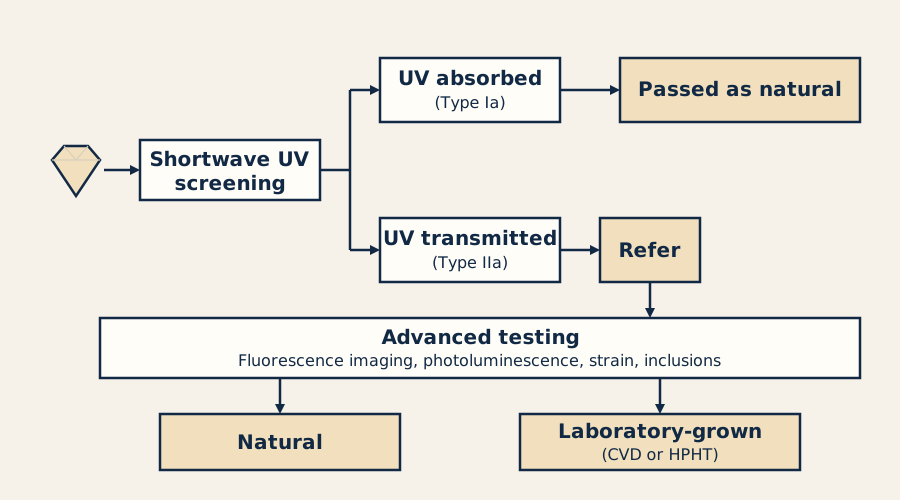
Separating natural from lab-grown takes two stages. Screening comes first: a machine shines shortwave ultraviolet light through the stone. A Type Ia diamond absorbs it, and since lab-grown colourless diamonds are almost never Type Ia, it can be passed as natural. A Type IIa diamond lets the light through, so the machine says 'refer' and the stone goes for advanced testing, which can include:
- Fluorescence imaging: under very short-wave UV, CVD stones often show fine parallel growth bands, and HPHT stones show geometric, many-sided growth sectors. Natural diamonds show irregular, curved patterns.
- Photoluminescence: lasers reveal tiny defect signatures; a silicon-related peak near 737 nanometres is common in CVD diamonds.
- Strain under polarised light: natural Type IIa diamonds often show a cross-hatched 'tatami' strain pattern; CVD stones tend to show column-like strain.
- Inclusions: HPHT stones can carry metallic flux inclusions, sometimes strong enough to be attracted to a magnet.
None of this can be done at home with a loupe. The simple checks for whether a diamond is real will help rule out glass or cubic zirconia, but deciding natural or lab-grown needs laboratory equipment.
What does Type IIa mean on a diamond certificate?
Grading reports (often called certificates) treat diamond type differently for natural and lab-grown stones. This is how the main fields usually compare:
| Report field | Natural diamond | Lab-grown diamond |
|---|---|---|
| Report title | Diamond grading report | Laboratory-grown diamond report |
| Origin | Natural (the stone has passed origin testing) | States laboratory-grown, usually with the growth method (CVD or HPHT) |
| Diamond type | Usually not shown; can be confirmed by separate type testing | Often listed in the comments, e.g. 'Type IIa' |
| Treatment | 'HPHT processed' or other treatment, if any | 'As grown' or 'indications of post-growth treatment' |
| Girdle inscription | Report number | Report number plus 'LG' or 'Laboratory-grown' |
Read a report in this order: origin first, then treatment, then the 4Cs, and only then the type. On a lab-grown report, seeing 'Type IIa' simply confirms what is expected for a colourless stone. On a natural report, a confirmed Type IIa is an interesting extra, as long as the treatment line is clear.
The clarity features listed can also hint at origin. CVD stones may show dark pinpoints of non-diamond carbon, while HPHT stones can show metallic flux inclusions. Our guide to what clarity grades are typical in lab-grown stones shows what to expect in each method.
Is a type IIa diamond worth paying more for?
For a lab-grown diamond, no. Type IIa is the standard result for colourless lab-grown stones, so there is no reason to pay extra for the label. Judge a lab-grown diamond on its cut, colour, clarity, carat and treatment status, like any other diamond.
For a natural diamond, the type itself does not set the price. Natural diamonds are priced on the 4Cs, and a Type IIa with G colour and VS clarity trades at roughly the same level as a Type Ia with the same grades. Some sellers ask more for a confirmed natural Type IIa in D colour, because that combination is genuinely scarce, but there is no standard premium. If you are quoted one, ask what you are paying for.
| 1 ct round brilliant, G colour, VS clarity | Approximate price range (AUD) |
|---|---|
| Lab-grown (usually Type IIa) | about $800–$2,500 |
| Natural Type Ia | about $7,000–$14,000 |
| Natural Type IIa | about the same as Type Ia at the same grades |
These are broad ranges and they move with the market, especially lab-grown prices, which have fallen considerably in recent years. If the look of a colourless stone matters more than diamond itself, compare a lab-grown diamond against white sapphire, or look at moissanite against cubic zirconia and how moissanite is graded for colour and clarity. For pieces with many small stones, see lab-grown stones in earrings and tennis bracelets.
Shop lab-grown diamonds
How should Type IIa diamonds be described in Australia?
The Australian Consumer Law prohibits conduct that is misleading or deceptive, or likely to be, and false or misleading claims about where goods come from or what they are. For diamonds, that means a lab-grown stone must be clearly and prominently described as lab-grown or laboratory-grown, not left for the buyer to discover in fine print. Our page on lab-grown diamond terms and the ACCC rules in Australia sets out the accepted wording in more detail. Here is how a Type IIa stone might be described, clearly or not:
- Clear: 'Laboratory-grown diamond, CVD, Type IIa, as grown.'
- Clear: 'Natural diamond, Type IIa confirmed by the lab, not treated.'
- Likely to mislead: 'Type IIa diamond' on its own for a lab-grown stone, with the origin left out.
- Likely to mislead: 'Rarer than 98% of mined diamonds' used to describe a lab-grown stone.
- Likely to mislead: calling a lab-grown diamond 'fake', or promising that a natural stone will rise in value.
The same logic applies to coloured stones: a lab-created sapphire or ruby should never be sold under the gem name alone. Our guide to lab-created sapphire, ruby and emerald explains how those stones are made and how they should be named.
Related guideLab-Grown Diamond Terms in Australia (ACCC Rules)How to check a Type IIa diamond before you buy
- Find the origin line first. The report should state plainly whether the diamond is natural or laboratory-grown, and for lab-grown stones, the growth method.
- Check the treatment line. Look for 'HPHT processed' on natural stones, and 'as grown' or 'post-growth treatment' on lab-grown stones.
- Match the inscription. Ask to see the girdle inscription under magnification and check that the number matches the report.
- Treat the type as a footnote. Confirm 'Type IIa' only after origin and treatment are clear; do not pay extra for it on a lab-grown stone.
- Compare on the 4Cs. Judge cut, colour, clarity and carat against other stones of the same origin, not across natural and lab-grown.
- Check the price against the origin. A lab-grown 1 ct priced like a natural stone, or a 'natural Type IIa' priced like a lab-grown one, is a reason to ask more questions.
Free consultation
Talk to a gemologist
Compare stones in person or online with Raj Sood, Graduate Gemologist (GIA), AJP (GIA).
Book a consultationShop this shape
FAQ
Common questions
What does Type IIa mean on a diamond?
It means the diamond has no nitrogen or boron that infrared testing can measure. It is a scientific category, not a quality grade, and it applies to both natural and lab-grown diamonds.
Are all lab-grown diamonds Type IIa?
Most colourless lab-grown diamonds are Type IIa, whether grown by CVD or HPHT. Yellow HPHT stones are often Type Ib, and blue ones Type IIb because of added boron.
Is a Type IIa diamond better than a Type Ia?
Not in everyday wear. Both have the same hardness, sparkle and durability; a Type IIa can reach the very top colour grades more easily, but each stone is still judged on its own 4Cs.
Are natural Type IIa diamonds more valuable?
Natural Type IIa diamonds are rare, about 1–2% of mined diamonds, but price still follows colour, clarity, cut and carat. There is no standard premium for the type itself.
Can a diamond tester tell if a Type IIa diamond is lab-grown?
No. Thermal testers read every diamond type as diamond. Separating natural from lab-grown needs screening and advanced testing at a gemmological laboratory.
Does a Type IIa diamond pass a diamond tester?
Yes. Type IIa diamonds conduct heat extremely well, so they read as diamond on thermal testers. Only Type IIb diamonds, which conduct electricity, can confuse combined testers into reading moissanite.

Ask a gemologist
Not sure which diamond to choose?
Raj Sood is a Graduate Gemologist (GIA) and master jeweller. Bring the stones you are considering, or send the reports, and he will tell you honestly which one is better and why.
Keep learning
Related guides
 Natural DiamondsDiamond Types Ia, Ib, IIa and IIb
 Lab-Grown DiamondsHPHT vs CVD Lab-Grown DiamondsLab-Grown DiamondsLab-Grown Diamond Terms in Australia (ACCC Rules)Lab-Grown DiamondsDo Lab-Grown Diamonds Test as DiamondsLab-Grown DiamondsLab-Grown Diamonds Guide
 Lab-Grown DiamondsHow to Tell if a Diamond Is Real
 Lab-Grown DiamondsMoissanite vs Diamond
 Lab-Grown DiamondsDoes Moissanite Pass a Diamond Tester?
Explore more
More guides on this topic
Education