
Gemstones
Gemstone Identification: A Scientific Guide to How Gems Are Identified
Two red stones can look identical and be ruby, garnet, spinel or glass. Gemstone identification is how a gemologist tells them apart, using measurements rather than guesswork.
 Reviewed by Raj Sood, Graduate Gemologist (GIA), AJP (GIA)Master jeweller and Graduate Gemologist (GIA) · reviewed 4 November 2026
Quick answer
Gemstone identification is the process of naming a gem by measuring its physical and optical properties. A gemologist checks refractive index, birefringence, specific gravity, pleochroism, spectrum and inclusions, then separates natural, lab-created and treated stones. Basic tests use a loupe, refractometer and polariscope; origin and many treatments need laboratory spectroscopy.
What is gemstone identification?
Gemstone identification is the job of working out exactly what a stone is. That means its species (the mineral, such as corundum or beryl), its variety (the trade name, such as ruby, sapphire, emerald or aquamarine), and whether it is natural, lab-created or an imitation. A full laboratory report also states any treatment and, sometimes, an opinion on where the stone was mined.
Colour alone tells you very little. A red stone could be ruby, red spinel, garnet, rubellite tourmaline, lab-created ruby or glass. A blue one could be sapphire, tanzanite, spinel, blue topaz, iolite or glass. So a gemologist measures properties fixed by the gem's chemistry and crystal structure. Any single number can overlap with another gem, but two or three together rarely do.
Every stone that crosses the bench falls into one of four groups:
- Natural: formed in the earth. It may still have been treated afterwards, for example by heating.
- Synthetic (lab-created): the same chemistry, crystal structure and properties as the natural gem, but grown in a laboratory. A lab-created sapphire is genuine corundum, just not mined.
- Simulant (imitation): a different material that only looks similar, such as cubic zirconia imitating diamond or green glass imitating emerald.
- Composite: two or more pieces joined together, such as opal doublets and triplets or garnet-topped glass doublets.
These groups matter for value and for honest disclosure, which is why the words in our jewellery glossary are so precise. Our guide to lab-created and man-made gemstones explains how synthetics are grown, and the coloured gemstones hub introduces each species in turn.
Which properties do gemologists use to identify a gem?
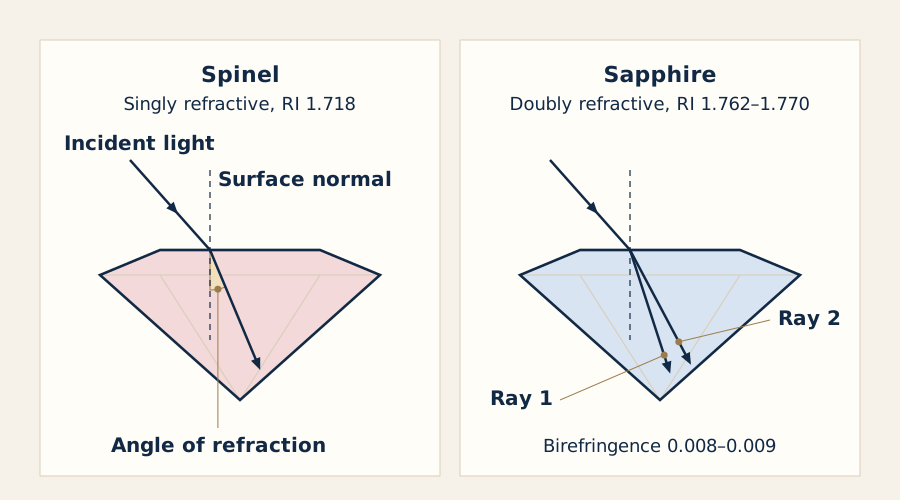
Refractive index (RI) measures how much light slows and bends as it enters the stone. It is the single most useful number in gem testing. Quartz sits around 1.54–1.55, sapphire around 1.76–1.77 and diamond at about 2.42.
Many gems also split each light ray into two, which is called being doubly refractive. The difference between the two readings is the birefringence. Diamond, spinel, garnet, glass and opal are singly refractive and have none. Gems with high birefringence, such as peridot (about 0.036), zircon (up to about 0.059) and moissanite (about 0.043), show doubled back facet edges that you can see with a loupe.
Specific gravity (SG) is density compared with water. A 1 carat sapphire (SG 4.00) is noticeably smaller than a 1 carat emerald (SG about 2.72), so carat weight never translates directly into size across different gems. Hardness is resistance to scratching on the Mohs scale; our guide to the Mohs hardness scale explains why it is a relative scale, not an even one.
Gemologists also look at pleochroism (different colours seen from different directions), the absorption spectrum (dark lines where specific elements absorb light), fluorescence under ultraviolet light, and phenomena such as stars, cat's-eyes and colour change. Those are covered in optical effects such as asterism and play-of-colour. The table below is a gemstone identification chart of typical values.
| Gem | Refractive index | Birefringence | Specific gravity | Mohs hardness |
|---|---|---|---|---|
| Diamond | 2.417 | None (singly refractive) | 3.52 | 10 |
| Moissanite (lab-created) | 2.65–2.69 | 0.043 | 3.22 | 9.25 |
| Cubic zirconia (simulant) | 2.15–2.18 | None | 5.6–6.0 | 8–8.5 |
| Ruby and sapphire (corundum) | 1.762–1.770 | 0.008–0.009 | 4.00 | 9 |
| Spinel | 1.718 | None | 3.60 | 8 |
| Pyrope–almandine garnet | 1.71–1.81 | None | 3.65–4.30 | 7–7.5 |
| Tanzanite (zoisite) | 1.691–1.700 | 0.009 | 3.35 | 6–6.5 |
| Peridot | 1.654–1.690 | 0.036 | 3.34 | 6.5–7 |
| Tourmaline | 1.624–1.644 | 0.018–0.020 | 3.06 | 7–7.5 |
| Topaz | 1.61–1.64 | 0.008–0.010 | 3.53 | 8 |
| Emerald (beryl) | 1.57–1.60 | 0.005–0.009 | 2.67–2.78 | 7.5–8 |
| Quartz (amethyst, citrine) | 1.544–1.553 | 0.009 | 2.66 | 7 |
| Opal | 1.37–1.47 | None | 1.98–2.25 | 5.5–6.5 |
| Glass (imitation) | 1.47–1.70 | None | 2.3–4.5 | 5–6 |
What tools are used for gemstone identification?
A trained gemologist can identify most common gems with a handful of instruments. Each one answers a specific question, and the skill is in choosing the right order.
| Tool | What it measures | What it tells you |
|---|---|---|
| 10x loupe | Lustre, surface wear, doubling, inclusions | First impressions, obvious glass or composites |
| Refractometer | RI and birefringence, up to about 1.81 | Narrows the species quickly; diamond, CZ and moissanite read over the limit |
| Polariscope | Single or double refraction, strain | Separates spinel, garnet and glass from corundum, topaz and others |
| Dichroscope | Pleochroism | Ruby shows two reds; red spinel and garnet show one |
| Hydrostatic balance or heavy liquids | Specific gravity | Useful for loose stones, cabochons and jade; avoid heavy liquids on porous opal |
| Hand spectroscope | Absorption lines | Chromium lines in ruby; iron line near 450 nm in blue sapphire |
| UV lamp (365 nm and 254 nm) | Fluorescence | Ruby often glows red; patterns help screen diamonds |
| Gemological microscope (about 10–60x) | Inclusions and growth features | Natural vs lab-created, many treatments |
| Thermal and electrical testers | Heat and electrical conduction | Diamond vs CZ; flags moissanite |
When the standard instruments are not enough, gems go to a laboratory. Labs use FTIR and Raman spectroscopy to read molecular structure, UV-Vis-NIR spectroscopy for colour causes, EDXRF and LA-ICP-MS for trace-element chemistry, and photoluminescence and fluorescence imaging to screen diamonds. These are what reveal origin, subtle treatments and lab-grown diamond.
Mounted stones are harder. Specific gravity cannot be measured once a gem is set, and the refractometer needs a flat, polished facet in contact with its glass. Pearls are a special case too: their identity sits inside, so labs use X-radiography to see the nacre and nucleus, as explained in how natural and cultured pearls are told apart.
How do inclusions help identify a gemstone?
Inclusions are tiny crystals, fluids, fractures or growth marks trapped inside a gem. Because lab-created and natural stones share the same RI and SG, inclusions are often the only way to separate them on the bench. They record how and where the crystal grew.
- Natural corundum: fine rutile needles called silk, often crossing at 60°, and straight, angular colour zoning that follows the crystal faces.
- Flame-fusion lab-created corundum: curved growth lines (curved striae) and round gas bubbles, which never occur in natural sapphire or ruby.
- Flux-grown lab-created ruby and emerald: wispy flux fingerprints and, sometimes, bright triangular or hexagonal platinum platelets from the crucible.
- Natural emerald: a busy interior known as the jardin, including three-phase inclusions (a liquid, a gas bubble and a salt crystal in one cavity) typical of Colombian stones.
- Hydrothermal lab-created emerald: chevron or zigzag growth patterns and nailhead spicules, small spikes with a crystal at one end.
- Glass: round or elongated bubbles, swirl marks and soft, rounded facet edges from moulding.
- Lab-grown diamond: metallic inclusions in HPHT-grown stones and distinctive growth patterns in CVD-grown stones, confirmed by lab imaging.
Emerald is the classic example of inclusions as a signature. Our emerald gemstone guide explains why its jardin is expected, and how fillings in surface-reaching fractures change both its look and its care.
Not sure which one is right?
Send us the stones you are looking at and our gemologist will tell you which to choose and why.
How do you tell natural from lab-created gemstones?
A lab-created gem gives the same refractometer, polariscope and SG readings as its natural counterpart, because it is the same material. Separating them relies on growth features under the microscope and, for difficult stones, laboratory spectroscopy and chemistry. Simulants are much easier: their numbers simply do not match.
| Natural gem | Lab-created (synthetic) gem | Simulant | |
|---|---|---|---|
| Chemistry and structure | Mineral formed in the earth | Same as the natural gem | Different material |
| RI and SG | Matches the species | Matches the species | Does not match |
| Typical inclusions | Mineral crystals, silk, natural fluid inclusions | Curved striae, flux, seed plates, metallic inclusions | Bubbles, swirls, moulded edges |
| How it is identified | Microscope; lab for origin and treatment | Microscope; lab spectroscopy for clean stones | Standard bench tests |
| Typical price | Highest for fine quality | Much lower than natural | Usually lowest |
Lab-grown diamond follows the same logic. It is real diamond, with the same hardness, RI and SG, so a standard diamond tester will read it as diamond. Labs separate it with spectroscopy and fluorescence imaging, and a reputable report states clearly whether a diamond is natural or laboratory-grown. Our page on how synthetic gems are produced describes the flame-fusion, flux, hydrothermal, HPHT and CVD methods.
Browse natural gemstones in our stock
Neither choice is fake. A lab-created sapphire is a genuine sapphire material at a lower price; a natural sapphire carries the rarity of having formed in the earth. What matters is that the stone is described accurately, so you know which one you have.
Can a gemologist detect gemstone treatments?
Many coloured gems are treated to improve colour or clarity, and most treatments are accepted in the trade when disclosed. Some are easy to spot on the bench; others can only be confirmed by a laboratory.
| Treatment | Common in | How it is detected |
|---|---|---|
| Heating | Sapphire, ruby, tanzanite, aquamarine, citrine | Altered silk, discoid fractures with halos; lab spectroscopy |
| Beryllium diffusion | Orange, yellow and pink-orange sapphire | Surface-related colour; trace chemistry by LA-ICP-MS |
| Titanium surface diffusion | Blue sapphire | Colour concentrated at facet edges when immersed |
| Lead-glass filling | Ruby | Blue or orange flash, gas bubbles in filled fissures |
| Oil or resin filling | Emerald | Flash effect in fractures; FTIR identifies the filler |
| Irradiation | Blue topaz, some diamonds | Often not detectable in topaz; spectroscopy for diamond |
| Dyeing | Jade, quartz, pearls, coral | Colour concentrated in cracks; absorption spectrum |
| Impregnation or stabilising | Turquoise, opal, jadeite (B jade) | FTIR and other lab tests |
Treatment changes both value and care: a filled emerald should not go in an ultrasonic cleaner, and a glass-filled ruby can be damaged by jeweller's torch heat or acid pickle. Our guide to treated and untreated stones compared goes through each treatment in detail.
Can gemstone identification tell where a gem came from?
Sometimes, but origin is an expert opinion rather than a measurement. Labs compare a stone's trace elements and inclusion suite with reference collections from known mines. It works well for some gems, such as sapphire, ruby and emerald, and poorly for others. Our article on how labs determine a gem's origin explains the methods and their limits.
Australia has some of the most distinctive gem sources in the world, and each has identification clues:
- Sapphire: from basalt-related fields in Central Queensland (Anakie, Rubyvale, Sapphire) and New England in New South Wales (Inverell, Glen Innes). These sapphires are iron-rich, so they are often deep or inky blue, show a strong absorption line near 450 nm, and also come in green, yellow and parti-colours.
- Opal: black opal from Lightning Ridge (NSW), white and crystal opal from Coober Pedy and Andamooka (SA), and boulder opal from western Queensland. Australia produces most of the world's precious opal. A side view reveals doublets and triplets by their layers, and lab-created opal often shows a columnar lizard-skin pattern.
- Pink diamond: the Argyle mine in Western Australia, which closed in 2020.
- Zircon: from the Harts Range in the Northern Territory and the eastern sapphire fields. Natural zircon is not cubic zirconia; it has a high RI (about 1.92–1.98), strong doubling and a characteristic line near 653 nm.
- Chrysoprase: apple-green chalcedony from Queensland and Western Australia, coloured by nickel.
- South Sea pearls: from the Pinctada maxima oyster along the Kimberley coast around Broome.
Some Australian finds, such as parti sapphire or boulder opal with pronounced patterns, cross into collector-grade gemstones where provenance and documentation matter a great deal.
Which gemstones are hard and tough enough for an everyday ring?
Once a stone is identified, the next question is how it will wear. Hardness is resistance to scratching. Toughness is resistance to chipping and breaking, and cleavage is a tendency to split along flat planes. A gem can be hard but not tough: topaz is 8 on the Mohs scale yet can split with one sharp knock. Our full guide to durability for everyday rings covers each factor.
| Gem | Mohs | Toughness | Cleavage | Everyday ring? |
|---|---|---|---|---|
| Diamond | 10 | Good | Perfect, four directions | Yes |
| Ruby and sapphire | 9 | Excellent | None (parting possible) | Yes |
| Spinel | 8 | Good | None | Yes |
| Jadeite and nephrite jade | 6–7 | Exceptional | None | Yes, with polish wear over time |
| Garnet | 6.5–7.5 | Fair to good | None | Yes, with a protective setting |
| Tourmaline | 7–7.5 | Fair | None | With care |
| Topaz | 8 | Poor | Perfect, one direction | With care; protect from knocks |
| Emerald | 7.5–8 | Poor to fair | Poor | Protective setting, gentle wear |
| Peridot | 6.5–7 | Fair | Poor | Occasional wear |
| Tanzanite | 6–6.5 | Fair to poor | Perfect, one direction | Occasional wear, protective setting |
| Opal | 5.5–6.5 | Poor to fair | None | Occasional wear, bezel setting |
| Pearl | 2.5–4.5 | Fair to good | None | Occasional wear |
If you want colour on a ring worn every day, our guides to gems that suit daily wear and engagement rings with a coloured centre stone go through the realistic options. For softer or cleavable gems, a bezel, half-bezel or low claw setting does much of the protecting; see protective setting styles for diamonds and gems.
How can you tell if a gemstone is real at home?
Honestly, you cannot identify a gem reliably at home. Lab-created stones pass every home test because they are the same material, and many simulants pass most of them. What you can do is spot a few warning signs before getting a stone properly tested:
- Bubbles: round bubbles seen with a 10x loupe usually mean glass or flame-fusion lab-created material.
- Facet edges: sharp, crisp edges suggest a hard gem; rounded, worn or chipped edges on an old ring suggest glass or a softer stone.
- Layers: look at an opal or a red stone from the side; a visible join line means a doublet or triplet.
- Too perfect: a large, flawless, vividly coloured stone at a low price deserves a second look.
- Doubling: doubled back facet edges suggest a doubly refractive gem, but tell you nothing about natural versus lab-created.
Avoid scratch tests, streak tests or heat tests. They prove little and can permanently damage a gem, especially an emerald, opal or pearl. Once you know what a stone is, our advice on cleaning and care for each stone tells you what is safe.
How does gemstone identification work, step by step?
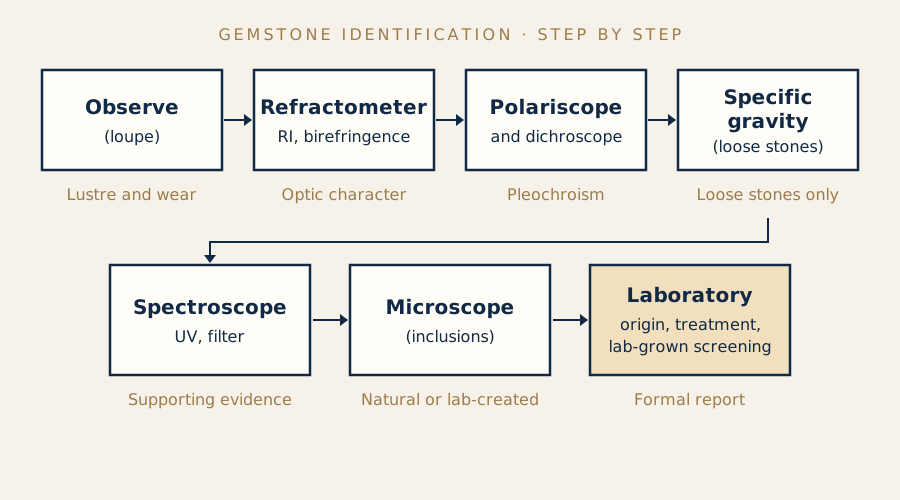
- Clean and record. Note the weight, measurements, colour, cut, transparency and whether the stone is loose or mounted.
- Look with a loupe. Check lustre, surface wear, doubling, obvious inclusions and any join line from a composite.
- Take a refractometer reading. Record the RI, birefringence and optic character. A reading over 1.81 points to a high-RI material such as diamond, zircon, CZ or moissanite.
- Use the polariscope and dichroscope. Confirm single or double refraction and check for pleochroism.
- Measure specific gravity if the stone is loose.
- Check the spectrum and fluorescence. A hand spectroscope, UV lamp and colour filter add supporting evidence.
- Study the inclusions under the microscope. This separates natural from lab-created and reveals many treatments.
- Send to a laboratory when needed. Origin, subtle treatments and lab-grown diamond screening need advanced spectroscopy and a formal report.
If you are remodelling an inherited ring, identification usually comes first. The stone and mount can then be measured with 3D scanning for CAD remodelling, so the new setting is designed around the gem's exact size and its durability.
Free consultation
Talk to a gemologist
Compare stones in person or online with Raj Sood, Graduate Gemologist (GIA), AJP (GIA).
Book a consultationShop this shape
FAQ
Common questions
How do gemologists identify a gemstone?
They measure properties that are fixed by the gem's chemistry and crystal structure, mainly refractive index, birefringence, specific gravity and pleochroism, then study inclusions under a microscope. Difficult stones go to a laboratory for spectroscopy and trace-element analysis.
Can a diamond tester identify other gemstones?
No. A thermal tester only separates diamond from materials such as cubic zirconia, and moissanite needs an electrical test as well. Lab-grown diamond reads as diamond on both, and the tester tells you nothing about coloured gems.
Is a lab-created gemstone fake?
No. A lab-created sapphire, ruby or emerald has the same chemistry and properties as the natural gem; it is grown in a laboratory rather than mined. A simulant, such as glass or cubic zirconia, is a different material that only looks similar.
Can you tell if a sapphire is Australian?
Often a laboratory can give an opinion. Australian sapphires are typically iron-rich, with a strong absorption line near 450 nm and a characteristic set of inclusions, but origin reports are expert opinions based on comparison with reference stones.
How much does gemstone identification cost in Australia?
Bench identification by a qualified gemologist is often modest or included when you buy or remodel, while a formal laboratory report usually costs from roughly AUD 100 to several hundred dollars, depending on the lab, the stone and whether origin is requested.
Can a gemstone be identified while it is set in a ring?
Usually yes, using a loupe, refractometer on an exposed facet, polariscope, spectroscope and microscope. Specific gravity cannot be measured on a set stone, so some gems, and most origin questions, are easier to answer once the stone is removed.

Ask a gemologist
Not sure which diamond to choose?
Raj Sood is a Graduate Gemologist (GIA) and master jeweller. Bring the stones you are considering, or send the reports, and he will tell you honestly which one is better and why.
Keep learning
Related guides
 GemstonesGemstone Hardness Guide
 GemstonesTreated vs Untreated Gemstones
 GemstonesHow Gemstone Origin Is Determined
 GemstonesMan-Made GemstonesGemstonesGemstones | Coloured Gemstones, Birthstones and Custom Jewellery
 PearlsTypes of Pearls and Pearl Identification Guide
 Engagement Rings & SettingsDiamond & Gemstone Setting Guide
 GemstonesEngagement Rings with Colour, Meaning and Personal Gemstone Choice
Explore more
More guides on this topic
Education