
Gemstones
How Gemstone Origin Is Determined: Inclusions, Chemistry and Lab Reports
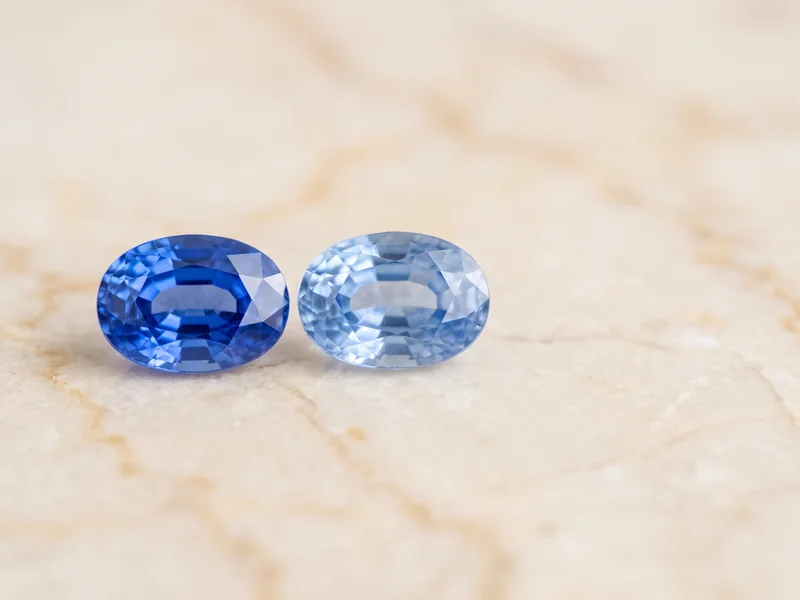
Two sapphires can look almost identical yet differ in price several times over because of where they were mined. Here is how gemstone origin is determined, what the laboratory is looking at, and how far you can rely on the result.
 Reviewed by Raj Sood, Graduate Gemologist (GIA), AJP (GIA)Master jeweller and Graduate Gemologist (GIA) · reviewed 4 November 2026
Quick answer
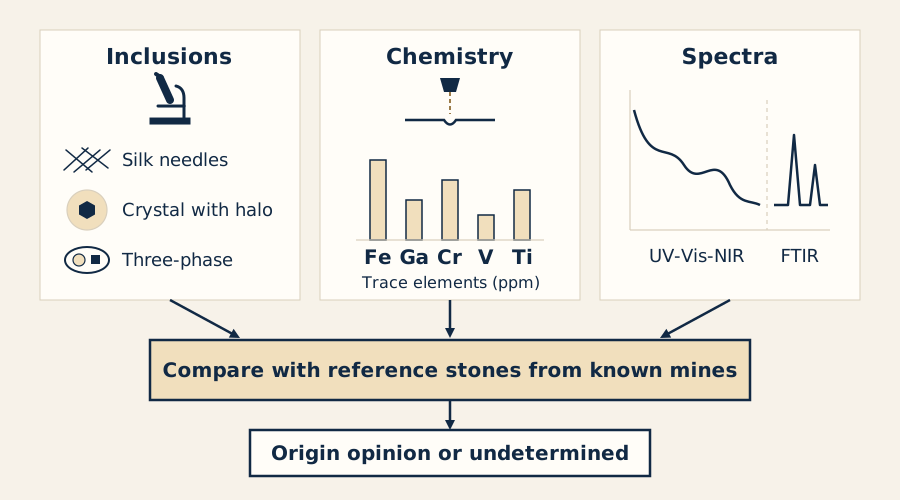
Gemstone origin is determined by a specialist laboratory comparing a stone's inclusions, trace-element chemistry and spectra with reference samples from known mines. No single test proves origin. Labs such as GIA, SSEF, Gübelin and AGL give an expert opinion, mostly for valuable sapphire, ruby, emerald, spinel and Paraíba tourmaline, and some stones stay 'undetermined'.
What does gemstone origin mean?
When a jeweller or laboratory talks about gemstone origin, they mean the geographic source: the country, and sometimes the region or mine, where the crystal formed. A sapphire described as 'Ceylon' came from Sri Lanka; a 'Burmese' ruby came from Myanmar, usually the Mogok valley. That is a different question from whether the stone is natural or lab-created, and a laboratory always answers that one first. A lab-created ruby has no geographic origin at all, only a manufacturer and a growth method, which is why our guide to natural and lab-grown gemstones for engagement rings treats them as separate choices.
Origin can be worked out at all because every deposit formed in its own geology: different host rocks, temperatures, pressures and fluids. That environment leaves a record inside the stone, in the tiny crystals and fluids trapped as it grew, and in the trace elements (impurities measured in parts per million) built into its crystal structure. Read together, those clues let a trained gemmologist say which kind of deposit a stone most likely came from, and often which country. For an overview of the gems themselves, start with our coloured gemstones and birthstones hub; for the famous localities, see the major gem sources from Ceylon to Mozambique.
A few terms come up constantly. Inclusions are anything trapped inside a gem: crystals, fluids, gas bubbles or healed cracks. Silk is a mass of fine needle-like inclusions, usually rutile (titanium dioxide) in ruby and sapphire. Corundum is the mineral species of both ruby and sapphire; red corundum is ruby and every other colour is sapphire. Any other unfamiliar word on this page is explained in our plain-English glossary of jewellery terms.
Does gemstone origin affect price?
Yes, at the top of the market. Certain sources earned reputations for exceptional colour, and buyers pay for the name on the report. The classic examples are Kashmir sapphire, Burmese ruby, Colombian emerald and Brazilian Paraíba tourmaline. A fine stone with one of those origins, on a report from a respected lab, can cost several times as much as a similar-looking stone from elsewhere. That premium reflects reputation and rarity. It does not mean the stone is harder, tougher or more durable.
| Origin | Gems | What the name is known for | Background |
|---|---|---|---|
| Kashmir (India) | Sapphire | Soft, velvety cornflower blue | Classic production mainly in the 1880s; very little since |
| Burma (Myanmar, Mogok) | Ruby, sapphire, spinel | Glowing red from strong fluorescence | Some countries restrict imports of Burmese gems |
| Ceylon (Sri Lanka) | Sapphire, padparadscha | Bright, lively blues and pastel colours | Centuries of mining, mostly from gem gravels |
| Colombia | Emerald | Pure, slightly bluish green | Muzo, Chivor and Coscuez mines |
| Mozambique | Ruby, copper-bearing tourmaline | Bright red rubies; neon blue-green tourmaline | Montepuez ruby deposit found around 2009 |
| Madagascar | Sapphire, ruby | Wide range; some resemble Kashmir or Ceylon | Ilakaka sapphire rush from 1998 |
| Australia | Sapphire | Deep blue, green, yellow and parti-colour | Queensland and New England (NSW) basalt fields |
Origin is only one part of value. Colour, clarity, cut, size and treatment usually matter more, and an average stone from a famous place is still an average stone. A bright, unheated Sri Lankan sapphire can be far more attractive than a dull Burmese one, and our explainer on what Sri Lankan origin actually tells you shows why. The same applies to rubies: our ruby gemstone guide covers how colour and fluorescence are judged. Origin reports matter most on high-value stones and on the rarer gems that collectors chase, where a few words on a report can shift the price considerably.
How is gemstone origin determined in a laboratory?
A lab works in two stages. First it identifies the stone: the species, whether it is natural or lab-created, and any treatment. Standard gemmological tests do much of that, including refractive index (how strongly the stone bends light), specific gravity (density compared with water) and the microscope. Our page on refractive index, specific gravity and other gem properties explains each one, and why density changes how big a carat looks puts specific gravity into practice. These tests separate a ruby (RI about 1.76–1.77, SG about 4.00) from a red garnet, but they cannot separate a Burmese ruby from a Mozambican one. Both are the same mineral with almost identical physical properties.
The second stage is origin, and it rests on three lines of evidence weighed together:
- Inclusions: the minerals, fluids and growth patterns trapped inside, viewed under the microscope.
- Chemistry: the trace elements in the crystal, measured in parts per million or lower.
- Spectra: how the stone absorbs light across the ultraviolet, visible and infrared range.
| Method | What it does | Origin clue it gives |
|---|---|---|
| Gemmological microscope | Magnifies inclusions, zoning and colour banding, from about 10× to well over 100× | The combination of inclusions typical of a deposit |
| Raman spectroscopy | Uses a laser to identify the mineral of an inclusion without touching it | Host-rock minerals such as calcite, amphibole or zircon |
| EDXRF (X-ray fluorescence) | Measures surface chemistry with X-rays, non-destructive | Iron, gallium, chromium, vanadium, titanium |
| LA-ICP-MS | A laser takes a microscopic sample, analysed in a mass spectrometer | Dozens of trace elements at very low levels |
| UV-Vis-NIR spectroscopy | Records how the stone absorbs light | Iron-related absorption; basalt-related or metamorphic type |
| FTIR (infrared) | Records infrared absorption | Water and hydrogen-related features; signs of heating |
LA-ICP-MS (laser ablation inductively coupled plasma mass spectrometry) is the workhorse of modern origin work. The laser leaves a pit far smaller than a millimetre, usually on the girdle (the outer edge), invisible without magnification. The lab then compares the results with its reference collection: thousands of samples, ideally collected directly at the mines. Building that collection takes decades, which is why origin opinions come from a handful of large laboratories rather than from a jeweller's bench.
What inclusions reveal where a gemstone formed?
Inclusions are often the most telling evidence, because they record the conditions the crystal grew in. Gemmologists talk about an inclusion 'scene': not one feature, but the combination of several. A single needle of rutile proves nothing; a particular mix of silk, crystals and healed fractures can point strongly to one region.
| Gem and origin | Typical inclusion clues |
|---|---|
| Kashmir sapphire | Fine milky zones of tiny particles that give a velvety, 'sleepy' look; tourmaline and pargasite crystals |
| Sri Lankan sapphire | Long, fine rutile silk; zircon crystals with stress haloes; fingerprint-like healed fractures |
| Burmese (Mogok) ruby | Short, fine silk; swirling 'treacle' growth lines; calcite and apatite crystals from the marble host rock |
| Thai and Cambodian ruby | Little or no silk; rounded crystals ringed by disc-like healed fractures; often darker red |
| Mozambican ruby | Amphibole crystals, rutile silk and fine platy particles; varies between mining areas |
| Australian sapphire | Strong, straight colour zoning; dense blue body colour typical of basalt-related sapphire |
| Colombian emerald | Jagged three-phase inclusions: liquid, a gas bubble and a tiny salt (halite) cube |
| Zambian emerald | Brown mica flakes and needle-like amphibole crystals |
These are typical patterns, not rules. Mines produce variable material, and a stone can lack the textbook features of its source. Heat treatment complicates things further. Heating corundum to roughly 1,200–1,800 °C can dissolve silk, alter crystals and crack the stone around them, erasing some of the very features used for origin. That is one reason labs report treatment and origin together, and why unheated stones from classic sources sit at the top of the market. Our guide to how heating, oiling and other treatments change a gemstone covers each process.
The lab must also rule out lab-created material first. Flux-grown lab-created rubies, for example, can contain fingerprint-like inclusions that look a little like natural healed fractures, so the gemmologist confirms the stone is natural before any origin question is asked.
Not sure which one is right?
Send us the stones you are looking at and our gemologist will tell you which to choose and why.
How do trace elements and spectra pinpoint origin?
Corundum is aluminium oxide, Al2O3. Pure, it is colourless. Tiny amounts of other elements give it colour: chromium makes ruby red, and iron with titanium makes sapphire blue. Other elements, such as gallium, vanadium and magnesium, do little to the colour but act as tracers of the rock the crystal grew in.
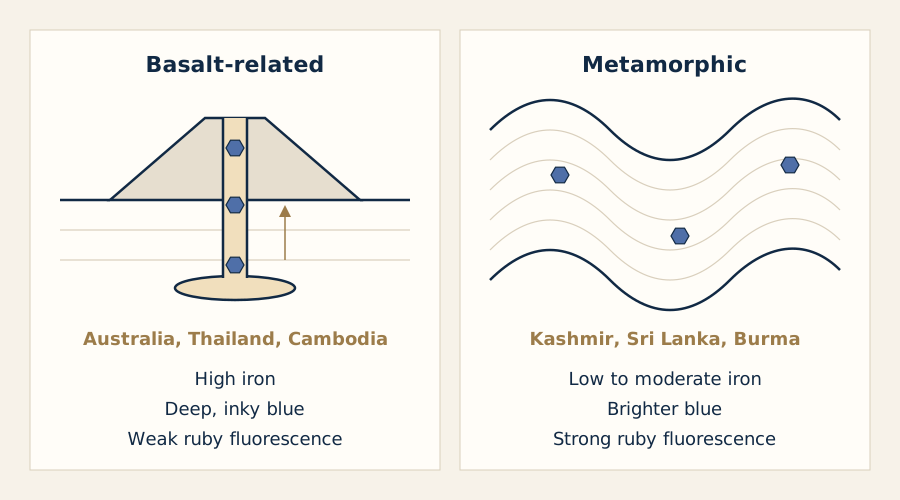
The first big split is between two families of deposit. Basalt-related sapphires and rubies were carried up from deep in the earth by volcanic basalt, the type found in eastern Australia, Thailand and Cambodia. Metamorphic stones grew in rocks changed by heat and pressure, such as marble and gneiss, the type found in Kashmir, Sri Lanka and Burma. The two families differ in predictable ways.
| Feature | Basalt-related corundum | Metamorphic corundum |
|---|---|---|
| Example sources | Australia, Thailand, Cambodia, Nigeria | Kashmir, Sri Lanka, Burma, much of Madagascar |
| Iron content | High | Low to moderate |
| Gallium to magnesium ratio | Usually higher | Usually lower |
| Typical blue sapphire | Deep, inky, sometimes greenish | Brighter, lighter, often slightly violet |
| Colour zoning | Often strong and straight | Usually softer |
| Ruby fluorescence under UV | Weak, because iron dampens it | Strong red in marble-hosted rubies |
Once the family is known, finer chemistry narrows it down. Within metamorphic sapphire, for instance, labs plot several trace elements against each other and see which reference group the stone falls into. Other gems use other tracers. Emeralds from different countries differ in iron, vanadium, caesium and alkali elements, and some labs also measure oxygen isotopes. Copper-bearing tourmaline from Brazil, Nigeria and Mozambique can often be separated by trace elements, although the trade name 'Paraíba' is now used for the variety whatever its source. Some labs also date zircon inclusions, which can separate deposits that formed at very different times even when their chemistry overlaps.
None of this changes how the stone wears. A sapphire is 9 on the Mohs scale whether it came from Kashmir or Queensland, as our Mohs hardness guide for gemstones shows.
Can gemstone origin always be determined?
No, and a good lab will say so. Origin is an opinion based on the weight of evidence, and sometimes the evidence does not point clearly one way. The usual reasons:
- Overlapping deposits: Madagascar's Ilakaka sapphires formed in similar rocks to Sri Lanka's, and some overlap closely in inclusions and chemistry.
- Treatment: heating can remove silk and alter crystals, leaving less to compare.
- Clean stones: a stone with almost no inclusions gives the microscope little to work with.
- New mines: a new deposit may not yet be in the lab's reference collection.
- Small stones: origin testing is rarely worth the cost for stones under about half a carat, so little reference work exists for them.
Different labs can also reach different conclusions on the same stone, particularly for Kashmir-like or Burma-like material, because each uses its own reference data and judgement. A result of 'undetermined' or 'no conclusion' is normal and does not mean anything is wrong with the stone. For diamonds, laboratory origin testing is rarely offered at all; diamond source information generally comes from a documented supply chain rather than from the stone's chemistry.
Related guideGemstone Origins: Ceylon, Burma, Kashmir, Madagascar, MozambiqueWhat does a gemstone origin report say?
An origin report usually carries a line such as 'Origin: Sri Lanka (Ceylon)', often with careful wording like 'gemmological testing revealed characteristics corresponding to those of natural sapphires from Sri Lanka'. That phrasing is deliberate: it states an opinion, not a certainty. The report will also describe the stone (weight, measurements, shape, colour), state that it is natural, and comment on treatment, for example 'no indications of heating' or 'indications of heating'. Some labs add a grade of clarity enhancement for emeralds, such as minor or moderate oil.
| Identification report | Origin report | |
|---|---|---|
| Answers | Species, natural or lab-created, treatments | All of that, plus the most likely geographic source |
| Testing | Standard gemmology and spectroscopy | Adds advanced trace-element work and reference comparison |
| Typical stones | Most coloured gems | High-value sapphire, ruby, emerald, spinel, Paraíba-type tourmaline, alexandrite |
| Approximate cost (AUD) | about $100–$400 | about $300–$1,500+, depending on lab and stone |
| Result | A definite identification | An expert opinion; can be 'undetermined' |
Browse natural gemstones
Which gemstones are worth an origin report?
An origin report makes sense when the origin could change the value by more than the report costs. In practice that means larger, finer stones of a handful of species:
- Blue sapphire and padparadscha: especially from about 1 carat, where Kashmir, Burma and Ceylon names carry weight.
- Ruby: Burmese, Mozambican and Thai rubies differ in price, and fluorescence helps explain why.
- Emerald: Colombian origin is the most requested, alongside a clarity-enhancement comment.
- Spinel: Burmese and Tanzanian (Mahenge) red and pink spinels are prized, as our page on why spinel suits engagement rings explains.
- Copper-bearing tourmaline and alexandrite: both command premiums for particular sources.
For gems such as amethyst, citrine, garnet, topaz, peridot and most aquamarine, origin rarely changes the price enough to justify testing, and an identification report is usually all you need. If you are choosing a stone for a ring worn every day, durability matters more than any place name, so our list of durable gemstones for rings worn every day is a sensible place to start. Across the counter, our advice is the same: choose the stone you like the look of first, then let the report tell you its story.
Does origin change how a gemstone is set or cared for?
Not directly. Care depends on the species, the treatment and the inclusions, not the country. A heavily included or oiled emerald needs gentle handling whatever its source, and fracture-filled rubies can be damaged by heat and solvents. Our guide to which gems are safe in an ultrasonic cleaner lists the risks for each gem.
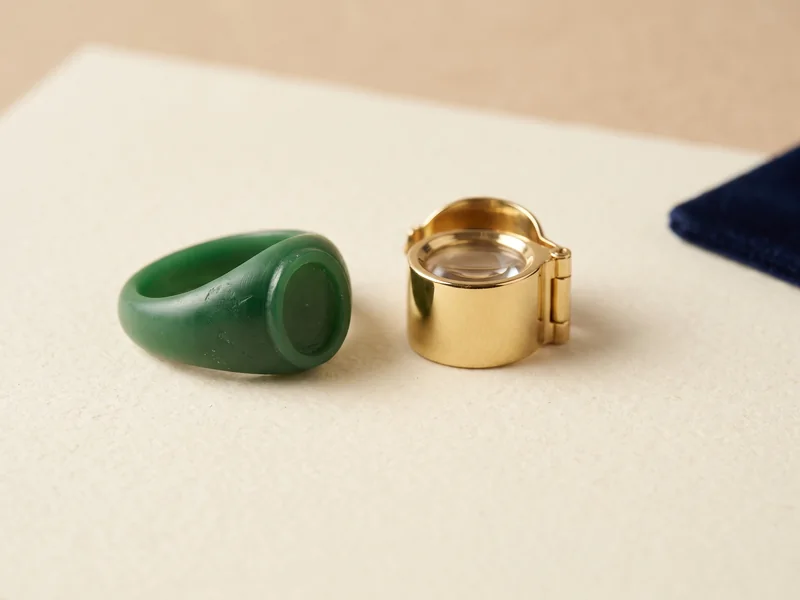
Setting follows the same logic: claws, bezels and halos are chosen for the stone's shape, hardness and weak points, as covered in our guide to setting diamonds and coloured gems. If you are remodelling an inherited ring with a reported stone, keep the report with the stone. A lab may need the stone unset to re-test it, and a 3D scan of the stone and ring before remodelling records its exact dimensions so the new setting fits without re-cutting.
How to check a gemstone's origin before you buy: step by step
- Confirm it is natural. The report should state natural, or clearly say lab-created or synthetic if it is not.
- Find the origin line and its wording. Note whether it gives a country, says 'undetermined' or gives no origin at all.
- Check the lab. Origin opinions from large labs with mine-sourced reference collections carry the most weight.
- Read the treatment comment. Origin and heating together drive price; an unheated classic origin is priced very differently from a heated one.
- Verify the report. Look up the number online and match the weight, measurements and photo to the stone.
- Weigh origin against beauty. Compare colour, clarity and cut side by side, and read up on what each famous origin is known for before paying a premium for a name.
Free consultation
Talk to a gemologist
Compare stones in person or online with Raj Sood, Graduate Gemologist (GIA), AJP (GIA).
Book a consultationShop this shape
FAQ
Common questions
How do labs determine the origin of a gemstone?
They combine inclusions seen under the microscope, trace-element chemistry measured by methods such as LA-ICP-MS, and absorption spectra, then compare the results with reference stones collected from known mines. The result is an expert opinion rather than proof.
Can a jeweller tell where a sapphire is from just by looking?
Not reliably. Experienced gemmologists may form an impression from colour and inclusions, but a defensible origin needs laboratory chemistry and a reference collection.
Does heat treatment affect origin determination?
Yes. Heating can dissolve silk and alter inclusions, removing some of the clues labs rely on, so heated stones are more often reported as undetermined.
Is a Kashmir or Burmese stone better quality?
Not automatically. Those origins carry a reputation and a price premium, but each stone still has to be judged on its own colour, clarity and cut.
Do lab-created gemstones have an origin?
They have no geographic origin, only a manufacturer and a growth method such as flame fusion, flux or hydrothermal growth. A lab report will identify them as lab-created or synthetic.
Can origin testing damage my gemstone?
Most methods are non-destructive. LA-ICP-MS removes a microscopic amount, usually from the girdle, leaving a pit that cannot be seen without magnification.

Ask a gemologist
Not sure which diamond to choose?
Raj Sood is a Graduate Gemologist (GIA) and master jeweller. Bring the stones you are considering, or send the reports, and he will tell you honestly which one is better and why.
Keep learning
Related guides
 GemstonesGemstone Origins: Ceylon, Burma, Kashmir, Madagascar, MozambiqueGemstonesCeylon Sapphire: What Does Sri Lankan Origin Mean?
 GemstonesTreated vs Untreated Gemstones
 GemstonesGemstone Properties: Hardness, RI, SG, Durability and Jewellery UseGemstonesGemstones | Coloured Gemstones, Birthstones and Custom Jewellery
 GemstonesGemstone Hardness Guide
 GemstonesGemstone and Ring Scanning for CAD Remodelling
 GemstonesCan Every Gemstone Go in an Ultrasonic Cleaner?
Explore more
More guides on this topic
Education