
Gemstones
Gemstone Durability for Everyday Rings: Hardness, Toughness and Stability
A ring takes more knocks than any other piece of jewellery, so gemstone durability decides whether a coloured stone still looks crisp in ten years or comes back chipped and dull. Here is how a gemmologist judges it, stone by stone.
 Reviewed by Raj Sood, Graduate Gemologist (GIA), AJP (GIA)Master jeweller and Graduate Gemologist (GIA) · reviewed 4 November 2026
Quick answer
Gemstone durability is the combination of hardness (scratch resistance), toughness (resistance to chipping and breaking) and stability (resistance to heat, light and chemicals). For a ring worn every day, choose stones of 8 or more on the Mohs scale with good toughness, such as diamond, sapphire, ruby and spinel, and use a protective setting for softer gems.
What is gemstone durability?
Gemstone durability is how well a stone survives being worn. Gemmologists break it into three separate properties, and a stone can be strong in one and weak in another. That is why a single number, such as a Mohs hardness, never tells the whole story.
- Hardness: resistance to scratching and abrasion. This is what keeps facet edges sharp and the polish bright.
- Toughness: resistance to chipping, cracking and breaking when the stone takes a knock.
- Stability: resistance to heat, light, chemicals, moisture and sudden temperature changes.
A ring is the hardest-working piece of jewellery you own. It hits door frames and car doors, grips trolley handles and gym weights, goes into dishwater and gets coated in sunscreen and hand cream. Earrings and pendants sit largely out of harm's way. A stone that will last a lifetime in a pair of drops can show wear within a few years on a hand, so the question is not simply whether a gemstone is durable, but whether it is durable enough for the way you will wear it.
Durability sits alongside the other measurable properties gemmologists use, such as refractive index and specific gravity. Our page on how hardness, refractive index and specific gravity fit together covers the full set, and any unfamiliar word on this page is explained in our plain-English jewellery glossary.
What does the Mohs scale tell you about a ring stone?
The Mohs scale ranks minerals from 1 (talc) to 10 (diamond) by which one can scratch which. It is a ranking, not a measurement, and the steps are uneven. In absolute terms diamond is roughly four times harder than sapphire, even though they sit only one step apart on the scale. Treat Mohs numbers as a guide to which stones will scratch others, not as a precise strength rating.
The number that matters most for rings is 7. Quartz, the mineral in sand and much ordinary household dust, is 7 on the Mohs scale. Any stone softer than 7 is slowly scratched by everyday grit, and its facet edges become rounded and fuzzy, which jewellers call abrasion. That is why an opal (5.5–6.5) or a tanzanite (6–7) worn daily loses its polish, while a sapphire (9) still looks freshly cut decades later. Stones of 8 and above stay crisp with ordinary wear; stones of 7 to 8 are serviceable but will need repolishing eventually.
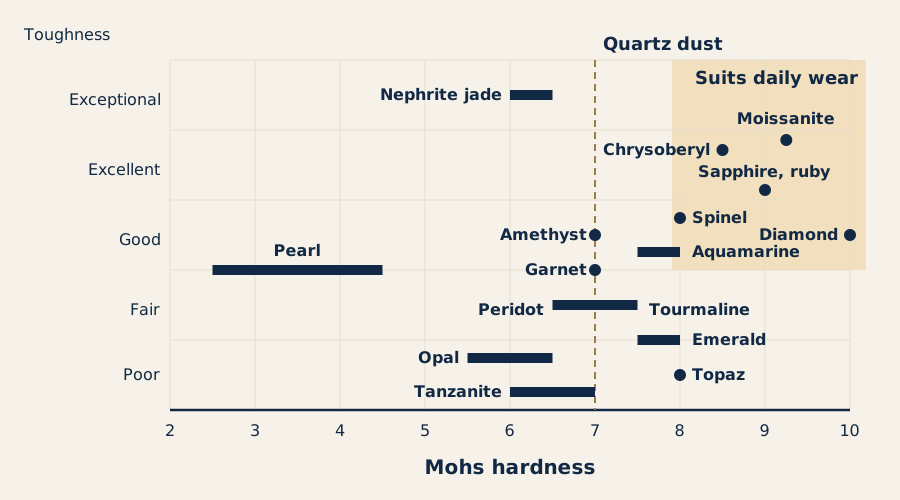
Hardness also works between gems. A diamond ring thrown in a jewellery box with a sapphire ring will scratch the sapphire, and a sapphire will scratch a topaz or a tourmaline. Store pieces separately, in soft pouches or divided trays. Our full gemstone hardness guide with Mohs values lists more than 50 stones.
Some gems are simply too soft for a ring on the hand every day. Fluorite (4), sphalerite (3.5–4) and rhodochrosite (3.5–4) can be extraordinary to look at, but they belong with the collector stones better suited to display than daily wear.
Why is toughness different from hardness?
Toughness is how well a stone resists breaking, and it depends on the crystal structure, on cleavage (flat planes along which a crystal tends to split cleanly) and on inclusions (internal features such as fractures and crystals). Gemmologists usually describe it in words rather than numbers: exceptional, excellent, good, fair or poor.
Two stones show the difference clearly. Nephrite jade is only about 6–6.5 on the Mohs scale, yet it has exceptional toughness because it is made of tightly interlocking fibres; it can survive a drop onto a hard floor that would shatter a harder gem. Diamond, at 10, is the hardest natural material, but it has perfect cleavage in four directions, so a sharp knock at the wrong angle can chip a thin girdle or a pointed corner. Hard is not the same as unbreakable.
- Sapphire and ruby (corundum): no true cleavage and excellent toughness. This is why they are so widely used in rings.
- Topaz: hardness 8, but one perfect cleavage. A single hard knock can split it cleanly across the stone.
- Tanzanite: one perfect cleavage on top of moderate hardness, which makes it vulnerable on both counts.
- Kunzite and moonstone: two directions of cleavage; better kept for pendants and earrings.
- Emerald: little cleavage to speak of, but almost always included with fractures, which lower its toughness to fair or poor.
The cut matters as much as the material. Sharp corners and points, such as those on princess, marquise, pear and kite shapes, concentrate any impact into a tiny area, and a very thin girdle (the outer edge of the stone) chips more easily than a medium one. Rounded shapes such as ovals, rounds and cushions are more forgiving. A smooth domed cabochon is the toughest shape of all, which is one reason star sapphires and other phenomenal cabochons wear so well in rings.
How do heat, chemicals and light affect a gemstone?
Stability is the least discussed part of durability, and the one that catches people out. A stone can be hard and tough and still be damaged by something as ordinary as a hot oven, a squeeze of lemon or a bottle of perfume.
- Opal holds water in its structure, usually about 3–10%. Dry heat or a sudden temperature change can cause crazing (a network of fine surface cracks). Doublets and triplets, which are thin slices of opal glued to a backing, can lift if soaked.
- Pearls are calcium carbonate and are etched by acids, including sweat, vinegar, perfume and some cosmetics. At 2.5–4.5 on the Mohs scale they also scratch easily.
- Emerald is usually clarity-enhanced with oil or resin in its fractures. Solvents, steam and ultrasonic cleaning can draw the filler out, making fractures suddenly more visible.
- Tanzanite is sensitive to thermal shock, meaning a rapid change in temperature, such as moving from a hot dishwasher to cold tap water.
- Kunzite and some amethyst can fade with long exposure to strong light or heat.
- Glass-filled ruby (ruby with lead glass in its fractures) can be etched by mild acids such as lemon juice and damaged by a jeweller's torch during repair.
Treatments are often the hidden factor. Heat treatment of sapphire and ruby is stable and permanent, but fillings, coatings and dyes can be fragile. The grading report or invoice should state any treatment, and our guide to which gemstone treatments affect wear and care explains each one.
Not sure which one is right?
Send us the stones you are looking at and our gemologist will tell you which to choose and why.
How does gemstone durability compare stone by stone?
This table brings the three properties together for the stones most often chosen for rings. Hardness figures are the usual published ranges; toughness and verdicts reflect a gemmologist's view of everyday ring wear, not display or occasional wear.
| Stone | Mohs hardness | Toughness | Cleavage / weak points | Stability concerns | Everyday ring? |
|---|---|---|---|---|---|
| Diamond (natural or lab-grown) | 10 | Good | Perfect, 4 directions | Very stable | Yes |
| Moissanite (lab-created) | 9.25 | Excellent | None of note | Very stable | Yes |
| Sapphire and ruby | 9 | Excellent | None (parting possible) | Stable unless glass-filled | Yes |
| Chrysoberyl and alexandrite | 8.5 | Excellent | Weak | Very stable | Yes |
| Spinel | 8 | Good | None of note | Very stable | Yes |
| Topaz | 8 | Poor | Perfect, 1 direction | Some colours fade | With a protective setting |
| Aquamarine and morganite | 7.5–8 | Good | Indistinct | Stable | Yes, with care |
| Emerald | 7.5–8 | Fair to poor | Fractures and fillers | Fillers dislodged by heat and solvents | With a protective setting |
| Tourmaline | 7–7.5 | Fair | Fractures, especially pink and red | Mostly stable | With care |
| Amethyst and citrine | 7 | Good | None of note | Can fade in strong light | With care; will need repolishing |
| Garnet | 6.5–7.5 | Fair to good | None of note | Stable | With care |
| Peridot | 6.5–7 | Fair | Weak | Sensitive to acids | Occasional wear |
| Tanzanite | 6–7 | Poor | Perfect, 1 direction | Thermal shock | Occasional wear, or a protective setting |
| Opal | 5.5–6.5 | Poor to fair | Brittle | Heat, dryness, soaking | Occasional wear |
| Pearl | 2.5–4.5 | Fair to good | Surface layers | Acids, perfume, sweat | Occasional wear |
The pattern is clear. Diamond, sapphire, ruby, spinel, chrysoberyl and moissanite combine high hardness, good to excellent toughness and stability, so they handle daily ring wear with ordinary care. The beryls (aquamarine, morganite and emerald), tourmaline and garnet sit in the middle: fine for everyday wear if they are well set and you take the ring off for heavy work. Tanzanite, opal, peridot and pearl are better as occasional-wear rings or in pendants and earrings. You can explore each of these stones in our coloured gemstone collection and guides.
At the bench, the damage we see most often follows the same table: chipped corners on tanzanite and emerald, worn and scratched opal surfaces, and topaz cracked along its cleavage after a knock. Sapphires mainly come in for claw repairs, not stone repairs.
Which ring settings protect softer gemstones?
A well-chosen setting can move a stone up a whole category in practical durability. The aim is to cover the weakest parts of the stone, usually the girdle and any corners, and to keep it low enough that it is not the first thing to hit a bench top.
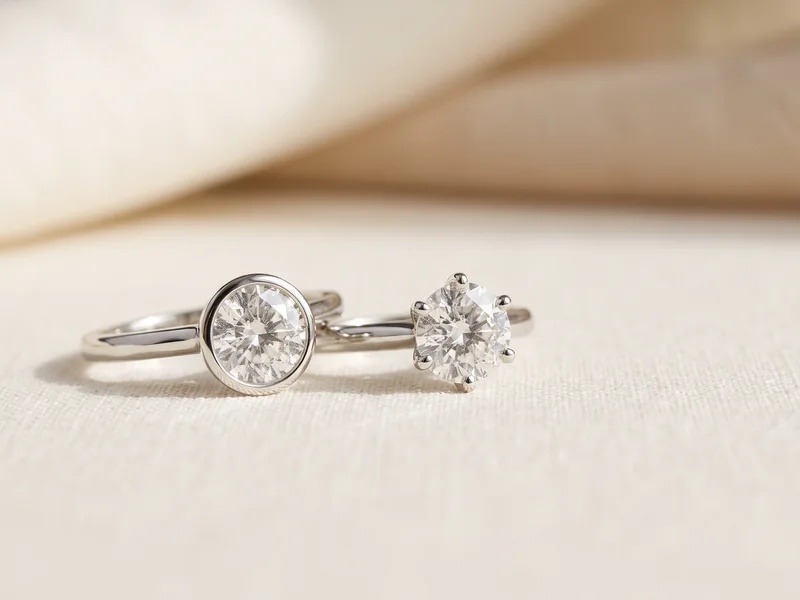
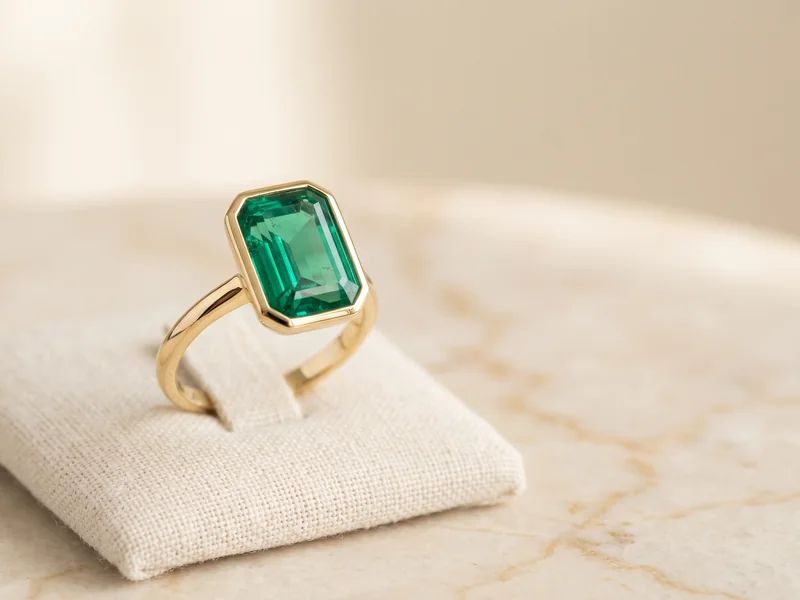
- Bezel (rub-over): a continuous rim of metal around the stone. It protects the entire girdle and is the most secure choice for emerald, tanzanite and opal.
- Half-bezel: metal on two sides, leaving the other two open for light. A good middle ground for elongated stones.
- Six claws instead of four: spreads the grip and means the stone stays put if one claw is damaged.
- V-claws or corner claws: wrap pointed corners on princess, pear, marquise and emerald cuts.
- Low profile: a setting that sits the stone closer to the finger takes fewer side knocks than a tall cathedral setting.
- Halo: a ring of small diamonds or sapphires around the centre stone takes the first impact, though the small stones themselves need checking.
| Setting | How much of the girdle is covered | Protection level | Suits |
|---|---|---|---|
| Full bezel | All of it | Highest | Opal, tanzanite, emerald, peridot |
| Half-bezel | Two sides | High | Elongated stones, tourmaline, morganite |
| Halo with claws | Edge framed by small stones | High against side knocks | Tanzanite, morganite, aquamarine |
| Six claws | Six small points | Moderate | Sapphire, spinel, aquamarine |
| Four claws | Four small points | Lowest | Diamond, sapphire, ruby, moissanite |
| V-claws or corner claws | Pointed corners | Protects the weakest points | Princess, pear, marquise and emerald cuts |
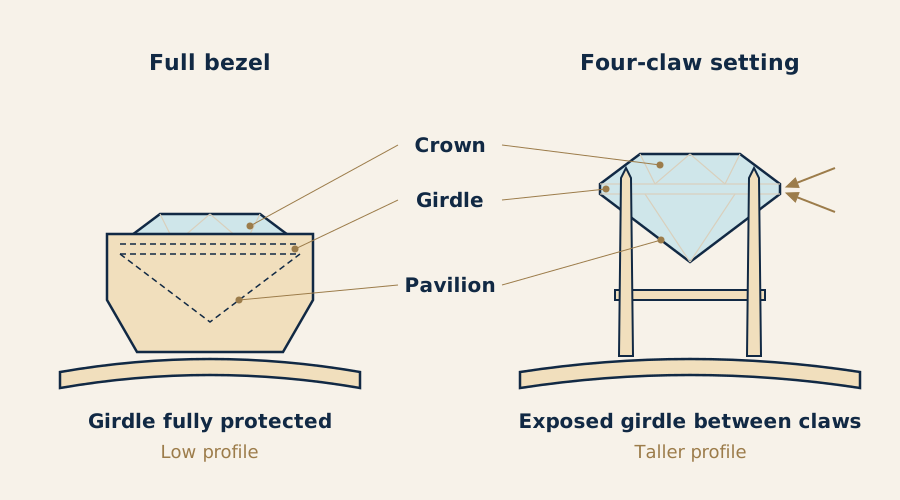
Metal choice matters too. Claws in platinum or a hard white gold alloy wear more slowly than soft yellow gold claws, which can thin within a few years on a ring worn every day. For a side-by-side look at the trade-offs, see bezel and claw settings compared for daily wear, and for every setting style in detail, our guide to diamond and gemstone settings.
If you already own a soft stone in a tall, exposed setting, it does not have to be retired. The stone and ring can be measured precisely and the design rebuilt around it; our page on scanning a gemstone and ring for a CAD remodel explains how that works.
Can you wear tanzanite, emerald or opal in an engagement ring every day?
You can, but go in with clear expectations. An engagement ring is usually worn every day for decades, which is the toughest test any gemstone faces. Here is how the popular softer choices behave.
- Tanzanite (6–7): will lose its polish and is prone to chipping. Choose a bezel or a halo, and accept that it may need repolishing or, eventually, replacing. Our guide to tanzanite rings and how they hold up to daily wear goes further.
- Emerald (7.5–8): hard enough to resist dust, but fractures make it brittle. A bezel or protective claws on the corners of an emerald cut are strongly advised.
- Opal (5.5–6.5): realistic as an everyday ring only in a full bezel, and only if you remove it for cleaning, gardening and the gym.
- Tourmaline (7–7.5): a solid middle choice in a secure setting; read our page on tourmaline engagement rings, colour by colour.
- Morganite and aquamarine (7.5–8): good toughness and stable colour; they collect skin oils and look dull quickly, so they need regular cleaning.
Birthstones raise the same question, because several months fall on softer gems: opal for October, pearl for June, peridot for August and tanzanite as a December option. Our guide to choosing a birthstone engagement ring that will last suggests harder alternatives in the same colour, such as a blue sapphire for tanzanite lovers or a green sapphire or tsavorite garnet for peridot.
Related guideBirthstone Engagement Rings: Choosing for DurabilityAre lab-created gemstones more durable than natural ones?
Lab-created gemstones (also called synthetic) have the same chemical composition, crystal structure and physical properties as their natural counterparts. A lab-created sapphire is 9 on the Mohs scale, with the same refractive index of about 1.76–1.77 as a natural sapphire, and a laboratory-grown diamond is 10, just like a natural diamond. Neither type is inherently harder or softer.
The practical differences come from inclusions and treatments. Lab-created stones are often cleaner, with fewer fractures, so a lab-created emerald can be slightly less brittle than a heavily included natural one, though it is still a beryl at 7.5–8 and still deserves a protective setting. Natural stones, on the other hand, are more likely to carry clarity treatments such as oiling or glass filling, which affect stability. Always check the report or invoice for both origin and treatment.
Some ring stones exist only as lab-created materials. Moissanite (silicon carbide, 9.25) is very durable. Cubic zirconia (8–8.5) is hard enough to resist dust, but over years of daily wear its facet edges tend to scuff and it can look dull compared with sapphire or diamond. Glass, at about 5–6, wears quickly. Our page on how lab-created and simulated gemstones differ covers each in detail.
Browse natural gemstones
How do you care for a gemstone ring you wear every day?
Good habits extend the life of any stone, and they matter most for the middle and lower rows of the durability table.
- Take it off for heavy work: gardening, the gym, moving furniture and cleaning with chemicals or chlorine.
- Last on, first off: put rings on after perfume, hairspray and sunscreen.
- Clean gently: warm water, a drop of mild dishwashing liquid and a soft toothbrush suit almost every stone. Avoid steam and ultrasonic cleaning for emerald, tanzanite, opal, pearl and any filled stone.
- Store separately: keep each ring in its own pouch or compartment so harder stones do not scratch softer ones.
- Check the claws: have the setting inspected every 6–12 months, sooner if the ring has caught on fabric or you can feel a rough claw tip.
Whether an ultrasonic is safe depends entirely on the stone and its treatments; our answer to which gemstones are safe in an ultrasonic cleaner lists them one by one. For cleaning and storage advice for each gem, see care instructions for each gemstone.
How do you choose a durable gemstone for an everyday ring? Step by step
- Be honest about how you live. Hands-on work, sport or young children mean more knocks; favour stones of 8 or more with good to excellent toughness.
- Check all three properties. Look up the hardness, toughness and cleavage, and any heat, light or chemical sensitivity, not just the Mohs number.
- Ask about treatments. Confirm on the report or invoice whether the stone is natural or lab-created and whether it has been heated, oiled, filled or coated.
- Look for open fractures. Under a loupe, avoid fractures that reach the surface, especially near corners and the girdle.
- Choose a forgiving shape. Rounded outlines and a medium girdle resist chipping better than sharp points and knife-edge girdles.
- Match the setting to the stone. Bezel, half-bezel, six claws or a halo for softer or brittle gems; keep the profile low for daily wear.
- Plan the upkeep. Book a claw check every 6–12 months and know which cleaning methods to avoid for your stone.
Free consultation
Talk to a gemologist
Compare stones in person or online with Raj Sood, Graduate Gemologist (GIA), AJP (GIA).
Book a consultationShop this shape
FAQ
Common questions
What is the most durable gemstone for a ring?
Diamond is the hardest, at 10 on the Mohs scale, but sapphire and ruby (9) have excellent toughness and no true cleavage, so they resist chipping very well. Spinel, chrysoberyl and lab-created moissanite are also strong everyday choices.
Is tanzanite too soft for an engagement ring?
Tanzanite is 6–7 on the Mohs scale and has one perfect cleavage, so it scratches and chips more easily than most ring stones. It can work in a bezel or halo if you remove it for heavy tasks and accept it may need repolishing.
Can you wear an emerald ring every day?
Yes, with care. Emerald is hard enough (7.5–8) but usually included and often oiled, so it needs a protective setting and should never go in an ultrasonic or steam cleaner.
Are sapphires as durable as diamonds?
Diamond is harder, so it resists scratching better, but sapphire has excellent toughness and no cleavage, so in some knocks it is less likely to chip. For everyday rings both are very durable.
What gemstones should you avoid in an everyday ring?
Opal, pearl, peridot, tanzanite, moonstone, kunzite and turquoise are better kept for occasional-wear rings, pendants or earrings. Very soft collector stones such as fluorite are not suited to rings at all.
Does a bezel setting make a soft gemstone safe?
A bezel protects the girdle and corners from chips, which is the most common damage, but it cannot stop the top of the stone being scratched by dust. It greatly improves practical durability without changing the stone's hardness.
Terms in this guide

Ask a gemologist
Not sure which diamond to choose?
Raj Sood is a Graduate Gemologist (GIA) and master jeweller. Bring the stones you are considering, or send the reports, and he will tell you honestly which one is better and why.
Keep learning
Related guides
 GemstonesTanzanite Rings: Beauty vs Everyday Durability
 Engagement Rings & SettingsBezel vs Claw Settings for Everyday Wear
 GemstonesGemstone Hardness Guide
 GemstonesGemstone Care by StoneGemstonesGemstones | Coloured Gemstones, Birthstones and Custom Jewellery
 GemstonesBirthstone Engagement Rings: Choosing for Durability
 GemstonesGemstone Properties: Hardness, RI, SG, Durability and Jewellery Use
 GemstonesTourmaline Engagement Rings: Colour and Durability
Explore more
More guides on this topic
Education