
- Education
- Gemstones
- Optical Phenomena in Gemstones: Stars, Cat's-Eyes, Colour Change and Play-of-Colour
Gemstones
Optical Phenomena in Gemstones: Stars, Cat's-Eyes, Colour Change and Play-of-Colour
Optical phenomena in gemstones, from the star in a sapphire to the flash in an opal, can matter more to a stone's beauty and value than its colour alone. Here is what causes each effect, how to judge it, and how to wear these stones safely.
 Reviewed by Raj Sood, Graduate Gemologist (GIA), AJP (GIA)Master jeweller and Graduate Gemologist (GIA) · reviewed 4 November 2026
Quick answer
Optical phenomena in gemstones are special light effects caused by a stone's inclusions, internal structure or chemistry rather than its body colour. The main ones are asterism (a star), chatoyancy (a cat's-eye), colour change, play-of-colour, adularescence, iridescence and aventurescence. Their sharpness, centring and brightness, plus body colour and durability, drive value.
What are optical phenomena in gemstones?
An optical phenomenon is a light effect in a gem that goes beyond its ordinary colour and sparkle: a star that glides across a domed surface, a sharp line like a cat's eye, or patches of rainbow colour that shift as you tilt the stone. Gemmologists call stones that show these effects phenomenal gems. The effect comes from how light meets something inside the stone, such as aligned needle-like inclusions, microscopic spheres, ultra-thin layers or the stone's chemistry.
These effects sit alongside a gem's basic measurable properties, such as refractive index (RI, how strongly a gem bends light) and specific gravity (SG, its density compared with water). Our guide to refractive index, specific gravity and other gem properties explains those numbers. Phenomena are a different layer: two sapphires with identical RI and SG can look completely different if one is full of aligned silk and the other is clean.
Broadly, phenomena fall into three groups, depending on what the light is doing:
- Reflection from inclusions: asterism (stars), chatoyancy (cat's-eyes) and aventurescence (glitter).
- Interference, diffraction and scattering: play-of-colour in opal, labradorescence, iridescence and adularescence in moonstone.
- Absorption and dispersion: colour change, fire, pleochroism and fluorescence.
If you are new to coloured stones, start with our overview of coloured gemstones and birthstones. Every technical word on this page is also defined in the GemTrove jewellery glossary.
Which optical phenomena in gemstones are most common?
The table below sets out each phenomenon, what you actually see, what causes it and the gems where you are most likely to meet it.
| Phenomenon | What you see | Cause | Classic examples | Usual cut |
|---|---|---|---|---|
| Asterism | A star of 4, 6 or (rarely) 12 rays | Light reflecting off needles aligned in two or three directions | Star sapphire, star ruby, star garnet, star diopside, star spinel | Domed cabochon |
| Chatoyancy | One sharp band of light, like a cat's eye | Light reflecting off parallel fibres or tubes in one direction | Cat's-eye chrysoberyl, tourmaline, quartz, apatite | Domed cabochon |
| Colour change | A different colour in daylight and in warm indoor light | Selective absorption with two balanced transmission windows | Alexandrite, colour-change garnet, sapphire and spinel | Faceted |
| Play-of-colour | Patches of pure spectral colour that move with angle | Diffraction by stacked silica spheres | Precious opal | Cabochon or freeform |
| Adularescence | A soft glow that floats below the surface | Scattering from thin alternating feldspar layers | Moonstone | High-domed cabochon |
| Labradorescence | A broad flash of blue, green or gold | Interference from thin internal layers (lamellae) | Labradorite, spectrolite | Flat or low cabochon |
| Iridescence and orient | A rainbow or soft sheen on or near the surface | Interference from thin stacked layers | Pearl, ammolite, fire agate | Whole pearl, cabochon |
| Aventurescence | Glittering spangles | Reflection from flat metallic or mineral platelets | Sunstone, aventurine quartz | Cabochon or faceted |
| Fire (dispersion) | Flashes of spectral colour from facets | White light split into its colours | Diamond, demantoid garnet, sphene, zircon | Faceted |
The rarer the effect and the cleaner it shows, the more it matters to value. A sharp six-rayed star on a well-coloured, translucent blue body, or a chrysoberyl with a crisp line that seems to open and close as you rotate it, can be worth many times more than the same material without the effect.
How do star sapphires and cat's-eye gemstones form?
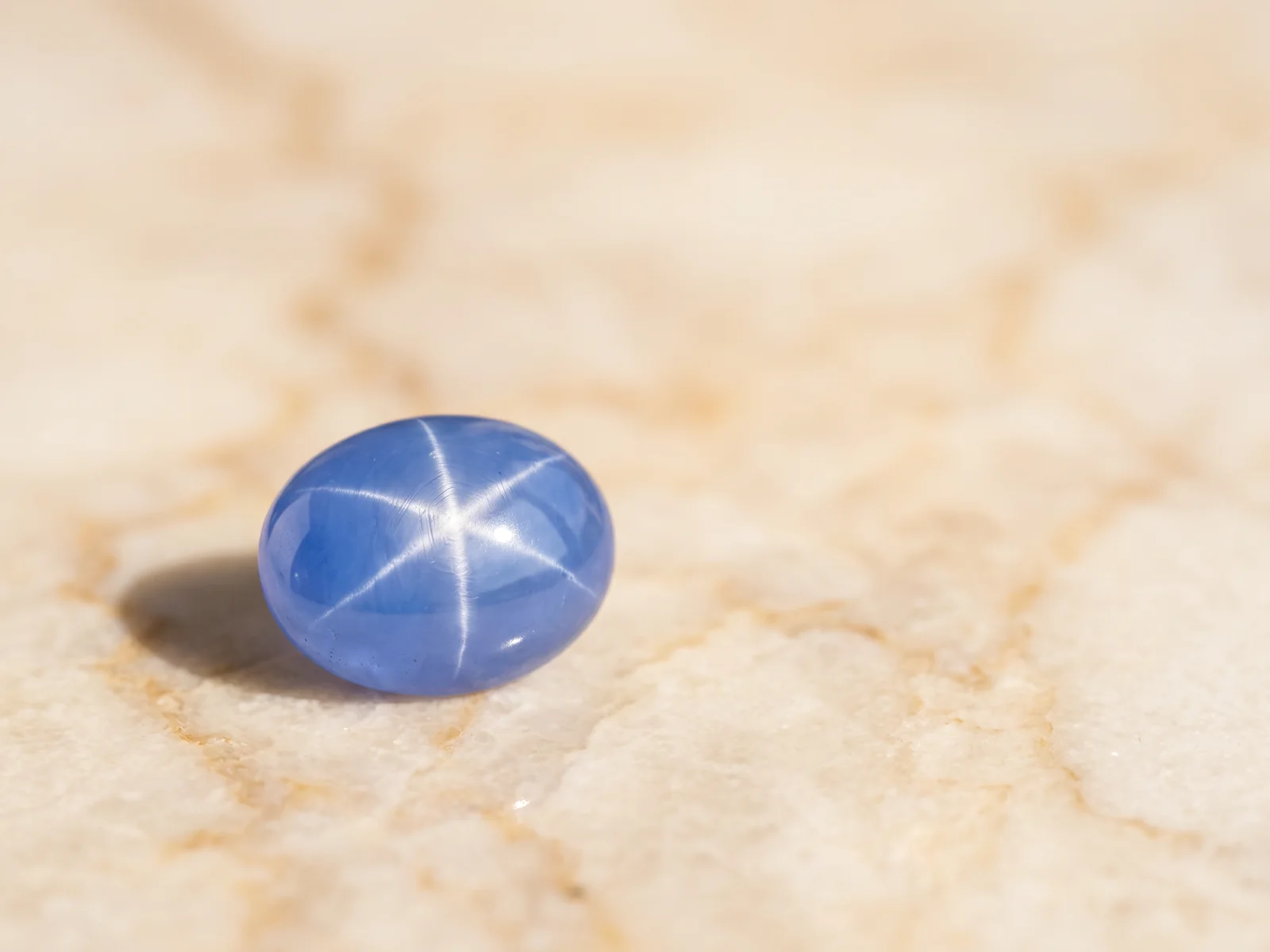
Asterism starts with inclusions. Corundum (the mineral that forms sapphire and ruby) often grows with very fine needles of rutile, a titanium oxide. Gemmologists call these needles silk. Because corundum has a hexagonal crystal structure, the needles line up in three directions about 60° apart. Each set of needles reflects a thin band of light at right angles to itself, so three bands cross on the dome of a cabochon (a stone with a smooth, rounded top and no facets) and you see a six-rayed star.
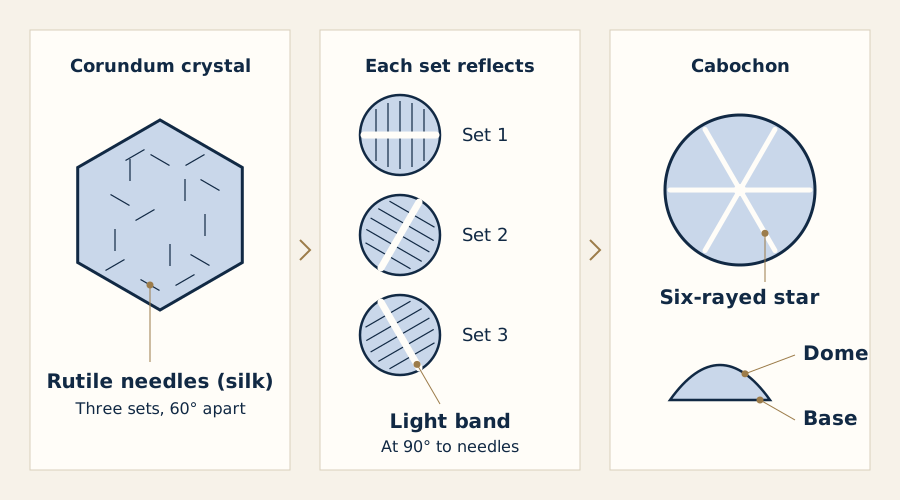
The cutter has to orient the rough so the dome sits directly over the crystal's main axis. Get it slightly wrong and the star is off-centre or its rays bend. Garnet and diopside usually show four-rayed stars, because their needles run in two main directions. Spinel can show four or six rays depending on how it is cut. Very rarely, sapphire shows a 12-rayed star, where two different sets of inclusions each make their own six-rayed star, offset from each other.
Chatoyancy works the same way with only one set of parallel inclusions, so you see a single band of light instead of a star. The word comes from the French for cat. In the trade, 'cat's-eye' on its own means chrysoberyl; any other species must be named, such as cat's-eye tourmaline or cat's-eye quartz. Fine chrysoberyl cat's-eyes show the milk-and-honey effect: lit from one side, the half nearest the light looks milky while the other half stays golden.
A few stones combine two phenomena, such as cat's-eye alexandrite, which shows a line and changes colour. They sit among the collector gems such as cat's-eye alexandrite and 12-rayed stars. Stars are also found in ruby, including the classic star ruby, and in spinel, an underrated choice for engagement rings. The density and pattern of silk can also help a laboratory work out where a sapphire or ruby was mined.
Why do colour change gemstones like alexandrite change colour?
Alexandrite is a variety of chrysoberyl coloured by traces of chromium. Chromium absorbs much of the yellow part of the spectrum and lets green-blue and red light through in roughly equal amounts. Daylight and cool LED light are rich in blue-green, so the stone looks green to bluish green. Incandescent globes and candlelight are rich in red, so the same stone looks red to purplish red. The stone itself does not change; the light does, and your eye reads the balance differently.
Other colour change gemstones include some garnets (often blue-green to purple), sapphires (commonly blue in daylight and violet to purple indoors) and spinels. The trade describes the strength of change as weak, moderate or strong, and judges how saturated the colour is in each light. A strong change from clean green to clean red is the ideal; brownish or greyish tones in either light lower the value.
Lab-created alexandrite is widely available, often with a stronger and cleaner change than most natural stones, at a small fraction of the price. Lab-created corundum doped with vanadium is also sold as a colour-change imitation and must be described as synthetic or lab-created sapphire, not alexandrite. Telling these apart needs magnification and instruments; our page on the lab tests gemmologists use to tell natural from lab-created explains how.
Do not confuse colour change with pleochroism, where a gem shows different colours when viewed along different crystal directions in the same light. Tanzanite (blue, violet and burgundy), iolite (violet-blue and grey-yellow) and andalusite (green and brownish red) are strongly pleochroic, and alexandrite is too. Pleochroism is why a cutter's choice of orientation changes the face-up colour.
Not sure which one is right?
Send us the stones you are looking at and our gemologist will tell you which to choose and why.
What causes play-of-colour in opal and the glow in moonstone?
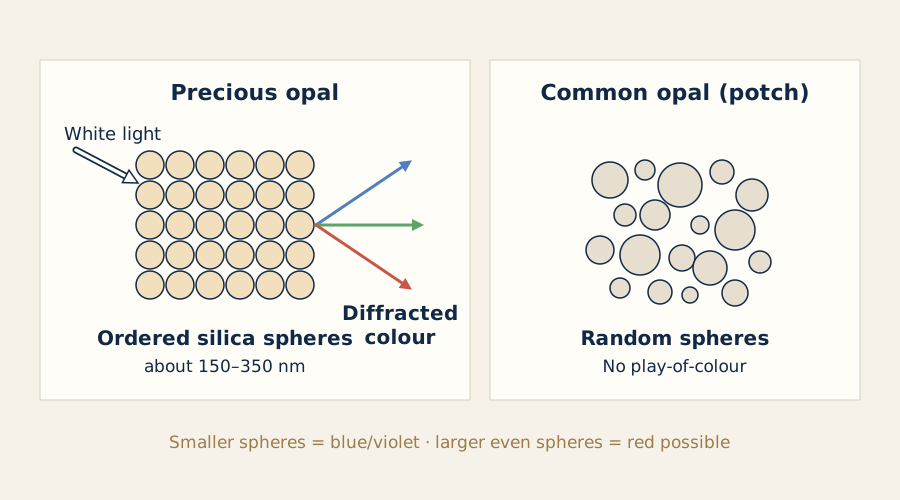
Precious opal is hydrated silica (silicon dioxide holding some water). Under an electron microscope it is made of tiny silica spheres, roughly 150–350 nanometres across, stacked in an orderly grid. The gaps between rows act like a diffraction grating, splitting white light into pure spectral colours. Smaller spheres diffract blues and violets; only larger, very even spheres produce reds, which is why red play-of-colour is the rarest. Common opal, or potch, has the same material with jumbled spheres, so it shows no play-of-colour.
Australia produces most of the world's precious opal: black opal from Lightning Ridge in New South Wales, white and crystal opal from Coober Pedy and Andamooka in South Australia, and boulder opal, which forms in ironstone, from Queensland. Opal is valued on body tone (light to black, often described on an N1–N9 scale), the brightness and pattern of its play-of-colour, which colours appear, and freedom from cracks.
Adularescence is the soft, moving glow in moonstone. Moonstone is a feldspar made of extremely thin, alternating layers of two minerals, orthoclase and albite. When the layers are very thin they scatter blue light, giving the prized blue sheen; thicker layers give a whiter glow. The finest moonstones have a near-transparent body with a blue sheen that floats in the centre of the dome.
- Labradorescence: thin internal layers in labradorite reflect broad flashes of blue, green, gold or orange from one angle; spectrolite from Finland shows the full range.
- Iridescence and orient: the overlapping nacre layers in a pearl create its soft orient; ammolite (fossil shell) and fire agate show bolder rainbow colour from stacked layers.
- Aventurescence: flat platelets reflect light like glitter, such as copper in Oregon sunstone, hematite in some feldspar sunstone, or green mica (fuchsite) in aventurine quartz.
Many of these gems are softer than sapphire. Opal is 5.5–6.5 on the Mohs scale, moonstone and labradorite about 6–6.5, and pearl only 2.5–4.5. Our guide to how each gem rates on the Mohs hardness scale puts them in context.
What is fire in a gemstone, and which gems have the most?
Fire is the flash of spectral colour you see as a faceted stone moves. It comes from dispersion, the way a gem bends each colour of light by a slightly different amount, so white light fans out into a rainbow. Dispersion is measured as the difference in refractive index between red and violet light (between two specific wavelengths of the spectrum). The higher the number, the more fire a well-cut stone can show.
| Gem | Dispersion | Mohs hardness | Note |
|---|---|---|---|
| Moissanite (lab-created) | 0.104 | 9.25 | More than twice diamond's fire |
| Demantoid garnet | 0.057 | 6.5–7 | Highest fire of common natural gems |
| Sphene (titanite) | 0.051 | 5–5.5 | Strong fire but soft |
| Diamond | 0.044 | 10 | The benchmark |
| Zircon | 0.039 | 6–7.5 | Natural zircon, not cubic zirconia |
| Spinel | 0.020 | 8 | Modest fire, bright and durable |
| Sapphire and ruby | 0.018 | 9 | Fire mostly hidden by body colour |
| Quartz | 0.013 | 7 | Very little fire |
Body colour masks fire, so a light-toned demantoid or zircon shows its flashes more clearly than a deep green or blue one. Cut matters too: fire needs crisp facets and good proportions.
Fluorescence is a related effect: a glow when a gem absorbs ultraviolet light. Ruby's chromium makes it fluoresce red, and in natural light that glow adds to its colour, one reason fine rubies look so vivid. Many diamonds fluoresce blue under UV. Fluorescence is not usually counted as a visible phenomenon in daylight, but labs use it as an identification clue.
Are optical phenomena in gemstones natural, treated or lab-created?
Every effect on this page occurs in nature, but most can also be enhanced, imitated or grown. That is not a problem in itself, as long as it is disclosed and priced accordingly. The main ones to know:
- Diffusion stars: titanium is diffused into the surface of a corundum cabochon, then heated so a thin layer of rutile needles forms near the surface. The star is often too sharp and too even, sits only skin deep and can disappear if the stone is repolished.
- Lab-created star sapphire and ruby: grown since the mid-20th century, with very sharp stars, even colour and curved growth lines under magnification.
- Heat treatment: heating can dissolve silk, which removes star or cat's-eye potential but clears the stone; it is also used to improve colour.
- Opal treatments and assembled opal: smoke and sugar-acid treatment darken porous opal to imitate black opal, and some opal is impregnated with plastic. Doublets and triplets are thin slices of opal glued to a backing, with a clear quartz or glass cap on a triplet. Lab-created opal often shows a regular lizard-skin or chicken-wire pattern under magnification.
- Coatings: thin films on quartz or topaz create a rainbow 'mystic' surface that is not natural iridescence and can wear off.
- Glass imitations: fibre-optic glass makes convincing cat's-eyes, but shows a honeycomb pattern from the side.
A natural star sapphire and a lab-created star sapphire are both corundum, with the same hardness of 9, but they differ hugely in rarity and price. Any treatment or synthetic origin should be stated on the invoice and the laboratory report. Our guide to how treatments change value and are disclosed goes through each one.
Related guideTreated vs Untreated GemstonesHow are phenomenal gemstones graded and valued?
There is no single international grading scale for phenomenal gems like the colour and clarity scales used for diamonds. Gemmologists judge the strength and quality of the effect first, then body colour, transparency, clarity, cut and size. Here is what to look for in the main types:
| Gem | What to look for | Common faults |
|---|---|---|
| Star sapphire or ruby | Six straight, sharp rays, centred and reaching the girdle; saturated body colour; some transparency | Wavy, broken or off-centre rays; grey or milky body; a very thick base |
| Cat's-eye chrysoberyl | A thin, sharp, straight line across the centre; milk-and-honey effect; honey to greenish body | A broad, fuzzy band; line off-centre or bent |
| Alexandrite | A strong change, ideally green to red, with good saturation in both lights | Weak change; brownish or greyish tones |
| Precious opal | Bright play across the whole face, a range of colours including red, dark body tone in black opal | Dull patches, crazing (fine surface cracks), visible potch lines |
| Moonstone | Blue sheen spread across the dome on a near-transparent body | White sheen only; visible cleavage cracks |
Cabochons are often cut with a deep or heavy base to keep the star centred and save weight, which adds carats without adding face-up size. Always compare the millimetre measurements as well as the carat weight; our page on why carat weight and face-up size differ from gem to gem explains the density side of this.
Natural phenomenal stones with strong effects and good body colour are scarce, while lab-created star sapphires, alexandrites and opals cost much less and often show sharper, more even effects. Both are legitimate choices, as long as you know which one you are looking at.
Browse natural gemstones
Are phenomenal gems suitable for everyday rings?
It depends on the species, not the effect. Star and cat's-eye stones in corundum and chrysoberyl are excellent for daily wear; opal, moonstone and pearl need more care.
- Star sapphire and star ruby: Mohs 9, tough; well suited to engagement rings.
- Chrysoberyl and alexandrite: Mohs 8.5 and very tough; a durable everyday choice.
- Spinel: Mohs 8, no cleavage; good for rings.
- Moonstone and labradorite: Mohs 6–6.5 with cleavage (planes along which they can split); better in pendants and earrings, or protected ring settings.
- Opal: Mohs 5.5–6.5, contains water and can craze or crack with knocks and sudden temperature changes; best in a low, protective setting.
- Pearl: Mohs 2.5–4.5; keep away from perfume, sunscreen and household chemicals.
For a fuller comparison, see our list of gems that cope well with daily wear in rings. Cleaning matters too: opal, moonstone, pearls, doublets, triplets and fracture-filled stones should never go in an ultrasonic cleaner. Check which gems are unsafe in an ultrasonic cleaner before you try; warm soapy water and a soft brush are safe for almost everything.
Cabochons usually sit in a bezel (a metal rim around the edge) or in claws that hold the girdle while leaving the dome free to catch the light. A low profile protects opal and moonstone from knocks. Our guides to designing a secure setting for softer coloured stones and bezel, claw and other setting styles compared cover the options. If you are resetting an inherited star sapphire or opal, scanning the stone and ring for a CAD redesign lets the new setting be built around its exact dome height and the orientation of the star.
How do you check a star, cat's-eye or opal before you buy? Step by step
- Confirm what it is. Ask for the species, whether it is natural or lab-created, and any treatment, ideally backed by a laboratory report.
- Use a single light. Move a phone torch over a star or cat's-eye; the star should glide smoothly, with straight, sharp rays meeting in the centre.
- Check in ordinary light. Look at body colour and transparency under soft, even light, where the effect should still be visible.
- Test colour change in two lights. View alexandrite or colour-change sapphire in daylight or cool LED, then under a warm incandescent globe.
- Look at the side and back. A glue line points to an opal doublet or triplet; a very thick base adds weight; a too-perfect star may be diffused or lab-created.
- Inspect for cracks. Check opal for crazing and moonstone for cleavage cracks under magnification.
- Match the setting to the stone. Choose a protective bezel or low setting for softer gems before you commit to wearing them every day.
Free consultation
Talk to a gemologist
Compare stones in person or online with Raj Sood, Graduate Gemologist (GIA), AJP (GIA).
Book a consultationShop this shape
FAQ
Common questions
What is the rarest optical phenomenon in gemstones?
Among the well-known effects, 12-rayed stars in sapphire and stones that combine two phenomena, such as cat's-eye alexandrite, are among the rarest. Fine red play-of-colour in black opal is also scarce.
Is a star sapphire a real sapphire?
A natural star sapphire is genuine corundum with aligned rutile needles that create the star. Lab-created star sapphires are also corundum but grown in a laboratory, and some natural stones have stars added by surface diffusion, which must be disclosed.
What does cat's eye mean in a gemstone?
It describes chatoyancy, a single band of light across a cabochon caused by parallel inclusions. On its own, 'cat's-eye' refers to chrysoberyl; other gems must be named, such as cat's-eye tourmaline.
Why does my alexandrite look different at night?
Alexandrite absorbs yellow light and transmits green and red in near balance. Daylight is rich in blue-green so it looks green, while warm indoor light is rich in red so it looks red to purplish.
Is moonstone durable enough for an engagement ring?
Moonstone is about 6–6.5 on the Mohs scale and has cleavage, so it can scratch and split with hard knocks. It can work in a protective bezel with careful wear, but sapphire or spinel is more forgiving for daily use.
Can you clean opal in an ultrasonic cleaner?
No. Vibration and heat can crack solid opal and loosen the glue in doublets and triplets. Use lukewarm water, a little mild soap and a soft cloth.

Ask a gemologist
Not sure which diamond to choose?
Raj Sood is a Graduate Gemologist (GIA) and master jeweller. Bring the stones you are considering, or send the reports, and he will tell you honestly which one is better and why.
Keep learning
Related guides
 GemstonesTreated vs Untreated Gemstones
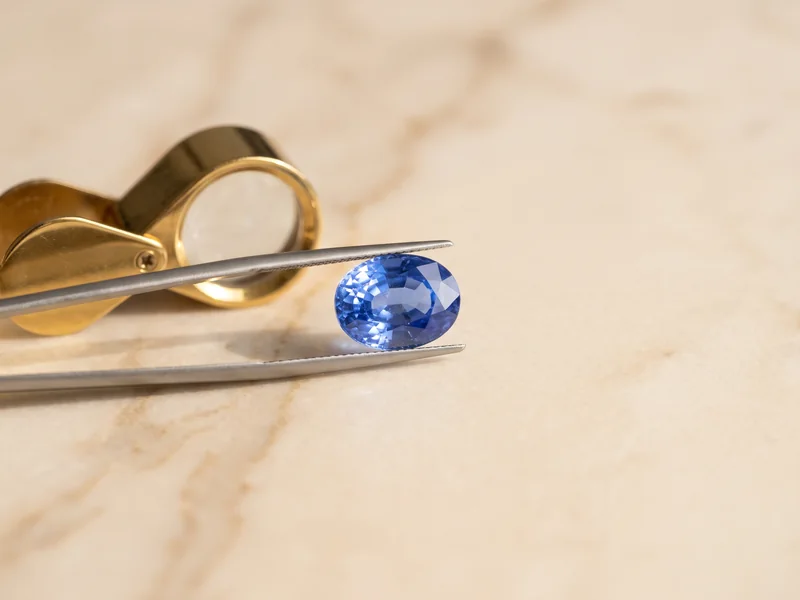 GemstonesGemstone Identification Scientific Guide
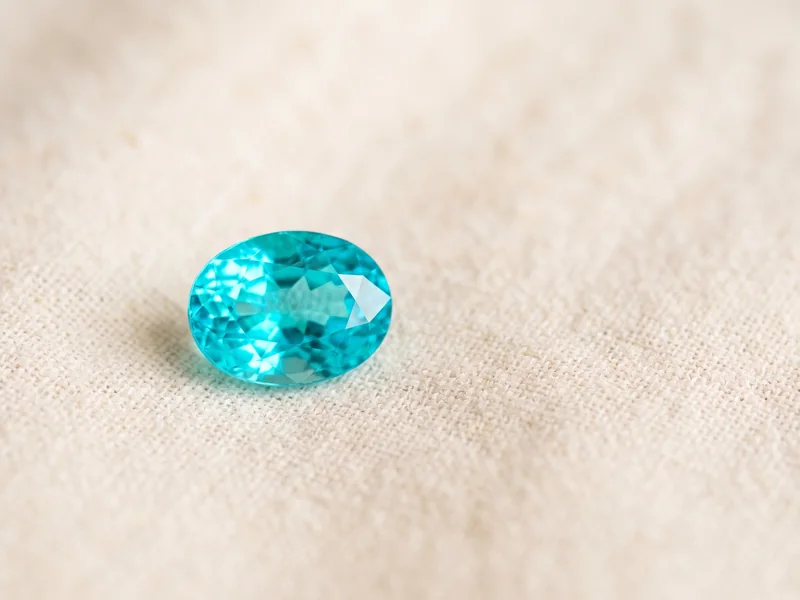 GemstonesRare Collector Gemstones
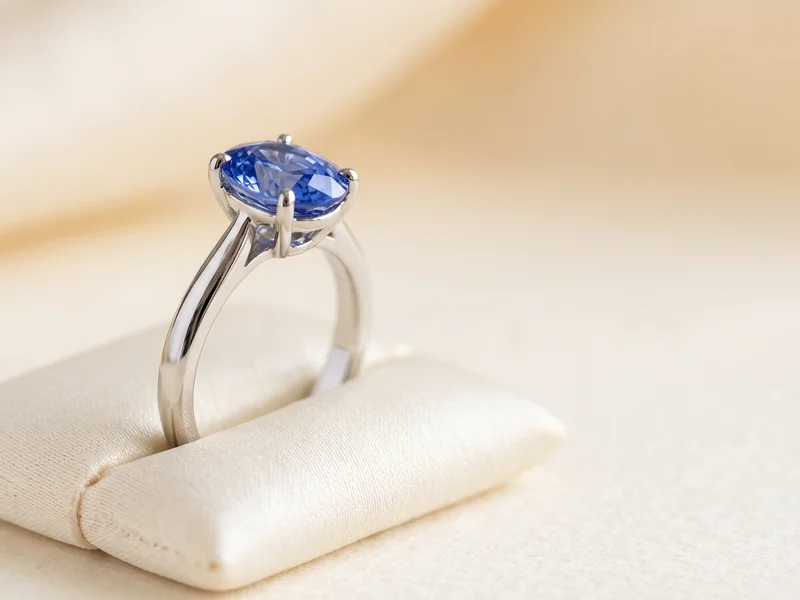 GemstonesHow to Design a Secure Setting for a Coloured GemstoneGemstonesGemstones | Coloured Gemstones, Birthstones and Custom Jewellery
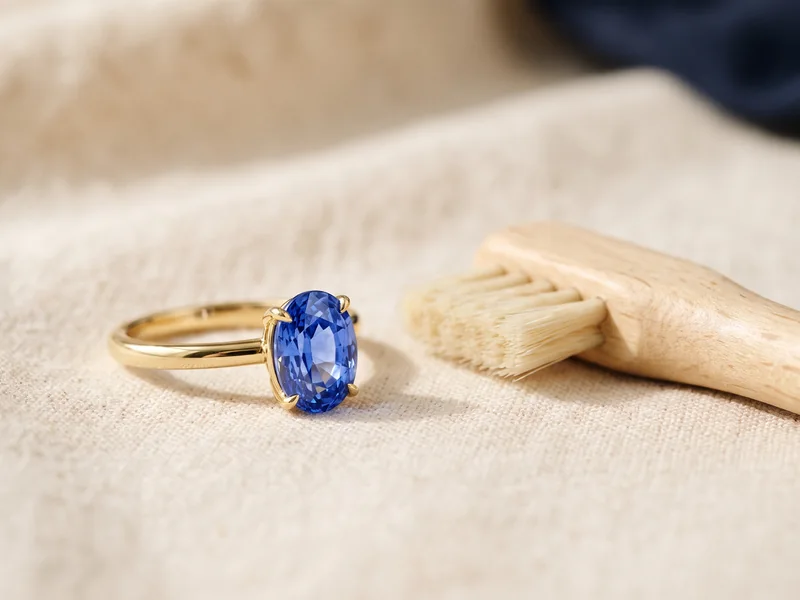 GemstonesCan Every Gemstone Go in an Ultrasonic Cleaner?
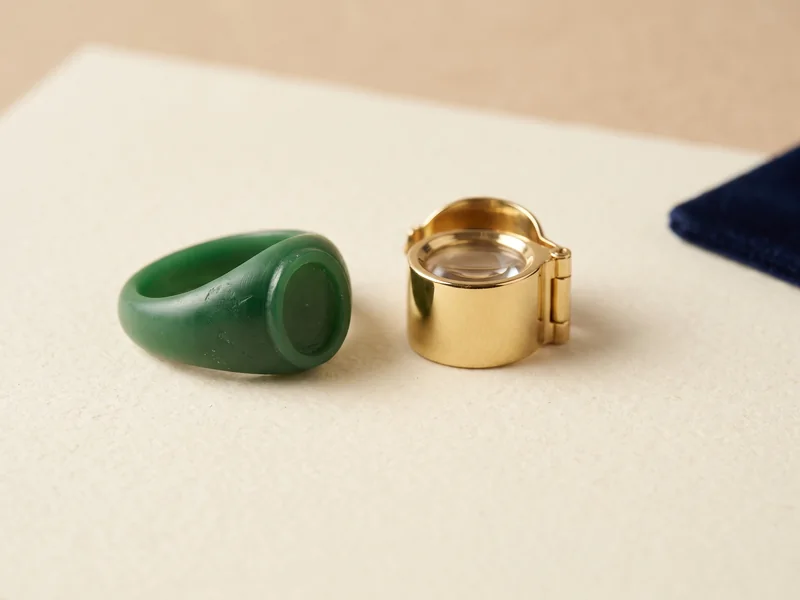 GemstonesGemstone and Ring Scanning for CAD Remodelling
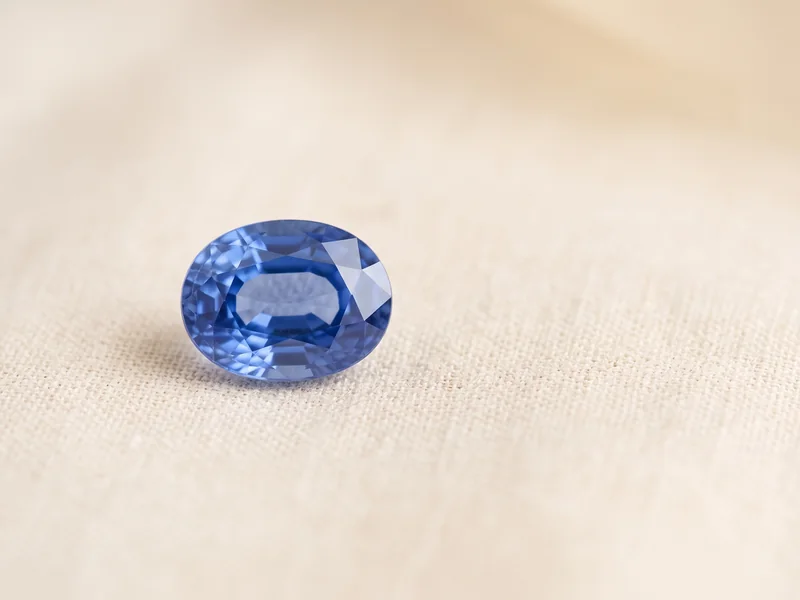 GemstonesGemstone Properties: Hardness, RI, SG, Durability and Jewellery Use
Explore more
More guides on this topic
Education