
Gemstones
Gemstone Origins Explained: Ceylon, Burma, Kashmir, Madagascar and Mozambique
Gemstone origins such as Ceylon, Burma and Kashmir can change the price of a sapphire or ruby more than almost any other line on a report. Here is what each origin really tells you about colour, treatment and value, and what it does not.
 Reviewed by Raj Sood, Graduate Gemologist (GIA), AJP (GIA)Master jeweller and Graduate Gemologist (GIA) · reviewed 4 November 2026
Quick answer
Gemstone origins describe where a natural gem was mined, such as Ceylon (Sri Lanka), Burma (Myanmar), Kashmir, Madagascar or Mozambique. Each region's geology leaves typical colours, inclusions and trace elements, so labs can give an expert opinion on origin. Origin can add a large premium, but colour, clarity, cut and treatment still matter more for beauty.
What do gemstone origins mean?
A gem's origin is the country, and sometimes the mining area, where it formed and was dug from the ground. In the coloured stone trade the old names stick: Ceylon for Sri Lanka and Burma for Myanmar are still used on lab reports and price lists. Origin applies only to natural gems. A lab-created sapphire grown in a furnace has no mine and no geographic origin, which our page on lab-created and synthetic gems explains.
Origin matters most for three gems: sapphire and ruby (both the mineral corundum, 9 on the Mohs scale) and emerald (the mineral beryl, 7.5–8). For these, a handful of famous sources have built reputations over centuries, and buyers pay for the name. For most other stones, such as garnet, peridot or topaz, origin is a curiosity rather than a price factor. Our complete sapphire guide and guide to emerald colour and clarity cover those stones in full, and the wider family sits in our coloured gemstones hub.
It helps to be clear about what origin is not. It is not a quality grade. A Burmese ruby can be dull and heavily included, and a Mozambique ruby can be superb. Origin describes geology and history; the stone in front of you still has to earn its price on colour, clarity and cut.
How does geology shape a gem's colour?
Corundum is colourless aluminium oxide (Al2O3). Tiny amounts of other elements, often well under 1% by weight, give it colour: chromium makes ruby red and pink sapphire pink, while iron and titanium together make sapphire blue. How much of each element was present when the crystal grew depends on the rock it grew in, and that is the real reason the famous origins look different.
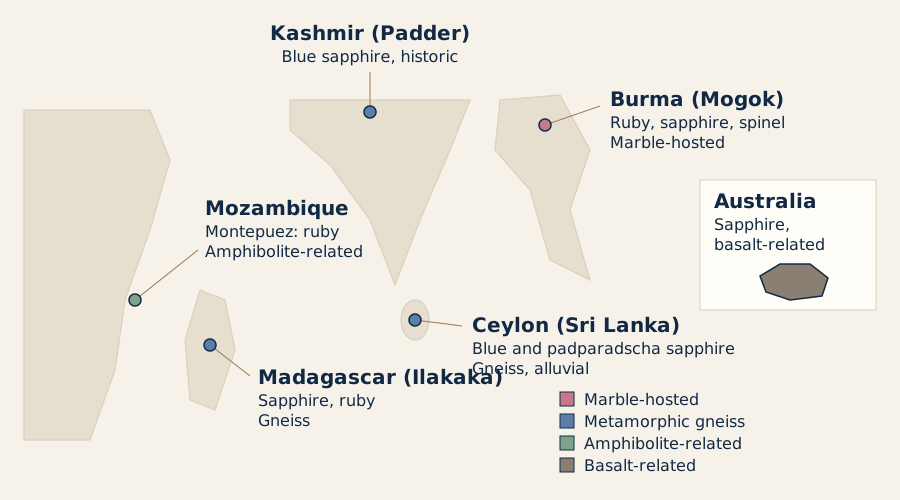
| Deposit type | Example sources | Typical result |
|---|---|---|
| Marble-hosted (metamorphic) | Mogok in Burma; parts of Vietnam and Afghanistan | Low-iron rubies that glow red under UV light, adding brightness in daylight |
| Metamorphic gneiss and related rocks | Sri Lanka, Madagascar, Kashmir | Light to medium blues, padparadscha, fine silk |
| Amphibolite-related | Montepuez in Mozambique | Rubies from low-iron, Burma-like red to slightly darker, higher-iron stones |
| Basalt-related | Australia (New England NSW, central Queensland), Thailand, Cambodia | Higher-iron, darker blue, green and yellow sapphires; darker rubies with weak fluorescence |
Iron is the key. Iron dampens fluorescence (a glow under ultraviolet light), so marble-hosted rubies, which formed with very little iron, light up red even in sunlight. Basalt-related stones carry more iron, which is why Australian blue sapphires are usually a deep, inky blue, often with green tones. Australia is a genuine sapphire origin too, known for deep-coloured, durable stones.
Many gems are found far from the rock that formed them. Over millions of years rivers wear the host rock away and leave the hard corundum behind in alluvial gravels (gem-bearing river sediments). Most of Sri Lanka's gems are mined this way, which is why a single gravel pit can yield sapphire, spinel, garnet and chrysoberyl at once.
What does a Ceylon sapphire look like?
Sri Lanka has traded gems for more than 2,000 years, and the town of Ratnapura, whose name means 'city of gems', is still the centre of the trade. Ceylon sapphires are known for a light to medium, bright blue, often called cornflower, with lively brilliance because the colour is not too dark. Many are cut with deep pavilions (the lower half of the stone) to hold onto colour in paler rough, so check the face-up size in millimetres, not only the carat weight.
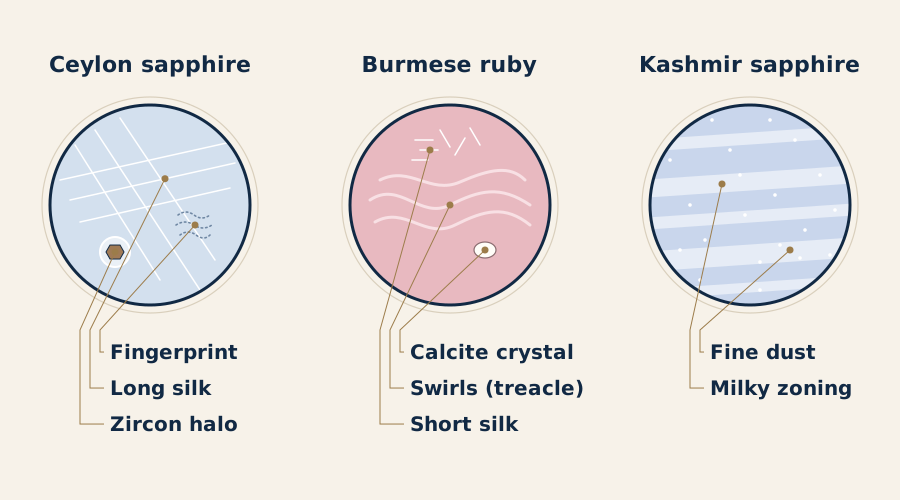
- Typical inclusions: long, fine rutile needles called silk, fingerprint-like healed fractures, and small zircon crystals surrounded by stress haloes.
- Other colours: yellow, pink, purple and the pink-orange padparadscha, one of the rarest sapphire colours.
- Phenomenal stones: star sapphires and cat's-eye chrysoberyl, where aligned silk or fibres reflect a star or band of light.
- Treatment: heating is common. Milky white 'geuda' sapphire from Sri Lanka turns blue when heated, a process that reshaped the sapphire market from the 1970s onwards.
Unheated Ceylon sapphire with good colour carries a clear premium over heated stones that look the same. Our page on what Sri Lankan origin means for a sapphire goes deeper. For stars and cat's-eyes, see how star and cat's-eye effects form, and padparadscha appears among the rare stones that collectors chase.
What makes a Burmese ruby so prized?
The Mogok Stone Tract in central Myanmar has produced rubies for centuries and set the standard every other ruby is compared with. Mogok rubies grew in marble, so they are low in iron and rich in chromium. The result is a saturated red that fluoresces strongly, giving a glowing look the trade calls pigeon's blood. Several major labs now use that term for a colour type rather than an origin, and can apply it to stones from other sources that meet the same standard.
Burma also produces fine blue sapphire, usually a richer, more saturated royal blue than Ceylon, plus spinel and peridot. Typical Mogok ruby clues include short rutile silk, swirl-like colour zoning (called 'treacle') and small calcite crystals from the marble. A second source, Mong Hsu, reached the market in the 1990s; its rubies have a dark bluish core that heating removes, so nearly all of them are heated.
Burmese gems raise questions beyond geology. Some countries have restricted imports of Burmese rubies at various times, and some buyers avoid them for human-rights reasons. If that matters to you, ask the seller about the source and the paperwork, and read our guide to heated and untreated stones before comparing prices, because an unheated Burmese ruby and a heated one sit at very different levels.
Not sure which one is right?
Send us the stones you are looking at and our gemologist will tell you which to choose and why.
Why are Kashmir sapphires so rare?
Kashmir sapphires come from a small area in the Padder region of the Zanskar range, at roughly 4,500 metres altitude, where a landslide is said to have exposed them around 1881. The richest pocket was worked out within about five years. Later digs found little, and the area has produced almost nothing of note for decades. Nearly every Kashmir sapphire for sale today was mined more than a century ago and comes back to market from old jewellery and collections.
Their look is distinctive: a velvety, soft cornflower blue, caused by microscopic particles and fine milky zones that scatter light. The trade calls it a 'sleepy' look. It softens the hard edges of the facets so the colour seems to fill the whole stone evenly, in both daylight and warm indoor light, where many blue sapphires turn darker.
Because of that rarity, fine Kashmir sapphires sell for far more per carat than stones of the same appearance from anywhere else. The premium is also why labs are cautious with the word Kashmir, and why a Kashmir claim without a report from a recognised coloured stone lab means very little.
What about Madagascar sapphire and Mozambique ruby?
Madagascar and Mozambique are the newer sources that now supply a large share of the world's fine corundum.
Madagascar became a major source after a sapphire rush at Ilakaka in 1998, and it produces blue, pink, yellow and padparadscha sapphires as well as ruby. Because its geology resembles Sri Lanka's, some Madagascar sapphires look almost identical to Ceylon stones, and labs may need trace-element testing to separate them. A large find near Ambatondrazaka around 2016 produced blues with a velvety look often compared with Kashmir.
Mozambique changed the ruby market when the Montepuez deposit in the north of the country was found around 2009. It is now one of the world's largest ruby sources. The finest Montepuez rubies are low in iron, fluoresce well and can match Burmese colour; others are slightly darker or more purplish. Most are heated, though fine unheated stones exist. Mozambique also produces copper-bearing tourmaline, often sold as 'Paraíba-type' after the Brazilian original.
One caution with rubies from any source: some low-grade rubies are filled with lead glass to hide fractures. These are composite or glass-filled rubies, and they must be disclosed. They are far less durable and cannot take heat, solvents or ultrasonic cleaning; our cleaning and care advice for each stone covers what to avoid.
How do the main gemstone origins compare?
| Ceylon (Sri Lanka) | Burma (Myanmar) | Kashmir | Madagascar | Mozambique | |
|---|---|---|---|---|---|
| Known for | Blue and padparadscha sapphire | Ruby, royal blue sapphire, spinel | Blue sapphire | Sapphire in many colours, ruby | Ruby, copper-bearing tourmaline |
| Typical colour | Light to medium bright blue | Saturated red; deep royal blue | Velvety cornflower blue | Wide range; some Ceylon-like or Kashmir-like | Red to slightly purplish red |
| Typical clues | Long fine silk, zircon haloes | Short silk, swirls, calcite crystals | Milky zoning, fine particles | Similar to Ceylon; often needs trace elements | Amphibole crystals, fine particles |
| Still producing? | Yes | Yes | Essentially no | Yes | Yes |
| Origin premium | Moderate | High, especially unheated | Very high | Low to moderate | Low to moderate |
Emerald follows the same pattern. Colombian emeralds from Muzo and Chivor are prized for a warm, pure green and often contain jagged three-phase inclusions (a cavity holding liquid, a gas bubble and a tiny salt crystal). Zambian emeralds carry more iron and lean towards a cooler, slightly bluish green, often with good clarity. Brazil and Ethiopia supply many emeralds too. Nearly all emeralds are oiled or resin-filled to reduce the look of fractures, whatever their origin.
Hardness does not change with origin. A sapphire from any country is 9 on the Mohs scale, and an emerald is 7.5–8 with more fragile inclusions. Our Mohs hardness chart for every gem lists them side by side.
How is gemstone origin determined on a lab report?
No single test proves where a gem was mined. Labs build an opinion from several lines of evidence:
- Microscope: a gemmologist studies inclusions at roughly 10× to 100× magnification. Silk length, crystal types and growth patterns point to a geological type.
- Spectroscopy: UV-visible and infrared (FTIR) spectra show how the stone absorbs light and can reveal heat treatment.
- Trace elements: instruments such as EDXRF and LA-ICP-MS (a laser that vaporises a microscopic speck, usually from the girdle) measure parts-per-million amounts of iron, gallium, vanadium, chromium, titanium and magnesium.
- Reference collections: results are compared with large collections of stones of known origin gathered by the lab over decades.
The result is an opinion, usually worded along the lines of 'gemmological testing revealed characteristics consistent with Sri Lanka'. Labs can disagree, and for some stones the answer is 'inconclusive' or 'no origin determined'. Origin opinions for coloured stones come from specialist labs such as SSEF, Gübelin, GRS, AGL and GIA. A standard identification report confirms the species and any treatments; origin is often an extra service. Our page on scientific gem identification methods shows how species and treatments are tested, and how labs work out where a gem was mined covers each origin test step by step.
Related guideHow Gemstone Origin Is DeterminedDo gemstone origins affect value and price?
Yes, sometimes a great deal, but only once a stone already has fine colour. A dark, heavily included Burmese sapphire gains little from its name. A bright, eye-clean, unheated one can cost several times as much as a heated stone from a less famous source that looks very similar. Origin and treatment together set the premium more than either alone.
| 1 ct fine blue sapphire | Approximate price range (AUD) |
|---|---|
| Heated, Madagascar or Sri Lanka | about $1,000–$4,000 |
| Unheated, Sri Lanka | about $2,500–$8,000 |
| Unheated, Burma | about $4,000–$15,000 |
| Unheated, Kashmir | rarely offered; often well above $20,000 |
These are broad ranges only; prices move with the market, the exact colour and the lab behind the report. For a ring you will wear every day, origin is a personal choice rather than a practical one. A heated Madagascar sapphire is just as hard and wearable as an unheated Kashmir stone. If you are planning engagement rings set with coloured stones, put durability first: our guides to how durable gems are for everyday rings and gems that suit daily wear compare the options.
Browse natural gemstones
How do you buy a gemstone with a stated origin? Step by step
- Confirm it is natural. Origin applies only to natural gems; a lab-created stone should be described as lab-created or synthetic.
- Ask for the lab report. Check the lab's name, the report number and whether origin is stated or listed as not determined.
- Read the treatment line. Look for 'no indications of heating' or the type of treatment, such as heat, oil or glass filling.
- Match the stone to the report. Compare the carat weight, the measurements in millimetres and the colour description.
- Judge the colour yourself. View the stone in daylight and warm indoor light; the origin should never outweigh what you see.
- Compare like with like. Price an unheated stone against other unheated stones of the same origin, colour and size.
- Keep the paperwork. The report stays part of the stone's history for insurance, resale or a future remodel.
Any term you meet on a report that is not explained here is in our glossary of jewellery terms.
Free consultation
Talk to a gemologist
Compare stones in person or online with Raj Sood, Graduate Gemologist (GIA), AJP (GIA).
Book a consultationShop this shape
FAQ
Common questions
Is Ceylon sapphire the same as Sri Lankan sapphire?
Yes. Ceylon was Sri Lanka's name until 1972, and the trade still uses it for sapphires mined there. A report may say 'Sri Lanka (Ceylon)'.
Does gemstone origin affect value?
For fine sapphire, ruby and emerald it can, sometimes greatly, with Kashmir and Burma carrying the largest premiums. For lower-quality stones and most other gems, colour, clarity, cut and treatment matter far more than origin.
Can a lab tell exactly where a gem came from?
Not with certainty. Labs give an expert opinion based on inclusions, spectra and trace elements, and for some stones they report the origin as inconclusive.
Are Burmese rubies better than Mozambique rubies?
Not automatically. The finest Mozambique rubies can match Burmese colour and fluorescence; Burmese stones carry a historical premium, but each ruby should be judged on its own colour, clarity and treatment.
Do lab-created rubies and sapphires have an origin?
They have no mine or geographic origin because they are grown in a laboratory. A report should describe them as synthetic or lab-created.
Are Kashmir sapphires still mined?
Almost none. The main pocket was worked out in the 1880s, so nearly all Kashmir sapphires on the market today are old stones re-sold from earlier jewellery.

Ask a gemologist
Not sure which diamond to choose?
Raj Sood is a Graduate Gemologist (GIA) and master jeweller. Bring the stones you are considering, or send the reports, and he will tell you honestly which one is better and why.
Keep learning
Related guides
 GemstonesCeylon Sapphire: What Does Sri Lankan Origin Mean?
 GemstonesHow Gemstone Origin Is Determined
 GemstonesTreated vs Untreated Gemstones
 GemstonesSapphire GemstonesGemstonesGemstones | Coloured Gemstones, Birthstones and Custom Jewellery
 GemstonesGemstone Hardness Guide
 GemstonesGemstone Care by Stone
 GemstonesEngagement Rings with Colour, Meaning and Personal Gemstone Choice
Explore more
More guides on this topic
Education