
- Education
- Buying Knowledge & Custom Process
- Cast vs Hand-Fabricated Jewellery: How Each Is Made and Which Lasts
Buying Knowledge & Custom Process
Cast vs Hand-Fabricated Jewellery: How Each Is Made and Which Lasts
Two rings can look identical in the shop window yet be made in completely different ways. Understanding cast vs hand-fabricated jewellery helps you judge durability, price, repairs and what your insurance valuation should say.
 Reviewed by Raj Sood, Graduate Gemologist (GIA), AJP (GIA)Master jeweller and Graduate Gemologist (GIA) · reviewed 4 November 2026
Quick answer
Cast jewellery is made by pouring molten metal into a mould formed from a wax or 3D-printed model; hand-fabricated jewellery is built by a jeweller from rolled sheet and drawn wire, then sawn, forged and soldered. Fabricated metal is usually denser and free of casting porosity, while casting reproduces complex designs faster and at lower cost.
What is the difference in cast vs hand-fabricated jewellery?
Almost every ring, pendant or pair of earrings is made in one of two basic ways. Cast jewellery starts as liquid metal poured into a mould. Hand-fabricated jewellery starts as solid metal (sheet, wire and tube) that a jeweller cuts, bends, hammers and solders into shape at the bench. The finished pieces can look almost identical, but the metal inside behaves differently, and that affects strength, detail, price and how the piece wears over decades.
Neither method is automatically better. Casting is how most fine jewellery in Australia and overseas is made today, and a well-cast ring from a good model is a durable, honest piece. Hand fabrication is older, slower and more labour-intensive, and it produces denser metal that suits thin, high-wear parts such as claws and slim bands. Many quality pieces combine the two. If you are early in your research, our complete engagement ring buying guide puts the making method in context alongside the diamond, metal and setting, and our plain-English jewellery glossary explains any bench term you come across.
One quick point on language. 'Handmade' is used loosely in the trade. A cast ring that has been cleaned up, set and polished by hand is sometimes described as handmade, even though its shape came from a mould. It is reasonable to ask a jeweller exactly which parts were cast and which were fabricated, and a good one will tell you plainly.
How is cast jewellery made?
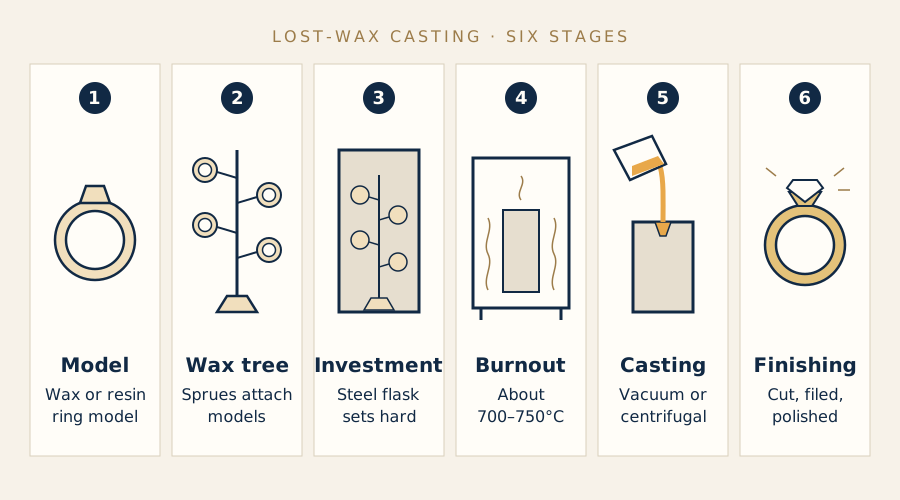
Nearly all cast jewellery uses lost-wax casting, a method thousands of years old that is still the backbone of the modern trade. The 'lost' wax is a model of the piece that is melted or burnt out to leave a hollow mould in exactly its shape.
- Model: a wax is carved by hand, or the design is drawn in CAD (computer-aided design) and 3D-printed in castable resin or wax.
- Sprue and tree: the model is attached to a wax stem called a sprue, usually on a 'tree' with other pieces, so the metal has a channel to flow in.
- Investment: the tree goes into a steel flask that is filled with investment, a fine plaster-like slurry that sets hard around the model.
- Burnout: the flask is heated in a kiln for several hours, typically peaking around 700–750°C for gold, so the wax or resin burns away and leaves a cavity.
- Casting: molten metal is drawn or forced into the cavity by vacuum, centrifugal force or pressure.
- Finishing: the investment is washed away, the piece is cut from the sprue, then filed, sanded, set and polished by hand.
Casting's strengths are detail and repeatability. A CAD model can include fine filigree, undercuts, hidden galleries and pavé seats that would take days to build by hand, and you can see a 3D render, or try on a resin sample, before any gold is used. That makes it easy to fine-tune proportions; a slimmer shank or lower head, for example, can suit the diamond shapes that flatter small hands and long fingers. It also makes casting a practical way to build a head shaped exactly around a fancy cut such as a heart shaped diamond, where the seat has to follow two lobes and a point.
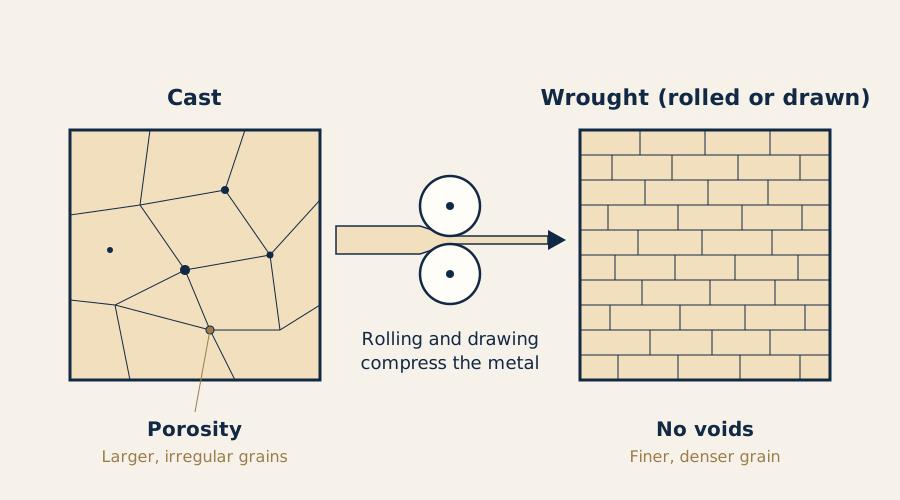
The weakness is porosity: tiny voids left by trapped gas or by metal shrinking as it cools. Most is microscopic and harmless. Some sits just under the surface and shows up as pinholes when the piece is polished, resized or worn down over the years. Platinum is harder again to cast well, because it melts at about 1,768°C compared with about 1,064°C for pure gold, and it needs special investment and equipment. Careful casters control porosity with clean metal, correct temperatures and good sprue design, which is why the skill of the caster matters as much as the method.
How is hand-fabricated jewellery made?
A hand-fabricated piece is built from metal that has already been mechanically worked, known as wrought metal. The jeweller starts with an alloy ingot, then passes it through a rolling mill to make sheet, or pulls it through a draw plate to make wire of an exact gauge. Each pass squeezes the metal, closing internal voids and breaking the coarse crystal structure of the ingot into a finer, tighter grain.
From there it is traditional bench work:
- Sawing and filing sheet into shapes such as a ring shank, bezel strip or gallery.
- Forging with hammers on a steel mandrel or anvil to shape and harden the metal.
- Soldering parts together with a slightly lower-melting solder of matching carat and colour.
- Annealing (heating the metal to soften it) between stages, so it can be worked further without cracking.
- Claw and bezel making from drawn wire or tube, followed by stone setting and polishing.
Fabrication suits clean, architectural designs: plain and knife-edge bands, tube and bezel settings, hand-made claw heads, signet blanks and bold geometric pieces such as many statement right-hand rings. It suits very intricate organic shapes less well; those are usually easier and more affordable to carve in wax or model in CAD and cast.
Is hand-fabricated jewellery stronger than cast?
In most cases, yes, metal for metal. Wrought sheet and wire are denser and more uniform than cast metal, and rolling and hammering work harden them, which raises hardness and springiness. As a rough guide, an 18ct yellow gold alloy might measure somewhere around 130–170 on the Vickers hardness scale (HV) as cast, and 200 HV or more once it has been rolled or forged. Exact figures vary a lot between alloys, so treat them as an illustration rather than a specification.
What that means on the hand:
- Claws: drawn-wire claws resist bending and wear more slowly than thin cast claws, which matters most for the claws holding a centre diamond, including the V-claws described in our guide to claw and bezel options that protect a heart's point.
- Thin bands: a 1.5–2 mm band made from wrought stock is less likely to go out of round.
- Polish: dense metal takes a high polish without pinholes appearing years later.
- Resizing: solid wrought metal is predictable to cut, stretch and solder; a porous cast shank can reveal voids at the join.
Two caveats. First, soldering heat anneals the metal around each joint, so some of that work hardening is lost where parts meet, and a poorly made solder joint is a weak point in its own right. Second, design matters more than method. A thick, well-cast shank with sensible claws will outlast a flimsy fabricated one. If you work with your hands, read our guides to settings that stand up to active hands and choosing a men's wedding band for tradies and hands-on work before you decide.
Not sure which one is right?
Send us the stones you are looking at and our gemologist will tell you which to choose and why.
Cast vs hand-fabricated jewellery: which should you choose?
| Cast | Hand-fabricated | |
|---|---|---|
| Starting material | Molten metal poured into a mould | Rolled sheet, drawn wire and tube |
| How the shape is formed | Wax or 3D-printed model, then lost-wax casting | Sawing, forging, bending and soldering at the bench |
| Metal structure | Larger grain, possible porosity | Finer grain, dense, work hardened |
| Detail and complexity | Excellent: filigree, pavé, undercuts | Best for clean, geometric shapes |
| Repeatability | Easy to make matching copies | Each piece made individually |
| Typical bench time | Clean-up, setting and polishing | Many hours of construction plus finishing |
| Making cost | Lower | Higher |
| Suits | Detailed rings, halos, pavé, matching sets | Plain bands, solitaire heads, bezels, thin sections |
For most engagement rings, a well-cast piece from a CAD model is a sound choice, especially for detailed designs, halos and pavé. Hand fabrication earns its extra cost on simple, high-wear pieces: everyday bands, solitaire heads, bezels and anything with very thin sections. A common middle path is a cast ring with hand-made claws or a fabricated shank, covered in the next section.
Whichever you choose, get the size right before the metal stage. A plain band can be sized up or down whichever way it was made, but patterned or stone-set designs are harder to alter, so start with measuring your ring size at home and confirm it with a jeweller.
Related guideBest Engagement Ring Settings for Active HandsWhat about die-struck, machine-made and hybrid jewellery?
Cast and hand-fabricated are not the only options, and you will see these terms in product descriptions too.
- Die-struck: metal blanks are stamped between hardened steel dies under very high pressure. The result is dense, like wrought metal, and very consistent, but each design needs expensive tooling, so it is mostly used for mass-produced bands, heads and findings (clasps, posts and other small parts).
- Machine-made (turned): many plain wedding bands are cut on a lathe or CNC machine from seamless tube or solid bar. The metal is wrought, so these bands are dense and strong, and the profile (court, flat, D-shape, comfort fit) is very precise.
- Hybrid: a cast body with fabricated parts, such as a cast setting on a hand-made shank, or a CAD-cast head fitted with drawn-wire claws. It combines casting's detail with fabrication's strength where it counts.
- Hand-forged: a type of fabrication where the shape comes mainly from hammering rather than sawing and soldering, often used for textured bands.
Platinum shows how the methods split. Platinum 950 (95% platinum) is often alloyed with cobalt for casting and with ruthenium for fabrication and machining, because each alloy behaves better for that process. Plain bands for hard-working hands are often turned or fabricated for the same reason; see our advice on comfort-fit and court-profile bands for people who work with their hands. Curved or contoured bands that hug a fancy-shape centre stone are the opposite case: they are usually modelled in CAD and cast, as in our guide to contoured wedding bands that sit flush beside a heart.
For an engagement ring, ask how the head and claws are made, because they do the hardest job. Our step-by-step guide to choosing an engagement ring covers the other questions worth asking.
Does hand-fabricated jewellery cost more?
Usually, yes, because you are paying for more bench time rather than more metal. Metal cost depends on weight and carat (18ct is 75% gold, 14ct 58.5% and 9ct 37.5%), and the same design weighs about the same either way. The difference is labour: a fabricated piece is built part by part, while a cast piece arrives close to its final shape and needs finishing.
| What you pay for | Cast and hand-finished | Hand-fabricated |
|---|---|---|
| Design | CAD model or hand-carved wax, plus renders | Sketch and measurements; CAD optional |
| Metal | By weight and carat | By weight and carat, plus small offcut losses |
| Bench time | Often about 2–6 hours of clean-up, setting and polishing | Often about 6–20+ hours of construction and finishing |
| Approximate extra making cost | Baseline | About AUD 300–1,500 more for a simple band or solitaire; more for complex pieces |
| Repeat orders | Cheaper once the model exists | Each piece made from scratch |
These are broad ranges only; prices vary with the design, the metal and the jeweller. A cast piece made from a CAD model also carries the cost of design time, but once a model exists, extra copies cost less, which is why casting suits matching pairs or family sets. The diamond or gemstone is priced separately, and the same setting suits either a natural or a laboratory-grown diamond. Lab-grown diamonds are real diamond, grown in a laboratory rather than mined, and cost much less than natural diamonds of the same size and grade.
A higher making cost also means a higher replacement cost, which is where cover matters. Our guide to how jewellery insurance works in Australia explains the basics.
Explore custom jewellery, natural diamonds and lab-grown diamonds
How does the making method affect insurance, valuation and the Tourist Refund Scheme?
An insurance valuation describes your piece so it can be replaced like for like. If it only says '18ct yellow gold diamond solitaire', an insurer could reasonably replace a hand-fabricated ring with a cast one, which costs less to make. Ask for the valuation to record:
- Method of manufacture: cast, hand-fabricated or hybrid, and which parts are which.
- Metal: carat or platinum fineness, colour and approximate weight in grams.
- Dimensions: band width and thickness, head height and claw style.
- Stones: each stone's details, whether natural or lab-grown, and any grading report number.
- Photographs: front, side and inside of the shank, including any maker's or fineness marks.
Check whether your policy is agreed value or market value, and whether the insurer can choose the replacement jeweller; our explainer on agreed-value and market-value jewellery cover sets out the differences. Gold prices and labour rates change, so many valuers suggest a review every two to three years; see how often to revalue your jewellery.
If you are visiting Australia, or an Australian resident heading overseas, the making method does not change your Tourist Refund Scheme (TRS) eligibility. The TRS lets eligible travellers claim back the 10% GST, which is 1/11 of the GST-inclusive price, when they spend AUD 300 or more, GST included, with one business in the 60 days before departure, and carry the goods (or wear the ring) through the airport with the original tax invoice. Custom work raises one practical point: lead times. If a piece takes several weeks to make, plan the invoice and collection dates around your flight. The full rules are in our guide to claiming GST back on jewellery under the Tourist Refund Scheme.
How do you choose between cast and hand-fabricated jewellery? Step by step
- Start with the design. Intricate, organic or pavé-heavy designs usually suit casting; clean, simple or very thin designs suit fabrication.
- Think about wear. If you use your hands hard, prioritise dense metal in the claws and shank, and pair it with low-profile settings for busy hands.
- Ask what was cast and what was made by hand. The head, claws, shank and gallery can each be made differently.
- Inspect the finish. Use a 10× loupe on the inside of the shank and under the claws, looking for pinholes or uneven solder lines.
- Confirm your size early. Check your size before the CAD or wax stage, because it is built into the model.
- Get the paperwork right. Ask for a tax invoice and a valuation that records the making method, weight and dimensions, and look up any unfamiliar valuation terms before you sign off.
Free consultation
Talk to a gemologist
Compare stones in person or online with Raj Sood, Graduate Gemologist (GIA), AJP (GIA).
Book a consultationShop this shape
FAQ
Common questions
Is cast jewellery lower quality than handmade jewellery?
Not necessarily. A well-cast ring from a good model, carefully finished, is durable and is how most fine jewellery is made. The main risk is porosity, which depends on the skill and equipment of the caster.
How can I tell if a ring is cast or hand-fabricated?
It is hard to tell once a piece is polished. Tiny pinholes inside the shank or under the claws suggest casting, while fabricated pieces may show faint solder lines under magnification; the simplest approach is to ask the jeweller.
Can a cast ring be resized?
Yes, most cast rings can be resized by cutting and soldering or by stretching. Occasionally hidden porosity shows up at the join and needs extra work, and rings set with stones all the way around are hard to resize whichever way they were made.
Is platinum jewellery cast or hand-fabricated?
Both. Platinum's very high melting point makes it harder to cast, so it needs specialist equipment; many platinum bands are fabricated or machined from wrought stock, while detailed settings are usually cast.
Should my insurance valuation say how the ring was made?
Yes. Recording whether a piece is cast, hand-fabricated or hybrid, along with its weight and dimensions, helps make sure any replacement is genuinely like for like.
Is CAD jewellery the same as cast jewellery?
CAD is the design stage, not the making method. A CAD design is usually 3D-printed and cast, but it can also guide hand fabrication or CNC machining.

Ask a gemologist
Not sure which diamond to choose?
Raj Sood is a Graduate Gemologist (GIA) and master jeweller. Bring the stones you are considering, or send the reports, and he will tell you honestly which one is better and why.
Keep learning
Related guides
 Buying Knowledge & Custom ProcessHow Jewellery Insurance Works in Australia
 Buying Knowledge & Custom ProcessTourist Refund Scheme on Jewellery ExplainedBuying Knowledge & Custom ProcessEngagement Ring Buying Guide
 Engagement Rings & SettingsBest Engagement Ring Settings for Active Hands
 Engagement Rings & SettingsRight-Hand Rings Explained
 Diamond ShapesBest Diamond Shapes for Small Hands and Long Fingers
 Certificates & ValuationsHow Often to Revalue Jewellery
 Wedding Bands & EternityHow to Choose a Men’s Wedding Band for Hands-On Work
Explore more
More guides on this topic
Education