
- Education
- Fancy Colour Diamonds
- What Is a Fancy Vivid Diamond? Meaning, Rarity and Price
Fancy Colour Diamonds
What Is a Fancy Vivid Diamond? Meaning, Rarity and Price
Fancy Vivid is the grade that changes a coloured diamond's price more than almost anything else on the report. Here is what a Fancy Vivid diamond grade actually means, how it compares with Fancy Intense and Fancy Deep, and how to check one before you commit.
 Reviewed by Raj Sood, Graduate Gemologist (GIA), AJP (GIA)Master jeweller and Graduate Gemologist (GIA) · reviewed 4 November 2026
Quick answer
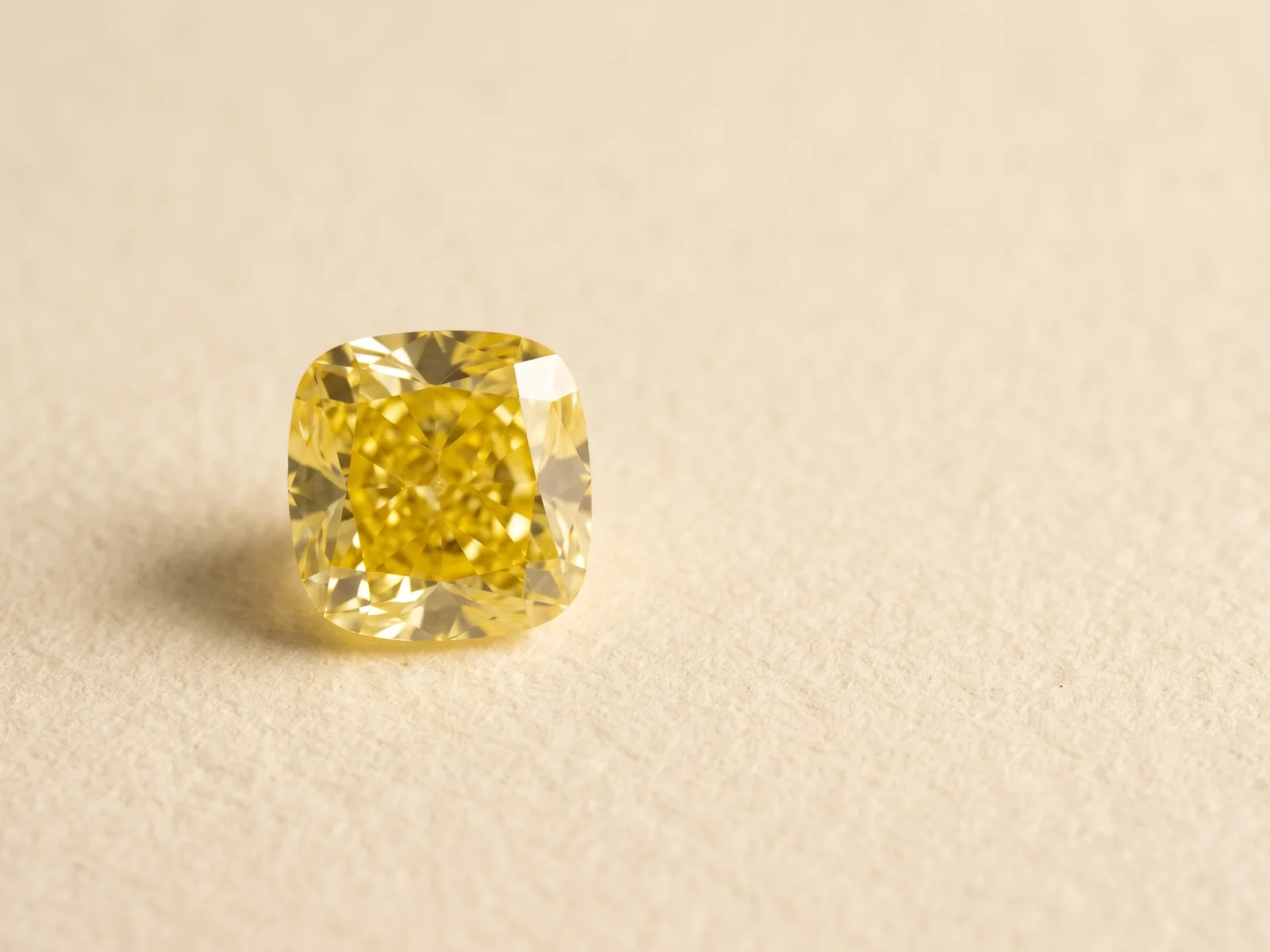
A Fancy Vivid diamond is a coloured diamond that GIA grades at the strongest saturation on its fancy colour scale: rich, pure colour that is neither pale nor dark. It sits above Fancy Intense, while Fancy Deep and Fancy Dark describe darker stones. Vivid is the rarest, most valued intensity, often costing several times more than Fancy Intense.
What is a Fancy Vivid diamond?
Fancy Vivid is a colour grade, not a type of diamond. It is one of the words GIA (the Gemological Institute of America) uses to describe how strong the colour is in a fancy coloured diamond, meaning a diamond with a distinct colour such as yellow, pink, blue or green, rather than the near-colourless stones graded D to Z. A Fancy Vivid diamond has the most saturated colour on GIA's scale: rich and pure, not muddied by grey or brown and not so dark that it looks heavy. Our introduction to fancy colour diamonds covers the whole category.
For white diamonds, less colour means more value. For fancy colours the logic flips: the stronger and purer the colour, the rarer and more valuable the stone. That is why the intensity word on the report usually matters more to price than clarity. GIA judges every fancy colour on three things: hue (the colour itself, such as pink or purplish pink), tone (how light or dark it is) and saturation (how strong or pure the colour is). Fancy Vivid means the highest saturation, at a tone that is neither very light nor very dark. The full method is set out in how GIA grades a fancy colour diamond, and any unfamiliar word here is explained in our glossary of jewellery terms.
Fancy colour is judged face-up, the way you see the stone in a ring, under controlled daylight-equivalent lighting and compared against GIA's colour references in a neutral grey environment. That is the opposite of D-to-Z diamonds, which are graded face-down so the faceting does not distract from a faint body colour. For a fancy colour, the face-up impression is the whole point.
What does Fancy Vivid mean on a GIA report?
On a GIA coloured diamond report, the colour grade is written as one phrase that combines intensity and hue, for example Fancy Vivid Yellow, Fancy Vivid Purplish Pink or Fancy Vivid Orangy Yellow. The first two words are the intensity. Everything after them is the hue, and the last word is always the dominant colour. A word ending in -ish or -y placed in front is a modifier: a secondary colour the grader can see in the stone.
| Report line | Example wording | What it tells you |
|---|---|---|
| Colour grade | Fancy Vivid Yellow | Intensity (Fancy Vivid) plus hue (Yellow) |
| Colour origin | Natural, Treated or Undetermined | Whether the colour formed in the earth or was created or changed afterwards |
| Colour distribution | Even or Uneven | Whether the colour is spread evenly across the face-up stone |
| Shape and cutting style | Cut-cornered rectangular modified brilliant | The shape description GIA uses; radiant cuts often appear this way |
| Measurements | For example 6.10 × 5.20 × 3.70 mm | Length, width and depth, so you can judge face-up size |
| Clarity | VS1, SI1 and so on | Graded on the same scale used for colourless diamonds |
Modifiers can move the price as much as the intensity word. A Fancy Vivid Pink is usually valued above a Fancy Vivid Purplish Pink, and a Fancy Vivid Yellow above a Fancy Vivid Greenish Yellow. Brownish modifiers generally lower value in most hues. Our guide to secondary hues, modifiers and overtones explains how each one shifts the look and the price.
When we go through real GIA fancy colour reports with customers, the line people skip is colour origin. Read it first. 'Natural' means the colour formed naturally. 'Treated' means the colour was created or altered, for example by irradiation or by high pressure, high temperature (HPHT) processing. A lab-grown diamond has its own report that states clearly that it is laboratory-grown. The word Vivid means very different things to value depending on which of these you are holding.
Where does Fancy Vivid sit on the fancy colour intensity scale?
GIA uses nine intensity grades for fancy coloured diamonds. Not every hue uses all nine: yellow and brown diamonds weaker than Fancy Light are graded on the normal D-to-Z scale instead, while pinks, blues and greens start at Faint.
| Intensity grade | What you see face-up | Where it sits |
|---|---|---|
| Faint | A trace of colour | Lowest (pink, blue, green and similar hues) |
| Very Light | Slight colour | Low |
| Light | Noticeable but pale colour | Low |
| Fancy Light | Clear, soft colour | First grade with the word Fancy |
| Fancy | Moderate, obvious colour | Middle |
| Fancy Intense | Strong colour at a medium tone | High |
| Fancy Vivid | Strongest, purest colour | Highest saturation |
| Fancy Deep | Darker tone with good saturation | Darker branch beside Vivid |
| Fancy Dark | Dark tone, lower saturation | Darkest; often brownish colours |
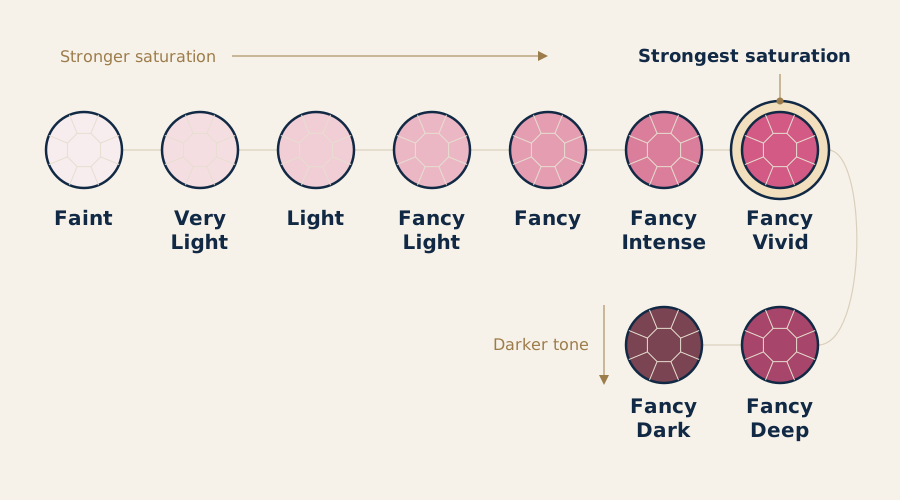
The scale is not a simple ladder where each step is 'more' colour. It is better thought of as a map of tone and saturation. Moving to the right means stronger saturation; moving down means a darker tone. Fancy Vivid occupies the strongest saturation region at light-to-medium-dark tones. Fancy Deep covers stones that are darker but still well saturated, and Fancy Dark covers dark stones with weaker saturation. Our page on the full intensity scale from Faint to Vivid walks through each grade with colour examples.
Fancy Vivid vs Fancy Intense vs Fancy Deep: what is the difference?
| Fancy Intense | Fancy Vivid | Fancy Deep | |
|---|---|---|---|
| Saturation | Strong | Strongest | Moderate to strong |
| Tone | Medium | Light-medium to medium-dark | Medium-dark to dark |
| Look face-up | Clearly coloured, a little softer | Bright, saturated, lively | Rich and dark; can look heavier in low light |
| Rarity | Rare | Rarest for most hues | Rare; varies a lot by hue |
| Price for the same hue and size | High | Usually the highest | Often below Vivid; can be close in some hues |
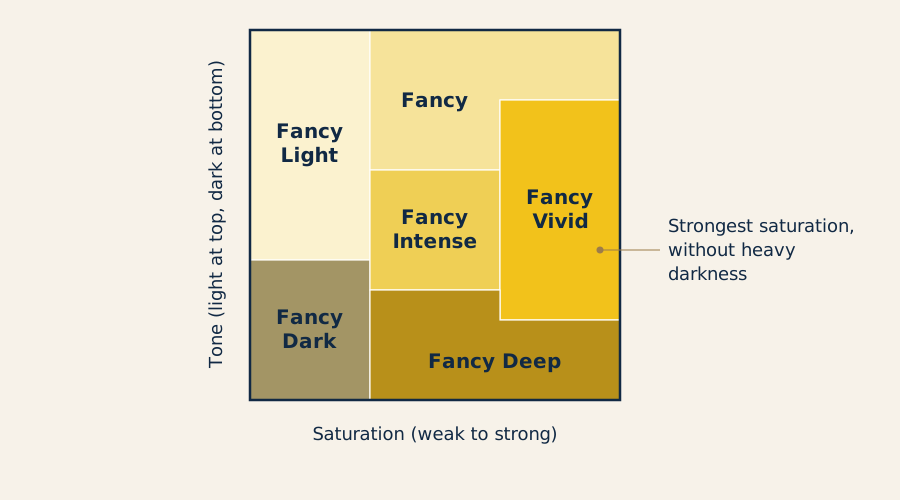
The difference between Fancy Intense and Fancy Vivid is saturation. Both sit at similar tones, but a Vivid stone's colour looks purer and stronger, and it holds that colour across more of the face as the stone moves. The difference between Fancy Vivid and Fancy Deep is tone: a Deep stone is darker. Some people prefer the richness of a Deep pink or blue, and in those hues a Deep can sell close to a Vivid. In yellow, a Deep usually trades below a Vivid, because the market values bright, sunny yellow over darker, olive-leaning shades.
Each grade covers a range, so two stones with the same grade can look a little different. A stone just inside the Vivid boundary may look very similar to a strong Intense, which is why comparing stones side by side tells you more than comparing reports.
Related guideFancy Colour Intensity Scale: Faint to VividNot sure which one is right?
Send us the stones you are looking at and our gemologist will tell you which to choose and why.
Which colours can be graded Fancy Vivid?
Most hues can reach Fancy Vivid, but how often they do varies enormously. The colour comes from different causes in each case, which is part of why rarity and price differ so much.
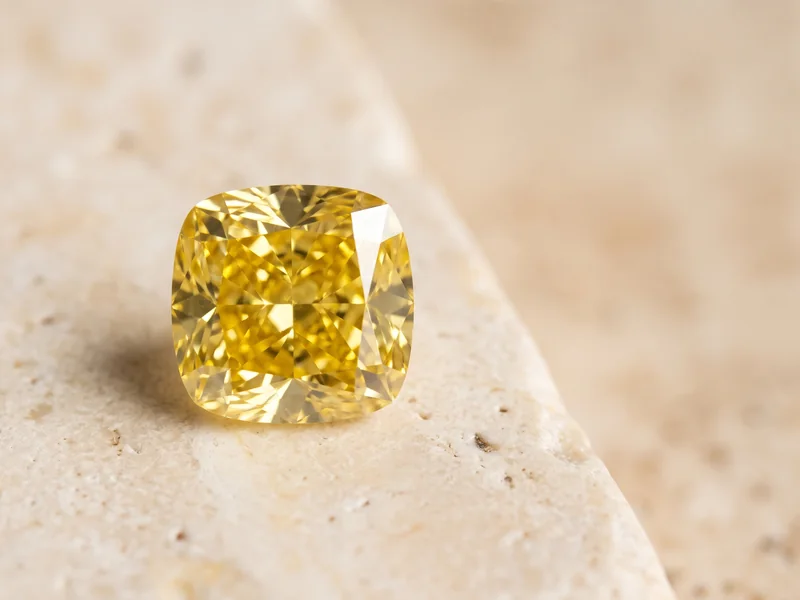
- Yellow: the most frequently seen Fancy Vivid hue, coloured by nitrogen. Fancy Vivid Yellow is still far rarer than Fancy Yellow. 'Canary' is a trade nickname, not a GIA grade.
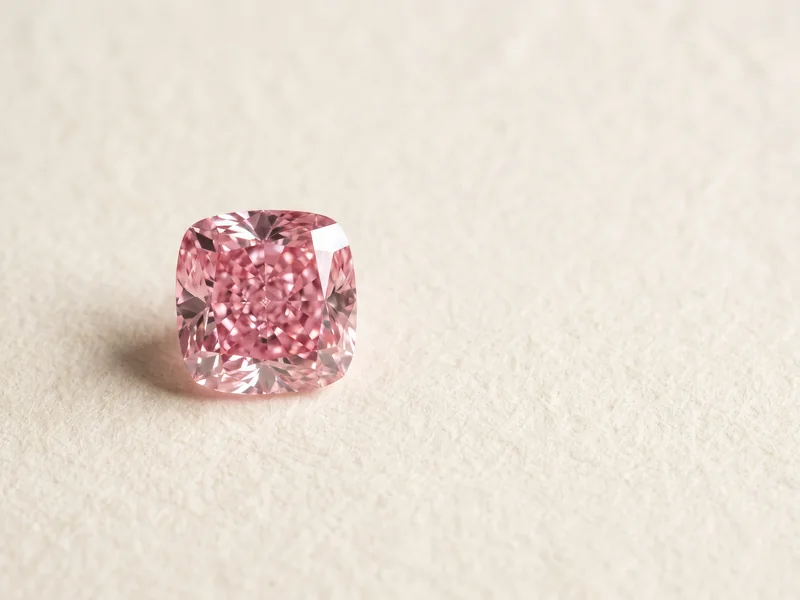
- Pink: the colour is linked to distortion in the crystal structure. Australia's Argyle mine in Western Australia supplied most of the world's pinks until it closed in 2020, and Fancy Vivid pinks are among the rarest stones in the trade.
- Blue: coloured by boron (Type IIb diamonds). A Fancy Vivid Blue is one of the rarest and most costly of all diamond colours.
- Green: caused by natural radiation, often concentrated near the surface. Vivid greens are very rare; see our guide to natural green diamonds.
- Orange: a pure orange without brown or yellow is unusual, and Vivid oranges are rarer again. Our orange diamond guide explains the common modifiers.
- Purple: usually seen with pink modifiers; a strong, pure purple is rare. Read more on purple and purplish diamonds.
- Red: GIA usually grades red simply as Fancy Red, with no intensity word, because red only occurs as a strong, dark colour. See our page on why red diamonds carry no Vivid grade.
- Brown: brown is low in saturation by nature, so it is graded Fancy, Fancy Deep or Fancy Dark rather than Vivid. Our guide to champagne, cognac and brown diamonds covers how these are described.
- Grey and black: grey has little saturation, and black diamonds are graded Fancy Black with no intensity word. For these stones, see grey and salt-and-pepper diamonds.
How rare is a Fancy Vivid diamond and what does it cost?
Fancy coloured diamonds of any intensity are a small fraction of the diamonds mined, and within each hue only a small share reaches Vivid. Rarity rises sharply with each step up the scale, and price follows. As a rough guide, moving from Fancy Intense to Fancy Vivid in the same hue, size and clarity can multiply the price by about two to five times, and more in the rarest colours.
| About 1 ct, eye-clean | Approximate price range (AUD) |
|---|---|
| Natural Fancy Yellow | about $6,000–$15,000 |
| Natural Fancy Intense Yellow | about $10,000–$25,000 |
| Natural Fancy Vivid Yellow | about $20,000–$60,000 |
| Natural Fancy Vivid Pink | hundreds of thousands, up to over $1 million |
| Natural Fancy Vivid Blue | often well over $1 million |
| Lab-grown Fancy Vivid (yellow, pink or blue) | about $1,000–$5,000 |
These are broad ranges only; fancy colour prices depend heavily on the exact hue, modifiers, size and evenness of colour, and very rare stones are often priced individually. Hue matters most, then intensity, then size, with clarity and cut further back. A Fancy Vivid Yellow with a greenish modifier can cost noticeably less than a pure Fancy Vivid Yellow of the same weight. Our guide to what pushes fancy colour diamond prices up or down sets out each factor.
Shop fancy colour diamonds: natural and lab-grown
Can a lab-grown diamond be Fancy Vivid?
Yes. Laboratory-grown diamonds are real diamond, with the same hardness (10 on the Mohs scale) and refractive index (about 2.42) as natural diamond, and they can be produced in strong, saturated colours. Blue lab-grown diamonds get their colour from boron added during growth, yellows from nitrogen, and pinks are usually created by treatment after growth. Our guide to lab-grown fancy colour diamonds explains each process.
Lab-grown fancy colours are graded by labs such as IGI, often using the same intensity words, so you may see 'Fancy Vivid Blue' on a lab-grown report. GIA's reports for lab-grown diamonds use different, simpler descriptions. Either way, the report and the seller must state clearly that the stone is lab-grown. Because lab-grown colour can be produced on demand, a lab-grown Fancy Vivid costs a small fraction of a natural one.
Natural diamonds can also be treated to strengthen or change colour, using irradiation, annealing or HPHT processing. A treated natural stone can reach a Vivid-looking colour, but the report will say 'Treated' under colour origin, and it is valued far below a natural-colour stone of the same grade.
How does cut change a Fancy Vivid grade?
Because fancy colour is graded face-up, the cut directly affects the grade. Cutters of coloured rough usually choose shapes and facet patterns that bounce light back and forth inside the stone, which concentrates the colour. That is why so many Fancy Vivid diamonds are radiants and cushions: their mixed faceting and deeper pavilions (the lower part of the stone) deepen the face-up colour. A round brilliant returns light quickly and tends to show colour less strongly, so the same rough cut as a round might grade one step lower.
GIA does not give fancy shapes an overall cut grade, and fancy colour diamonds are cut for colour first and brightness second. You judge the cut by how evenly the colour spreads, whether there are pale or dark patches, and whether the stone looks lively. Our page on judging cut quality without a GIA cut grade explains the checks, and why fancy shapes have no single ideal proportion chart covers the numbers.
A deeper cut also carries more weight below the girdle, so a Fancy Vivid radiant can look smaller face-up than its carat weight suggests. Always compare the millimetre measurements, not just the carat figure.
Is a Fancy Vivid diamond right for an engagement ring?
For durability, yes. A Fancy Vivid diamond is just as hard as a colourless one, so it suits everyday wear in a secure setting. The bigger question is how the metal affects the colour, because the setting reflects into the stone.
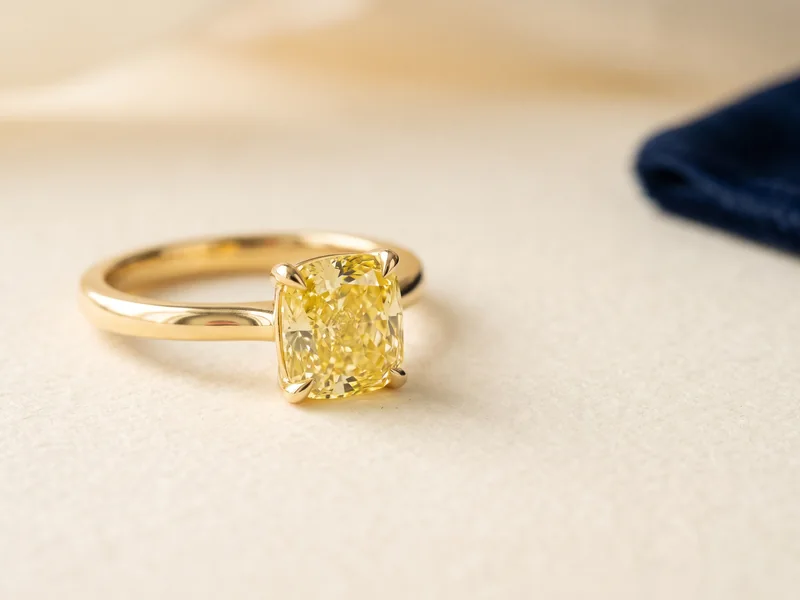
- Yellow: yellow gold claws or a yellow gold cup behind the stone strengthen the colour; a halo of colourless diamonds adds contrast.
- Pink: rose gold warms it, while platinum or white gold keeps the pink looking cleaner and cooler.
- Blue and green: usually set in platinum or white gold, which keeps the hue crisp.
- Small Vivid accents: coloured side stones or a coloured halo can bring Vivid colour into a ring without the cost of a large centre stone.
For design ideas and how fancy colours sit with different bands, see our guide to fancy coloured diamond engagement rings.
How to check a Fancy Vivid diamond: step by step
- Read the full colour grade. Note the intensity (Fancy Vivid) and every modifier in the hue, such as purplish or greenish.
- Check colour origin. Confirm Natural, Treated or lab-grown before you compare prices.
- Look at colour distribution. Even colour across the face is worth more than a stone with pale or patchy areas.
- Compare face-up in daylight-balanced light. Put it beside a Fancy Intense of the same hue and see whether the step is obvious to you.
- Check measurements, not just carats. Deep radiants and cushions can look smaller face-up than their weight suggests.
- Confirm the report number. Verify it on the grading lab's online report check before you commit.
Free consultation
Talk to a gemologist
Compare stones in person or online with Raj Sood, Graduate Gemologist (GIA), AJP (GIA).
Book a consultationShop this shape
FAQ
Common questions
What does Fancy Vivid mean on a diamond?
It is GIA's grade for the strongest, purest saturation of colour in a fancy coloured diamond, at a tone that is neither pale nor dark. It sits above Fancy Intense on the intensity scale.
Is Fancy Vivid better than Fancy Intense?
Vivid shows stronger, purer colour and is rarer, so it is usually valued higher than Fancy Intense in the same hue and size. Whether the difference is worth the extra cost is something to judge by eye, side by side.
Is Fancy Deep higher than Fancy Vivid?
No. Fancy Deep is not a step above Vivid but a darker branch beside it. Deep stones have a darker tone, and for most hues they are valued at or below Vivid.
How much is a Fancy Vivid yellow diamond?
A natural 1 carat Fancy Vivid Yellow is roughly AUD $20,000–$60,000 depending on modifiers, clarity and cut. A lab-grown one of similar size costs a small fraction of that.
Are lab-grown Fancy Vivid diamonds real diamonds?
Yes. Lab-grown diamonds are real diamond with the same hardness and sparkle as natural diamond. The report and the seller must clearly state that the stone is laboratory-grown.
Why is there no Fancy Vivid red diamond?
Red only occurs as a strong, dark colour, so GIA usually grades it simply as Fancy Red without an intensity word. Pure red diamonds are among the rarest of all.

Ask a gemologist
Not sure which diamond to choose?
Raj Sood is a Graduate Gemologist (GIA) and master jeweller. Bring the stones you are considering, or send the reports, and he will tell you honestly which one is better and why.
Keep learning
Related guides
 Fancy Colour DiamondsFancy Colour Intensity Scale: Faint to Vivid
 Fancy Colour DiamondsHow Fancy Colour Diamonds Are Graded
 Fancy Colour DiamondsWhat Drives Fancy Colour Diamond PricesFancy Colour DiamondsFancy Colour Modifiers and OvertonesFancy Colour DiamondsFancy Colour Diamonds Guide
 Fancy Colour DiamondsFancy Coloured Diamond Engagement Rings
 Lab-Grown DiamondsLab-Grown Fancy Colour Diamonds
 Diamond 4Cs & GradingCut Quality in Fancy Shapes (No GIA Cut Grade)
Explore more
More guides on this topic
Education