
Metals
Best Metal for Wedding Bands: An Australian Guide to Gold, Platinum and More
A wedding band is worn every day for decades, so the best metal for wedding bands is the one that suits your skin, your work and your engagement ring. Here is how each metal wears, what Australian hallmarks mean and what the alloys actually contain.
 Reviewed by Raj Sood, Graduate Gemologist (GIA), AJP (GIA)Master jeweller and Graduate Gemologist (GIA) · reviewed 4 November 2026
Quick answer
For most Australians, the best metal for wedding bands is 18 carat gold or platinum. 18 carat gold is 75% pure gold, holds its colour and resizes easily. Platinum is about 95% pure, naturally white and gentle on sensitive skin. 9 and 14 carat gold cost less; titanium and tungsten cost less again but usually cannot be resized.
What is the best metal for wedding bands?
A wedding band is the ring you put on at the ceremony and, for most people, rarely take off again. That makes it the hardest-working piece of jewellery you will own. It knocks against door handles, steering wheels and gym bars, and it rubs against your engagement ring every single day. If you are not sure which name applies to your ring, we explain the difference between a wedding ring and a wedding band. The metal you choose decides how the band looks in 20 years, whether it can be resized and whether your skin will tolerate it.
There is no single answer for everyone, but the trade-offs are clear. In Australia the mainstream choices are 9, 14 and 18 carat gold and platinum, with palladium and alternative metals such as titanium and tungsten carbide filling particular needs. The table below is the short version; the sections after it explain each line.
| Metal | Precious metal content | Colour over time | Resizable? | Sensitive skin | Feel on the hand |
|---|---|---|---|---|---|
| 9ct gold | 37.5% gold | Stable; paler yellow, can dull slightly | Yes | Usually fine in yellow; check white alloys | Light |
| 14ct gold | 58.5% gold | Stable | Yes | Usually fine in yellow; check white alloys | Medium |
| 18ct gold | 75% gold | Richest yellow; white gold needs re-plating | Yes | Very good in yellow; check white alloys | Medium to heavy |
| Platinum (Pt950) | 95% platinum | Naturally white; softens to a satin patina | Yes | Excellent | Heaviest |
| Palladium (950) | 95% palladium | Naturally white-grey | Yes, by fewer workshops | Very good | Light |
| Titanium | Commercially pure or alloyed | Grey, stable | Rarely, and only slightly | Excellent | Very light |
| Tungsten carbide | Not a precious metal | Dark or steel grey, holds polish | No | Check the binder metal | Heavy |
Every metal word in this guide, from alloy to patina, is also defined in our jewellery glossary of metal and ring terms.
What is the difference between 9ct and 18ct gold wedding bands?
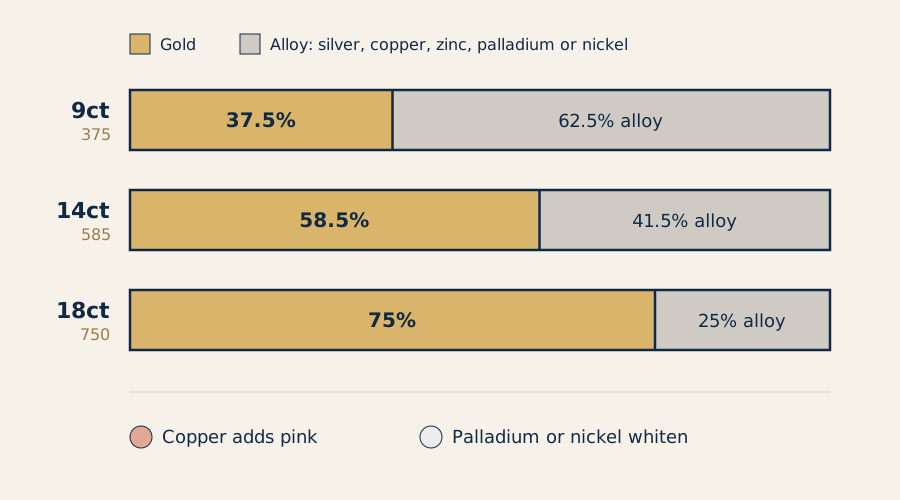
Gold purity is measured in carats out of 24. Pure gold is 24 carat, so 18 carat is 18 parts in 24, or 75% gold. The rest is an alloy (a blend of other metals) such as silver, copper, zinc, palladium or nickel. Pure gold is too soft for a ring worn every day, sitting at only about 2.5–3 on the Mohs scale of hardness, so the alloy metals add strength and set the colour.
| Carat | Gold content | Common stamps | Colour | How it wears |
|---|---|---|---|---|
| 9ct | 37.5% | 375, 9ct, 9K | Paler yellow | Often harder than 18ct, so it resists light scuffs; the high alloy content can dull slightly over years |
| 14ct | 58.5% | 585, 14ct, 14K | Mid yellow | A balance of colour and toughness; more common in the US than Australia |
| 18ct | 75% | 750, 18ct, 18K | Rich, warm yellow | Softer, so it shows scratches sooner, but holds colour and polishes up well |
| 22ct | 91.6% | 916, 22ct | Deep yellow | Too soft for a thin everyday band; bends and scratches easily |
In Australia, 9ct and 18ct have long been the two standard choices, with 14ct appearing more often in recent years. 9ct appeals on price and is genuinely tough in many alloys. 18ct has the deeper colour, feels heavier and is the usual pairing for a diamond engagement ring, because most centre-stone settings are made in 18ct or platinum. Our guide to choosing a metal for an engagement ring covers the same metals from the setting's point of view.
All gold wears away very slowly. Each scratch removes a microscopic amount of metal, and over 20–30 years of daily wear a band can lose noticeable thickness, particularly on the palm side. A band of about 1.8–2 mm thickness gives you enough metal for a lifetime of polishing and resizing, whereas very thin 1.2–1.4 mm bands may need rebuilding sooner.
Yellow, white or rose gold: which colour wears best?
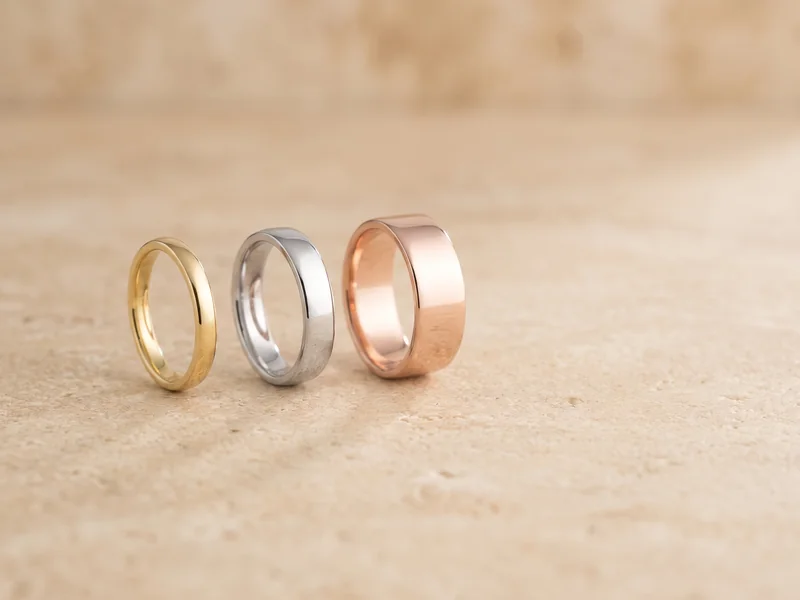
Yellow gold is the simplest. Its colour comes from the gold itself, balanced with silver and copper, and there is no plating to wear off. It ages honestly: scratches soften the shine, and a polish brings it back.
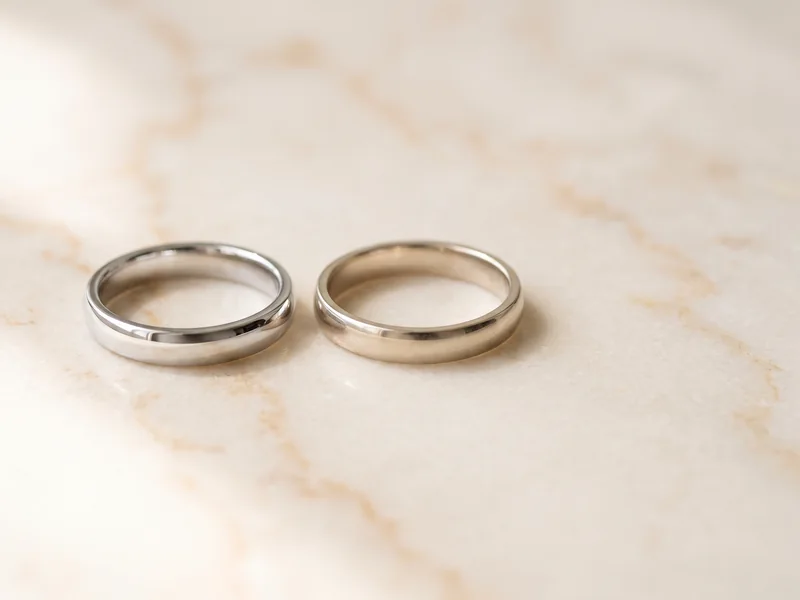
White gold is gold alloyed with whitening metals, either palladium or nickel. Neither makes it truly white; the raw alloy is a pale grey or faintly yellow. Almost all white gold is therefore finished with rhodium plating, a thin coat of a bright white platinum-group metal. On a wedding band the plating wears fastest where the band touches your engagement ring and on the palm side, and a warmer tone usually starts showing within about 1–3 years. Re-plating is a routine workshop job, typically about AUD $60–$150.
Rose gold gets its pink from copper. The more copper, the pinker and tougher the alloy, so 9ct rose gold is often noticeably redder than 18ct rose. It does not need plating. Copper allergy is uncommon, but rose gold can darken slightly with time as the copper reacts with skin and air.
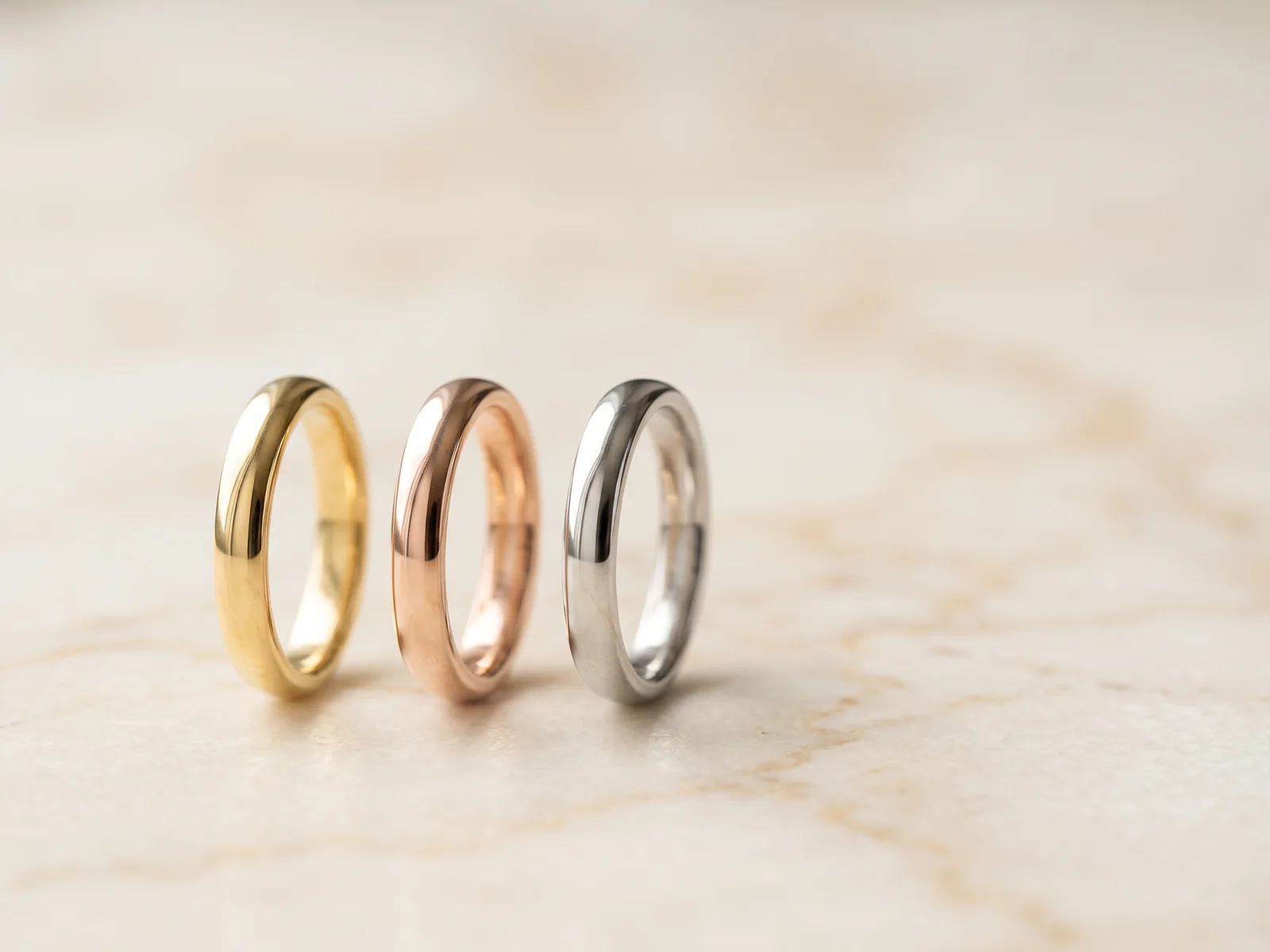
Colour matters most when diamonds are involved. Small diamonds look whitest in white metal and warmer in yellow, which is one of the points weighed in our comparison of plain versus diamond-set wedding bands.
Is platinum worth it for a wedding band?
Platinum used for jewellery in Australia is usually Pt950: 95% platinum with 5% of another metal such as ruthenium, iridium or cobalt. It is naturally white, so there is no plating to maintain, and it is one of the least reactive metals you can wear, which makes it a safe choice for sensitive skin.
It is also dense. Pure platinum weighs about 21.4 g per cm³, against about 15.5 g for 18ct yellow gold, so the same band in platinum is roughly a third heavier. Some people love that solid feel; others find a wide platinum band too heavy.
Platinum wears differently from gold. It scratches about as easily, but a scratch mostly pushes metal aside instead of removing it. Over time the surface develops a soft, satin-grey patina (a worn-in finish) that some wearers prefer. A polish restores the shine, and very little metal is lost along the way. That toughness is why platinum is often chosen to hold small stones securely; our guide to diamond sizes for a set wedding band explains how stone size and metal work together.
Is it worth it? If you want a white band with no re-plating, have sensitive skin or are matching a platinum engagement ring, usually yes. If budget matters more and you are happy to re-plate, white gold gives a similar look for less.
Palladium is platinum's lighter cousin. Palladium 950 is naturally white-grey, hypoallergenic and only about 12 g per cm³, so it feels light. Its market price has swung sharply in recent years, and fewer workshops cast and repair it, so check that your jeweller can resize it later.
Not sure which one is right?
Send us the stones you are looking at and our gemologist will tell you which to choose and why.
Are titanium and tungsten good metals for wedding bands?
Alternative metals are popular for men's bands and for people who work with their hands, mainly on price and scratch resistance. Each has a catch worth knowing before you commit.
| Metal | Mohs hardness (approx.) | Strengths | Drawbacks |
|---|---|---|---|
| Titanium | about 6 | Very light (about 4.5 g per cm³), hypoallergenic, low cost | Hard to resize, difficult to set stones in, needs heavy-duty cutters to remove |
| Tungsten carbide | about 9 | Highly scratch-resistant, keeps its polish for years | Brittle: can crack if dropped on tiles; cannot be resized; some contain a nickel binder |
| Black zirconium | oxide surface harder than the core | Natural black surface without paint | The black oxide layer can wear through on edges |
| Sterling silver (925) | about 2.5–3 | Inexpensive | Soft, bends and tarnishes; best as a travel or temporary ring |
Tungsten carbide deserves a closer look. It is a ceramic-like compound held together with a small amount of binder metal, usually cobalt or nickel. Nickel-bound tungsten can trigger skin reactions, so ask which binder is used. Because it cannot be cut in the usual way, emergency staff remove it by cracking it with locking pliers; titanium needs a powered or heavy-duty ring cutter.
The biggest practical issue with both is sizing. Fingers change with age, weight and pregnancy, and a gold or platinum band can be sized up or down by about one to two sizes. A titanium or tungsten band usually has to be replaced. Width, comfort and style choices for these metals are covered in the men's wedding band guide.
Related guideMen’s Wedding Band GuideWhich wedding band metals are safe for sensitive skin?
Nickel is the most common cause of metal allergy, estimated to affect roughly 10–20% of people, more often women. The reaction is an itchy, red rash under the ring, usually appearing within a day or two of wear. White gold is the usual culprit, because some white gold alloys are whitened with nickel. Nickel-white gold is whiter and harder; palladium-white gold is softer, slightly greyer and nickel-free. Both look the same once rhodium plated, so the only way to know is to ask.
- Lowest risk: platinum, palladium, titanium and 18ct yellow gold.
- Check the alloy: white gold in any carat, 9ct alloys and tungsten carbide with a nickel binder.
- Avoid for daily wear: plated, gold-filled or costume rings, where a base metal sits under a thin surface layer.
Not every rash is an allergy. Wedding ring dermatitis often comes from soap, moisturiser or sweat trapped under a wide band. Taking the ring off to wash, and choosing a rounded inner edge, usually fixes it. Our guide to comfort-fit, court and flat band profiles shows which shapes trap the least moisture.
What do the stamps inside a wedding band mean in Australia?
Look inside a wedding band and you will usually find a fineness mark (the metal and its purity) and often a maker's mark (initials or a logo). In the UK these marks are applied by an independent assay office. Australia has no compulsory government hallmarking system, so a stamp here is the manufacturer's or importer's own declaration of the metal. A false or misleading stamp can breach the Australian Consumer Law, which is why reputable makers stamp carefully.
| Stamp | What it means |
|---|---|
| 375 or 9ct | 9 carat gold, 37.5% gold |
| 585 or 14ct | 14 carat gold, 58.5% gold |
| 750 or 18ct | 18 carat gold, 75% gold |
| 916 or 22ct | 22 carat gold, 91.6% gold |
| PLAT, Pt950 or 950 | Platinum, 95% |
| Pt900 | Platinum, 90% |
| 950 Pd or PALL | Palladium, 95% |
| 925, STG or STER | Sterling silver, 92.5% |
| GF, RGP, GP, HGE or 'bonded' | Gold-filled, rolled, plated or bonded: not solid gold |
| Ti, W or TC | Titanium or tungsten carbide |
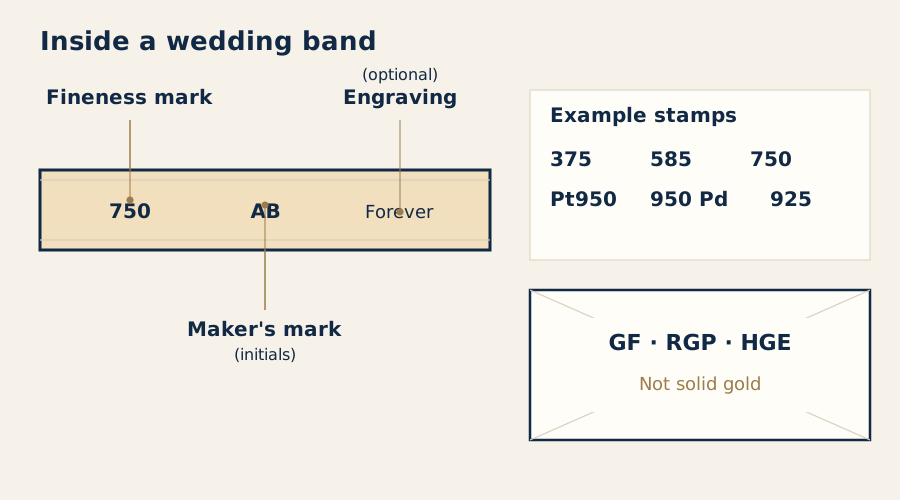
Older or overseas rings may carry extra marks, such as a UK assay office symbol and a date letter. If a ring has no stamp at all, a jeweller can test the metal with XRF (X-ray fluorescence), which reads the alloy without damaging the ring. This is worth doing before remodelling an inherited band.
Should your wedding band match your engagement ring metal?
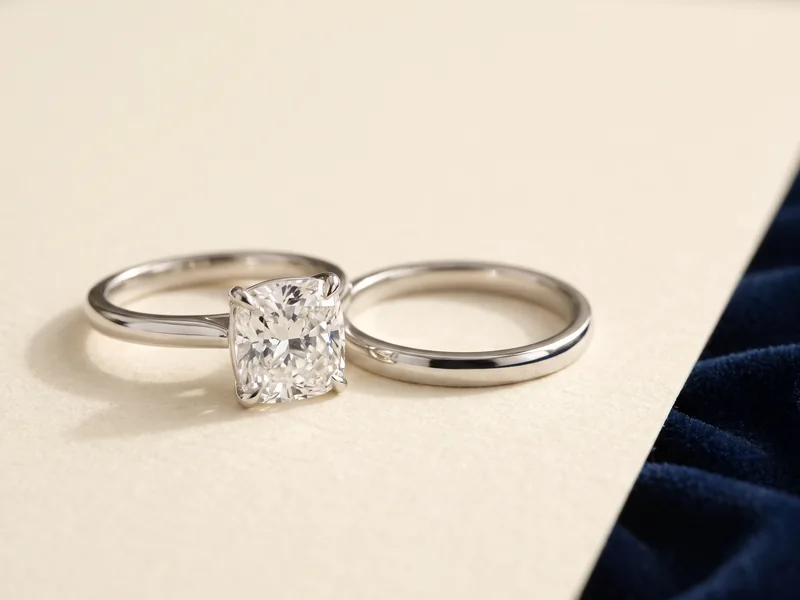
Usually, yes. When two rings sit side by side all day, the harder alloy slowly wears the softer one. A 9ct band beside an 18ct engagement ring, or gold beside platinum, can wear a groove into the softer ring over the years. Matching the metal and the carat keeps the wear even and means both rings age to the same colour. White gold beside platinum is a common mismatch: they look identical when new, but once the rhodium wears the gold turns faintly warm while the platinum stays grey-white.
Mixing metals is fine if you love the look, such as a rose gold band against a platinum ring, but plan for slightly faster wear on the softer ring. Our step-by-step guide to matching a band to your engagement ring covers colour, width and height together.
The shape of the centre stone also changes what band will sit flush. See the specific guides for bands beside a round engagement ring, bands that suit an oval, bands for a princess cut ring, cushion cut ring pairings, bands that curve around a pear, marquise ring band options and bands for an Asscher cut. Where a straight band leaves a gap, a custom fitted or curved wedding band is shaped to the engagement ring, and it should be made in the same metal.
How much does a wedding band cost in each metal?
Price follows two things: the precious metal content and the weight of the band. Gold and platinum prices move daily, so treat these as broad, approximate ranges for a plain 4 mm comfort-fit band in a mid-range finger size.
| Metal | Approximate price range (AUD) |
|---|---|
| Sterling silver | about $80–$300 |
| Titanium | about $100–$500 |
| Tungsten carbide | about $100–$400 |
| 9ct gold | about $500–$1,200 |
| 14ct gold | about $800–$1,800 |
| Palladium 950 | about $900–$2,000 |
| 18ct gold | about $1,200–$2,800 |
| Platinum Pt950 | about $1,400–$3,200 |
Wider and thicker bands cost more because they contain more metal, and a 6 mm platinum band can cost close to double a 3 mm one. Diamond-set bands add the cost of the stones and the setting work. Lifetime cost matters too: white gold needs periodic re-plating, while titanium and tungsten may need replacing rather than resizing if your size changes.
Browse ring settings by metal
How do you choose the best metal for wedding bands? Step by step
- Start with your engagement ring. Note its metal and carat from the stamp inside; matching it is usually the safest choice.
- Think about your skin. If you have reacted to jewellery before, choose platinum, palladium, titanium or yellow gold, or ask for nickel-free white gold.
- Be honest about your work and hobbies. Hands-on jobs suit 9ct or 14ct gold, platinum or a thicker band; very active wearers might consider titanium.
- Decide on colour and upkeep. Yellow and rose gold need no plating; white gold needs re-plating every few years; platinum stays white.
- Check the stamp. Confirm 375, 585, 750, Pt950 or similar, and avoid GF, RGP or HGE marks on a ring meant to last.
- Plan for the future. Choose a resizable metal and a band of about 1.8–2 mm thickness if you want it to last a lifetime.
Free consultation
Talk to a gemologist
Compare stones in person or online with Raj Sood, Graduate Gemologist (GIA), AJP (GIA).
Book a consultationShop this shape
FAQ
Common questions
Is 9ct or 18ct gold better for a wedding band?
18ct gold has a richer colour and is the usual match for an 18ct engagement ring. 9ct costs less and is often harder, so it resists light scuffs, but its colour is paler. Matching the carat of your engagement ring keeps wear even.
Is platinum or white gold better for a wedding band?
Platinum is naturally white, hypoallergenic and loses very little metal with wear, but costs more and is heavier. White gold looks similar for less, but its rhodium plating wears off and needs redoing every 1–3 years or so.
What wedding band metal is safe if I have a nickel allergy?
Platinum, palladium, titanium and 18ct yellow gold are the lowest-risk choices. If you want white gold, ask for a nickel-free palladium-white alloy and get it confirmed in writing.
Can a titanium or tungsten wedding band be resized?
Titanium can sometimes be stretched or reduced very slightly, but tungsten carbide cannot be resized at all. If your size changes, these bands usually have to be replaced.
What does 750 mean inside a ring?
750 means the metal is 750 parts per thousand gold, which is 18 carat or 75% gold. 375 is 9 carat and 585 is 14 carat.
Do Australian rings have official hallmarks?
Australia has no compulsory government hallmarking, so the stamp is the maker's own declaration of the metal. Misleading stamps can breach consumer law, and a jeweller can test an unmarked ring with XRF if you are unsure.

Ask a gemologist
Not sure which diamond to choose?
Raj Sood is a Graduate Gemologist (GIA) and master jeweller. Bring the stones you are considering, or send the reports, and he will tell you honestly which one is better and why.
Keep learning
Related guides
 Wedding Bands & EternityHow to Match a Wedding Band to an Engagement Ring
 Wedding Bands & EternityWedding Band Profiles Explained
 Wedding Bands & EternityMen’s Wedding Band Guide
 Wedding Bands & EternityBest Wedding Band for Princess Engagement Rings
 Wedding Bands & EternityWedding Ring vs Wedding Band
 Wedding Bands & EternityPlain vs Diamond Wedding BandsWedding Bands & EternityBest Wedding Band for Cushion Engagement Rings
Explore more
More guides on this topic
Education