
Metals
Sterling Silver Jewellery Guide: 925 Alloy, Hallmarks, Wear and Care
Sterling silver jewellery is where many people start with precious metal, yet the 925 stamp, the tarnish and the softness are rarely explained plainly. Here is what the alloy is, how it wears, what Australian stamps mean and how to look after it.
 Reviewed by Raj Sood, Graduate Gemologist (GIA), AJP (GIA)Master jeweller and Graduate Gemologist (GIA) · reviewed 4 November 2026
Quick answer
Sterling silver jewellery is made from an alloy of 92.5% pure silver and 7.5% other metals, usually copper, and is stamped 925. It is bright white, soft (about 2.5–3 on the Mohs scale), tarnishes over time, rarely causes allergies and costs far less than gold or platinum. Regular wear, dry storage and gentle cleaning keep it bright.
What is sterling silver jewellery?
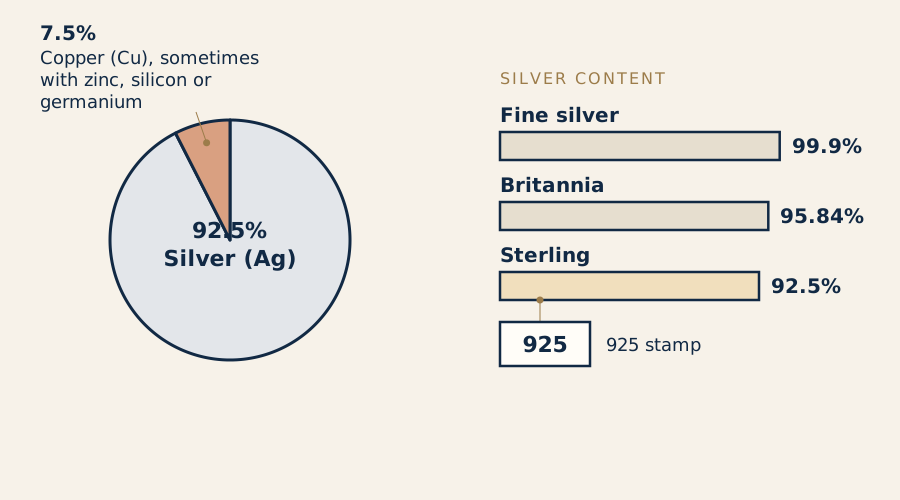
Sterling silver is an alloy (a blend of metals melted together) of 92.5% pure silver and 7.5% other metals by weight. That is where the stamp 925 comes from: 925 parts silver in every 1,000. The other 7.5% is almost always copper, sometimes with small amounts of zinc, silicon or germanium that alloy makers add to improve casting or slow tarnish. Any term on this page you have not met before is also explained in our plain-English jewellery glossary.
Why not simply wear pure silver? Fine silver (99.9%, stamped 999) is so soft that a ring pushes out of round and claws open with ordinary wear. Adding copper makes the metal roughly two to three times harder without changing the colour much. Gold works in exactly the same way: 18K is 75% gold and 9K is 37.5% gold, and our guide to how gold alloys are built explains what makes up the rest.
Silver is the most reflective of all metals, sending back roughly 95% of visible light when it is polished. That is what gives sterling its bright, white lustre. Sterling has a density of about 10.4 g/cm³, so a piece weighs a little less than the same piece in 9K gold and about half as much as it would in platinum. It melts at about 893 °C, well below fine gold (about 1,064 °C), which makes it easy to cast, solder and repair.
What do sterling silver hallmarks mean in Australia?
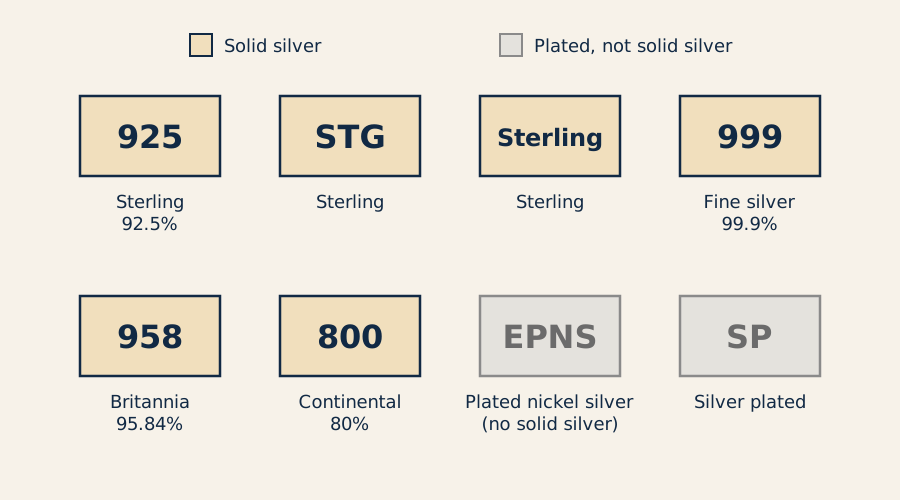
In the United Kingdom, silver above a small exemption weight (7.78 g) has to be tested by an independent assay office and hallmarked before it can be sold as silver. Australia has no national assay office and no compulsory hallmarking. Here the stamp inside a ring or on a clasp is a quality mark (also called a fineness mark) applied by the maker or importer. It is still a legal claim: under the Australian Consumer Law, stamping or describing metal as sterling when it is not would be misleading.
| Stamp you might see | What it means | Silver content |
|---|---|---|
| 925, STG, STER, Sterling | Sterling silver | 92.5% |
| 958, Britannia | Britannia silver, a higher standard | 95.84% |
| 999, FS, Fine | Fine silver | 99.9% |
| 935 or 960 (often with a maker's name) | Germanium sterling, sold as Argentium | 93.5% or 96% |
| 800, 830, 835 | Older continental European silver | 80–83.5% |
| EPNS | Electroplated nickel silver: base metal with a thin silver coat | None in the base metal |
| SP, silver plated | Base metal with a silver surface | Surface only |
| 925 with 'vermeil' | Sterling with a thick gold plating | 92.5% underneath |
Older Australian silver often carries a maker's mark, a city name or pseudo-hallmarks (little symbols that imitate English marks) instead of a number. Imported pieces usually show 925 beside a maker's initials or a country of origin. Fineness numbers work the same way across metals, from high-purity 22K and 24K gold to platinum 950 and 900 purity marks.
Watch for names that sound like silver but are not. Nickel silver, also called German silver, contains no silver at all; it is copper, nickel and zinc. Trade names such as 'Tibetan silver' are often used for base-metal alloys. If a piece has no 925 stamp and no paperwork, ask what it is made of before you assume it is sterling.
Does sterling silver tarnish, and what colour is it?
Freshly polished sterling is a bright white with a faint warm grey tone. It looks whiter than unplated white gold, which has a slight yellow cast, and a touch brighter and whiter than platinum, which reads as a deeper grey-white.
Yes, sterling silver tarnishes. Tarnish is a thin surface film of silver sulfide (Ag2S) that forms when silver reacts with sulfur compounds in the air, in sweat and in things like wool, rubber bands, eggs, onions and some cosmetics. It starts as a pale yellow, deepens to brown and ends up close to black. It sits only on the surface and polishes off. The copper in sterling also oxidises, which is why sterling tarnishes faster than fine silver. Our page on why silver tarnishes and how patina forms goes into the chemistry and when you might want to keep the darker look.
Jewellers use three main finishes to control colour:
- Oxidised: deliberately darkened, often with a sulfur solution, to make engraving and texture stand out. Polishing removes it, so clean these pieces gently.
- Rhodium plated: a thin coating of rhodium, a platinum-group metal, that stays bright white and slows tarnish. On rings it wears through in months to a few years.
- Gold vermeil: sterling with a relatively thick layer of gold plating, giving a gold colour over a silver core.
If a silver piece has been rhodium plated, it will need recoating as it wears; see rhodium plating and when it needs redoing. If you want a white metal that stays white without any coating, naturally white platinum is the usual step up.
One workshop term worth knowing: when sterling is heated for soldering, copper oxide can form just below the surface as a purple-grey shadow called firescale. It is removed by careful polishing or prevented with flux and controlled heating, and it is one reason a quick, cheap repair can leave silver looking patchy.
How hard is sterling silver compared with gold, platinum and titanium?
The Mohs scale ranks scratch resistance from 1 (talc) to 10 (diamond). Sterling silver sits at about 2.5–3, so everyday grit, especially quartz dust at about 7, will scratch it. All precious metals scratch, though, and the differences between them show up mostly over years of wear.
| Metal | Mohs (approx.) | Weight compared with sterling | White without plating? | Relative cost |
|---|---|---|---|---|
| Sterling silver | 2.5–3 | — | Yes, but tarnishes | Lowest of the precious metals |
| 9K white gold | 3–4 | Slightly heavier | Usually rhodium plated | Moderate |
| 18K white gold | 3–4 | About 1.4 times | Usually rhodium plated | High |
| Platinum 950 | 4–4.5 | About twice | Yes | High |
| Palladium 950 | 4–4.5 | Slightly heavier | Yes | Moderate to high |
| Titanium | About 6 | Less than half | Grey, yes | Low to moderate |
| Tungsten carbide | 8.5–9 | About 1.5 times | Grey, yes | Low to moderate |
Mohs only tells part of the story. Jewellers also look at Vickers hardness, a measure of how well a metal resists denting. Fine silver is very soft at roughly 25–30 HV. Sterling is about 60–75 HV when annealed (softened by heating) and can reach over 100 HV once it has been hammered, rolled or worn, which is called work-hardening. Most gold alloys are harder again, and that gap is why claws and thin bands wear faster in silver.
If you are weighing up metals, compare 9K versus 18K gold for durability and colour, or look at palladium as a white precious metal. For people who are hard on their hands, lightweight titanium rings, scratch-resistant tungsten and cobalt, tantalum and carbon fibre bands trade the softness of silver for much higher hardness, though most of them cannot be resized.
Not sure which one is right?
Send us the stones you are looking at and our gemologist will tell you which to choose and why.
Is sterling silver good for everyday wear and engagement rings?
Sterling silver jewellery wears well where it does not take constant knocks and rubbing. Rings, bangles and fine chains work harder than earrings or pendants, so they show wear sooner.
- Wears well: stud and drop earrings, pendants, brooches, cufflinks and heavier chains.
- Wears faster: everyday rings, thin bangles and fine chains under about 1 mm, which can stretch or kink.
- Think twice: holding a valuable diamond or gemstone long-term, because silver claws thin and bend more quickly than gold or platinum claws.
A sterling band about 1.5–2 mm thick worn every day will lose some thickness over the years and can slowly go out of round, especially if you lift weights, garden or work with tools. Heavier bands of 2 mm or more last much longer. Claws are the weak point: a claw that has worn thin can let a stone loosen, so a jeweller should check silver settings at least once a year.
A sterling silver engagement ring can make sense as a proposal ring, a placeholder while a custom ring is made, or a lower-cost ring set with a lab-created stone. For a ring you plan to wear for decades with a diamond in it, gold, platinum or palladium hold claws more securely; our guide to choosing a metal for an engagement ring compares them in detail. Silver also appears in layered mokume gane rings, where it is bonded with copper or gold to create a wood-grain pattern; those silver layers tarnish and wear a little faster than the gold around them.
Related guideBest Metal for Engagement RingsIs sterling silver hypoallergenic, and why does it turn skin green?
Silver itself very rarely causes allergy, and traditional sterling made with copper is tolerated by most people. When a 'silver' piece does cause an itchy red rash, the usual culprit is nickel, the most common metal allergen. Nickel can turn up in some low-cost alloys, in the base metal under silver-plated pieces, or in posts, clasps and jump rings made from mixed metals.
Green or dark marks on your skin are a different thing and are not an allergy. Copper in the alloy reacts with sweat, salt and acids to form green copper salts, and tarnish can rub off as a grey-black smudge. Both are harmless and wash off with soap. They are more common in hot, humid weather, with sunscreen or moisturiser, and with rings worn snug, where moisture is trapped.
- Choose solid sterling stamped 925 rather than silver-plated base metal.
- Ask whether the alloy and findings are nickel-free.
- Keep rings dry and take them off before applying lotion or sunscreen.
- Rhodium plating can act as a temporary barrier, but it wears through.
- For very sensitive skin, titanium or platinum are common alternatives.
How much does sterling silver jewellery cost in Australia?
Silver is far cheaper than gold. Over recent decades gold has usually traded at somewhere between 60 and 100 times the price of silver per gram. At recent prices the silver in a 5 g ring is worth only around AUD $5–$20, so most of what you pay for sterling silver jewellery goes on design, labour, finishing, plating and any stones. That is the opposite of heavy gold pieces, where the metal itself is a large share of the price; our page on how metal prices flow through to jewellery prices explains the difference.
| Item in sterling silver | Approximate price range (AUD) | What moves the price |
|---|---|---|
| Plain stud earrings | about $30–$150 | Size, finish, brand |
| Chain, 45 cm | about $50–$300 | Weight, link style, clasp quality |
| Plain band ring | about $60–$300 | Width, thickness, handmade or cast |
| Ring set with a gemstone | about $150–$800 | The stone, setting style, plating |
| Custom handmade piece | about $300–$1,500 | Design time, hand work, stones |
These ranges are broad and move with the silver price and the maker. As a rough rule, the same design in 9K gold usually costs several times as much, and in 18K gold or platinum much more again. A very low price for a heavy piece is worth questioning: check the stamp and whether it is solid or plated.
Compare ring settings by metal
Can sterling silver be resized, repaired or remodelled?
Yes, and more easily than most metals. Sterling is soft and solders at lower temperatures than gold, so plain bands can usually be sized up or down by about two sizes by cutting and adding or removing metal. Chains and clasps can be re-soldered, and worn claws can be rebuilt. Rhodium-plated pieces need replating after any repair, and stones that dislike heat (opals, pearls, emeralds and many treated gems) must be removed before soldering.
Some silver pieces cannot be resized well: rings with stones set all the way around, tension-style designs and very thin bands that would distort. Old sterling can also be reworked or recycled into new pieces, but silver cannot simply be melted together with gold, because mixing the metals changes both. Our guide to what can be reused when you remodel a piece covers which parts are worth keeping.
How do you care for sterling silver jewellery? Step by step
- Wear it often. Gentle rubbing against skin and clothes keeps tarnish from building up.
- Take it off first for swimming pools, spas, cleaning with bleach, the gym and applying sunscreen or perfume.
- Wipe after wearing with a soft, dry cloth to remove sweat and oils before you put it away.
- Store it dry and sealed. Use a zip-lock bag or lined box with an anti-tarnish strip, each piece separate so harder stones and gold do not scratch it.
- Polish light tarnish with a silver polishing cloth, working in straight strokes rather than circles.
- Wash heavier grime in warm water with a drop of mild dishwashing liquid and a soft brush, then rinse and dry completely.
- Skip harsh shortcuts. Avoid toothpaste (it is abrasive) and silver dips on oxidised finishes, pearls, opals and porous stones.
- Have rings checked yearly for thin claws, cracks and plating wear.
For more detail on solutions and what not to use, see our guide to cleaning silver safely at home. When a piece is heavily tarnished, set with delicate stones or needs a full repolish, compare professional cleaning versus doing it yourself. And if you are taking silver on holiday, our notes on packing jewellery for travel help you avoid tangled chains and lost earrings.
Free consultation
Talk to a gemologist
Compare stones in person or online with Raj Sood, Graduate Gemologist (GIA), AJP (GIA).
Book a consultationShop this shape
FAQ
Common questions
Is 925 the same as sterling silver?
Yes. 925 means 925 parts pure silver per 1,000, or 92.5%, which is the sterling standard. You may also see STG, STER or the word Sterling.
Does sterling silver tarnish in the shower?
Water alone does little harm, but soap film dulls the surface and some water supplies, pools and spas contain chemicals that speed up tarnish. It is easiest to take silver off before showering and swimming.
Is sterling silver hypoallergenic?
Most people wear sterling without any reaction, because silver and copper rarely cause allergy. Reactions usually come from nickel in cheaper alloys, plating bases or findings, so choose solid 925 and ask whether it is nickel-free.
Sterling silver vs white gold: which is better for a ring?
White gold is harder, holds claws more securely and does not tarnish, but it costs much more and is usually rhodium plated. Sterling silver is brighter and far cheaper, but wears and tarnishes faster, so it suits fashion rings more than heirloom rings.
Can you wear a sterling silver ring every day?
Yes, as long as you expect some scratching and gradual wear. Choose a band at least 2 mm thick, take it off for heavy work and chemicals, and have any claws checked yearly.
How long does sterling silver jewellery last?
Earrings and pendants can last for generations; antique sterling from the 1800s is still worn today. Rings and fine chains wear thinner over years of daily use but can usually be repaired.

Ask a gemologist
Not sure which diamond to choose?
Raj Sood is a Graduate Gemologist (GIA) and master jeweller. Bring the stones you are considering, or send the reports, and he will tell you honestly which one is better and why.
Keep learning
Related guides
 Care, Repairs & RemodellingHow to Clean Silver Jewellery
 MetalsSilver Tarnish and PatinaMetalsBest Metal for Engagement Rings
 MetalsGold Jewellery: 9K, 18K, Colours, Craftsmanship & Lasting Value
 MetalsTungsten Jewellery: Modern Strength, Scratch Resistance & Contemporary StyleMetalsPlatinum Jewellery Melbourne
 Metals22K and 24K Gold Jewellery
 MetalsHow Gold Prices Affect Jewellery Prices
Explore more
More guides on this topic
Education