
Metals
Titanium Rings Explained: Alloys, Colour, Hardness, Allergies and Cost
Titanium rings are a popular choice for wedding bands because they are light, tough and affordable. Here is what they are actually made of, how they wear, who they suit and the trade-offs a jeweller will explain before you choose one.
 Reviewed by Raj Sood, Graduate Gemologist (GIA), AJP (GIA)Master jeweller and Graduate Gemologist (GIA) · reviewed 4 November 2026
Quick answer
Titanium rings are made from commercially pure titanium (grade 2) or a titanium alloy with 6% aluminium and 4% vanadium (grade 5). They are light, grey, nickel-free and harder than gold or platinum, so they dent less, though they still scratch. Most cost about AUD $100–$400, but they are hard to resize or set with claws.
What are titanium rings made of?
Titanium is a light, silvery-grey metal, number 22 on the periodic table. It is not a precious metal like gold or platinum: it is common in the Earth's crust and is used for aircraft frames, surgical implants and watch cases. Jewellers like it because it is strong for its weight and does not corrode or tarnish in everyday wear. Two main versions turn up in rings, and the grade matters more than most product listings admit.
| Grade | Make-up | Hardness (Vickers, approx.) | Typical use in rings |
|---|---|---|---|
| Grade 1–2 | Commercially pure, about 99% or more titanium | about 120–200 HV | Plain turned bands, comfort-fit wedding bands |
| Grade 5 (Ti-6Al-4V) | About 90% titanium, 6% aluminium, 4% vanadium | about 330–360 HV | Tension settings, thin or detailed designs, crisp edges |
| Grade 23 (Ti-6Al-4V ELI) | Grade 5 with lower oxygen and iron (extra low interstitial) | about 320–350 HV | Surgical implants; occasionally sold for sensitive skin |
Commercially pure (CP) titanium, mostly grade 2, is softer and easier to machine, so it is the usual choice for plain bands. Grade 5 is an alloy (a blend of metals) roughly twice as hard. It holds a crisp edge, resists denting and springs back after flexing, which is why tension settings use it. Vickers hardness (HV) is a lab test that presses a diamond point into the metal and measures the dent; the higher the number, the harder the surface. If any other term here is new, our plain-English jewellery glossary explains it.
Titanium rings are almost always machined from solid bar or tube on a lathe, not cast like gold rings. Molten titanium reacts with oxygen in the air, so casting it needs a vacuum or an inert gas such as argon, equipment most jewellery workshops do not have. That one fact shapes how titanium rings are designed, sized and repaired, as later sections explain. Titanium sits in the same alternative-metals family as cobalt chrome, tantalum, zirconium and tungsten carbide; our guide to cobalt, tantalum and carbon fibre bands compares the others.
What colour are titanium rings?
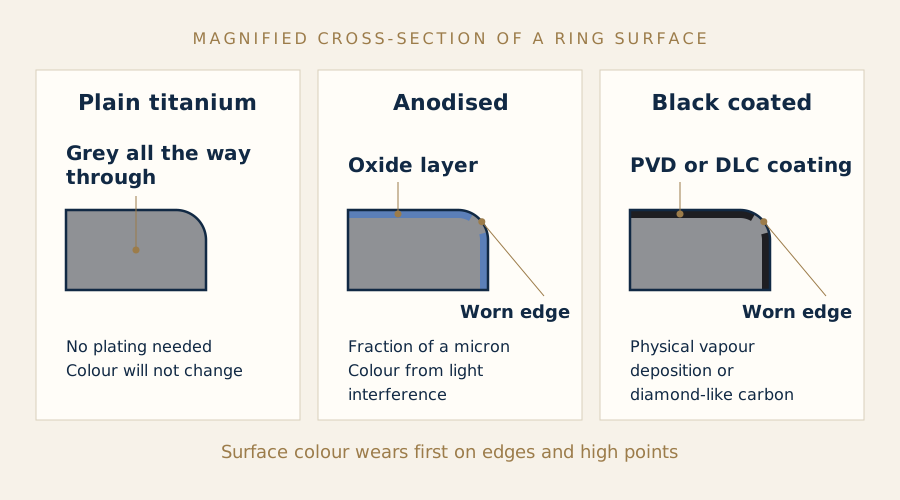
Natural titanium is a mid to dark grey, noticeably darker and slightly warmer than white gold or platinum. It is never yellow or rose. Because the colour runs right through the metal, a plain titanium ring does not need plating, and its colour will not change as it wears. The finish changes the look a great deal:
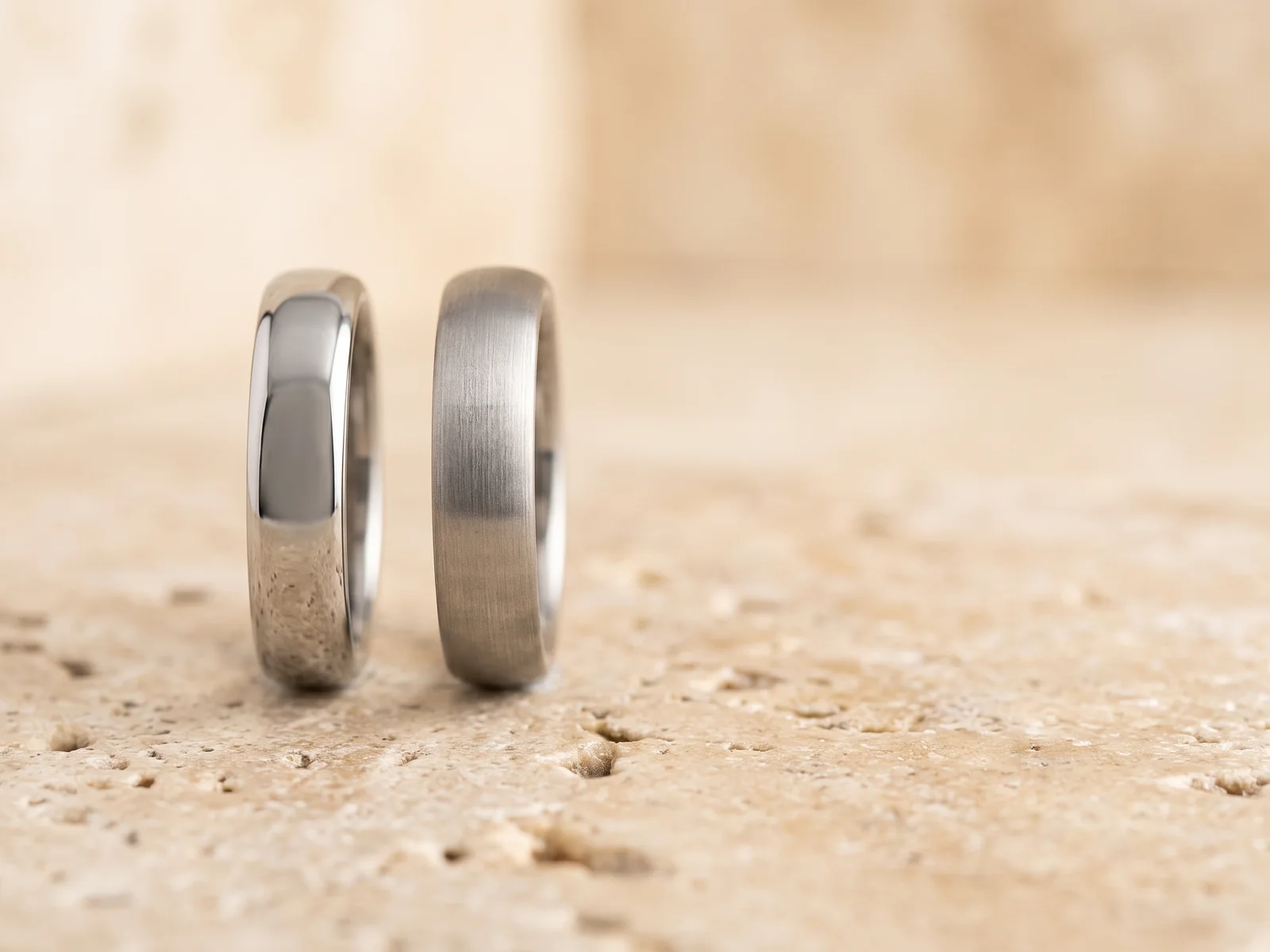
- High polish: a mirror surface, a shade darker than polished platinum.
- Brushed or satin: fine parallel lines that soften the colour and hide small scratches well.
- Sandblasted or matte: a soft, even grey with no shine.
- Hammered or textured: faceted dents cut into the surface that disguise wear.
Anodised titanium shows bronze, blue, purple or green. Anodising passes an electric current through the ring in a solution, thickening the thin natural oxide layer on the surface. No dye is involved: the colour comes from light interfering within that oxide film, which is a fraction of a micron thick. It is surface only, so it rubs off on high points and edges over months or years of wear, leaving grey metal showing through.
A black titanium ring is usually titanium with a hard coating applied by PVD (physical vapour deposition) or DLC (diamond-like carbon). These coatings resist scratches well, but once worn through at an edge they cannot be touched up at the jewellery bench and the ring has to go back to the maker. Some black rings are not titanium at all: black zirconium is zirconium baked until its surface turns to a black oxide.
Many titanium bands also carry inlays: a stripe of yellow or rose gold, silver, wood, carbon fibre or meteorite. A gold stripe gives a two-colour look without the cost of a solid gold band; see how two-tone and mixed-metal rings are made for the options. If you love patterned metal, layered mokume gane rings are a precious-metal alternative. The surface-wear point applies to white gold too: its bright white comes from a plating that also needs renewing, as explained in our guide to rhodium plating and when to replate.
Are titanium rings scratch resistant?
Titanium rings resist dents and bending far better than gold or platinum, but they are not scratch-proof. Hardness is the ability to resist a point pressing into the surface; scratch resistance depends on what is doing the scratching. Sand, concrete, granite benchtops and diamonds (10 on the Mohs scale) are all harder than titanium, which sits at about 6 on the Mohs scale. A polished titanium band will collect fine lines within weeks of daily wear. The good news is that the metal is tough, so it rarely shows deep gouges or loses its shape.
| Metal | Vickers hardness (approx.) | Mohs (approx.) | How it wears |
|---|---|---|---|
| Platinum 950 | 80–150 HV | 4–4.5 | Scratches easily; metal is pushed aside rather than lost, forming a soft patina |
| 18K yellow gold | 125–220 HV | 2.5–3 | Scratches and very slowly wears thin over decades |
| 14K gold | 140–230 HV | 3–3.5 | A little harder than 18K; still scratches |
| Grade 2 titanium | 150–200 HV | about 6 | Fine scratches, resists dents and bending |
| Grade 5 titanium | 330–360 HV | about 6 | Fewer dents and sharper edges; still scratches |
| Tungsten carbide | 1,500–2,400 HV | 8.5–9 | Very scratch resistant, but can crack or shatter if dropped on tile |
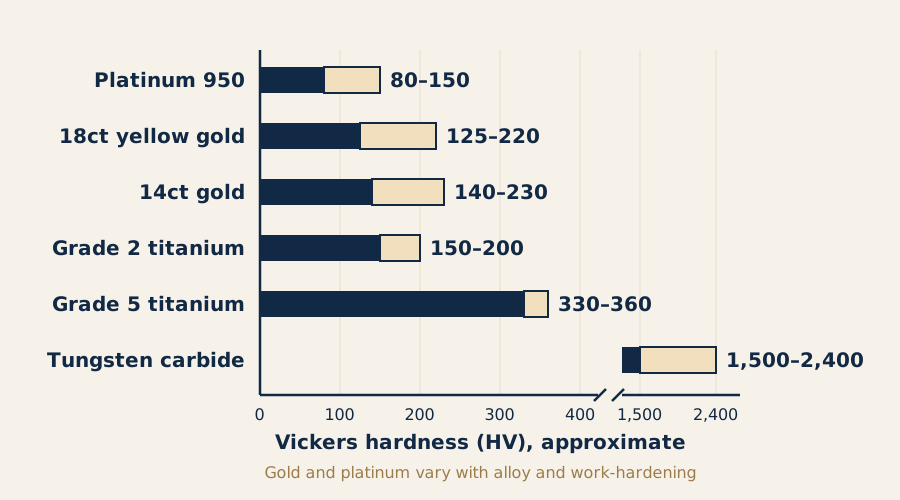
Hardness figures for gold and platinum vary with the alloy and with how much the metal has been worked, so treat the numbers as broad ranges. Our guides to how 14K gold alloys are made and the difference between platinum 950 and 900 show why two rings in the same precious metal can wear differently. The main difference with titanium is not just hardness but toughness: titanium bends before it breaks, while tungsten carbide is harder but brittle.
How heavy and comfortable is a titanium wedding band?
Weight is the first thing people notice. Titanium's density is about 4.5 g/cm³, against roughly 15–16 for 18K yellow gold and about 21.4 for platinum. A 6 mm titanium wedding band typically weighs about 2–4 grams; the same band in 18K gold is usually around 8–12 grams, and in platinum heavier again. Some wearers love that they forget it is there. Others find it feels insubstantial and prefer the heft of a precious metal, so try both on before you decide.
Most titanium wedding bands are made in a comfort-fit profile, with the inside gently domed so the ring slides over the knuckle more easily. A comfort-fit band can feel a little looser than a flat-inside band of the same size, so get sized in the style you plan to wear. Fingers also swell in heat and after exercise, which matters more with titanium than with gold because of the resizing limits explained below.
A common worry is whether titanium rings can be cut off in an emergency. They can. A powered ring cutter, of the kind used by hospital emergency departments and many jewellers, cuts through titanium, although it takes longer than gold. Tungsten carbide is different: it cannot be cut, and is removed by cracking it with locking pliers. Grade 5 and thick bands take the longest, which is one reason people in hand-heavy trades sometimes choose a thinner grade 2 band.
Not sure which one is right?
Send us the stones you are looking at and our gemologist will tell you which to choose and why.
Are titanium rings hypoallergenic?
For most people, yes. Nickel is one of the most common causes of contact allergy, showing up as itching, redness or a rash under the ring. Commercially pure titanium has no added nickel, and titanium is so well tolerated by the body that it is used for dental implants and, as grade 5 or 23 alloy, joint replacements. Grade 5 contains aluminium and vanadium, but they are tightly bound in the alloy and reactions are rare. Grade 23, the implant version, is sometimes offered to people with very sensitive skin. A true titanium allergy does exist but is uncommon.
When someone reacts to a titanium ring, the cause is usually something other than the titanium itself:
- Titanium steel: a marketing name for stainless steel, which can contain about 8–14% nickel. It is not titanium.
- Meteorite inlays: genuine meteorite is an iron-nickel alloy, so it can trigger a nickel reaction.
- Coatings and glues: black coatings, resins and adhesives in wood or carbon fibre inlays can irritate skin.
- Trapped soap and moisture: a wide band traps water, soap and hand cream against the skin.
If nickel is your concern in an engagement ring rather than a band, there are precious-metal options too. Our guide to nickel allergies and nickel-free ring metals covers patch testing and which alloys to ask for, and palladium, a naturally white and nickel-free metal is worth a look. Sterling silver jewellery is usually alloyed with copper rather than nickel, though plated or imported pieces can vary.
Can titanium rings be resized or set with diamonds?
This is the biggest trade-off. A gold or platinum ring is resized by cutting the shank, adding or removing metal and soldering it closed. Titanium cannot be soldered or welded at an ordinary jewellery bench, because the joint needs a vacuum or argon atmosphere. In practice:
- Going larger: a thick band can sometimes be machined out on the inside by about half a size, occasionally a full size, or stretched very slightly.
- Going smaller: not possible; the ring would need to be remade.
- Patterned or inlaid bands: usually cannot be altered at all without damaging the design.
- Exchange policies: many titanium makers offer a size exchange instead of resizing, so check the policy before you buy.
Setting stones is also limited. Claws are hard to make and repair in titanium, so diamonds and gemstones are usually flush set (sunk into a drilled seat so the table sits level with the metal), channel set between two walls, or tension set, where grade 5 titanium is machined slightly undersize and its springiness holds the stone between the two ends of the band. Some designs add a gold or platinum insert so a jeweller can set claws in a metal that can be soldered. Both natural and lab-grown diamonds are used in titanium, and a lab-grown stone should always be described as lab-grown on the paperwork.
How are titanium rings stamped and hallmarked in Australia?
Australia has no compulsory hallmarking and no government assay office. Marks are applied by the maker or retailer, and under Australian Consumer Law they must not be misleading. For precious metals you will see fineness marks such as 375 or 9K (37.5% gold), 585 or 14K, 750 or 18K, PT950 for platinum and 925 for sterling silver, usually alongside a maker's mark. Our guide to reading Australian hallmarks and metal stamps explains each one, and how platinum jewellery is marked and made covers the platinum side.
Titanium is not a precious metal, so there is no fineness number. A titanium ring may be marked TI, TITANIUM, TI G5 or nothing at all. Because titanium is hard, the marks are usually laser-engraved rather than punched. With no standard mark, the paperwork matters: ask for the grade in writing, and be wary of names like titanium steel, tungsten titanium or titanium alloy with no grade given, which can describe quite different metals.
Titanium vs tungsten, gold and platinum: which ring metal suits you?
| Titanium | Tungsten carbide | 18K gold | Platinum 950 | |
|---|---|---|---|---|
| Weight | Very light | Heavy | Medium-heavy | Heaviest |
| Colour | Grey; anodised or coated options | Grey to gunmetal; often coated black | Yellow, white (plated) or rose | Naturally white-grey |
| Dent resistance | High | Very high | Low to moderate | Low to moderate |
| Scratch resistance | Moderate | Very high | Low | Low (forms a patina) |
| Can it be resized? | Barely, larger only | No | Yes | Yes |
| Can it be cut off? | Yes, with a powered cutter | No; cracked off | Yes, easily | Yes |
| Nickel | None added (grades 2, 5, 23) | May use a nickel or cobalt binder | White gold may contain nickel | None |
| Plain 6 mm band (approx. AUD) | $80–$400 | $80–$400 | $1,200–$3,500 | $1,500–$4,000 |
Titanium suits people who want a light, tough, low-cost band and are happy with grey, or who work with their hands and want a ring that keeps its shape. Gold and platinum suit people who want a ring that can be resized for decades, passed down, re-set or remodelled, or that carries a claw-set centre stone. Our guides to choosing a metal for an engagement ring and white gold and platinum side by side go through those choices in detail.
One practical point from the workshop: if a titanium wedding band is worn hard against a gold or platinum engagement ring, the harder titanium can slowly wear the softer metal where the two rub. Many people solve this by choosing bands in the same metal as the engagement ring, wearing them on different fingers, or choosing a design where they do not touch.
Related guideBest Metal for Engagement RingsHow much do titanium rings cost in Australia?
Titanium itself is inexpensive, so most of the price of a titanium ring is machining, finishing, design and any stones or inlays. The price of a plain band barely moves with metal markets, unlike gold and platinum; our explainer on how the gold price flows through to jewellery prices shows the contrast. Approximate ranges:
| Type of ring | Approximate price range (AUD) |
|---|---|
| Plain grade 2 titanium band, 4–6 mm | about $80–$300 |
| Grade 5 or premium comfort-fit band | about $150–$500 |
| Titanium with an inlay (wood, carbon fibre, gold stripe) | about $200–$900 |
| Titanium with diamonds (flush or tension set) | about $500–$3,000 or more |
| Plain 18K gold band, 6 mm (for comparison) | about $1,200–$3,500 |
These are broad ranges only, and stone quality moves the top end a long way. When you compare, factor in the long term: a titanium ring usually cannot be resized much, so if your finger size changes you may need a new ring, while a gold or platinum band can be altered many times. Titanium also has little scrap value, whereas gold and platinum retain a scrap value based on their metal content, which moves with metal prices.
Browse ring settings by metal
How do you look after a titanium ring? Step by step
Titanium does not tarnish the way silver does (our guide to why silver tarnishes and develops patina explains that chemistry), and chlorine and salt water do not harm it. Care is mostly about the finish, the inlays and any stones.
- Confirm the grade. Ask whether the ring is grade 2, grade 5 or grade 23, and whether it is coated or anodised.
- Get sized in the right profile. Try a comfort-fit sample at the end of the day, when fingers are slightly larger, because the ring cannot easily be changed later.
- Clean it gently. Warm water, a drop of mild dishwashing liquid and a soft toothbrush, then dry thoroughly, especially under wide bands.
- Protect inlays and coatings. Take off wood, carbon fibre or black-coated rings before swimming, cleaning with chemicals or heavy work.
- Store it separately. Keep it away from diamond jewellery, which will scratch titanium and other metals.
- Refresh the finish. A jeweller with the right abrasives can re-brush or re-polish plain titanium; coated or anodised rings usually need to go back to the maker.
Free consultation
Talk to a gemologist
Compare stones in person or online with Raj Sood, Graduate Gemologist (GIA), AJP (GIA).
Book a consultationShop this shape
FAQ
Common questions
Are titanium rings good for wedding bands?
They suit many people as wedding bands because they are light, dent-resistant, nickel-free and affordable. The trade-offs are that they scratch, cannot be made smaller and are hard to set with claws.
Can titanium rings be cut off in an emergency?
Yes. A powered ring cutter of the kind used by hospital emergency departments and many jewellers cuts through titanium, though it takes longer than gold. Tungsten carbide is the metal that cannot be cut and has to be cracked off.
Can a titanium ring be resized?
Only a little, and only larger. A thick band can sometimes be machined out by about half a size; it cannot be made smaller, so many makers offer a size exchange instead.
Do titanium rings scratch?
Yes. Titanium resists dents well but sits at about 6 on the Mohs scale, so sand, stone and diamonds will scratch it. A brushed or textured finish hides scratches far better than a high polish.
Is titanium or tungsten better for a ring?
Tungsten carbide is more scratch resistant but heavy, cannot be resized or cut off, and can crack if dropped. Titanium is lighter and tougher, and can be cut off in an emergency, but scratches more easily.
Is a black titanium ring black all the way through?
No. Black titanium is usually grey titanium with a PVD or DLC coating, which can wear through at edges over time. Black zirconium is a different metal with a heat-grown black oxide surface.

Ask a gemologist
Not sure which diamond to choose?
Raj Sood is a Graduate Gemologist (GIA) and master jeweller. Bring the stones you are considering, or send the reports, and he will tell you honestly which one is better and why.
Keep learning
Related guides
Explore more
More guides on this topic
Education