
Metals
Platinum 950 vs 900: Alloys, Hardness, Hallmarks and Wear Compared
Platinum 950 vs 900 comes down to five per cent of metal. That five per cent, and what it is mixed with, changes how hard your ring is, how it wears and what is stamped inside the band.
 Reviewed by Raj Sood, Graduate Gemologist (GIA), AJP (GIA)Master jeweller and Graduate Gemologist (GIA) · reviewed 4 November 2026
Quick answer
Platinum 950 is 95% platinum and platinum 900 is 90%, with the rest usually iridium, ruthenium, cobalt or palladium. Both are white, dense and hypoallergenic for most people, and neither needs rhodium plating. Pt900 with iridium is harder than Pt950 with iridium, but the alloying metal matters more than the number: Pt950 with ruthenium or cobalt is harder still.
What is the difference between platinum 950 vs 900?
Platinum 950 (stamped Pt950) contains 950 parts of platinum in every 1,000 parts by weight, so it is 95% platinum. Platinum 900 (Pt900) contains 900 parts, or 90%. That number is the fineness. The remaining 5% or 10% is another metal, added to make an alloy (a blend of metals). Pure platinum is too soft for most rings: it bends, and claws made from it would not hold a stone securely for long. If any of these words are new to you, our glossary of jewellery terms explains them in plain English.
Platinum itself is a dense, grey-white precious metal. Pure platinum has a density of about 21.45 g/cm³, melts at about 1,768 °C and sits around 3.5 to 4.5 on the Mohs scale (a scratch-hardness scale where diamond is 10). Pt950 and Pt900 share these traits closely, so a ring in either feels noticeably heavier than the same ring in gold. Unlike white gold, which is yellow gold whitened with other metals and usually plated with rhodium, platinum is white all the way through. Our comparison of white gold against platinum covers that bigger choice.
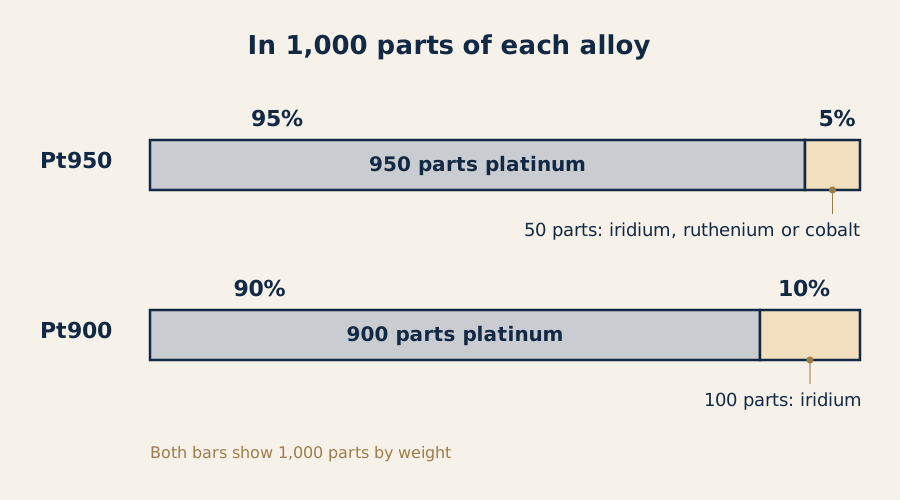
Pt950 is the usual standard for rings in Australia, the UK, Europe and the US. Pt900 is traditional in Japan and common in vintage rings, chains and some machine-made jewellery. Both are genuine platinum; neither is plated or watered down in any misleading sense. For a wider look at how the metal is used for rings, pendants and custom work, see our page on platinum jewellery made in Melbourne.
What metals are mixed into Pt950 and Pt900?
The stamp tells you how much platinum is in the piece, but not what makes up the rest. That second metal is what decides most of the practical differences. The common platinum alloys are:
| Alloy | Make-up | Character | Typical use |
|---|---|---|---|
| Pt950/Ir | 95% platinum, 5% iridium | Soft, very easy to hand-work and polish | Hand-made pieces, bezels, engraving |
| Pt950/Ru | 95% platinum, 5% ruthenium | Harder, holds a polish well, less forgiving to cast | Machined and hand-fabricated bands, claw settings |
| Pt950/Co | 95% platinum, 5% cobalt | Hard, flows well when cast, very slightly darker | Cast settings and detailed designs |
| Pt900/Ir | 90% platinum, 10% iridium | Harder than Pt950/Ir, still easy to work | Japanese jewellery, chains, vintage rings |
Iridium and ruthenium are both platinum-group metals, close chemical relatives of platinum that are also white and resistant to tarnish. Cobalt is not a platinum-group metal; it is added because it helps molten platinum fill fine detail in a casting mould. The cobalt in a platinum alloy is a small addition and should not be confused with cobalt chrome and tantalum wedding bands, which are a different family of metals altogether.
Some suppliers also make Pt950 with small amounts of copper, gallium or a mix of metals, each tuned for casting, machining or spring hardness. In a workshop, the alloy is chosen to suit the job: a soft iridium alloy for a bezel that is pushed over by hand, a harder ruthenium or cobalt alloy for thin claws that must grip a diamond for decades.
How are platinum 950 and 900 stamped in Australia?
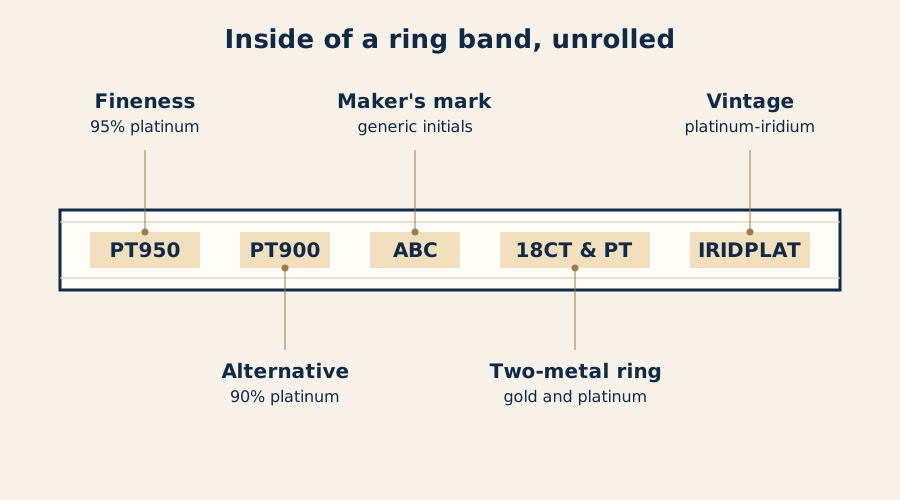
Australia has no compulsory government hallmarking system and no independent assay office. Stamps are applied by the maker, and they are protected by the Australian Consumer Law, which makes it illegal to misdescribe the metal in a piece. That means the stamp is only as reliable as the business that put it there. These are the marks you are most likely to see inside a platinum ring:
- PT950, 950PT or 950 PLAT: 95% platinum.
- PT900, 900PT or 900 PLAT: 90% platinum.
- PLAT or PLATINUM with no number: common on older pieces; the fineness was often 90–95%, but it should be tested to be sure.
- IRIDPLAT: found on vintage rings, meaning platinum alloyed with iridium, often around 90/10.
- A maker's or sponsor's mark: initials or a symbol identifying who made or sold the piece.
- Two metals, such as 18CT & PT: a ring made partly in gold and partly in platinum.
Overseas rules differ. The UK has legally recognised platinum standards of 850, 900, 950 and 999, tested and marked by an assay office. In the US, the Federal Trade Commission allows the word 'platinum' on its own only at 950 and above, with lower fineness shown by number. Japan commonly uses Pt900 and Pt850. Our guide to reading Australian hallmarks and metal stamps covers gold, silver and platinum marks in more detail, and if your ring combines metals, see how stamps work on two-tone and mixed-metal rings.
Is platinum 900 harder than platinum 950?
It depends on the alloy. Vickers hardness (HV) is a lab measure of how much a metal resists a diamond point being pressed into it: the higher the number, the harder the metal. Compared alloy for alloy, more iridium makes platinum harder, so Pt900/Ir is harder than Pt950/Ir. But Pt950 with ruthenium or cobalt is harder again than Pt900 with iridium.
| Metal | Approximate hardness (annealed or as cast) | How it behaves |
|---|---|---|
| Pure platinum (999) | about 40–50 HV | Very soft; bends easily |
| Pt950/Ir | about 80–90 HV | Soft; easy to shape, marks quickly |
| Pt900/Ir | about 100–120 HV | Medium; a common traditional ring alloy |
| Pt950/Ru | about 120–135 HV | Firm; good for claws and bands |
| Pt950/Co | about 125–135 HV | Firm; good for detailed cast settings |
| 18ct white gold (reference) | about 150–220 HV | Harder, but usually rhodium plated |
These figures are typical ranges, not fixed values. Hardness rises when metal is hammered, rolled or burnished (called work hardening), and falls again when it is heated. A finished, polished ring is usually harder than the annealed figures above. Gold alloys vary just as much; our page on how 14ct gold alloys are made shows the same principle in gold.
Harder does not mean scratch-proof. Every platinum alloy shows fine scratches with daily wear, because even the hardest sits around Mohs 4 to 4.5. If you want a band that barely scratches at all, you are looking at scratch-resistant tungsten rings, which trade that resistance for being impossible to resize.
Not sure which one is right?
Send us the stones you are looking at and our gemologist will tell you which to choose and why.
How does a platinum ring look and wear over time?
Platinum wears differently from gold. When gold is scratched, a tiny amount of metal is usually lost. When platinum is scratched, most of the metal is pushed aside into a small ridge rather than removed. Over months, those tiny ridges build up into a soft, satin-like finish called patina. Some people like it; others have the ring repolished, which smooths the displaced metal back into place.
- Colour: Pt950 and Pt900 look virtually identical side by side. Both are a cool grey-white, slightly greyer than rhodium-plated white gold. Pt950/Co can look a touch darker.
- No yellowing: platinum does not turn yellow underneath, because there is no gold under a plating layer.
- No tarnish: platinum does not react with air or skin, unlike the darkening described in our guide to why silver tarnishes and develops patina.
- Slow metal loss: bands thin very slowly over decades, but claw tips still wear and should be checked.
Some people ask for platinum to be rhodium plated so it matches the brighter white of plated white gold. It can be done, but the plating wears off in time like any plating and then needs redoing. Our guide to rhodium plating and how often to replate explains the process. For most platinum wearers, polishing every few years is enough.
Is platinum 950 or 900 better for metal allergies?
Both are among the most skin-friendly jewellery metals. Platinum itself very rarely causes contact allergy, and neither Pt950 nor Pt900 normally contains nickel, the most common cause of jewellery rashes and an ingredient in some white gold. Iridium and ruthenium are also very rarely a problem.
The one alloy to think about is Pt950/Co. Cobalt is a known skin allergen. Reactions to platinum-cobalt jewellery appear to be uncommon, because the cobalt is a small share and bound into the alloy, but if a dermatologist has confirmed a cobalt allergy, ask for platinum with iridium or ruthenium instead. For a full list of metals and what to ask, read our guide to nickel-free options for sensitive skin.
Rashes under a ring are not always an allergy. Soap, moisturiser and water trapped under a wide band can irritate skin with any metal, so clean the ring and dry your hands well before assuming the metal is at fault. If you react to most metals, lightweight titanium rings are another low-allergy option, though they cannot be resized easily.
Platinum 950 vs 900: which costs more?
Pt950 contains slightly more platinum, so its metal value is a little higher, but the difference in a finished ring is small. Platinum is traded per troy ounce (31.1 g), and over recent years the fine metal has ranged very roughly from AUD 40 to AUD 80 per gram. A 6 g band in Pt950 holds about 5.7 g of platinum; in Pt900, about 5.4 g. That 0.3 g gap is worth roughly AUD 12–25 at those prices.
What makes platinum jewellery cost more than gold is mostly weight and labour. Platinum is denser, so the same ring weighs more in platinum than in 18ct gold. It also melts at a much higher temperature (around 1,770 °C, against about 1,064 °C for pure gold), needs special casting moulds, and takes longer to finish and polish. Those costs are about the same for Pt950 and Pt900.
| Piece (metal only, no stones) | Approximate range (AUD) |
|---|---|
| Plain platinum wedding band, 3–5 mm wide | about $1,500–$3,500 |
| Platinum solitaire engagement setting | about $2,000–$4,500 |
| Metal difference, Pt950 vs Pt900, in a 6 g ring | about $12–$25 |
These are broad ranges only. Prices move with the platinum market and with the weight, width and design of the piece, so always compare quotes on the same weight in grams.
Browse ring settings by metal
How does platinum compare with white gold, palladium and other white metals?
| Pt950 | Pt900 | 18ct white gold | Palladium 950 | |
|---|---|---|---|---|
| Precious metal content | 95% platinum | 90% platinum | 75% gold | 95% palladium |
| Natural colour | Grey-white | Grey-white | Pale yellow-grey | Grey-white, a little darker |
| Rhodium plating | Not needed | Not needed | Usually applied | Not needed |
| Density | about 20.7–21.4 g/cm³ | about 21.5 g/cm³ | about 14.5–16 g/cm³ | about 12 g/cm³ |
| Hardness | about 80–135 HV by alloy | about 100–120 HV | about 150–220 HV | about 100–130 HV |
| Allergy note | Very low; ask if cobalt | Very low | Check for nickel | Very low |
Palladium is platinum's lighter cousin: naturally white, nickel-free and only a little over half the weight, which some people find more comfortable in a wide band. See our guide to palladium rings and how they wear. Silver is far softer and tarnishes, so sterling silver jewellery suits fashion pieces better than an everyday engagement ring.
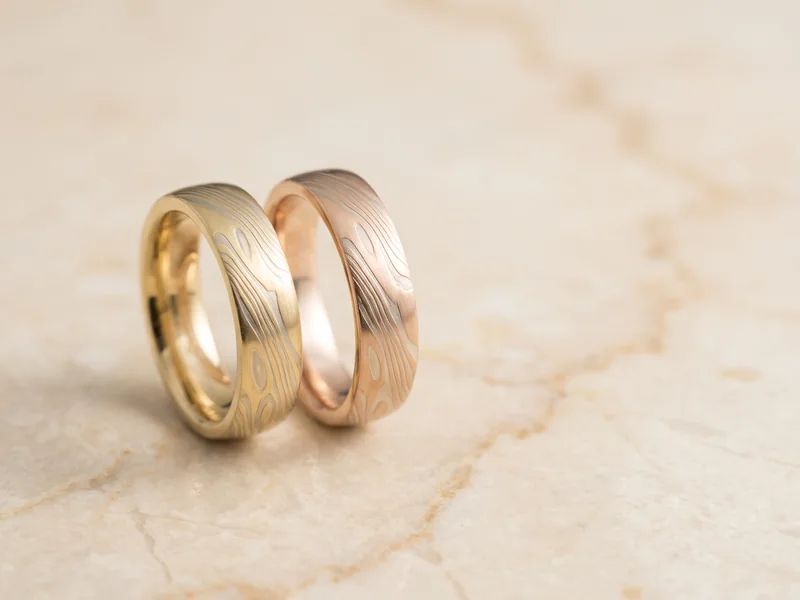
Platinum also turns up in craft pieces: it can be layered with gold in patterned mokume gane rings, though many mokume makers use palladium or silver instead. If you are weighing every option from gold to alternative metals, start with our overview of choosing a metal for an engagement ring.
Related guideWhite Gold vs PlatinumHow do you care for a platinum 950 or 900 ring?
Platinum is low maintenance, and care is the same for both fineness grades:
- Clean at home: warm water, a drop of mild dishwashing liquid and a soft toothbrush, then rinse and dry.
- Check claws: have a jeweller check claws and settings every 6–12 months, even though platinum claws wear slowly.
- Repolish when you like: polishing removes patina; plan on it every few years rather than every year.
- Store separately: platinum and gold rings can scratch each other, and diamonds can scratch platinum, so keep pieces apart.
- Ultrasonic cleaners: safe for the metal itself, but check first if the ring holds treated or fragile gemstones.
- Two-metal rings: keep chlorine away from any gold or solder parts; platinum handles chlorine better than gold does.
How do you choose between Pt950 and Pt900? Step by step
- Ask the fineness and the alloy. Find out whether it is Pt950 or Pt900, and which metal makes up the rest: iridium, ruthenium or cobalt.
- Match the alloy to the design. Thin claws and slim bands benefit from a harder alloy such as Pt950/Ru, Pt950/Co or Pt900/Ir; bezels and hand-engraved work suit a softer iridium alloy.
- Check for allergies. If you have a confirmed cobalt allergy, ask for an iridium or ruthenium alloy.
- Look at the stamps. Confirm the fineness mark and maker's mark inside the band, and keep any paperwork that states the metal.
- Compare weight, not just price. Ask for the finished weight in grams so quotes in different metals can be compared fairly.
- Plan the upkeep. Book a claw check every 6–12 months and decide whether you prefer the patina or an occasional polish.
Free consultation
Talk to a gemologist
Compare stones in person or online with Raj Sood, Graduate Gemologist (GIA), AJP (GIA).
Book a consultationShop this shape
FAQ
Common questions
Is platinum 900 real platinum?
Yes. Pt900 is 90% platinum, usually with 10% iridium or palladium, and it is a long-established standard, especially in Japan and in vintage jewellery. It is not plated and is white all the way through.
Is Pt950 better than Pt900?
Neither is better overall. Pt950 has more platinum, but hardness depends mostly on the alloying metal: Pt950 with ruthenium or cobalt is harder than Pt900 with iridium, which is harder than Pt950 with iridium.
What does PT950 mean on a ring?
It means the ring is 950 parts platinum per 1,000, or 95% platinum. In Australia the stamp is applied by the maker rather than an independent assay office.
Does platinum need rhodium plating?
No. Both Pt950 and Pt900 are naturally white and do not yellow, so plating is optional. Some people plate platinum for a brighter white, but it will wear off and need redoing.
Can a platinum 950 ring be resized?
Yes. Platinum can be resized, but it needs much higher temperatures than gold and a jeweller with platinum experience, often using platinum solder or laser welding.
Is platinum safe for sensitive skin?
For most people, yes. Platinum alloys normally contain no nickel; the only common caution is Pt950/Co for anyone with a confirmed cobalt allergy.
Terms in this guide

Ask a gemologist
Not sure which diamond to choose?
Raj Sood is a Graduate Gemologist (GIA) and master jeweller. Bring the stones you are considering, or send the reports, and he will tell you honestly which one is better and why.
Keep learning
Related guides
Explore more
More guides on this topic
Education