
Metals
How Gold Prices Affect Jewellery Prices in Australia
Gold has reached record prices in Australian dollars, and every solid gold ring, chain and bangle carries that cost in its metal. Here is how the gold price flows into what you pay, and why some pieces move far more than others.
 Reviewed by Raj Sood, Graduate Gemologist (GIA), AJP (GIA)Master jeweller and Graduate Gemologist (GIA) · reviewed 4 November 2026
Quick answer
Gold prices affect jewellery prices through the pure gold each piece contains. Multiply the weight in grams by the purity (37.5% for 9ct, 75% for 18ct, 91.6% for 22ct) and the day's price per gram. Heavy plain gold moves almost in step with the market; diamond rings move far less, because stones and labour dominate.
How do gold prices affect jewellery prices?
Every solid gold piece is priced, at its base, on the pure gold it contains. Jewellery gold is an alloy: pure gold mixed with other metals such as silver, copper, zinc or palladium to make it harder and to set its colour. The carat tells you how much of that alloy is pure gold, measured in parts out of 24. When the market price of gold rises, the metal cost inside every 9ct, 18ct or 22ct piece rises with it, and jewellers who restock metal at the new price pass that on over time.
How far the final price moves depends on two things: how much gold the piece holds, and how much of its price is everything else. A heavy 22ct bangle is mostly metal, so its price tracks the gold market closely. A diamond engagement ring is mostly stone and skilled labour, so even a sharp gold rise changes its total by a much smaller share.
Our overview of gold jewellery from 9ct to 18ct covers the metal itself: colour, strength and craftsmanship. This page is about the money. Any term you have not met before is explained in our plain-English jewellery glossary.
What sets the price of gold in Australia?
The figure you see in the news is the spot price: the price for immediate delivery of pure gold on the world market. It is quoted in US dollars per troy ounce, a traditional precious-metals unit equal to 31.1035 grams (heavier than the everyday ounce of 28.35 grams). Benchmark prices are set twice a day in London and trade continues around the clock in other markets.
For an Australian buyer, the gold price in Australian dollars is the US dollar price divided by the AUD/USD exchange rate. That means two things move it. If gold rises in US dollars, it rises here. If the Australian dollar falls, gold also rises here, even when the US price has not changed at all. In some years the exchange rate has mattered as much as the gold market itself.
- Interest rates and the US dollar: gold pays no interest, so it tends to look more attractive when interest rates fall or the US dollar weakens.
- Central bank buying: several central banks have been large buyers of gold in recent years, adding to demand.
- Uncertainty and inflation: investors often buy gold during economic or political stress.
- Jewellery demand: India and China are the largest jewellery markets, and wedding and festival seasons there affect demand.
- The AUD/USD exchange rate: the local factor that converts all of the above into Australian dollars.
To get a price per gram, divide the Australian dollar price per ounce by 31.1. As a worked example, AUD 5,600 an ounce is about AUD 180 a gram. We use AUD 180 a gram as a round example figure throughout this page so the maths is easy to follow; check the day's actual figure before you use it.
Jewellers also pay a little more than spot for the metal they actually use. Gold arrives from refiners already alloyed to 9ct, 18ct or 22ct, as casting grain, wire or sheet, and each step carries an alloying and handling fee on top of the gold content.
How much gold is in 9ct, 14ct, 18ct, 22ct and 24ct gold?
The carat system is simple fractions. 18ct means 18 parts gold out of 24, or 75%. The stamp inside a piece often shows the fineness instead: parts of pure gold per thousand, so 750 means 18ct and 375 means 9ct. Here is what each standard holds, using a 5 gram piece at the example price of AUD 180 a gram.
| Carat | Parts gold of 24 | Fineness stamp | Pure gold | Gold in a 5 g piece | Approx. gold value at AUD 180/g |
|---|---|---|---|---|---|
| 9ct | 9 | 375 | 37.5% | 1.88 g | about AUD 340 |
| 14ct | 14 | 585 | 58.5% | 2.93 g | about AUD 525 |
| 18ct | 18 | 750 | 75% | 3.75 g | about AUD 675 |
| 22ct | 22 | 916 | 91.6% | 4.58 g | about AUD 825 |
| 24ct | 24 | 999 | 99.9% | 5.00 g | about AUD 900 |
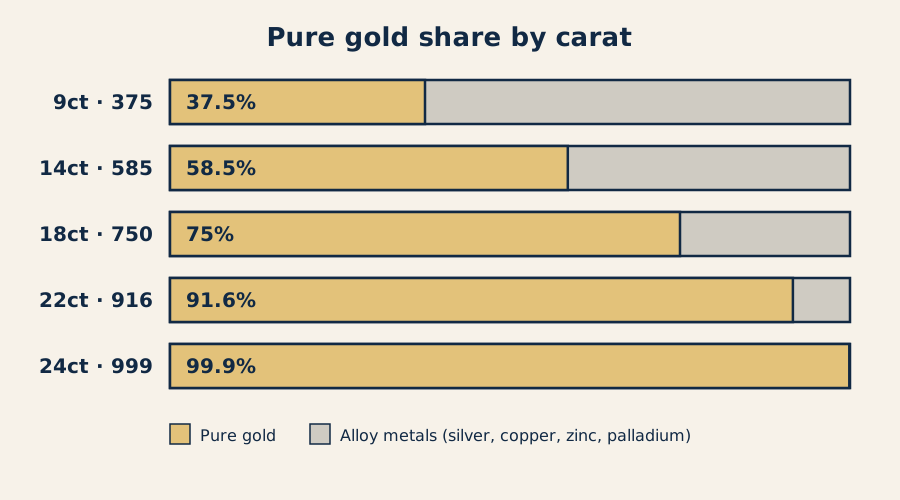
There is a second effect people often miss: density. Gold is far heavier than the silver, copper and zinc it is mixed with, so higher carat alloys weigh more for the same size. 9ct yellow gold is roughly 11–12 grams per cubic centimetre, 18ct about 15–16 and 22ct nearly 18. A ring design that weighs 3.0 g in 9ct weighs about 4.1 g in 18ct. The 9ct ring holds about 1.1 g of pure gold; the 18ct ring holds about 3.1 g, nearly three times as much.
That is why the price gap between 9ct and 18ct gold is usually much wider than the purity numbers alone suggest, and why it widens further when gold is expensive. Sitting between them, 14ct gold and its 58.5% gold content is common in North America and is becoming more popular here as a middle option.
How much do gold prices affect jewellery prices for each type of piece?
The metal is only one line in the cost of a finished piece. The larger its share, the more a change in the gold price shows up in what you pay. The figures below are rough illustrations, not quotes; they show the pattern rather than exact amounts.
| Piece | Typical gold weight | Gold's rough share of the price | Effect of a 20% rise in gold |
|---|---|---|---|
| 22ct chain or bangle | 20–40 g | roughly 70–90% | price rises about 14–18% |
| Plain 18ct wedding band | 4–7 g | roughly 40–60% | about 8–12% |
| Plain 9ct wedding band | 2–4 g | roughly 20–40% | about 4–8% |
| 18ct solitaire, 1 ct lab-grown diamond | 3–5 g | roughly 20–35% | about 4–7% |
| 18ct solitaire, 1 ct natural diamond | 3–5 g | roughly 5–10% | about 1–2% |
| Gold plated or vermeil piece | traces only | usually under 5% | under 1% |
The rest of the price is made up of the work and materials around the gold. For a custom ring that includes design and CAD (computer-aided design) modelling, casting, filing and polishing by hand, setting the stones, any rhodium plating, quality checks, the jeweller's overheads and 10% GST. Labour takes roughly the same hours whether the ring is 9ct or 18ct, which is why 9ct pieces are less sensitive to gold swings.
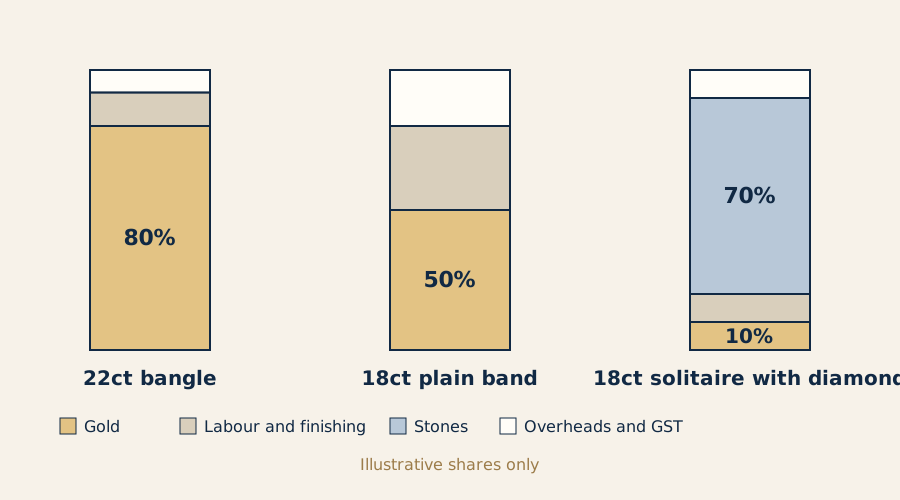
For engagement rings, the centre stone usually dominates. Lab-grown diamonds cost much less than natural diamonds of the same size and grades, so in a lab-grown ring the gold is a bigger share of the total and a gold rise is more noticeable. Our guide to diamond prices in Australia sets out typical stone costs, and our comparison of engagement ring metals for everyday wear weighs cost against durability.
Not sure which one is right?
Send us the stones you are looking at and our gemologist will tell you which to choose and why.
Does white, yellow or rose gold cost more?
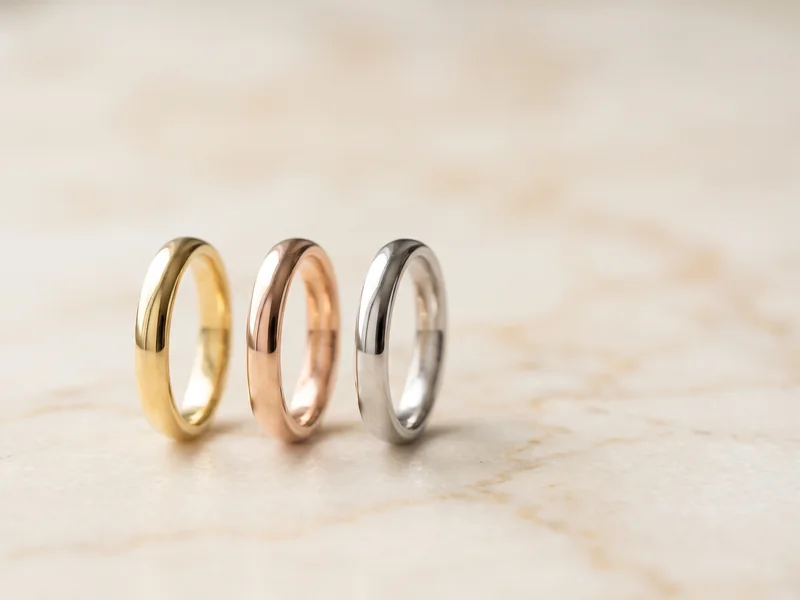
At the same carat, yellow, white and rose gold contain the same proportion of pure gold, so the gold price affects all three equally. The difference is in the other 25% (in 18ct) or 62.5% (in 9ct), and in the finishing.
- Yellow gold is gold alloyed with silver and copper. These are inexpensive additions, so yellow gold costs about the same as the gold content suggests. See how silver and copper give yellow gold its colour and strength.
- Rose gold uses more copper, the cheapest of the alloy metals, so it costs the same or a touch less than yellow. Our explainer on the copper behind rose gold's colour goes into the mixes.
- White gold is whitened with palladium or nickel. Palladium is itself a precious metal with a volatile price, so palladium white gold can cost noticeably more. Most white gold is also plated with rhodium, another precious metal, and needs replating every year or two; see why white gold gets a rhodium coat.
For a full side-by-side of look, wear and upkeep, read yellow, white and rose gold compared.
Is platinum more expensive than gold now?
Per gram, platinum has traded well below gold in recent years. That is a reversal: for most of the 20th century and up to about 2015, platinum usually cost more than gold. But a platinum ring is rarely cheaper than the same ring in 18ct white gold, for three reasons.
- Purity: jewellery platinum is usually 95% pure (stamped 950 or PT950), against 75% gold in 18ct.
- Weight: platinum 950 is about 20–21 grams per cubic centimetre, so the ring weighs roughly a third more than in 18ct gold. The 3.0 g 9ct ring from earlier would be about 5.5 g in platinum.
- Labour: platinum melts at a much higher temperature and is slower to cast, solder and polish, so workshop time is higher.
The result is that platinum and 18ct white gold rings often land in a similar price range, with platinum frequently a little higher. Our white gold and platinum comparison explains the wear differences, which matter more than the price for most people.
How are 22ct and 24ct gold jewellery priced?
For many Melbourne families from Indian, Sri Lankan, Chinese, Vietnamese and other Asian backgrounds, 22ct and 24ct gold are the traditional jewellery golds, worn for weddings, festivals and family occasions. These pieces are priced differently from Western fine jewellery: usually the weight in grams multiplied by the day's gold rate for that carat, plus a making charge for the craftsmanship. Because the metal is most of the cost, prices can change from one week to the next.
- Gross and net weight: net weight should exclude stones, enamel, beads or thread.
- Carat and stamp: 916 means 22ct; 999 means 24ct. Australia has no compulsory hallmarking scheme, so marks are applied by makers and importers.
- Gold rate used: the price per gram for that carat on the day of the quote.
- Making charge: quoted per gram or as a percentage of the metal value, and varying widely with how intricate the work is.
- Wastage charge: some sellers add a separate allowance for metal lost in making; ask whether it is included in the making charge.
- GST: 10% applies to jewellery, including 24ct pieces. Only investment-grade bullion is sold without GST.
Higher carat golds are also much softer. 22ct scratches and bends more readily than 18ct, thin bangles dent, and claws holding stones can loosen, so 22ct suits chains, bangles and earrings better than an engagement ring worn every day. 24ct is softer again and mostly used for coins, simple bands and traditional pieces. Our page on wearing and caring for 22ct and 24ct gold covers this in detail.
Related guide22K and 24K Gold JewelleryOne more point on value: when gold jewellery is sold back, buyers generally pay on the pure gold content only, below spot to cover assaying (purity testing) and refining. The making charge is not recovered, so the price of a new piece and its resale value are always some distance apart.
Do gold prices affect gold plated, gold filled and vermeil jewellery?
Only a little. These pieces carry a gold surface over another metal, so the gold price is a small part of their cost. That is also why they wear differently from solid gold: once the layer wears through, the base metal shows.
| Type | What it is | Gold content | How much the gold price matters |
|---|---|---|---|
| Gold plated | A thin gold layer, often under 1 micron, electroplated over brass or another base metal | Traces | Barely at all |
| Gold vermeil | Sterling silver plated with a thicker gold layer, commonly at least 2.5 microns | Small; silver price matters too | A little |
| Gold filled | A thick layer of gold alloy bonded to a base metal, typically 1/20 of the total weight | About 5% gold alloy by weight | Modest |
| Solid 9ct | Gold alloy all the way through | 37.5% gold | Moderate |
| Solid 18ct | Gold alloy all the way through | 75% gold | Strong |
| Solid 22ct | Gold alloy all the way through | 91.6% gold | Very strong |
Australia has no legal definition of vermeil or gold filled, so ask for the layer thickness and the base metal. Our guides to plated, filled and solid gold compared and what makes jewellery vermeil explain how long each layer lasts.
Should you wait for gold prices to fall before buying jewellery?
Nobody can reliably predict the gold price, and jewellery is not bullion. Its resale value is based on gold content minus refining costs, while the design, labour and stones are what you are really paying for. For an engagement ring or wedding band with a date attached, waiting for the market rarely makes sense. For a large 22ct purchase with no deadline, some families do watch the rate, but the market can move either way.
If gold prices are stretching the budget, these are the levers that actually change the metal cost:
- Choose a lower carat. 9ct or 14ct holds less gold and is harder-wearing, though less rich in colour than 18ct.
- Choose a lighter design. A slimmer band or open gallery uses less metal, but do not go so thin that the shank wears through within years.
- Reuse old gold. Remodelling inherited jewellery puts your own metal to work, though it needs refining or careful alloying to reach the right carat.
- Mix colours thoughtfully. A white-metal engagement ring with a yellow band can work well; see how to mix gold colours in a bridal set.
If you love yellow gold but worry about how it suits a white diamond, our guide to pairing yellow gold with colourless diamonds shows how a white-metal setting head keeps the stone looking crisp.
Ring settings by metal
How do you work out the gold value of a piece of jewellery?
You can check how much of a price is metal with a kitchen-scale level of maths. Here is the method, using an 18ct band as the example.
- Find the carat. Look for a stamp inside the band or on the clasp: 375 or 9ct, 585 or 14ct, 750 or 18ct, 916 or 22ct, 999 or 24ct.
- Weigh the piece in grams. A jeweller's scale reading to 0.01 g is ideal. Subtract the approximate weight of any stones; a 1 ct diamond weighs 0.2 g.
- Multiply by the purity. A 5.0 g 18ct band × 0.75 = 3.75 g of pure gold.
- Multiply by the day's gold price per gram in AUD. At the example price of AUD 180 a gram, 3.75 g × 180 = about AUD 675 of gold.
- Compare it with the price. The difference covers alloy metals, labour, design, finishing, stones, overheads and GST.
- For custom work, ask for the metal weight estimate. A CAD model gives a close estimate of finished weight before casting, so you can see how the carat choice changes the cost.
Free consultation
Talk to a gemologist
Compare stones in person or online with Raj Sood, Graduate Gemologist (GIA), AJP (GIA).
Book a consultationShop this shape
FAQ
Common questions
Why is gold jewellery so expensive at the moment?
Gold has reached record prices in Australian dollars, driven by strong investment and central bank demand and by the exchange rate. Every solid gold piece carries that metal cost, and heavier or higher carat pieces carry the most.
How much is 18ct gold worth per gram?
18ct is 75% gold, so its metal value is about three-quarters of the pure gold price per gram. At an example price of AUD 180 a gram for pure gold, 18ct holds about AUD 135 of gold per gram.
Will gold jewellery get cheaper if the gold price falls?
The metal part of the price would fall, but labour, stones and overheads would not, and jewellers adjust at different speeds. Pieces that are mostly gold, such as 22ct chains and bangles, follow falls most closely.
Is 9ct gold cheaper than 18ct gold?
Yes, usually by a wide margin. 9ct holds half the gold proportion of 18ct and is lighter for the same design, so the same ring holds nearly three times as much gold in 18ct.
Do I get the gold price back if I sell my jewellery?
Not the full retail price. Buyers generally pay on the pure gold content only, below spot to cover testing and refining, and the making charge and labour are not recovered.
Does the gold price affect gold plated jewellery?
Very little. Plating is often under a micron thick, so the gold is a tiny share of the cost; vermeil and gold filled pieces are affected a little more.

Ask a gemologist
Not sure which diamond to choose?
Raj Sood is a Graduate Gemologist (GIA) and master jeweller. Bring the stones you are considering, or send the reports, and he will tell you honestly which one is better and why.
Keep learning
Related guides
 Metals9K vs 18K Gold: Which Gold Is Better for Jewellery?
 Metals22K and 24K Gold JewelleryMetalsGold Plated vs Gold Filled vs Solid Gold
 MetalsWhite Gold vs PlatinumMetalsBest Metal for Engagement Rings
 MetalsYellow Gold vs White Gold vs Rose GoldMetalsGold Vermeil Explained
 MetalsGold Jewellery: 9K, 18K, Colours, Craftsmanship & Lasting Value
Explore more
More guides on this topic
Education