
Metals
Australian Hallmarks and Metal Stamps: What Every Mark Means
Australian hallmarks work differently from the British system most people have heard of. Knowing what the tiny numbers inside a ring actually promise, and what they leave out, helps you compare metals, avoid allergy surprises and check secondhand pieces.
 Reviewed by Raj Sood, Graduate Gemologist (GIA), AJP (GIA)Master jeweller and Graduate Gemologist (GIA) · reviewed 4 November 2026
Quick answer
Australia has no compulsory government hallmarking. Instead, the maker stamps a fineness mark and usually a maker's mark: 375 or 9ct, 585 or 14ct, 750 or 18ct for gold, 925 for sterling silver, Pt950 or Pt900 for platinum. A stamp shows the claimed purity, not the alloy mix or any plating, so ask, and test anything secondhand.
What are Australian hallmarks?
A hallmark, in the strict sense, is a set of marks applied by an independent assay office after it has tested a piece of precious metal. The word comes from Goldsmiths' Hall in London, where English silver and gold were tested and marked for centuries. In the United Kingdom that system is still compulsory: above set weights, gold, silver, platinum and palladium cannot be sold as such without an assay office hallmark.
Australia has never had a government assay office for jewellery. What Australians call hallmarks are really manufacturer's stamps: a fineness mark (how much precious metal the alloy contains) and, usually, a maker's or sponsor's mark (initials or a symbol identifying who made or sold the piece). They are struck or laser-engraved by the jeweller, not checked by an outside body before sale.
That does not make them meaningless. There is an Australian Standard covering how precious metal articles should be marked, and the Australian Consumer Law makes it illegal to mislead a buyer, which includes stamping 750 on metal that is not 18ct gold. But the system relies on the maker's honesty and skill, so it helps to know what each mark means. Any term here you have not met before is explained in our plain-English jewellery glossary.
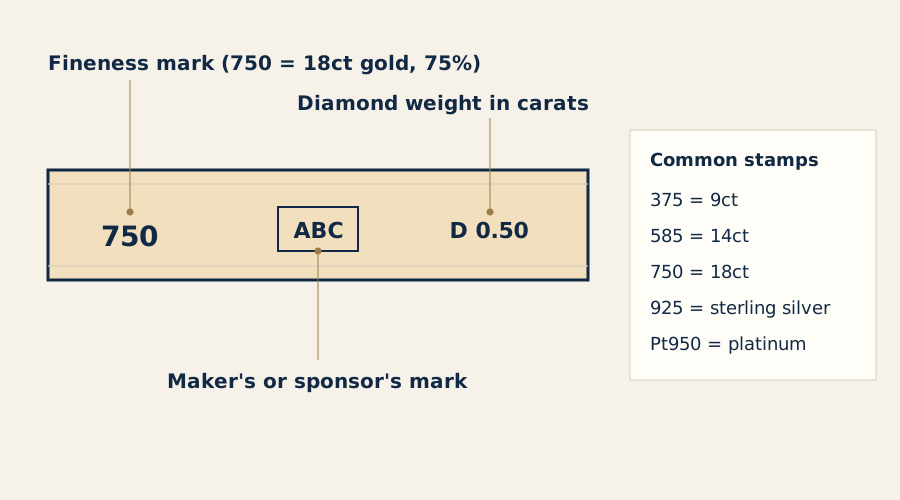
Fineness is written in parts per thousand. A stamp of 750 means 750 parts in every 1,000 by weight are pure gold, or 75%. Gold is also described in carats (ct), out of 24: 18ct gold is 18/24, which is the same 75%. Don't confuse this with carat weight for gemstones, which is a unit of mass (0.2 g).
How do you read the metal stamps on jewellery?
Most stamps you will find in Australia fall into a small set. Some makers use the number, some the carat, some both. Overseas-made pieces often use a letter K after the carat number, which means the same thing as ct.
| Stamp | Metal | Pure metal content | Notes |
|---|---|---|---|
| 375 / 9ct / 9K | 9ct gold | 37.5% gold | The most common gold in Australian jewellery |
| 585 / 14ct / 14K | 14ct gold | 58.5% gold | Common in American and European pieces |
| 750 / 18ct / 18K | 18ct gold | 75% gold | Standard for fine engagement rings |
| 916 / 22ct | 22ct gold | 91.6% gold | Traditional in Indian and Middle Eastern jewellery |
| 999 / 24ct | Fine gold | 99.9% gold | Very soft; rarely used for rings |
| 625 / 15ct | 15ct gold | 62.5% gold | Found on antique Australian and British jewellery |
| 925 / STG / Sterling | Sterling silver | 92.5% silver | Usually alloyed with copper |
| Pt950 / 950 Plat | Platinum | 95% platinum | Most common platinum alloy |
| Pt900 / 900 Plat | Platinum | 90% platinum | Slightly harder alloys, often from Japan |
| Pd950 / 950 Pall | Palladium | 95% palladium | A platinum-group metal, lighter than platinum |
You might also see a small number such as 0.50 or D 1.02. That is usually the total diamond weight in carats, not a metal mark. A word or code like LGD or LAB signals that the diamonds are laboratory-grown, which some makers stamp alongside the metal.
The stamp sits where it will not wear quickly or show: inside the shank of a ring, on the clasp or tag of a chain, on the back of a pendant bail or on earring posts. Very fine chains and small studs often carry no mark at all, because there is nowhere to put it.
What do 375, 585 and 750 mean on gold?
Pure gold is too soft for everyday rings, about 2.5–3 on the Mohs scale (a 1–10 scratch-hardness scale). So it is alloyed, meaning melted together with other metals, usually silver, copper and zinc, plus palladium or nickel for white gold. The fineness stamp tells you how much is gold; the rest of the alloy decides the colour and much of the hardness.
| 9ct (375) | 14ct (585) | 18ct (750) | |
|---|---|---|---|
| Gold content | 37.5% | 58.5% | 75% |
| Typical yellow alloy | Gold plus silver, copper, a little zinc | Gold plus silver, copper, zinc | Gold plus roughly equal silver and copper |
| Colour | Paler yellow, can look slightly brassy | Mid yellow | Rich, warm yellow |
| Density (approx.) | 11–12 g/cm³ | 13–14.5 g/cm³ | 15–16 g/cm³ |
| Wear | Hard-wearing, but can tarnish slightly | Good balance | Slightly softer; scratches polish out |
| Allergy risk | Higher; more base metal | Moderate | Lower; less base metal |
| Relative metal cost | Lowest | Middle | About double the gold of 9ct |
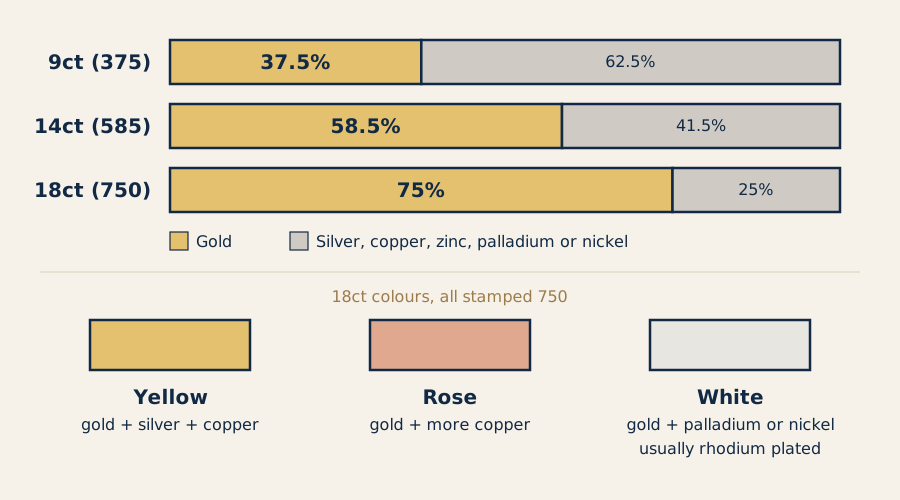
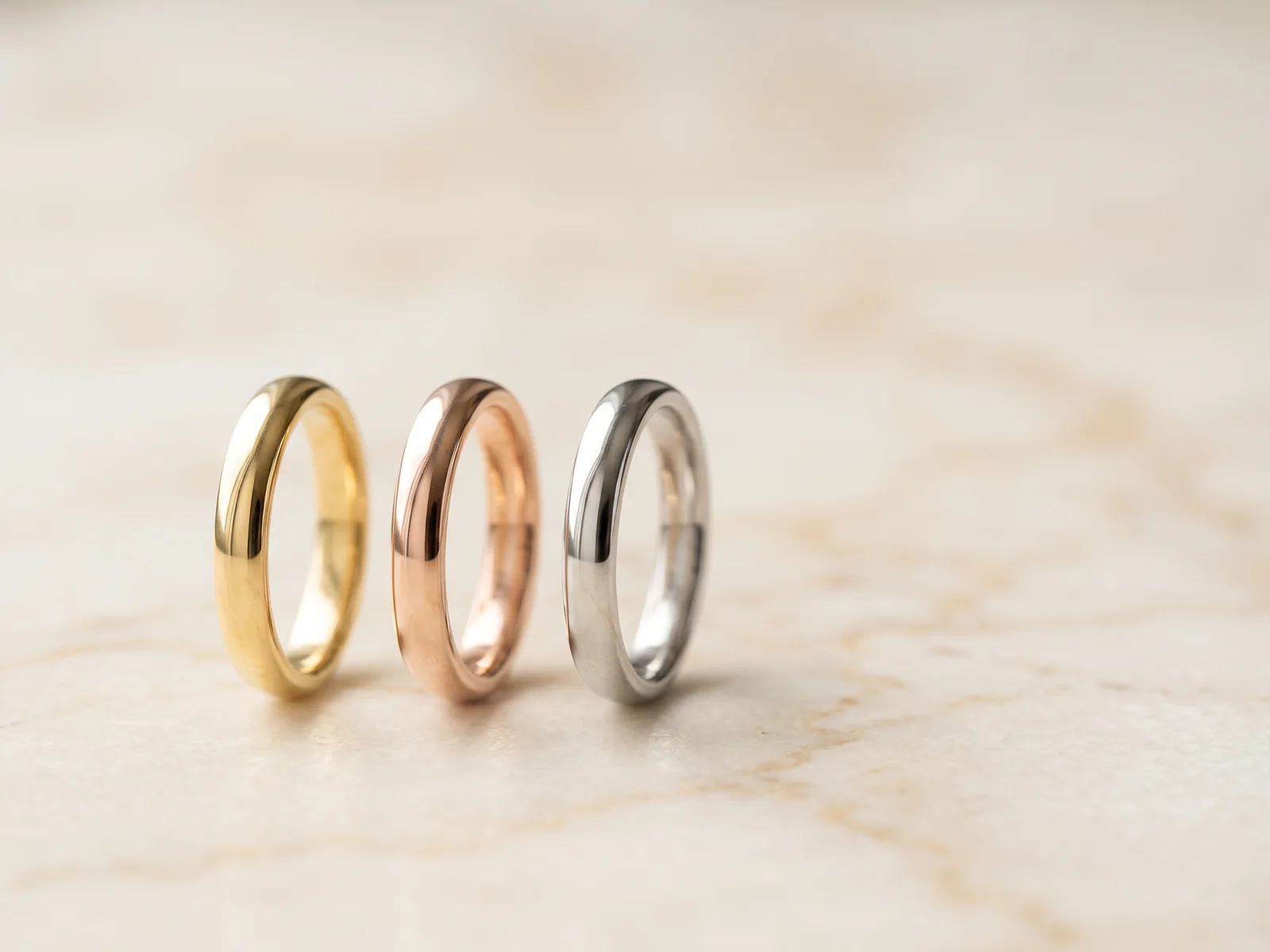
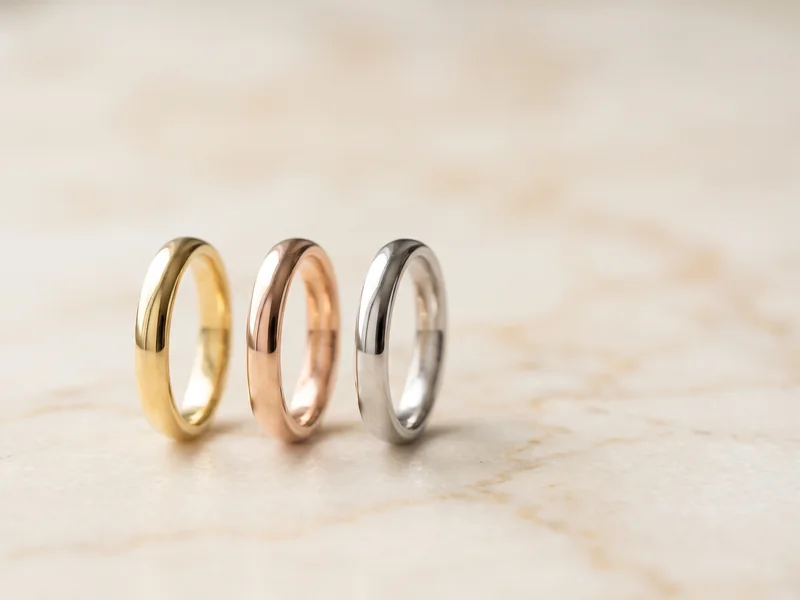
Colour comes from the alloy. Rose gold has more copper: an 18ct rose alloy is typically 75% gold with around 20–22% copper and a little silver. Yellow gold balances silver and copper. White gold replaces some of the copper and silver with whitening metals such as palladium or nickel. The stamp is the same 750 for all three. If you are mixing colours, our page on combining two gold colours in one ring explains how each alloy wears beside the other.
A common belief is that 9ct is "tougher" than 18ct. In practice, the alloy and how it was worked matter as much as the carat. A well-made 18ct ring is durable for decades; it simply shows fine scratches sooner and costs more. For a fuller comparison of how metals hold claws and resist thinning, see our guides to choosing a metal for an engagement ring and the metals that suit an everyday wedding band. If your centre stone is pink, yellow or blue, metal colour changes how it looks; matching metal colour to coloured diamonds covers that.
As a very broad guide, a plain 4 mm wedding band costs roughly AUD 500–1,000 in 9ct gold, AUD 1,500–3,000 in 18ct gold and AUD 1,800–3,500 in platinum, depending on weight, profile and the gold price on the day. Gold prices move daily, so treat these as ranges only.
What doesn't a metal stamp tell you?
A fineness mark is a promise about one number. It says nothing about three things that matter a great deal to how a piece wears:
- Which metals make up the rest of the alloy. A white gold ring stamped 750 can be a nickel white gold or a palladium white gold. Nickel is one of the most common causes of contact allergy, so this can decide whether a ring is comfortable.
- Whether the surface is plated. Most white gold is finished with rhodium plating, a very thin layer of a bright white platinum-group metal. The stamp underneath is unchanged, and the plating wears off, usually first on the underside of the band.
- How well the piece was made. Porosity (tiny air holes from casting), thin claws or weak solder joints are invisible in a stamp.
Nickel white golds are hard and quite white, so they need less plating, but they can cause itchy, red skin under the band in people sensitive to nickel. Palladium white golds are softer to work, slightly greyer and generally kinder to sensitive skin. If you have reacted to costume jewellery, belt buckles or watch backs before, read our guide to nickel-free metals for sensitive skin before choosing an alloy, and ask your jeweller in writing what the white gold contains.
Related guideMetal Allergies and Nickel-Free OptionsRhodium plating usually lasts about one to three years on a ring worn every day, less on the palm side. When it thins, the warmer colour of the gold underneath starts to show. Our page on when and how white gold is replated explains the process and the signs to watch for.
Not sure which one is right?
Send us the stones you are looking at and our gemologist will tell you which to choose and why.
How are platinum, palladium and silver stamped?
Platinum is usually stamped Pt950, 950 Plat or simply PLAT. That 5% of other metal is often ruthenium, iridium or cobalt, each of which changes how hard the metal is and how it polishes. Ruthenium alloys tend to be harder; iridium alloys are softer and favoured for fine setting work. Some Japanese and older pieces are Pt900, 90% platinum with 10% iridium or palladium. Our guide to how Pt950 and Pt900 differ in wear and colour goes into detail, and the wider guide to platinum jewellery covers weight, colour and care.
Platinum is naturally white, so it does not usually need rhodium plating. It is dense, about 21 g/cm³ for pure metal, which is why a platinum ring feels noticeably heavier than a gold one of the same size. It sits around 4–4.5 on the Mohs scale, and rather than wearing away it tends to push metal aside when scratched, leaving a soft satin look called a patina.
Palladium is stamped Pd950, 950 Pd or 950 Pall. It is also a platinum-group metal, naturally white and nickel-free, but at about 12 g/cm³ it is much lighter than platinum. Our page on palladium as a ring metal explains where it fits.
Sterling silver is 92.5% silver, usually with copper, stamped 925, STG or Sterling. It is soft (about 2.5–3 Mohs) and darkens over time as the silver reacts with sulphur in the air. That is normal and does not mean the silver is not genuine. Read our sterling silver buying and care guide and the page on why silver tarnishes and how to clean it. A piece stamped 925 with a gold colour is usually gold-plated silver, which brings us to plating marks.
What do GP, HGE, RGP and gold filled stamps mean?
Not every gold-coloured stamp means solid gold. These marks describe a base metal (often brass or silver) with a gold layer on top. The quality of that layer varies widely.
| Stamp | Meaning | How durable |
|---|---|---|
| GP / GEP | Gold plated / gold electroplate: a very thin gold layer applied by electric current | Wears through in months to a few years |
| HGE / HGP | Heavy gold electroplate: a thicker plated layer | Lasts longer, still wears through |
| RGP / Rolled gold | A thicker gold sheet bonded to base metal by heat and pressure | Can last many years; common in older Australian jewellery |
| GF / 1/20 14K GF | Gold filled: a bonded gold layer, often 1/20 of the total weight | Much more durable than plating |
| Vermeil | Gold plating over sterling silver | Depends on layer thickness |
| 18K GP / 14K GP | Plated with 18ct or 14ct gold, not solid | Same as GP |
The trap is a stamp like 18K GP or 14K RGP. The carat number describes only the thin outer layer. Read every letter after the number: if GP, GEP, HGE, RGP or GF is there, the piece is not solid gold.
How are titanium, tungsten and cobalt rings marked?
Alternative metals are not precious metals, so there is no fineness system for them. Makers often stamp a short code, and sometimes nothing at all:
- TI or Titanium: very light (about 4.5 g/cm³) and hypoallergenic in commercially pure grades. See our guide to titanium rings.
- TC, WC or Tungsten Carbide: very scratch-resistant, about 8.5–9 on the Mohs scale, but brittle and cannot be resized. Our page on tungsten carbide jewellery explains the trade-offs.
- Co or Cobalt: usually a cobalt-chrome alloy, bright white and hard. Compare it in cobalt, tantalum and carbon fibre ring options.
- Mixed precious metals: layered pieces may carry the fineness of each metal used, such as 750 and 925. Mokume gane, the Japanese layered-metal technique, is a good example.
Because these metals cannot usually be resized or easily repaired, the stamp matters less than knowing exactly which material you have before you need a jeweller to work on it.
How are Australian hallmarks different from British and European hallmarks?
Pieces made in the UK, Ireland and much of Europe often carry an independent hallmark as well as a fineness number. A modern UK hallmark has a sponsor's mark, a fineness mark, an assay office mark (for example the anchor of Birmingham, the leopard's head of London, the rose of Sheffield or the castle of Edinburgh) and sometimes a date letter. Some also carry the Common Control Mark, a pair of scales used under an international hallmarking convention. Australia is not a member of that convention, so Australian makers do not apply it.
Antique Australian jewellery has its own character. Nineteenth-century colonial gold and silversmiths sometimes used pseudo-hallmarks, symbols that imitated English marks, and some added local motifs such as a kangaroo or emu. Older Australian gold is frequently 15ct (62.5%), a standard that was common in Britain and Australia until the early twentieth century, and a lot of rolled gold was sold too.
| Australia | United Kingdom | |
|---|---|---|
| Who applies the mark | The maker or importer | An independent assay office |
| Compulsory | No; fineness marking follows a voluntary standard | Yes, above set weights |
| Independent testing before sale | No | Yes |
| Typical marks | Fineness (375, 750, 925, Pt950) plus maker's mark | Sponsor, fineness, assay office, optional date letter |
| Legal protection | Australian Consumer Law: no misleading claims | Hallmarking Act |
How does GemTrove mark the metals it uses?
Pieces made in our workshop are marked with their fineness, so you, an insurer or a future jeweller can tell at a glance what the metal is. If you have a sensitivity, ask which white gold or platinum alloy a design uses before it is made; it is a simple question and should get a clear answer in writing.
When we resize, repair or remodel a piece, we check where the stamp sits so it is not lost in the join. If an older ring has worn smooth inside, a fresh fineness mark can be added once the metal has been tested.
Browse ring settings by metal
How do you check a hallmark before you buy? Step by step
For new jewellery from an established maker, the stamp, invoice and a written description are normally enough. For secondhand, antique or online purchases, it is worth going further.
- Find the mark. Use a 10× loupe (a small magnifier) inside the shank, on the clasp or on the back of the piece.
- Read every character. Note the number, any letters after it (GP, HGE, RGP, GF) and any maker's mark.
- Compare the colour and weight. Platinum feels heavy; 9ct looks paler than 18ct; a gold colour over 925 means plating.
- Look for wear. A different colour showing at the edges or underside suggests plating, including rhodium on white gold.
- Ask about the alloy. Especially for white gold if you react to nickel.
- Have it tested if in doubt. A jeweller can use a touchstone and acid test, or an XRF analyser (X-ray fluorescence, which reads the metal content without damage).
A missing stamp does not mean a piece is fake, and a stamp is not proof on its own. Testing is what settles it.
Free consultation
Talk to a gemologist
Compare stones in person or online with Raj Sood, Graduate Gemologist (GIA), AJP (GIA).
Book a consultationShop this shape
FAQ
Common questions
Is Australian jewellery hallmarked?
Not in the British sense. Australia has no compulsory government assay office, so Australian jewellery carries maker's stamps showing fineness, such as 375 or 750, and often a maker's mark.
What does 750 mean on gold?
It means 750 parts per thousand, or 75%, of the metal is pure gold. That is 18ct gold, whether it is yellow, rose or white.
Is a 9ct gold stamp real gold?
Yes. 9ct, stamped 375, is solid gold alloy containing 37.5% pure gold. It is the most common gold standard in Australian jewellery and the most affordable.
What does 925 mean on jewellery?
It means sterling silver, 92.5% pure silver. If the piece is gold-coloured, it is almost always gold-plated silver, sometimes called vermeil.
Can a hallmark be faked?
Yes. Because the maker applies the stamp, a dishonest seller can stamp anything. For secondhand or online pieces, an acid or XRF test by a jeweller confirms the metal.
Does resizing remove the stamp?
It can if the cut runs through the mark. Ask for the stamp to be avoided or re-applied after the resize.

Ask a gemologist
Not sure which diamond to choose?
Raj Sood is a Graduate Gemologist (GIA) and master jeweller. Bring the stones you are considering, or send the reports, and he will tell you honestly which one is better and why.
Keep learning
Related guides
 MetalsPlatinum 950 vs 900
 MetalsRhodium Plating and Replating
 MetalsMetal Allergies and Nickel-Free Options
 MetalsBest Metal for Wedding BandsMetalsTwo-Tone and Mixed-Metal Rings
 Fancy Colour DiamondsBest Settings and Metals for Coloured DiamondsMetalsCobalt, Tantalum and Carbon Fibre Rings
Explore more
More guides on this topic
Education