
Metals
Metal Allergies and Nickel Free Jewellery: Which Ring Metals Are Safe
Nickel is the metal behind most jewellery rashes, and it hides inside many white golds and fashion pieces. Here is which metals contain it, how to check a stamp, and which nickel free jewellery options suit a ring you will wear every day.
 Reviewed by Raj Sood, Graduate Gemologist (GIA), AJP (GIA)Master jeweller and Graduate Gemologist (GIA) · reviewed 4 November 2026
Quick answer
Nickel is the most common cause of a jewellery rash. For nickel free jewellery, choose platinum 950, palladium 950, 18 carat yellow or rose gold, palladium white gold, grade 2 titanium, niobium or tantalum. Avoid nickel white gold, cheap plated fashion pieces and some stainless steels. Rhodium plating only hides nickel until it wears through.
What causes a metal allergy from jewellery?
Most jewellery rashes are allergic contact dermatitis: an immune reaction to metal ions that sweat dissolves out of the alloy (a mix of metals melted together) and carries into the skin. Nickel is by far the most common trigger. Once your immune system is sensitised to nickel, the sensitivity is usually lifelong, so the aim is to keep nickel away from your skin rather than to build up tolerance.
The reaction is delayed. Redness, itching and small blisters usually appear 12–48 hours after contact, which is why many people don't connect a rash with a ring they put on yesterday. Ear piercings are a common starting point: a cheap stud post sits in a healing wound for weeks, and that is how many people become sensitised in the first place.
| What you notice | Likely cause | What helps |
|---|---|---|
| Itchy red rash under the band, 1–2 days after wearing | Nickel (or cobalt) allergy | Identify the alloy; switch to a nickel free metal |
| Rash starts after a year on a white gold ring | Rhodium plating worn through on nickel white gold | Replate short term; remake in palladium white gold or platinum |
| Green or dark mark on the skin, no itch | Copper or silver reacting with sweat or lotion | Not an allergy; clean the ring and the skin |
| Dry, scaly patch under a wide band, worse after hand washing | Soap and water trapped under the ring (irritant dermatitis) | Remove rings to wash; dry well; try a comfort-fit band |
| Rash from a steel watch strap or cobalt ring | Nickel, chromium or cobalt release | Patch test; consider titanium, platinum or gold |
Nickel is not the only allergen. Cobalt and chromium cause reactions in a smaller group of people, and some people who react to nickel also react to palladium. True gold allergy exists but is uncommon. A dermatologist's patch test (small discs of each metal taped to your back for about two days) is the only reliable way to know which metals you react to. Any unfamiliar term here is also explained in our plain-English jewellery glossary.
Which jewellery metals contain nickel?
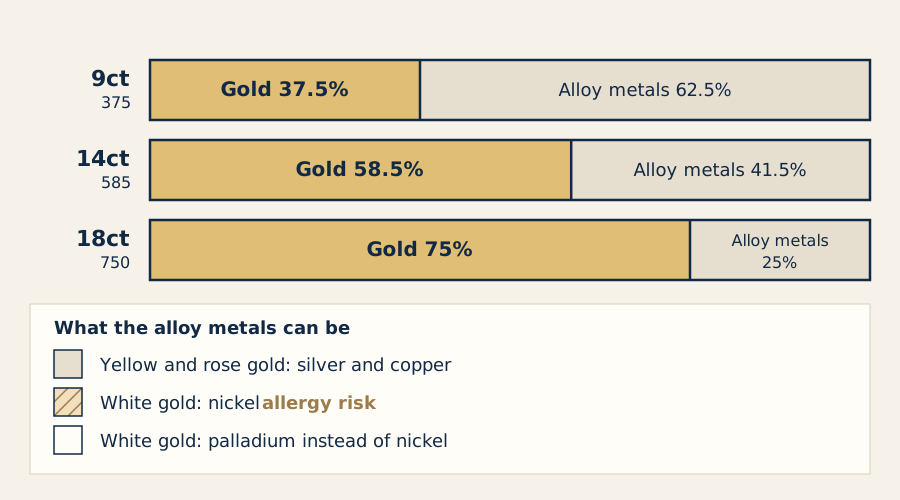
A carat stamp only tells you how much gold is in the metal. 9 carat is 37.5% gold, 14 carat is 58.5% and 18 carat is 75%. The rest, between 25% and 62.5% of the ring, is other metals, and that is where the allergy risk lives. Our guide to 14 carat gold and its alloys explains how that mix changes colour and hardness.
| Metal | Typical make-up | Contains nickel? | Allergy notes |
|---|---|---|---|
| 9ct yellow gold | 37.5% gold with silver, copper and zinc | Not normally | Low nickel risk; mostly copper and silver |
| 18ct yellow gold | 75% gold with silver and copper | No | Low risk; one of the gentlest gold options |
| 18ct rose gold | 75% gold, about 20–22% copper, some silver | No | Copper allergy is rare; can mark skin green in some people |
| Nickel white gold (9–18ct) | Gold with roughly 5–15% nickel, plus copper and zinc | Yes | Main cause of white gold rashes once plating wears |
| Palladium white gold (9–18ct) | Gold with palladium, silver and copper | No | Suits most nickel-allergic people; slightly greyer tone |
| Platinum 950 | 95% platinum with ruthenium, iridium or cobalt | No | Very low risk; avoid the cobalt alloy if you react to cobalt |
| Palladium 950 | 95% palladium with ruthenium or gallium | No | Low risk; occasional cross-reaction with nickel |
| Sterling silver 925 | 92.5% silver, mostly copper | Not normally | Tarnishes; cheap plated pieces may hide a nickel layer |
| Titanium (grade 2) | Over 99% titanium | No | Very low risk; used in medical implants |
| Stainless steel 316L | Iron, chromium and about 10–14% nickel | Yes | Nickel is tightly bound and releases slowly; some still react |
| Tungsten carbide | Tungsten carbide with a nickel or cobalt binder | Often | Ask which binder; nickel-binder rings can cause rashes |
Even metals sold as nearly pure are alloys. Platinum 950 can be alloyed with ruthenium, iridium or cobalt, and the choice affects hardness and how cleanly it casts, which our comparison of platinum 950 and 900 covers. For someone with a confirmed cobalt allergy, a ruthenium or iridium platinum alloy is the safer request.
Is white gold nickel free?
Not always, and it is the question people ask most. Gold is naturally yellow, so white gold is made by adding whitening metals. For most of the 20th century the whitener was nickel: it is inexpensive, hard and bleaches gold well. Nickel white gold is still widely used, particularly in 9 and 14 carat and in mass-produced jewellery.
The alternative is palladium white gold, which uses palladium (a platinum-group metal) as the whitener. It is nickel free, softer and easier to work, a little heavier, and has a warm grey tone. It costs more because palladium is a precious metal. Europe has limited how much nickel jewellery may release since the 1994 Nickel Directive (applied from 2000, now under REACH): no more than 0.5 micrograms per square centimetre per week for items in long skin contact, and, since 2005, 0.2 for piercing posts. That pushed many European makers to palladium alloys. Australia has no equivalent limit, so you need to ask.
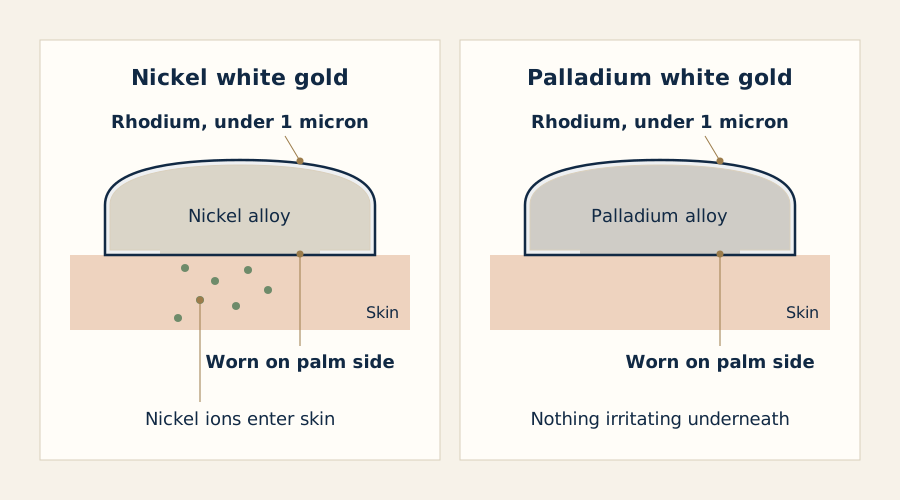
Both kinds are usually finished with rhodium plating, a thin bright-white layer of rhodium, a platinum-group metal, often well under a micron (a thousandth of a millimetre) thick. While the plating is intact it acts as a barrier, which is why a nickel white gold ring can feel fine for months. On the palm side of a daily-worn ring the plating commonly wears through within about 6–18 months, and the nickel alloy then sits directly against the skin. Our guide to rhodium plating and replating explains how often it needs redoing.
Two-tone rings need the same check. A yellow gold band with a white gold head can still put nickel against your finger if the white part is nickel-based. Our guide to combining metals in one ring covers how the two alloys are joined.
Which metals are safest for nickel free jewellery?
For people with a confirmed nickel allergy, these are the metals dermatologists and jewellers usually point to, with their practical trade-offs:
- Platinum 950: 95% platinum, naturally white, no plating needed. Very dense (about 21.4 g/cm³), so a ring feels heavy. It scratches, but the metal is pushed aside rather than lost, building a soft patina. See our platinum jewellery guide.
- Palladium 950: naturally white, nickel free and roughly 40% lighter than platinum (about 12 g/cm³). Its price has swung widely in recent years. Our guide to palladium rings covers wear and resizing.
- 18ct yellow or rose gold: 75% gold with silver and copper. Low risk and easy to resize and repair. Pure gold is only about 2.5–3 on the Mohs hardness scale; alloying makes it harder.
- Palladium white gold: white gold without nickel. Usually still rhodium plated for a brighter white, but nothing irritating is underneath when it wears.
- Titanium: very light (about 4.5 g/cm³), strong and used for medical implants. Hard to resize, and stones are harder to set securely. Read more on how titanium rings wear and age.
- Tantalum, niobium and zirconium: specialty metals that skin tolerates very well, used for bands and body jewellery.
For hypoallergenic engagement rings, hardness and repairability matter as much as skin comfort, because the ring has to hold a diamond securely for decades. Claws in platinum or 18ct gold can be retipped; titanium claws cannot. Our comparison of engagement ring metals, side by side weighs durability, colour and cost alongside allergy.
Not sure which one is right?
Send us the stones you are looking at and our gemologist will tell you which to choose and why.
Are stainless steel, tungsten and cobalt rings hypoallergenic?
'Hypoallergenic' has no legal definition in Australia, so treat it as a marketing word rather than a test result. The alternative metals vary a lot:
- Stainless steel: 316L 'surgical' steel contains about 10–14% nickel, but it is locked into a stable structure and releases very little. Most nickel-sensitive people tolerate it; highly sensitive people may not.
- Tungsten carbide: very scratch resistant (about 9 on the Mohs scale) but held together by a binder metal. Cobalt and nickel binders both exist, and nickel-binder rings are a common source of reactions. Our tungsten jewellery guide explains the grades.
- Cobalt rings: usually a cobalt-chromium alloy. Fine for many people, but a poor choice if you react to cobalt or chromium. Tantalum is a gentler dark-grey option; see cobalt, tantalum and carbon fibre bands compared.
- Mokume gane: layered metal with a wood-grain pattern. Some traditional layer combinations include nickel-bearing alloys, so ask what each layer is; a gold or platinum lining keeps the pattern off your skin. Our page on mokume gane shows the common combinations.
Tungsten, cobalt and titanium generally cannot be resized the way gold and platinum can, so if your finger size may change, weigh that up alongside the allergy question.
Does rhodium plating stop a nickel allergy?
Only temporarily. Rhodium itself very rarely causes allergy, so fresh plating can calm a rash for a while. But a typical jewellery plate is a fraction of a micron thick, and the inside of a ring rubs against skin, soap and other rings every day. Replating every 6–18 months is a maintenance cost, not a cure, and the rash tends to return each time it wears.
The same applies to plated fashion jewellery and to silver. Inexpensive plated earrings often have a brass base or a nickel underlayer, and once the top coat goes, the base metal touches your skin. Sterling silver is rarely a nickel problem, but it tarnishes, and rhodium-plated silver wears back to metal that darkens; our guide to why silver tarnishes and how to treat it explains the difference between tarnish and allergy.
Clear nail polish or barrier sprays painted inside a band are a stopgap some people use. They wear off within days and are no answer for a ring you wear every day.
How do you check if jewellery is nickel free?
Start with the stamp inside the band. Common Australian stamps are 375 or 9ct, 585 or 14ct, 750 or 18ct, PT950 or PLAT for platinum, PD950 or PALL for palladium, and 925 or STG for sterling silver. Australia has no government assay office, so these marks are applied by the maker or importer rather than tested independently. Our guide to reading Australian hallmarks and metal stamps decodes each one.
The catch is that no stamp says what the rest of the alloy is. '750' on a white ring tells you it is 18 carat, not whether it is nickel or palladium white gold. So:
- Ask the maker which alloy was used. A workshop that casts its own metal can tell you exactly.
- Use a DMG spot test: a swab with dimethylglyoxime turns pink when nickel is being released. Kits are inexpensive. On a rhodium-plated piece, test where the plating is worn, or the result can read falsely clear.
- See a dermatologist for patch testing if you react to more than one metal, or to palladium or cobalt as well as nickel.
How much does nickel free jewellery cost in Australia?
Nickel free does not have to mean expensive. The approximate ranges below are for a plain 4 mm wedding band. Weight, width, profile and finish all move the price, and precious metal prices change week to week, so treat these as a rough guide only.
| Metal (4 mm plain band) | Approximate price (AUD) | Nickel free? |
|---|---|---|
| Titanium | about $150–$450 | Yes |
| 9ct yellow or rose gold | about $500–$1,000 | Usually |
| 18ct yellow or rose gold | about $1,200–$2,200 | Yes |
| 18ct nickel white gold | about $1,200–$2,200 | No |
| 18ct palladium white gold | about $1,400–$2,500 | Yes |
| Palladium 950 | about $1,000–$2,200 | Yes |
| Platinum 950 | about $1,600–$3,200 | Yes |
Palladium white gold usually costs a little more than nickel white gold of the same carat, because palladium is pricier than nickel. Over many years, though, a nickel white gold ring that needs replating every year or so can cost more to keep comfortable. For nickel free wedding bands worn every day, our wedding band metal comparison sets price against long-term wear.
Browse ring settings by metal
How do you choose a ring if you have a metal allergy? Step by step
- Confirm the allergy. A GP or dermatologist patch test tells you whether it is nickel, cobalt, palladium or something else, and rules out irritation from trapped soap.
- Rule out metals. Cross off nickel white gold, nickel-binder tungsten and unidentified plated pieces; add cobalt alloys to the list if you react to cobalt.
- Pick from the safe group. Platinum 950, palladium 950, 18ct yellow or rose gold, palladium white gold or titanium, depending on budget, weight and whether the ring holds stones.
- Ask for the alloy in writing. Have the metal and alloy (for example, 'platinum 950 with ruthenium') noted on your receipt or valuation.
- Check every part. Claws, heads, solder joins and any metal added during resizing should be nickel free too.
- Wear it well. Take rings off to wash hands and apply hand cream, dry under the band, and choose a comfort-fit (rounded inside) profile if a wide band traps moisture.
Free consultation
Talk to a gemologist
Compare stones in person or online with Raj Sood, Graduate Gemologist (GIA), AJP (GIA).
Book a consultationShop this shape
FAQ
Common questions
Is 18ct gold nickel free?
18ct yellow and rose gold normally contain no nickel; they are 75% gold with silver and copper. 18ct white gold may or may not, depending on whether it is whitened with nickel or palladium, so ask which alloy is used.
Is platinum hypoallergenic?
Platinum 950 contains no nickel and very rarely causes a reaction, which makes it one of the most skin-friendly ring metals. If you are also allergic to cobalt, ask for a ruthenium or iridium platinum alloy.
Can I wear white gold with a nickel allergy?
Yes, if it is palladium white gold. Nickel white gold usually feels fine only while its rhodium plating is intact, and the rash tends to return as the plating wears.
Are titanium rings good for a nickel allergy?
Commercially pure titanium contains no nickel and is used in medical implants, so most people with a nickel allergy wear it comfortably. The trade-off is that titanium is difficult to resize and less suited to holding a precious stone.
Why does my ring turn my finger green?
A green mark is usually copper in the alloy reacting with sweat, lotion or chlorine to form a harmless copper salt. It is not an allergy and washes off, though an itchy rash alongside it is worth investigating.
Can an existing ring be remade in a nickel free metal?
Yes. A jeweller can usually recreate the design in platinum, palladium or palladium white gold and reset your original stones, provided they are in good condition.

Ask a gemologist
Not sure which diamond to choose?
Raj Sood is a Graduate Gemologist (GIA) and master jeweller. Bring the stones you are considering, or send the reports, and he will tell you honestly which one is better and why.
Keep learning
Related guides
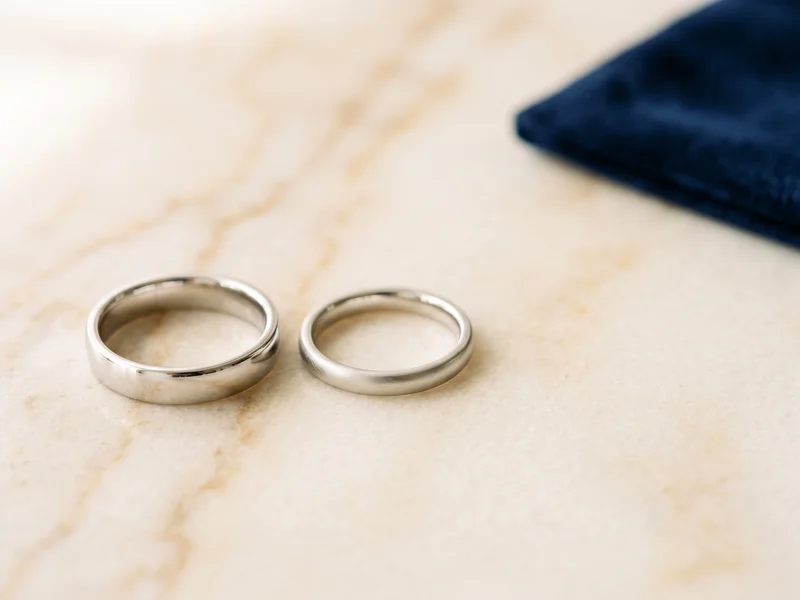
 MetalsPalladium Rings
 MetalsPlatinum Jewellery MelbourneMetalsRhodium Plating and Replating
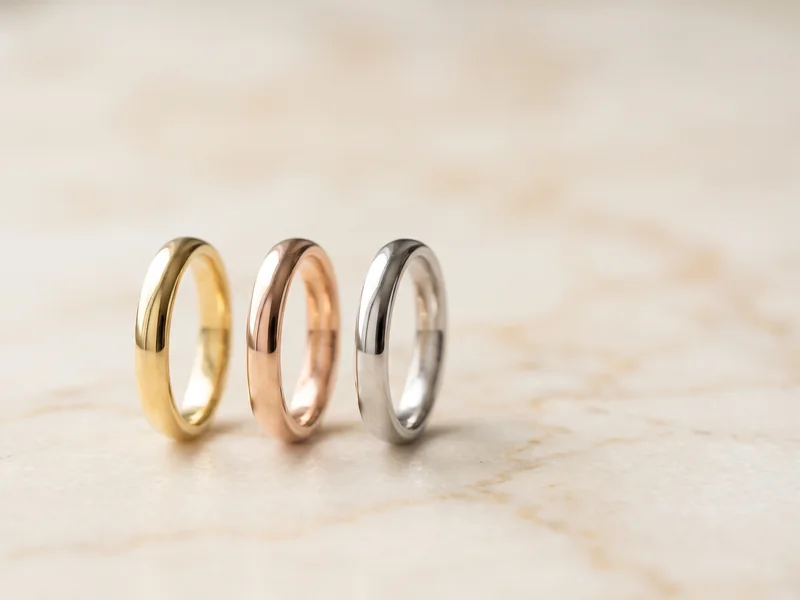 MetalsAustralian Hallmarks and Metal StampsMetalsBest Metal for Engagement RingsMetalsTwo-Tone and Mixed-Metal RingsMetalsBest Metal for Wedding Bands
 Natural DiamondsConflict-Free Diamonds – Responsible Sourcing at GemTrove
Explore more
More guides on this topic
Education