
Gemstones
White Sapphire Guide: Colour, Hardness, Value and Ring Wear
White sapphire is one of the most common natural alternatives to a colourless diamond, and it behaves differently in ways worth knowing before you choose one. Here is what a gemmologist checks, from tint and treatment to how it wears in a ring.
 Reviewed by Raj Sood, Graduate Gemologist (GIA), AJP (GIA)Master jeweller and Graduate Gemologist (GIA) · reviewed 4 November 2026
Quick answer
White sapphire is colourless corundum, the same mineral as blue sapphire, without the trace elements that add colour. It rates 9 on the Mohs scale with excellent toughness, so it suits everyday rings, but its refractive index of 1.76–1.77 gives softer sparkle than diamond. Choose an eye-clean, tint-free stone, ask about heating, and confirm natural or lab-created.
What is white sapphire?
White sapphire is corundum, a crystal of aluminium oxide (Al2O3), in its pure, colourless form. Blue sapphire gets its colour from traces of iron and titanium; ruby gets its red from chromium. Take those trace elements away and you are left with a stone that has no body colour at all. So yes, a white sapphire is a real sapphire, with exactly the same hardness and structure as a blue one. Our full sapphire gemstone guide covers the whole family.
The word "white" is trade shorthand. A fine white sapphire is actually colourless, like clear water, not milky. In practice, most stones sit on a range: truly colourless at the top, then stones with a faint yellow, grey, blue or pink tint that you notice when you lay them on a white card. The purer the stone, the closer it is to colourless, and the rarer it is in nature. The same mineral, with different traces, gives us the pinkish-orange padparadscha, violet and purple sapphires and even sapphires that shift colour between daylight and lamplight.
Corundum is doubly refractive, meaning light splits into two rays as it passes through. In sapphire the split is small (a birefringence of about 0.008–0.010), so you will not see doubled facet edges with the naked eye the way you can in some other gems. If any term on this page is new to you, our glossary of jewellery terms explains it in plain English.
How hard is white sapphire, and is it tough enough for a ring?
Two different properties decide how a stone survives daily wear. Hardness is resistance to scratching, measured on the Mohs scale from 1 (talc) to 10 (diamond). Toughness is resistance to chipping and breaking when the stone takes a knock. White sapphire scores well on both.
At 9 on the Mohs scale, white sapphire is harder than everything except diamond and moissanite (a lab-created gem). Ordinary household dust contains quartz at 7, which slowly scratches and dulls softer stones; sapphire shrugs it off. Sapphire also has no cleavage, the flat planes along which some crystals split cleanly. Diamond has cleavage, which is why a harder stone can still chip at a thin edge. Sapphire can show parting, a weakness along twinning planes, but it is uncommon in colourless stones and rarely a problem in jewellery.
| Stone | Mohs hardness | Toughness | Everyday ring? |
|---|---|---|---|
| Diamond (natural or lab-grown) | 10 | Good (has cleavage) | Yes |
| White sapphire (natural or lab-created) | 9 | Excellent (no cleavage) | Yes |
| Moissanite (lab-created) | 9.25 | Good to very good | Yes |
| Cubic zirconia (synthetic) | 8–8.5 | Fair to good | Scratches and dulls over years |
| White topaz | 8 | Poor (perfect cleavage) | With care; chips more easily |
| Emerald | 7.5–8 | Poor to fair | Protective setting needed |
| White opal | 5.5–6.5 | Poor to fair | Occasional wear or bezel only |
That table is why white sapphire is so often chosen for engagement rings. Compare it with white opal, a far softer gem at 5.5–6.5, which needs a bezel and gentle wear, or look at how sapphire's toughness compares with emerald's if you are weighing up a green stone.
White sapphire vs diamond: what is the real difference?
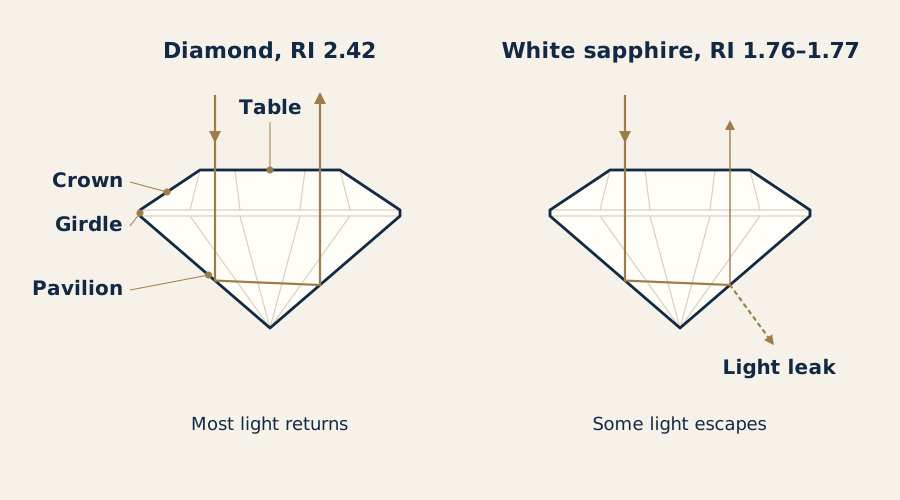
The difference you will notice is light. A gem's refractive index (RI) measures how strongly it bends light. Diamond's RI of 2.42 bends light so sharply that a well-cut stone sends most of it back up through the top, which reads as brightness. White sapphire's RI of 1.76–1.77 bends light less, so more leaks out of the back, and the stone looks softer and more glassy-bright than icy-bright.
Dispersion is the splitting of white light into rainbow flashes, often called fire. Diamond's dispersion is 0.044; white sapphire's is 0.018, so it shows very little colourful fire. Some people prefer that calmer, cleaner look. Others find it flat next to a diamond. Neither is wrong, but you should see the two side by side before you decide.
| White sapphire | Diamond | Moissanite | Cubic zirconia | |
|---|---|---|---|---|
| What it is | Natural or lab-created corundum | Natural or lab-grown carbon | Lab-created silicon carbide | Synthetic zirconium oxide |
| Refractive index | 1.76–1.77 | 2.42 | 2.65–2.69 | 2.15–2.18 |
| Dispersion (fire) | 0.018 (low) | 0.044 | 0.104 (very high) | about 0.060 |
| Mohs hardness | 9 | 10 | 9.25 | 8–8.5 |
| Specific gravity | about 4.00 | 3.52 | 3.22 | 5.6–6.0 |
| Look | Soft, bright, little fire | Bright with balanced fire | Strong rainbow fire | Bright, lots of fire |
| Approx. 1 ct price (AUD) | about $30–$2,500 (lab-created to fine natural) | much higher, natural especially | about $300–$1,000 | under $50 |
For the full ring-by-ring picture, including cost over a lifetime and how each stone looks after ten years, read diamond and sapphire engagement rings compared.
Related guideDiamond vs Sapphire Engagement RingsIs white sapphire treated, and what about lab-created white sapphire?
Most natural white sapphires on the market have been heat treated. Rough corundum is heated, often above 1,500 °C, to dissolve or reduce faint yellow, grey or blue tints and to improve clarity. The result is stable and permanent and is accepted across the trade, but it must be disclosed. An unheated, naturally colourless sapphire with a laboratory report is rarer and costs more.
Other treatments exist in the corundum family but are less common in colourless stones. Beryllium diffusion, a high-temperature process that drives colour into the stone, became well known on orange and yellow-orange sapphires and is rarely used to make white. Coatings and glass filling of fractures are seen occasionally in low-cost goods; both reduce durability and must be disclosed.
- Unheated natural: rarest; ask for a report that says "no indications of heating".
- Heated natural: the usual natural white sapphire; stable and durable.
- Lab-created (synthetic): same chemistry and hardness, grown in a factory; very inexpensive.
- Simulants: glass, cubic zirconia or white topaz sold as "white sapphire"; not sapphire at all.
Lab-created white sapphire is real corundum with the same Mohs 9 hardness and RI, but it is grown rather than mined. Most is made by the Verneuil flame-fusion method, developed in the early 1900s, in which powdered aluminium oxide is melted through a flame and builds up into a carrot-shaped crystal called a boule. The same material is used for scratch-resistant watch crystals. Lab-created white sapphire must always be sold as lab-created or synthetic, never simply as "white sapphire".
Not sure which one is right?
Send us the stones you are looking at and our gemologist will tell you which to choose and why.
How do gemmologists identify a natural white sapphire?
Under the loupe and the microscope, a colourless stone can be one of several things, so identification comes first. These are the checks a Graduate Gemologist runs at the bench:
- Refractometer: a reading of 1.762–1.770 with a birefringence of about 0.008 separates corundum from glass (about 1.50–1.70), white topaz (1.61–1.63) and cubic zirconia (over the limit of the instrument).
- Specific gravity: about 4.00, noticeably heavier than diamond, so a 1 ct white sapphire is a little smaller face-up than a 1 ct diamond of the same cut.
- Inclusions in natural stones: straight, angular growth zoning, fingerprints (healed fractures), small crystals and fine needles called silk. In heated stones the needles may look broken up, and small fractures can show glassy halos.
- Inclusions in flame-fusion stones: curved growth lines (curved striae) and round or stretched gas bubbles, which never occur in natural corundum.
- Pleochroism: colourless sapphire shows none, which is normal and not a sign of a fake.
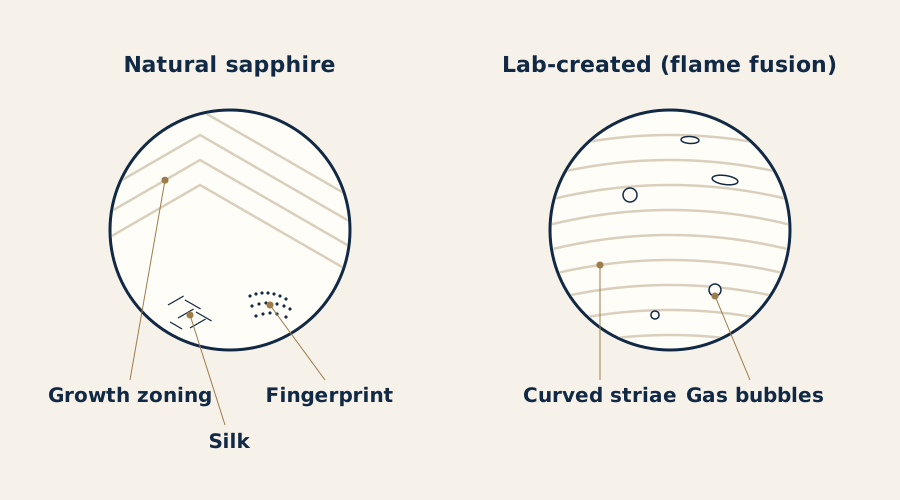
Clean lab-created stones can be very hard to tell from clean natural ones with standard tools, which is why a stone sold as natural and unheated should come with a report from an independent laboratory. Fluorescence under ultraviolet light varies between deposits and is not decisive on its own.
Where does white sapphire come from, and are there Australian white sapphires?
Most fine natural white sapphire comes from Sri Lanka, where alluvial gravels have produced colourless and pale corundum for centuries. Other sources include Myanmar, Madagascar, Thailand and parts of East Africa, often as pale material that is heated to remove a tint.
Australia is a major sapphire country, but its deposits are rich in iron, which is exactly what white sapphire must not have. The Central Queensland gemfields around Anakie and the New England fields near Inverell in New South Wales are known for deep blue, green and yellow-green stones and parti sapphires that mix two or more colours. Truly colourless sapphire from these fields is uncommon, and most Australian stones you will see are coloured.
If Australian origin matters to you, it often makes sense to choose an Australian colour rather than chase a rare Australian white. Have a look at rings set with Australian sapphires or the blue-green tones in teal sapphire engagement rings, a colour Australian fields produce well.
What affects white sapphire price in Australia?
With no colour to judge, the value of a white sapphire comes down to how close it gets to perfectly clear, and how well it is cut to make the most of its modest light return.
| Factor | What to look for | Effect on value |
|---|---|---|
| Colour | Truly colourless; no yellow, grey or blue tint on a white card | The biggest single factor |
| Clarity | Eye-clean at normal viewing distance; inclusions show more in a colourless stone | High; visible inclusions cut value sharply |
| Cut | Even proportions, no window (a see-through patch in the centre), no dark extinction | High; a good cut makes a sapphire look much brighter |
| Size | Fine clean stones above about 2 ct are scarce | Price per carat rises with size |
| Treatment | Unheated with a laboratory report | A clear premium over heated stones |
| Natural or lab-created | Stated on the report or invoice | Lab-created costs a small fraction of natural |
Cutting matters more here than with diamond. Because sapphire's RI is lower, a shallow cut lets light pass straight through and creates a window; many sapphires are cut with a deeper pavilion to avoid this, which adds weight below the girdle. Compare millimetre measurements, not only carats.
| About 1 ct, round, eye-clean | Approximate price range (AUD) |
|---|---|
| Lab-created white sapphire | about $30–$150 |
| Natural, heated, near-colourless | about $300–$1,200 |
| Natural, unheated, colourless, with report | about $800–$2,500 |
These are broad loose-stone ranges only and move with the market and exact quality. For context across the wider family of coloured gemstones and birthstones, white sapphire sits well below fine blue sapphire of the same size.
Browse natural gemstones
Is white sapphire good for an engagement ring?
Yes, white sapphire is one of the few colourless gems that genuinely suits daily wear for decades. It will not scratch from household dust, it has no cleavage to make thin edges vulnerable, and it is far less expensive than diamond in the same size. The trade-off is look, not durability: expect a softer, quieter brightness.
- Metal: white gold or platinum keep a colourless stone looking white; yellow gold can make a faint tint look warmer.
- Claws: four or six claws let the most light in, which helps a lower-RI stone look brighter.
- Bezel: very secure and good for active hands, though it blocks a little light at the edge.
- Halo: a ring of small diamonds adds sparkle around the centre; it also highlights the difference in brilliance, so view it in person first.
- Bands: white sapphire also works as accent stones in wedding and eternity bands.
Many couples use white sapphire as the centre stone with coloured sapphires at the sides, or the other way round. See sapphire engagement rings made in Melbourne for design ideas, and if you are still choosing a colour, compare teal versus blue sapphire for a ring.
Does white sapphire get cloudy, and how do you care for it?
White sapphire does not turn cloudy in itself; the stone is stable and will not change colour or go milky with age. What people notice is a film of skin oil, soap and hand cream on the back of the stone. Because sapphire returns less light than diamond to begin with, that film dulls it sooner and more obviously.
- Everyday cleaning: warm water, a drop of mild dish soap and a soft brush, then rinse and dry with a lint-free cloth.
- Ultrasonic and steam: generally safe for heated or unheated stones without fractures; avoid if the stone has been glass-filled or coated.
- Storage: keep it apart from other jewellery; a sapphire at 9 will scratch softer gems and gold.
- Check-ups: have claws checked about once a year, as worn claws are the usual cause of lost stones.
How do you choose a white sapphire? Step by step
- Decide natural or lab-created. Both are real corundum; lab-created costs far less, natural is rarer. Make sure the paperwork says which.
- Ask about treatment. Heating is normal; unheated stones should have an independent report. Avoid coated or glass-filled stones for a ring.
- Check the colour on white. Lay the stone face-down on a white card and look through the side for a yellow, grey or blue tint.
- Confirm it is eye-clean. Look from about 25–30 cm in daylight; inclusions are easier to see in a colourless stone.
- Tilt it to look for a window. A pale see-through patch in the centre means the stone is cut too shallow.
- Compare millimetres, not carats. Sapphire is heavier than diamond, so the same carat weight looks a little smaller.
- Plan the setting and metal. White gold or platinum with open claws gives a white sapphire the most light.
Free consultation
Talk to a gemologist
Compare stones in person or online with Raj Sood, Graduate Gemologist (GIA), AJP (GIA).
Book a consultationShop this shape
FAQ
Common questions
Is white sapphire a real sapphire?
Yes. White sapphire is colourless corundum, the same mineral as blue sapphire and ruby, with the same Mohs 9 hardness. Lab-created white sapphire is also real corundum but must be sold as lab-created or synthetic.
Does white sapphire look like a diamond?
From a distance it can, but side by side it looks softer, with less brightness and very little rainbow fire. That is because its refractive index is 1.76–1.77 compared with diamond's 2.42.
Does white sapphire get cloudy over time?
The stone itself stays clear. It can look dull when oil and soap build up on the back, and a weekly wash in warm soapy water restores it.
Is white sapphire durable enough for everyday wear?
Yes. At 9 on the Mohs scale with excellent toughness and no cleavage, it handles daily wear well. Have the claws checked about once a year.
How much is a 1 carat white sapphire worth in Australia?
Roughly AUD $30–$150 for lab-created, about $300–$1,200 for a heated natural stone and more for unheated colourless stones with a report. Prices vary with colour, clarity and cut.
Can you tell a natural white sapphire from a lab-created one?
Sometimes, by inclusions: natural stones show straight growth zoning, while flame-fusion stones show curved lines and gas bubbles. Clean stones may need laboratory testing, so ask for a report on any stone sold as natural.

Ask a gemologist
Not sure which diamond to choose?
Raj Sood is a Graduate Gemologist (GIA) and master jeweller. Bring the stones you are considering, or send the reports, and he will tell you honestly which one is better and why.
Keep learning
Related guides
 GemstonesDiamond vs Sapphire Engagement Rings
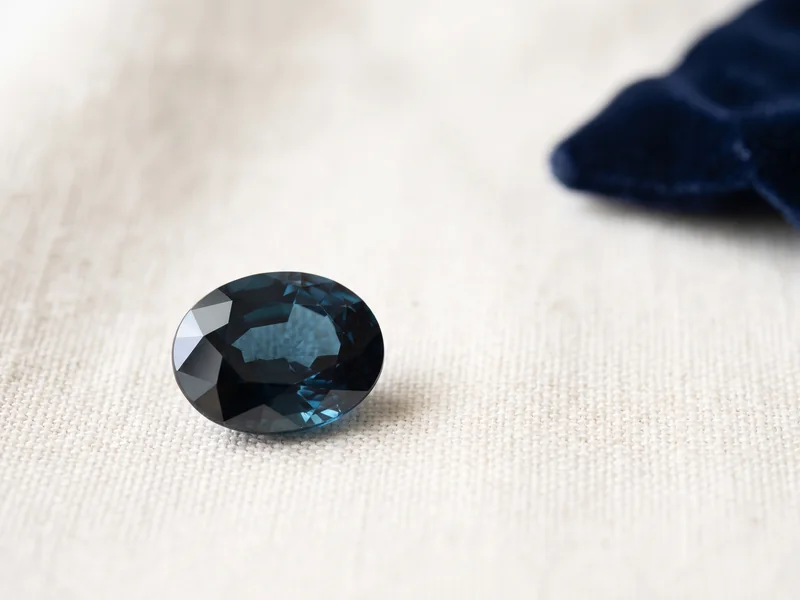 GemstonesSapphire Gemstones
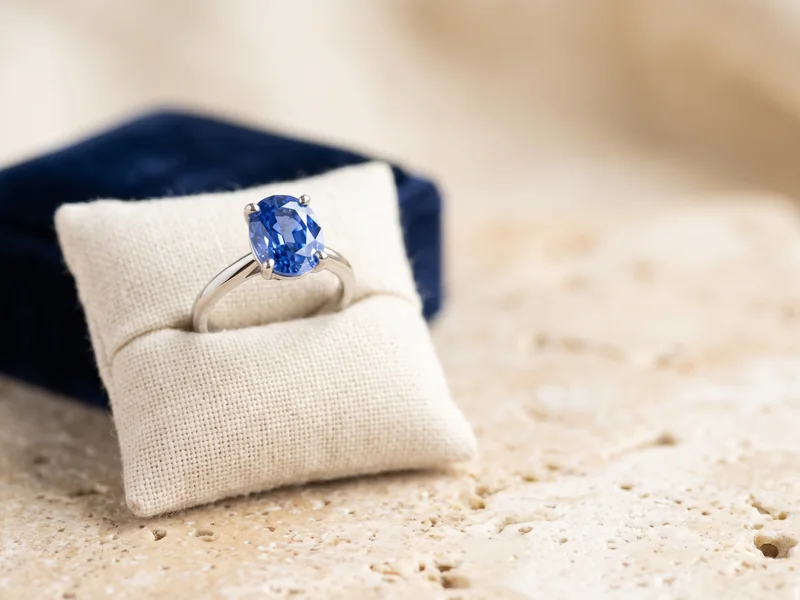 GemstonesSapphire Engagement Rings in Melbourne
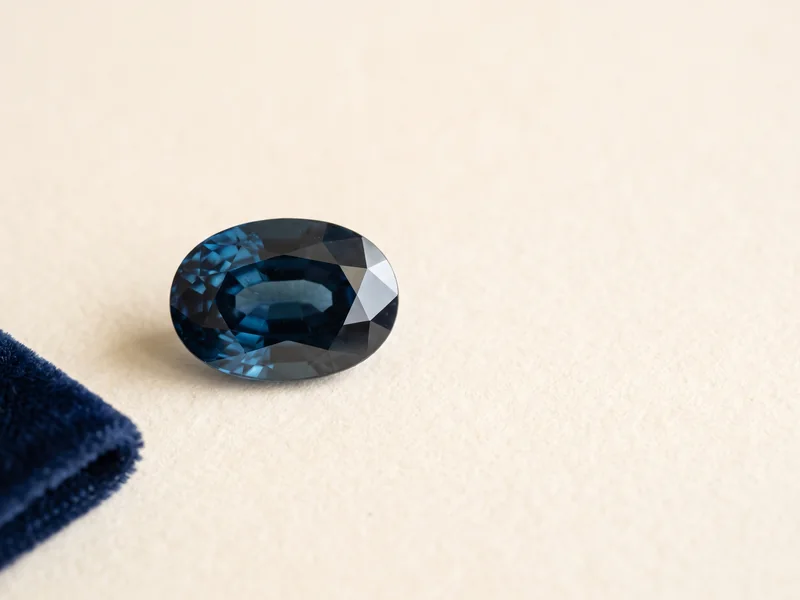 GemstonesAustralian Sapphire Engagement RingsGemstonesGemstones | Coloured Gemstones, Birthstones and Custom Jewellery
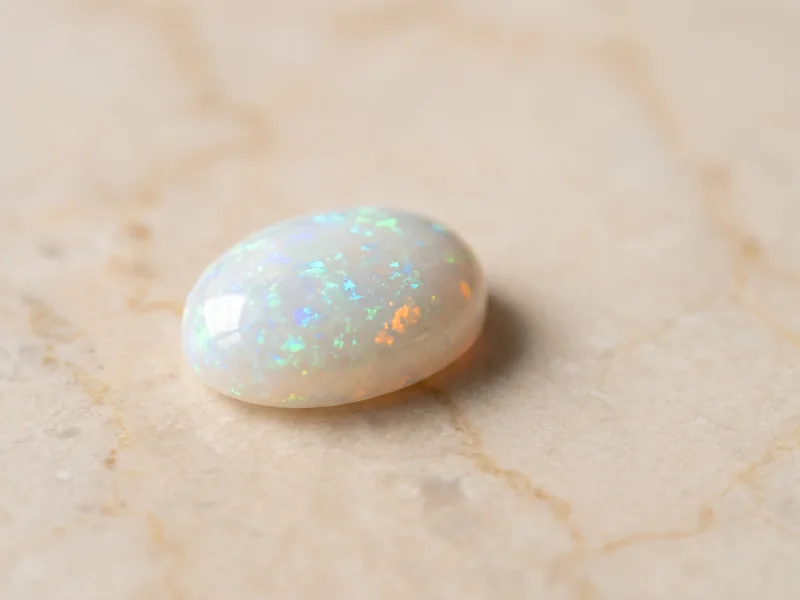 GemstonesWhite Opal
 GemstonesGreen Sapphire
 GemstonesTeal Sapphire Engagement Rings
Explore more
More guides on this topic
Education