
Gemstones
White Opal Guide: Colour, Hardness, Value, Origins and Care
White opal is the most familiar Australian opal, the milky stone with flashes of colour found in many family jewellery boxes. Here is what decides its value, how to spot treatments and doublets, and how to wear it in a ring without damaging it.
 Reviewed by Raj Sood, Graduate Gemologist (GIA), AJP (GIA)Master jeweller and Graduate Gemologist (GIA) · reviewed 4 November 2026
Quick answer
White opal, also called light opal, is precious opal with a pale white to light grey body tone (N7–N9) and flashes of play-of-colour. It rates 5.5–6.5 on the Mohs scale, so it scratches and chips more easily than sapphire or diamond. Most comes from Coober Pedy, South Australia. Value rests on colour brightness, pattern and solid versus doublet construction.
What is white opal?
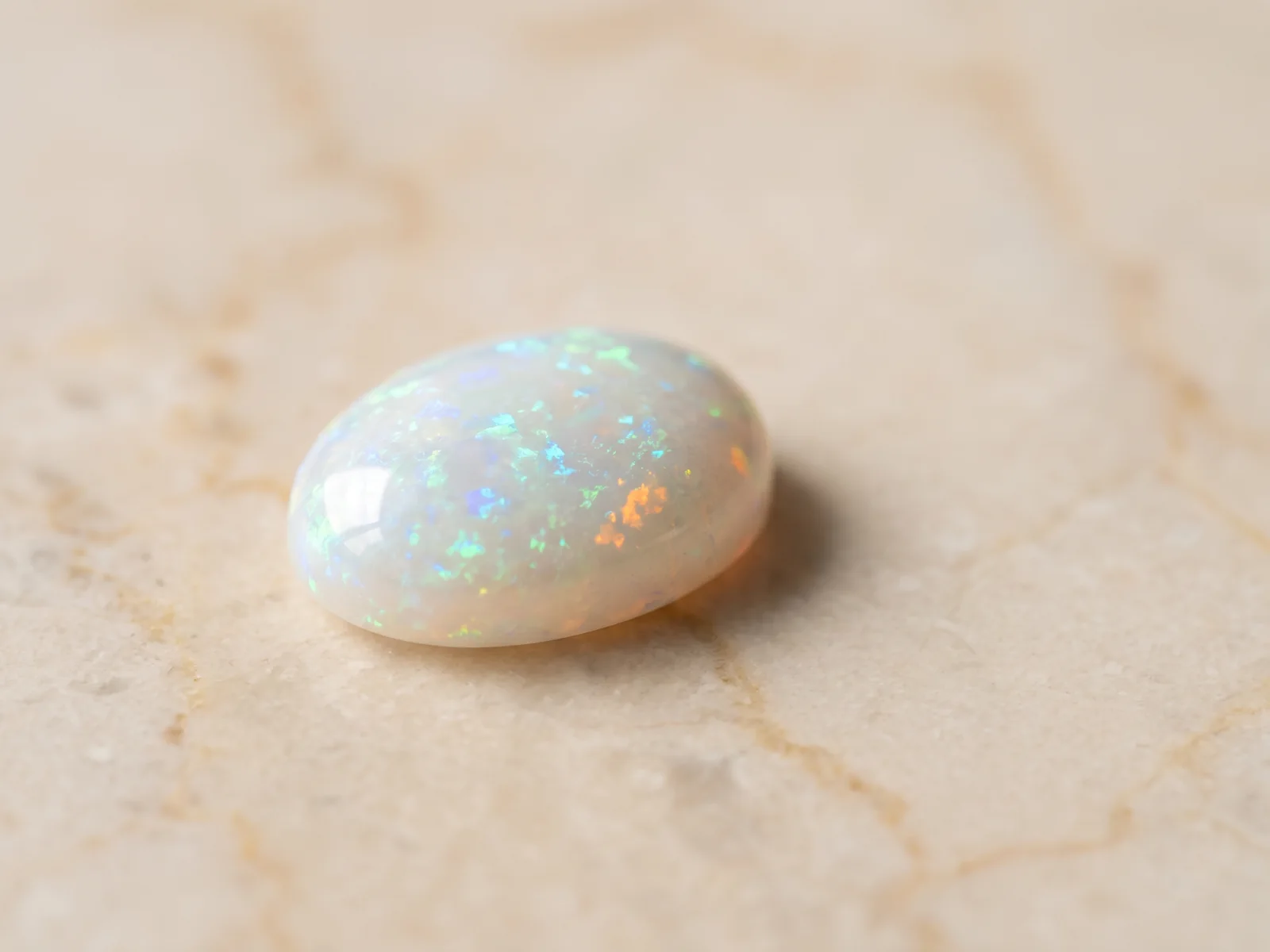
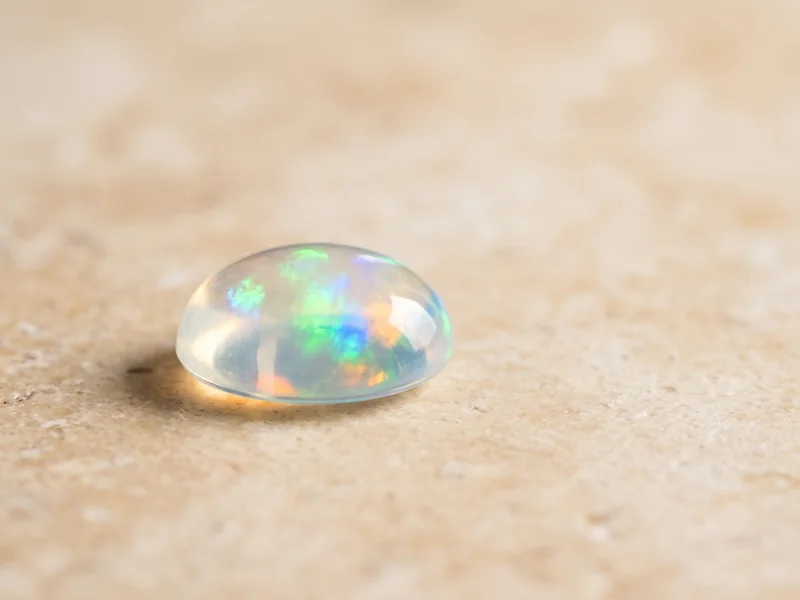
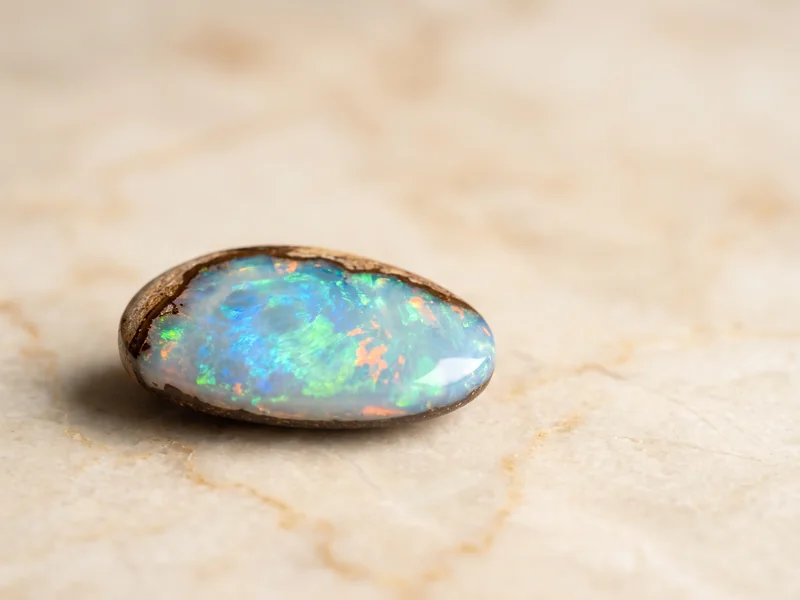
White opal, also called light opal, is precious opal with a pale body: white, cream or light grey. The body tone is the background colour of the stone, and the play-of-colour is the shifting flashes of spectral colour that move across it as you tilt it. In white opal those flashes sit on a milky base, which makes them look softer and more pastel than the same colours on a dark base. It is the most common precious opal mined in Australia and the one most people picture when they hear the word opal.
Opal is not a crystal. It is hydrated silica (SiO2·nH2O), an amorphous material built from tiny silica spheres, roughly 150–300 nanometres across, packed in layers. Where the spheres are even in size and neatly stacked, they diffract white light into colours, much like a fine grating. Only the larger spheres can diffract red, while smaller ones give blue and green, which is why red play-of-colour is the rarest. Opal usually holds about 3–10% water by weight. Our page on the chemical makeup of opal, diamond, sapphire and other gems sets the formula alongside the others.
On a gemmologist's bench, white opal reads with a refractive index of about 1.45 (range about 1.37–1.47), a specific gravity of about 2.15 (range about 1.98–2.20) and no double refraction. Those figures, together with the colour pattern under magnification, separate it from glass, plastic and lab-created opal. White opal is one of several Australian opal types; our wider guide to coloured gemstones and birthstones shows where it fits, and the plain-English jewellery glossary explains any term you have not met.
What colours does white opal show?
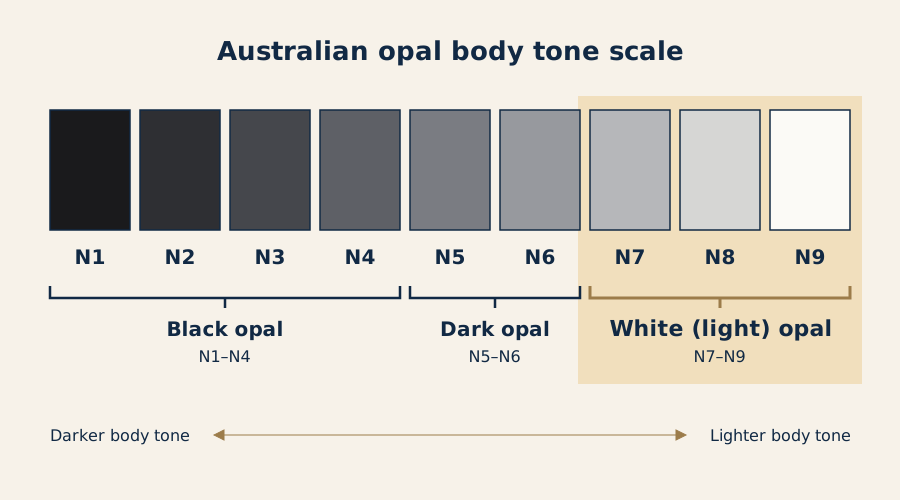
Two things describe an opal's colour: the body tone and the play-of-colour. Australian opal is graded for body tone on a scale from N1 (black) to N9 (very light). N1–N4 is black opal, N5–N6 is dark opal and N7–N9 is light or white opal. A true white opal looks like milk or porcelain when the play-of-colour is not showing; a light grey stone around N7 sits at the darker edge of the group and can make colours look a little stronger.
The play-of-colour itself is judged on brightness, the colours present and the pattern they form. Blue and green are the most common colours in white opal. Orange is less common and a clear red flash that shows from most angles is the rarest. Common patterns include:
- Pinfire: tiny dots of colour scattered across the face. Common and attractive, but usually valued lower.
- Flash: larger patches that light up and switch off as the stone turns.
- Broad flash or rolling flash: a sheet of colour that sweeps across the whole face.
- Harlequin: angular, patchwork-like blocks of colour. Very rare and highly prized.
- Floral or ribbon: irregular, swirling patterns, often described by the cutter or dealer.
A white opal with little or no play-of-colour is called potch, or common opal. It is the same material without the ordered sphere structure, and it is often left on the back of a stone or used as a backing. Opal is also the traditional October birthstone; our page on opal and tourmaline as October birthstones covers the birthday side.
How does white opal compare with black, crystal and boulder opal?
Every precious opal has the same basic chemistry. The difference between types is the body tone, the transparency and how the opal formed in the ground. That changes how bright the colours look and what the stone costs.
| Opal type | Body tone | Transparency | Main source | Price compared with white opal |
|---|---|---|---|---|
| White (light) opal | N7–N9, milky white to light grey | Opaque to translucent | Coober Pedy, Andamooka, Mintabie (SA) | Baseline |
| Black opal | N1–N4, dark grey to black | Opaque | Lightning Ridge (NSW) | Usually much higher |
| Crystal opal | Clear to slightly milky | Transparent to semi-transparent | Coober Pedy, Lightning Ridge | Usually higher |
| Boulder opal | Dark, with ironstone backing | Opaque | Western Queensland | Usually higher for fine stones |
| Ethiopian (Welo) opal | Often white to cream | Translucent | Wollo Province, Ethiopia | Often lower; behaves differently with water |
| Fire opal | Yellow, orange to red body | Transparent to translucent | Mexico mainly | Varies; often valued for body colour, not play-of-colour |
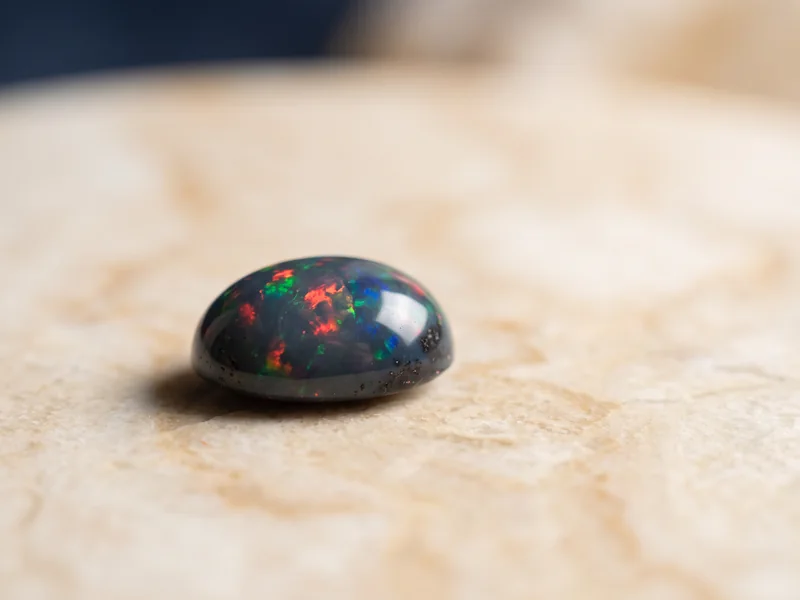
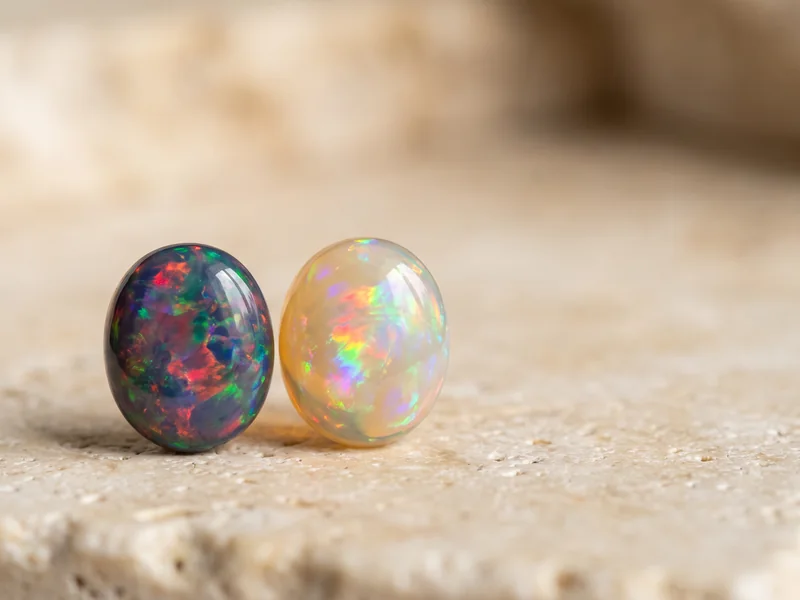
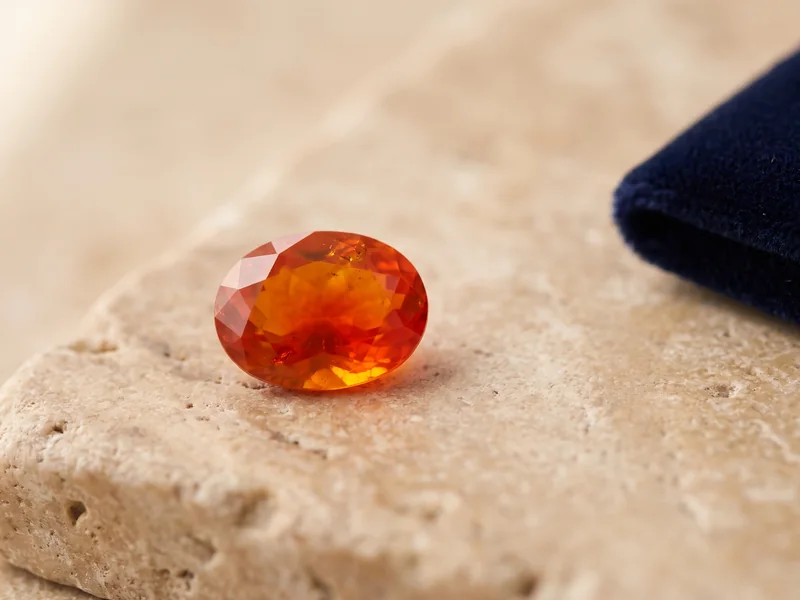
Placed side by side, a black opal from Lightning Ridge shows the same red or green with far more punch, because the dark body absorbs scattered light. A transparent crystal opal lets you look into the stone and see colour in depth. Queensland boulder opal forms in thin veins inside ironstone and is cut with the brown host rock left on the back. A Mexican fire opal is different again, prized mainly for its orange body colour.
The white opal versus Ethiopian opal question is common, because much Ethiopian opal also has a white body. Australian white opal is mostly sedimentary and fairly stable. Ethiopian Welo opal is usually hydrophane, meaning it can absorb water, turn more transparent and temporarily lose its colour when wet. Our comparison of how Australian opal types compare with Ethiopian opal goes through this in detail.
Is white opal hard enough for an everyday ring?
White opal hardness is 5.5–6.5 on the Mohs scale. Hardness is resistance to scratching; toughness is resistance to chipping and breaking. Opal is modest on both: GIA rates its toughness poor to fair. Ordinary household dust contains quartz, which is 7 on the Mohs scale, so even wiping an opal with a dusty cloth slowly dulls its polish. That is the main reason an opal ring needs more thought than a sapphire or diamond ring.
| Gem | Mohs hardness | Toughness | Everyday ring wear |
|---|---|---|---|
| Diamond | 10 | Good (can cleave) | Very well suited |
| Sapphire, including white sapphire | 9 | Excellent | Very well suited |
| Emerald | 7.5–8 | Poor to good | Needs a protective setting |
| White opal | 5.5–6.5 | Poor to fair | Possible with care and a protective setting |
| Pearl | 2.5–4.5 | Fair to good | Occasional wear in rings |
In practice, a solid white opal in a well-made bezel setting can be worn often, but it will pick up fine scratches and occasionally need re-polishing. Take it off for gardening, the gym, cleaning and anything involving hard surfaces. Doublets and triplets add another weak point, the glue layer, which can lift if soaked. Our guide to opal engagement rings and everyday wear covers how people make it work long term.
If you love the soft white look but want a harder stone for daily wear, compare it with white sapphire, a colourless corundum, or read our lab-grown diamond versus white sapphire comparison. For a milky lustre with organic warmth, white South Sea pearls are another option, although they are softer still and suit pendants and earrings better than rings.
Not sure which one is right?
Send us the stones you are looking at and our gemologist will tell you which to choose and why.
Where does Australian white opal come from?
Most of the world's precious opal has historically come from Australia, and most Australian white opal comes from South Australia. It formed in sedimentary rock of the Great Artesian Basin, where silica-rich water seeped into cracks and cavities and slowly set as opal. Opal was proclaimed Australia's national gemstone in 1993.
- Coober Pedy, South Australia: opal was found here in 1915, and it remains the best-known source of white and crystal opal. Many residents still live in dugouts underground to escape the heat.
- Andamooka, South Australia: known for white and crystal opal, and for matrix opal that is often treated to darken it.
- Mintabie, South Australia: produced white, crystal and some darker opal.
- White Cliffs, New South Wales: one of the first commercial opal fields in Australia, known for white opal and opalised fossils.
Each field produces a slightly different character of stone, and experienced cutters can often guess the origin from the body and pattern, although origin is not usually stated on a report. Our page on the Coober Pedy, Lightning Ridge and Queensland boulder fields explains how each field formed and what it is known for. Since around 2008, Ethiopia has also supplied large amounts of white-bodied opal, which is why origin and behaviour with water are worth asking about.
Is white opal treated, or could it be a doublet?
Opal is sold in several forms, and the price difference between them is large, so it matters to know which one you are looking at. Every form should be disclosed by the seller.
- Solid opal: one piece of natural opal, sometimes with natural potch or host rock on the back. Untreated.
- Doublet: a thin slice of natural opal glued to a backing, usually black potch, ironstone or glass. The dark backing makes thin white opal look brighter.
- Triplet: a doublet with a clear dome of quartz or glass glued on top to protect the thin opal slice. Easy to spot by its glassy look.
- Impregnated opal: porous opal filled with resin or plastic to improve stability or appearance.
- Sugar-acid or smoke treated: porous opal darkened with carbon to imitate a darker body tone. Used mainly on Andamooka matrix opal and Ethiopian opal.
- Lab-created (synthetic) opal: made in a laboratory, such as Gilson-type opal. It has the structure of opal but is not natural, and must be sold as lab-created or synthetic opal.
- Imitations: glass or plastic made to look like opal, such as the material sold as 'opalite'. Not opal at all.
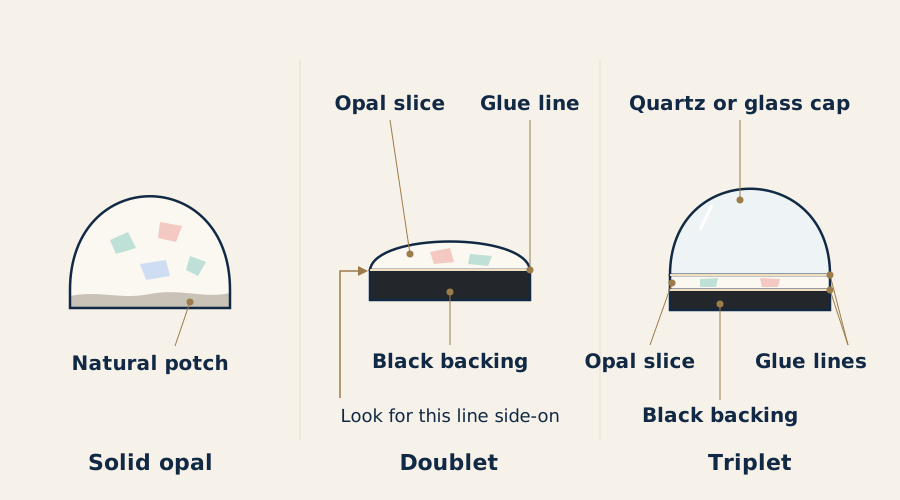
A few identification notes from the gemmologist's side. Under magnification, natural play-of-colour shows irregular patches with soft edges. Lab-created opal often shows a regular columnar or 'lizard skin' pattern within each colour patch, and many lab-created opals have a lower specific gravity because they contain polymer. Smoke-treated stones can show black specks on the surface, and impregnated opal can feel warm and look slightly waxy. When a stone is already set and its back is hidden, it is hard to tell solid from doublet, so ask for the stone to be described in writing.
What affects white opal value and price?
White opal value comes down to how the play-of-colour looks in the stone in front of you. In rough order of importance:
- Brightness: how vivid the colour is. Australian grading uses a brightness scale from brilliant down to dull, and brightness moves value more than anything else.
- Colour: red play-of-colour is rarest, then orange, then green and blue. A multicolour stone with red showing from several angles commands a premium.
- Pattern: harlequin and broad flash sit at the top; pinfire is common.
- Body tone: within white opal, a light grey body around N7 often shows colour more strongly than a pure white N9.
- Construction: solid is worth far more than a doublet, and a triplet costs least.
- Faults: sand spots, potch lines, cracks and crazing (a network of fine surface cracks from water loss) reduce value sharply.
- Cut: most white opal is cut as a cabochon, a smooth dome with no facets. A good dome and enough thickness keep the colour bright and the stone stable.
| White opal quality (solid, Australian) | Approximate price per carat (AUD) |
|---|---|
| Commercial: pale colour, mostly blue or green, pinfire | about $10–$80 |
| Good: bright blue-green, some flash pattern | about $80–$300 |
| Fine: bright multicolour with red, strong pattern | about $300–$1,500 |
| Doublets and triplets | priced per piece, usually far below solid opal |
These are broad ranges only; opal is priced stone by stone, and two white opals of the same weight can differ tenfold. For context, fine black opal can cost many times more per carat than the best white. Because opal is light, with a specific gravity around 2.15, a white opal looks larger for its weight than a sapphire or diamond of the same carat.
Browse natural gemstones
What is the best setting for a white opal ring?
The setting's job with any white opal ring is to protect the edge of the cabochon, where most chips start. The common choices:
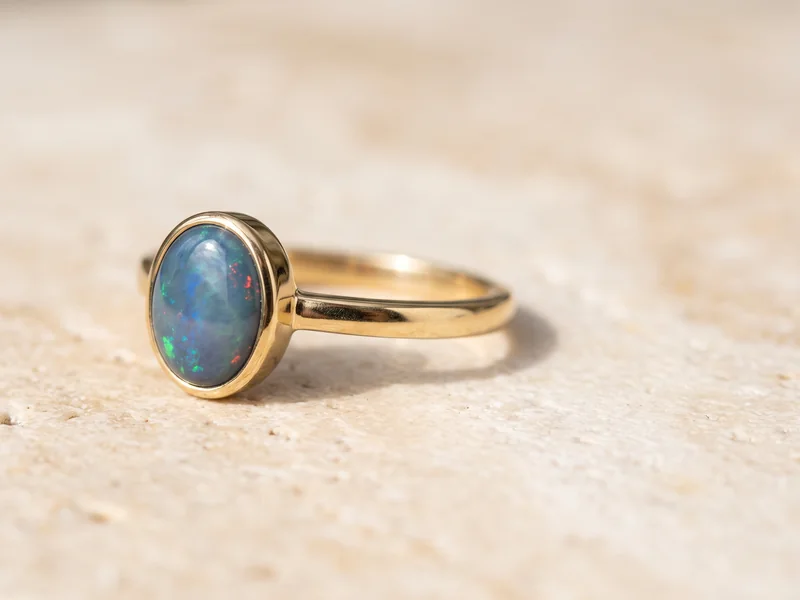
- Bezel (rub-over): a continuous metal rim around the whole stone. The most protective option for a white opal engagement ring.
- Half-bezel: metal protects the two most exposed sides and leaves the others open for light and a lighter look.
- Claws: four to six claws show more of the stone, but claws must be kept tight and the edge is more exposed.
- Halo: a ring of small diamonds around the opal frames the colour and helps shield the edge from knocks.
- Low profile: sitting the opal close to the finger reduces the chance of hitting it on doorframes and benches.
White opal suits both white and yellow metals. White metals keep the milky body looking cool and clean; yellow gold warms it and can draw out orange and red flashes. If you are weighing up a bezel in white metal, our comparison of white gold or platinum for a protective bezel and the explainer on why white gold gets a rhodium coating are worth reading first, because re-plating involves heat and chemicals an opal should not be exposed to; the stone is usually removed or protected for that work.
Related guideAustralian Opal Engagement Rings: Wearability and CareHow do you clean and care for white opal?
Solid white opal is not fragile in the way people sometimes fear, and there is no need to store it in water or oil it. It does dislike knocks, harsh chemicals, sudden temperature changes and long periods of heat and dryness. Doublets and triplets need extra care because water can weaken the glue.
- Check what you have. Confirm whether the opal is solid, a doublet or a triplet, and whether it is Australian or Ethiopian, because the cleaning rules differ.
- Clean gently. Wipe a solid opal with a soft cloth dampened in lukewarm water with a drop of mild detergent, then dry it. For doublets and triplets, wipe only and never soak.
- Skip the machines. Never use an ultrasonic cleaner, steam cleaner or jewellery dip on any opal.
- Avoid temperature shocks. Do not wear opal into a sauna or hot spa, or leave it on a sunny dashboard. Sudden heat or cold can cause cracking or crazing.
- Store it separately. Keep it in a soft pouch away from diamonds and sapphires, which will scratch it.
- Book regular checks. Have the bezel or claws checked about once a year, and ask about re-polishing if the surface looks dull or scratched.
With that routine, a white opal can be worn for decades. Many of the opals that come in for repair simply have a worn polish, which a skilled lapidary can usually restore by taking off a tiny amount of the surface.
Free consultation
Talk to a gemologist
Compare stones in person or online with Raj Sood, Graduate Gemologist (GIA), AJP (GIA).
Book a consultationShop this shape
FAQ
Common questions
Is white opal valuable?
It can be. Commercial white opal is relatively affordable, while a bright solid white opal with red play-of-colour and a strong pattern can cost hundreds of dollars per carat or more. Value depends far more on brightness and pattern than on size.
What is the difference between white opal and black opal?
Body tone. White opal has a pale N7–N9 body and comes mainly from South Australia, while black opal has a dark N1–N4 body, comes mainly from Lightning Ridge and shows its colours more vividly, which usually makes it far more expensive.
Can you wear a white opal engagement ring every day?
You can, with care. At 5.5–6.5 on the Mohs scale it will scratch and can chip, so choose a bezel or halo setting, take it off for rough work and expect occasional re-polishing.
How can you tell if a white opal is a doublet?
Look at the stone side-on. A doublet shows a straight join line with a dark backing, and a triplet adds a clear glassy dome on top. If the back is hidden by a setting, ask the seller to state in writing whether it is solid.
Can white opal get wet?
Solid Australian white opal can be washed in lukewarm soapy water. Doublets and triplets should not be soaked, and Ethiopian opal can absorb water and temporarily lose its colour, so keep it dry.
Why is my white opal cracking?
Fine surface cracks, called crazing, usually come from water loss or sudden temperature changes. Crazing cannot be reversed, so a gemmologist should look at the stone before any repair or re-setting.
Terms in this guide

Ask a gemologist
Not sure which diamond to choose?
Raj Sood is a Graduate Gemologist (GIA) and master jeweller. Bring the stones you are considering, or send the reports, and he will tell you honestly which one is better and why.
Keep learning
Related guides
Explore more
More guides on this topic
Education