
Gemstones
Diamond Simulants: CZ, YAG, GGG and Glass Explained
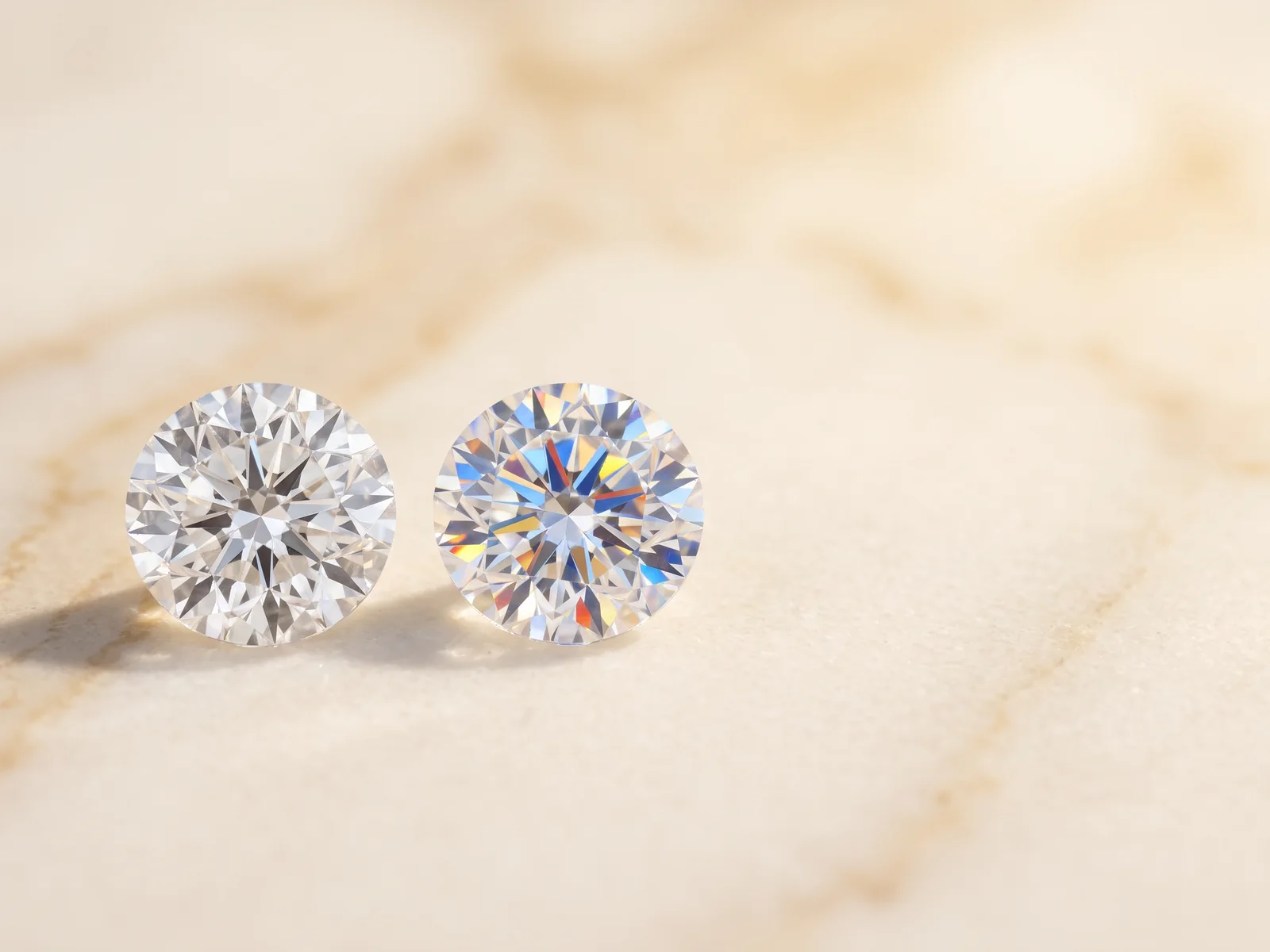
Diamond simulants turn up in costume jewellery, in old family rings and, now and then, in stones described as something they are not. Knowing how CZ, YAG, GGG and glass differ from diamond helps you buy, inherit and insure jewellery with confidence.
 Reviewed by Raj Sood, Graduate Gemologist (GIA), AJP (GIA)Master jeweller and Graduate Gemologist (GIA) · reviewed 4 November 2026
Quick answer
Diamond simulants are materials that look like diamond but are not diamond. The main ones are cubic zirconia (CZ), YAG, GGG, glass and lab-created moissanite. They differ from diamond in hardness, weight, refractive index and fire. Lab-grown diamond is not a simulant; it is real diamond. A gemologist can separate them with a loupe, thermal tester and scale.
What are diamond simulants?
A diamond simulant is any material that imitates the look of a diamond without being diamond. It can be natural, such as colourless zircon or rock crystal quartz, or made in a factory, such as cubic zirconia. What makes it a simulant is that its chemistry, crystal structure and physical properties are different from diamond's. A simulant is not a low grade of diamond; it is a different material altogether.
That is not the same as a synthetic or lab-grown stone. A laboratory-grown diamond is real diamond: the same carbon crystal, the same hardness of 10 and the same refractive index of about 2.42, grown by people rather than in the earth. So a lab-grown diamond is not a simulant. In the same way, a lab-created sapphire is real corundum. Our page on the difference between natural, synthetic and simulant gems sets out all three categories with examples.
- Natural: formed in the earth. Natural diamond, zircon, rock crystal quartz.
- Synthetic (lab-grown or lab-created): the same material as a natural gem, made in a laboratory. Lab-grown diamond, lab-created sapphire.
- Simulant: looks like the gem but is a different material. CZ, YAG, GGG and glass, plus lab-created moissanite or white sapphire when they are used in place of diamond.
A material can be both synthetic and a simulant. Lab-created moissanite is synthetic silicon carbide, and when it sits where a diamond would, it is also a diamond simulant. CZ, YAG and GGG are synthetic too, but none has a natural gem-quality counterpart. Whatever the price, a seller has to describe these materials honestly; a CZ described as diamond is misleading. Terms you have not met before are explained in our glossary of jewellery terms, and the natural stones mentioned here are covered in our section on coloured gemstones and birthstones.
Related guideNatural vs Synthetic vs Simulant GemstonesHow do diamond simulants compare with diamond?
Four measurements explain almost everything about how a simulant looks and wears. Hardness on the Mohs scale (1 to 10) tells you how well a stone resists scratching. Refractive index (RI) measures how strongly a material bends light; the higher it is, the more light returns to your eye as brightness. Dispersion measures how much white light is split into rainbow colours, which jewellers call fire. Specific gravity (SG) is density: how heavy a stone is for its size, compared with water.
| Material | Mohs hardness | Refractive index | Dispersion (fire) | Specific gravity | Refraction |
|---|---|---|---|---|---|
| Diamond (natural or lab-grown) | 10 | 2.42 | 0.044 | 3.52 | Single |
| Cubic zirconia (CZ) | 8–8.5 | 2.15–2.18 | 0.058–0.066 | 5.6–6.0 | Single |
| YAG | 8–8.5 | 1.83 | 0.028 | 4.5–4.6 | Single |
| GGG | 6–7 | 1.97–2.03 | 0.038–0.045 | 7.0–7.1 | Single |
| Glass (lead glass) | 5–6 | 1.50–1.70 | 0.009–0.040 | 2.3–4.5 | Single |
| Lab-created moissanite | 9.25 | 2.65–2.69 | 0.104 | 3.22 | Double |
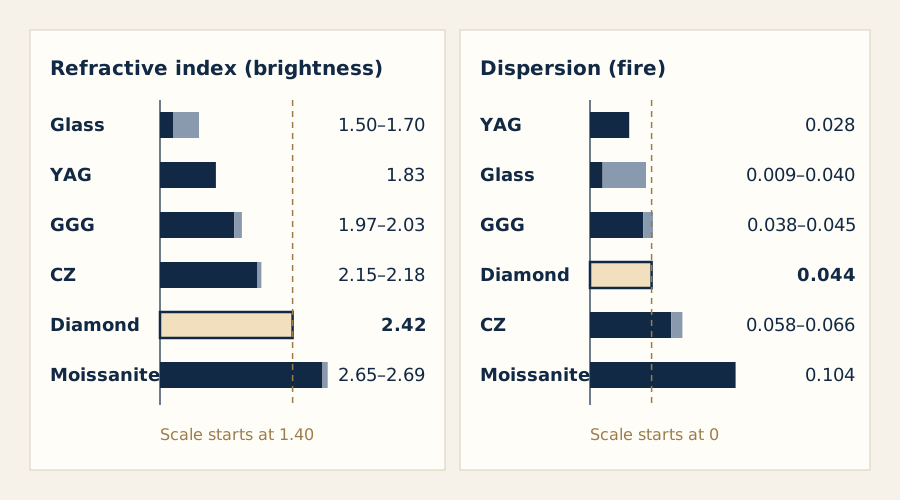
Read across the table and the visual tells start to make sense. CZ has more fire than diamond but a little less brightness, so it can look slightly too colourful under spotlights. Moissanite has more than twice diamond's fire, which shows as strong rainbow flashes. YAG returns less light and much less fire, so it looks glassy beside a diamond. GGG comes close for fire but is soft and very heavy. Glass sits at the bottom on every count except price.
Weight is a giveaway that many people overlook. A carat is a unit of weight (0.2 grams), not size. A round diamond of about 6.4–6.5 mm across weighs about 1 carat. A CZ of the same diameter weighs roughly 1.6–1.7 carats, a YAG about 1.3 carats and a GGG about 2 carats. That is why CZ is usually sold by millimetre size or as a 'diamond-equivalent' weight, and why a carat figure stamped on a CZ piece tells you little.
What is cubic zirconia, and is it a real diamond?
Cubic zirconia is not diamond. It is zirconium dioxide (ZrO2), kept in a cubic crystal form by adding a stabiliser such as yttrium oxide or calcium oxide. It is grown by a method called skull melting, in which the powder is melted at around 2,700 °C inside a crust of its own unmelted material. Research in the Soviet Union in the early 1970s led to mass production from about 1976, and within a few years CZ had pushed YAG and GGG out of the market. It has been the most common diamond simulant ever since.
Do not confuse cubic zirconia with zircon. Zircon is a natural silicate gem that has been mined for thousands of years; cubic zirconia is a synthetic oxide. The similar names cause endless mix-ups at the counter.
When people compare cubic zirconia vs diamond side by side, the usual clues are:
- Fire: CZ throws more coloured flashes, especially under halogen or LED spotlights.
- Clarity: CZ is almost always flawless. A large, perfectly clean stone in an older ring is worth testing.
- Weight: a loose CZ feels noticeably heavy for its size.
- Facet edges: at 8–8.5 on the Mohs scale, CZ is hard enough for occasional wear, but its edges scuff and chip over years of daily wear, while diamond's stay crisp.
- Heat: CZ conducts heat poorly, so it fails a standard thermal diamond tester.
CZ is often set in sterling silver or gold-plated mounts and may be stamped 'CZ' inside the band. It suits fashion jewellery, travel rings and trying out a design before committing. If you are considering one for an engagement ring to keep the cost down, it is worth comparing natural and lab-grown options for an engagement ring first, because the harder materials will stay sharp far longer.
What are YAG and GGG, and how does YAG vs CZ compare?
YAG and GGG are synthetic garnets. They share the crystal structure of the garnet family but have no natural equivalent, and they are unrelated in chemistry to the red and green garnets sold as gems. Both were invented for technology first and borrowed by the jewellery trade second.
YAG (yttrium aluminium garnet, Y3Al5O12) was developed for lasers in the 1960s and sold as a diamond simulant from the late 1960s into the 1970s. It is hard enough to wear well, at 8–8.5, but its refractive index of 1.83 and low dispersion of 0.028 mean it looks less bright and shows little fire. Coloured YAG is still used in some fashion jewellery.
GGG (gadolinium gallium garnet, Gd3Ga5O12) followed in the early 1970s, originally grown for electronics. A GGG gemstone has fire close to diamond's, but it is soft at 6–7 on the Mohs scale, it is about twice as heavy as diamond for its size, and some stones turn brownish after long exposure to sunlight or ultraviolet light. Its high production cost and poor durability meant it was never as common as YAG.
| YAG | GGG | CZ | |
|---|---|---|---|
| Main era as a simulant | Late 1960s to 1970s | Early to mid 1970s | 1976 to today |
| Look beside diamond | Glassy, less fire | Good fire, slightly less bright | Bright, more fire |
| Durability | Good (8–8.5) | Poor (6–7), scratches easily | Fair to good (8–8.5) |
| Weight of a 6.5 mm round | about 1.3 ct | about 2.0 ct | about 1.6–1.7 ct |
| Where you meet it now | Vintage 1970s rings, coloured fashion pieces | Vintage pieces, collections | Fashion and costume jewellery everywhere |
So on YAG vs CZ, CZ looks much closer to diamond and was cheaper to make, which is why it replaced YAG by around 1980. If an inherited ring from the 1970s holds a 'diamond' that looks a little lifeless, YAG is a real possibility. If the stone is soft-edged, scratched and surprisingly heavy, GGG is worth considering.
Not sure which one is right?
Send us the stones you are looking at and our gemologist will tell you which to choose and why.
Is glass a diamond simulant?
Glass is the oldest diamond simulant of all. In the 1700s, Paris jeweller Georges Frédéric Strass popularised high-lead glass, still called strass or paste, for imitation diamond jewellery. Adding lead oxide lifts glass's refractive index from about 1.50 to around 1.60–1.70, making it brighter. Georgian and Victorian paste was often set in closed backs with a metallic foil behind each stone to bounce more light forward. Today's rhinestones and crystal glass in costume jewellery follow the same idea.
A glass imitation diamond is usually easy for a trained eye to pick:
- Gas bubbles: small round bubbles trapped inside, unlike any natural inclusion.
- Swirl marks: curved flow lines from the molten glass.
- Rounded facet edges: glass at 5–6 on the Mohs scale wears quickly, and moulded glass has soft edges from the start.
- Concave facets or mould marks: signs the stone was pressed rather than cut.
- Warm to the touch: glass conducts heat slowly, so it does not feel cold the way diamond does.
Moulding is one reason glass looks different from a cut gem. Our guide to cabochon, faceted and carved gemstone cuts explains how precise faceting controls how light leaves a stone, something a mould cannot match.
Glass also turns up inside real gems, which is a different matter. Lead glass is used to fill fractures in lower-grade rubies and some other stones to improve their look. That is a treatment of a natural gem, not a simulant, and it must be disclosed. Our explainer on how glass is used to fill fractures in rubies and other gems covers how to recognise it and how to care for a filled stone. Good antique paste, by contrast, is collected in its own right for its craftsmanship and history.
What other stones are used to imitate diamond?
Lab-created moissanite (silicon carbide) has been sold for jewellery since the late 1990s and is now the main alternative to CZ. It is hard at 9.25, light at an SG of 3.22, and has a refractive index of 2.65–2.69 with dispersion of 0.104, so it shows very strong fire. It is doubly refractive: light splits into two rays inside it, so under a loupe the back facet edges look doubled when viewed at an angle. Moissanite also conducts heat well, which fools a basic thermal diamond tester.
On moissanite vs cubic zirconia: moissanite is harder, lighter for its size and more fiery, and it costs more. CZ is softer, heavier and cheaper. Both are diamond simulants, and neither is diamond. Older and less common imitations include:
- Lab-created white sapphire: Mohs 9 and very durable, but RI 1.76–1.77 and dispersion 0.018, so it looks noticeably less bright and fiery.
- Synthetic colourless spinel: Mohs 8, RI about 1.73, used in some mid-century jewellery.
- Synthetic rutile: from the late 1940s; RI 2.62–2.90 and dispersion around 0.28–0.33, giving an oily rainbow look, with a yellowish tint, strong doubling and softness at 6–6.5.
- Strontium titanate: from the 1950s; RI about 2.41, close to diamond, but dispersion about 0.19 and hardness only 5–6. Sometimes found as the base of a doublet with a synthetic spinel or sapphire top.
- Natural zircon: RI 1.92–1.98 with good fire and strong double refraction; colourless zircon has a long history as a diamond substitute.
- Rock crystal quartz: Mohs 7 and RI 1.54–1.55, so it looks glassy beside diamond.
Zircon deserves fairer treatment than the simulant label suggests. It is a natural gem with its own beauty, especially in blue, and is one of zircon, tanzanite and turquoise, the December birthstones. Colourless quartz is the same mineral as smoky quartz, just without the brown-grey colour from natural irradiation.
Are coloured gemstones imitated too?
Yes. Glass, plastic, lab-created stones and assembled stones (doublets and triplets, where layers are glued together) imitate coloured gems as well as diamond. These are the examples a gemologist sees most often:
- Ruby: red glass, garnet-and-glass doublets and lab-created ruby, which is real corundum but must be disclosed. Our guide to choosing a ruby engagement ring covers what to ask for on the report.
- Aquamarine: pale blue glass and synthetic blue spinel. See aquamarine engagement rings and how they wear.
- Alexandrite: colour-change lab-created corundum or spinel is often sold to travellers as 'alexandrite'. Read about genuine alexandrite in engagement rings before you buy one.
- Pink stones: pink glass and pink CZ imitate both pink sapphire and morganite; our page on morganite versus pink sapphire compares the real thing.
- Rose quartz: 'cherry quartz' is usually pink glass with streaky colour, not natural rose quartz.
- Amber: plastics, pressed amber and copal (a younger resin) imitate amber, the fossil tree resin. Amber floats in strongly salted water, while glass and most plastics sink.
Keep imitation separate from treatment. A heated sapphire is still natural sapphire, improved by a long-accepted process; the only issue is disclosure and price. Our guide to heated and unheated gemstones explains why it matters. Simulants never receive country-of-origin reports, because origin only applies to natural stones; see origin reports for Ceylon, Burma and Kashmir stones for how labs approach it.
How can you tell if a diamond is real?
No single home test is reliable, and some popular ones damage the stone. A gemologist combines several simple checks and only sends a stone to a laboratory when the answer still is not clear.
| Test | What it measures | What it catches | Limits |
|---|---|---|---|
| 10× loupe | Facet edges, inclusions, bubbles, doubling | Glass, worn CZ and GGG, moissanite (doubling) | Needs a trained eye |
| Thermal tester | How fast heat moves through the stone | CZ, YAG, GGG, glass, sapphire, zircon | Moissanite reads as diamond |
| Moissanite (electrical) tester | Electrical conductivity | Moissanite | Rare natural blue diamonds also conduct |
| Weight vs measurements | Specific gravity | CZ, YAG, GGG (too heavy for size) | Stone must be loose |
| Read-through test | How much light is returned | Glass, quartz, YAG, sapphire (print shows through) | Loose round brilliants only; CZ also blocks print |
| Fog (breath) test | How fast condensation clears | Some glass and CZ | Unreliable; skin oil skews results |
| Laboratory report | Material, treatments, natural or lab-grown | Everything, including lab-grown diamond | Costs money and time |
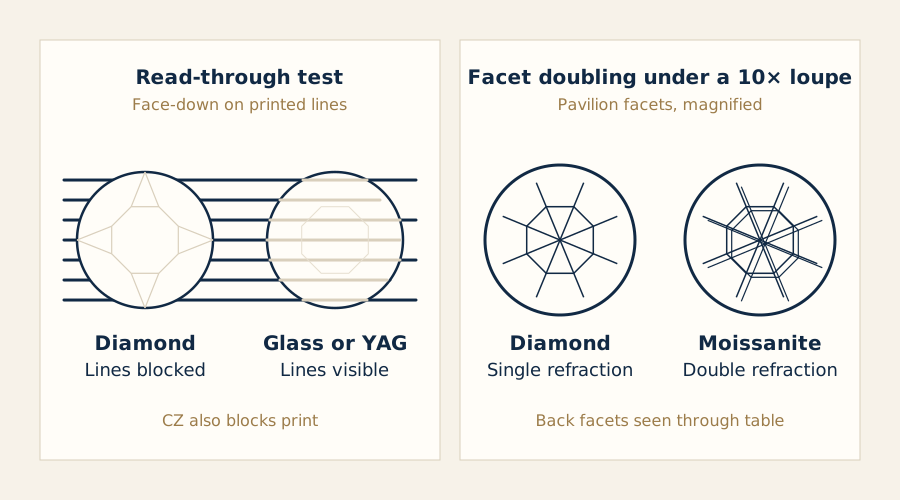
Every one of these tests treats lab-grown diamond as diamond, because it is. On a diamond simulant vs lab-grown diamond question, a thermal tester, loupe or scale cannot reliably separate a lab-grown diamond from a natural one. That takes laboratory instruments such as spectroscopy and fluorescence imaging, and the answer belongs on a grading report from a lab such as GIA or IGI.
Avoid the old tricks. Scratching a stone against glass proves little, since CZ, moissanite and sapphire all scratch glass too, and it can chip a diamond's girdle. Heating a stone and dropping it in cold water can crack it.
Are diamond simulants worth buying?
For the right job, yes. Simulants make sense for costume and fashion jewellery, travel rings, stage wear and trying a design before you commit to a stone. They cost a small fraction of diamond. The trade-offs are durability and value: softer simulants show wear within a few years of daily use, and simulants have little resale or replacement value, which affects insurance and valuations.
| Stone (round, about 6.5 mm) | Approximate price range (AUD) |
|---|---|
| Glass (costume crystal) | under $10 |
| Cubic zirconia | about $5–$50 |
| Lab-created white sapphire | about $50–$300 |
| Lab-created moissanite | about $300–$1,000 |
| Lab-grown diamond, about 1 ct | about $800–$3,000 |
| Natural diamond, about 1 ct, G–H VS | about $6,000–$15,000 |
These are broad ranges for loose stones only; prices move with the market and with quality. If you want something that will stay sharp for decades, the real choice is between lab-grown diamond, which is real diamond and costs much less than natural, natural diamond, and a hard coloured or colourless gem. Natural sapphire (Mohs 9) and spinel (Mohs 8) are both durable for everyday wear, and you can explore natural sapphires, spinels and other gemstones if colour appeals.
Shop natural gemstones
Inherited pieces are where simulants most often surprise people. A ring that tests as CZ, YAG or glass can keep its sentimental value: the mount can be repaired and the centre replaced with a diamond or gemstone, or the piece remodelled into something new.
How to check a stone you think may be a simulant: step by step
- Check the paperwork and stamps. Look for a receipt, grading report number, a 'CZ' stamp inside the band or a laser inscription on the girdle (visible under a loupe).
- Look at it in daylight and under a spotlight. Strong rainbow fire suggests CZ or moissanite; a dull, glassy look suggests YAG, glass or quartz.
- Use a 10× loupe. Check facet edges for rounding or nicks, look inside for round bubbles or swirls, and look through the side for doubled back facets.
- Weigh and measure a loose stone. A 6.5 mm round that weighs much more than 1 carat is not diamond.
- Ask a jeweller to test it. A thermal tester and a moissanite tester together separate diamond from nearly every simulant in seconds.
- Get a written identification for anything valuable. Before insuring, selling or resetting, ask for a gemologist's identification or a laboratory report; this is the only way to tell natural from lab-grown diamond.
- Do not scratch, heat or freeze it. These home tests are unreliable and can damage both diamonds and simulants.
Free consultation
Talk to a gemologist
Compare stones in person or online with Raj Sood, Graduate Gemologist (GIA), AJP (GIA).
Book a consultationShop this shape
FAQ
Common questions
Is cubic zirconia a real diamond?
No. Cubic zirconia is synthetic zirconium dioxide, a completely different material from diamond. It is softer (8–8.5 vs 10 on the Mohs scale), heavier for its size and shows more rainbow fire.
Can a jeweller tell CZ from a diamond?
Yes, usually within seconds. A thermal tester, a 10× loupe and, for loose stones, a quick weight check separate CZ from diamond reliably.
Is moissanite a diamond simulant?
Yes, when it is used in place of diamond. Lab-created moissanite is silicon carbide; it is hard and fiery, but it is doubly refractive and lighter than diamond, and an electrical tester identifies it.
Is a lab-grown diamond a simulant?
No. A lab-grown diamond is real diamond with the same chemistry, hardness and optical properties as natural diamond. Only laboratory instruments can tell the two apart, and the grading report states which it is.
Why does my cubic zirconia look cloudy?
Usually because of a film of skin oil and soap, plus fine abrasion on the facets after years of wear. Cleaning in warm soapy water helps; a heavily scuffed CZ cannot be restored and is normally replaced.
How can you tell YAG from CZ?
YAG is less bright and shows far less fire, because its refractive index is 1.83 against about 2.17 for CZ. YAG is also lighter, so a loose YAG weighs less than a CZ of the same size.

Ask a gemologist
Not sure which diamond to choose?
Raj Sood is a Graduate Gemologist (GIA) and master jeweller. Bring the stones you are considering, or send the reports, and he will tell you honestly which one is better and why.
Keep learning
Related guides
 GemstonesNatural vs Synthetic vs Simulant Gemstones
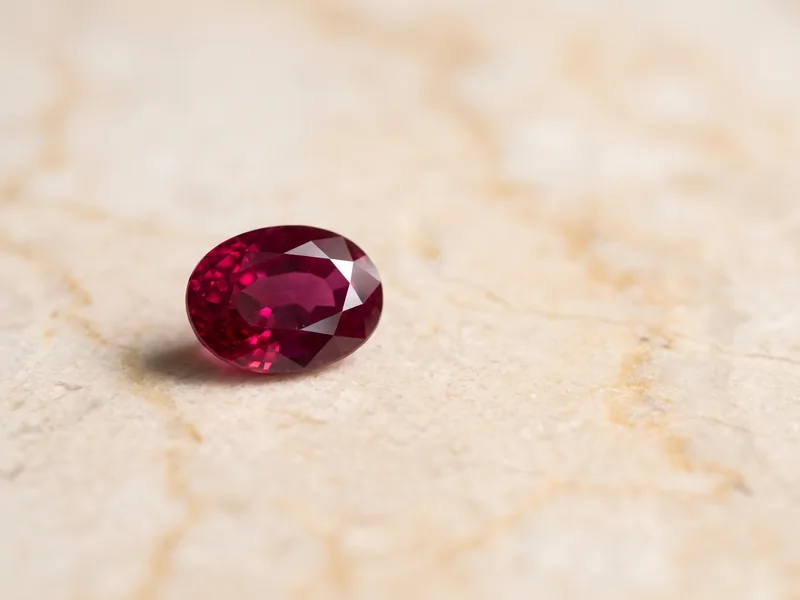 GemstonesGlass Filling and Fracture Filling Explained
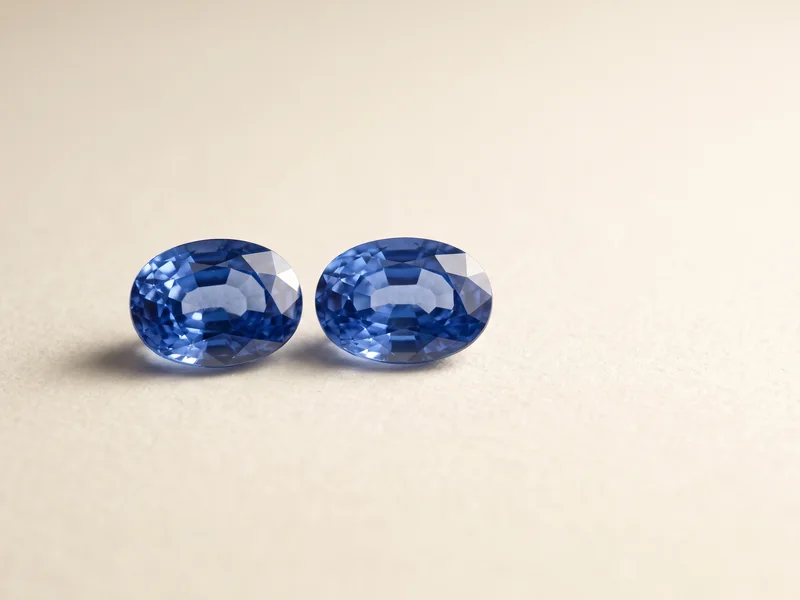 GemstonesNatural vs Lab-Grown Gemstones for Engagement Rings
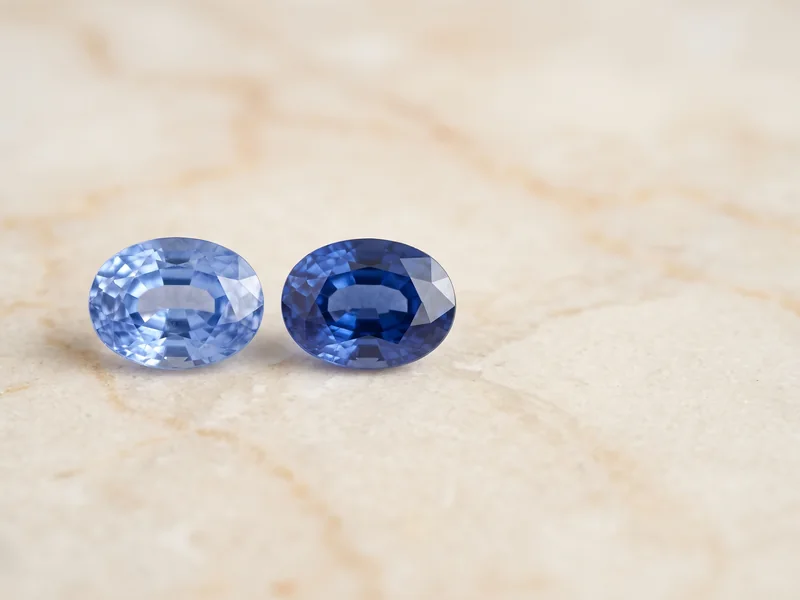 GemstonesHeated vs Unheated GemstonesGemstonesGemstones | Coloured Gemstones, Birthstones and Custom Jewellery
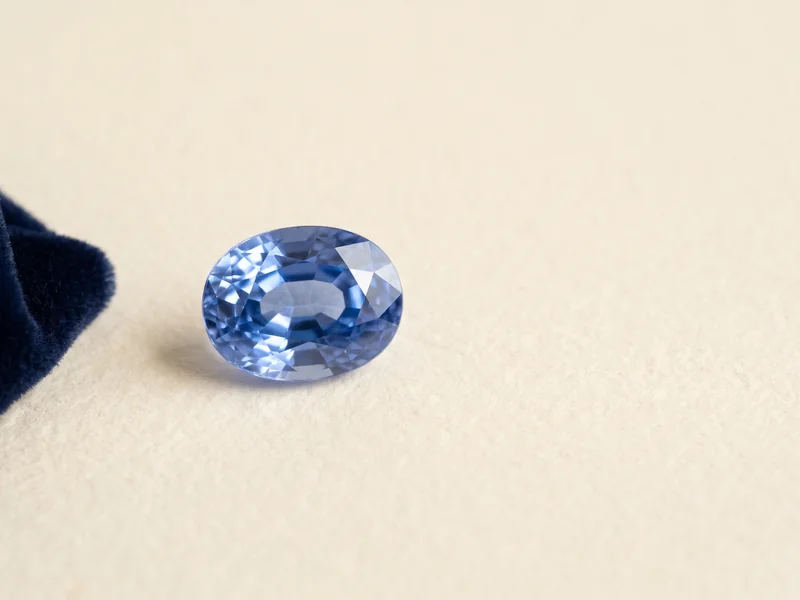 GemstonesGemstone Origins: Ceylon, Burma, Kashmir, Madagascar, Mozambique
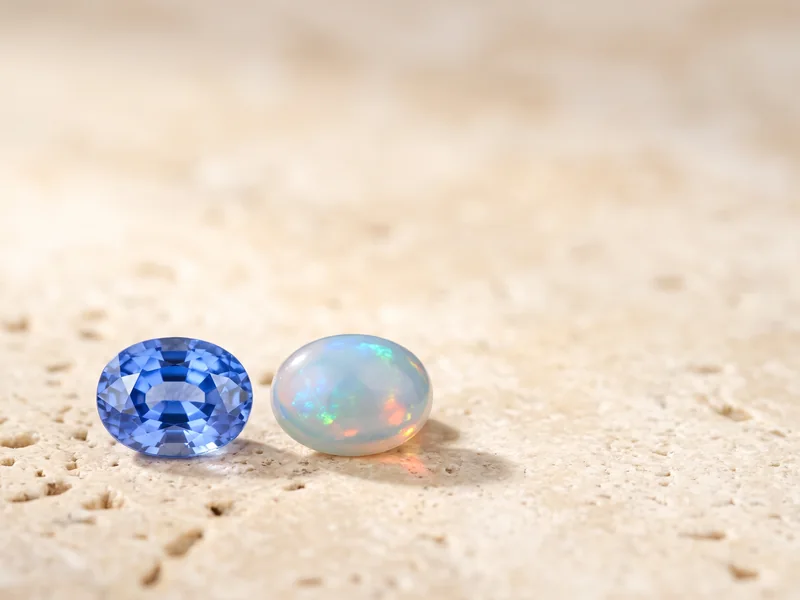 GemstonesGemstone Cuts: Cabochon, Faceted and Carved
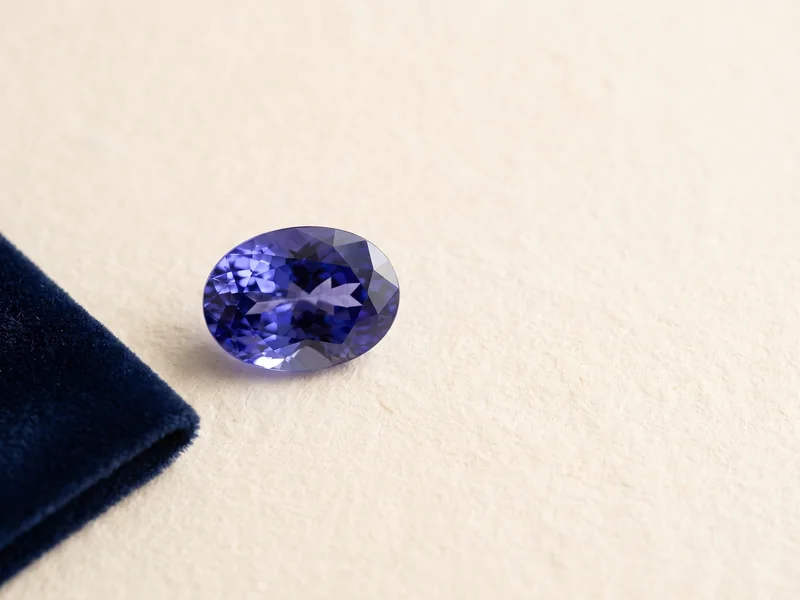 GemstonesDecember Birthstone: Tanzanite, Zircon and Turquoise
Explore more
More guides on this topic
Education