
Gemstones
Amethyst Jewellery Guide: Colour, Fading, Durability and Care
Amethyst jewellery is one of the most affordable ways to wear a rich, natural colour, but that purple can be changed by heat and, in some stones, by strong light. Here is what causes the colour, what can fade it, and how to wear and clean amethyst so it lasts.
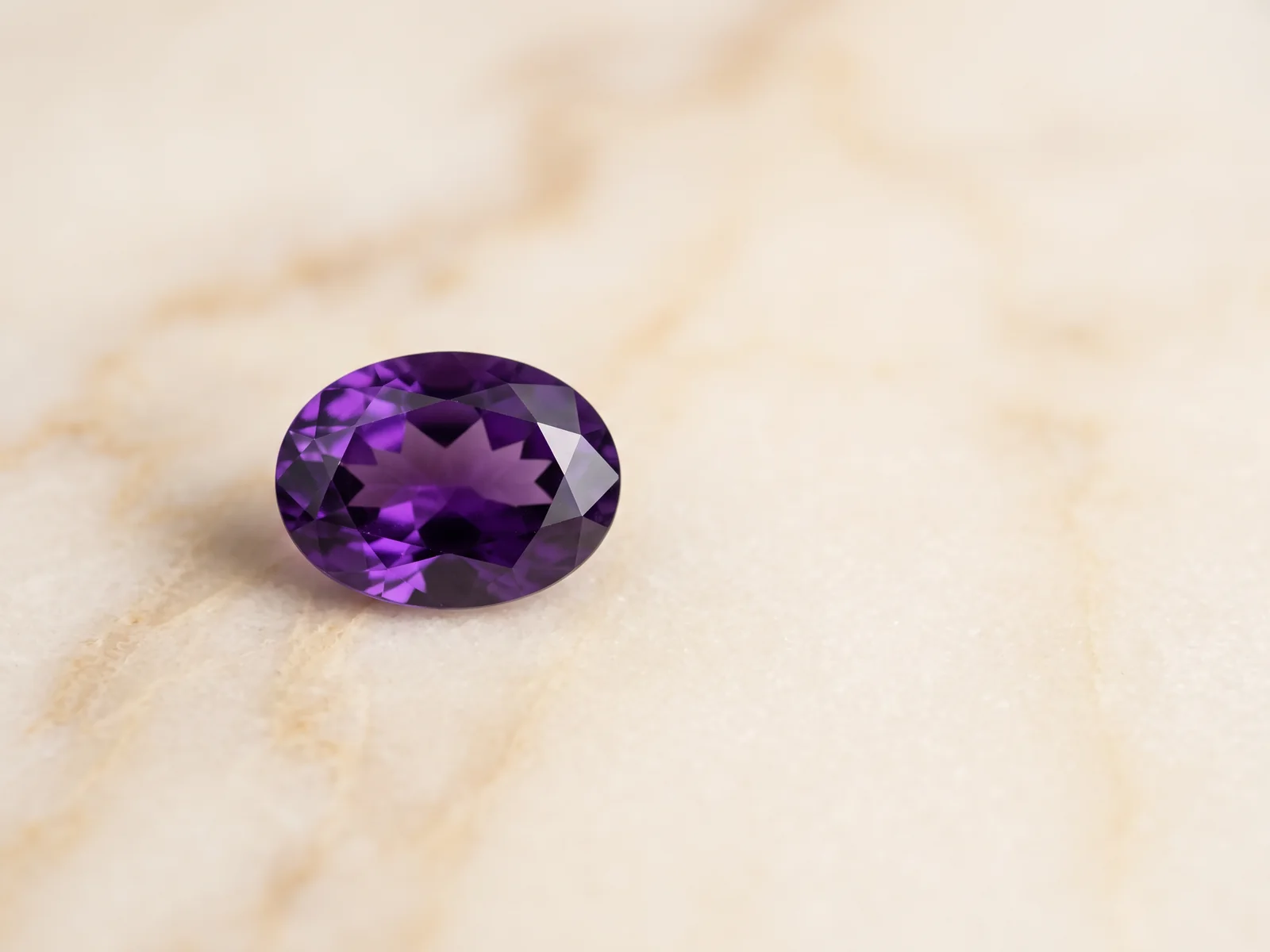
 Reviewed by Raj Sood, Graduate Gemologist (GIA), AJP (GIA)Master jeweller and Graduate Gemologist (GIA) · reviewed 4 November 2026
Quick answer
Amethyst is purple quartz, 7 on the Mohs scale, coloured by traces of iron and natural radiation. Its colour is stable in normal wear, but strong heat above about 300 °C, and long exposure to sunlight, can fade some stones. Clean amethyst jewellery in warm soapy water, avoid steam and jeweller's torches, and store it out of direct sun.
What is amethyst?
Amethyst is the purple variety of quartz, the same mineral as citrine, rock crystal and smoky quartz. Chemically it is silicon dioxide (SiO2). What makes it purple is a tiny amount of iron sitting inside the crystal structure, combined with natural radiation from the surrounding rock over millions of years. Together they create colour centres: small defects in the crystal that absorb yellow-green light, so the light that reaches your eye looks purple. For the full mineral profile, see our amethyst gemstone profile.
That origin matters for care. Because the colour comes from a defect rather than from a stable pigment, enough energy, usually heat, can undo it. This is the single most important fact about amethyst jewellery, and it explains nearly all of the care advice further down.
| Property | Amethyst | What it means for jewellery |
|---|---|---|
| Mineral | Quartz (SiO2) | Same family as citrine and ametrine |
| Mohs hardness | 7 | Resists most everyday scratches, but dust (also quartz) can dull it over years |
| Toughness | Good | No cleavage; breaks with a shell-like (conchoidal) fracture |
| Refractive index | 1.544–1.553 | Softer sparkle than diamond (about 2.42); colour does the work |
| Specific gravity | about 2.65 | A 1 ct amethyst looks larger than a 1 ct sapphire |
| Pleochroism | Weak to moderate | Can show reddish purple and bluish purple from different angles |
Amethyst sits among a wide range of options in our wider range of coloured gemstones. If any of the terms above are new, such as specific gravity (how heavy a stone is compared with the same volume of water) or pleochroism (different colours seen in different directions), our plain-English jewellery glossary explains each one.
What amethyst colour is most valued?
Gemmologists describe colour in three parts: hue (the basic colour), tone (how light or dark) and saturation (how strong or vivid). Our guide on how hue, tone and saturation are graded explains the system in detail. For amethyst, the most sought-after colour is a strong reddish purple to purple in a medium-dark tone, without brown or grey.
| Colour type | Hue and tone | How it is usually priced |
|---|---|---|
| Pale lilac (often sold as 'Rose de France') | Light pinkish or lavender purple | Lower per carat; popular in larger, delicate pieces |
| Medium purple | Even purple, medium tone | The everyday commercial range |
| Deep purple ('Siberian' grade) | Dark purple with red and blue flashes | Highest per carat for amethyst |
| Over-dark | Very dark, looks inky or black indoors | Lower; colour closes up in dim light |
| Brownish or greyish | Purple with a muddy secondary tone | Lower; less lively |
The name 'Siberian' is now a trade grade for top colour, not a statement that the stone came from Siberia. Much of today's deep amethyst comes from Zambia, Brazil and Uruguay. Lighter stones mainly come from the large geode deposits of southern Brazil. Small occurrences of amethyst are also known in Australia, including in Western Australia and Queensland, though most stones in Australian jewellery are imported.
Amethyst often shows colour zoning: bands or patches of stronger and weaker purple. A skilled cutter orients the stone so the deepest zone sits near the bottom (the pavilion), which spreads colour evenly when you look from above. Check a stone face-up and from the side; a pale window in the middle or a sharp purple stripe is a sign of a less careful cut. If you are choosing amethyst as the February birthstone, colour is the factor most worth spending on.
Does amethyst fade in sunlight or heat?
Yes, it can, but the two causes behave very differently. Heat is the real risk. Between roughly 300 and 500 °C, depending on where the stone was mined, amethyst's colour centres break down and the purple turns yellow, orange or brown. This is how much commercial citrine on the market is produced. Stones from a few deposits turn green instead; that material is properly called prasiolite or green quartz, not 'green amethyst'.
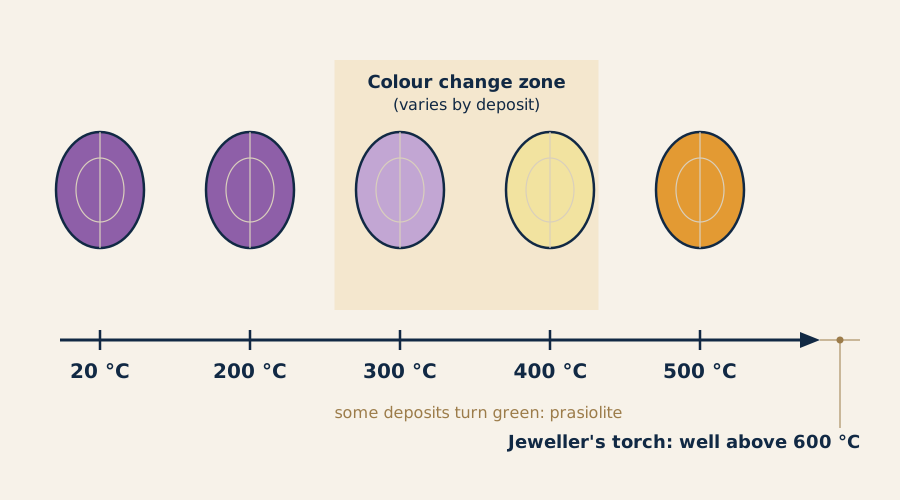
Sunlight is a slower, milder risk. Some amethyst, particularly paler material, can lose a little colour after long exposure to strong sun or ultraviolet light, the kind you would get from leaving a piece on a sunny windowsill for months. Normal wearing, including Australian summer days outdoors, is not usually enough to fade a stone noticeably. The practical rule: wear it freely, but store it in a drawer or box, not on display in direct sun.
| Situation | Risk to colour | What to do |
|---|---|---|
| Everyday wear, indoors and out | Very low | Wear it normally |
| Stored for months in direct sun or under strong UV | Low to moderate for some stones | Store in a closed box or pouch |
| Hot car dashboard | Low for colour; higher for sudden temperature change | Do not leave jewellery in the car |
| Steam cleaner or boiling water | Risk of cracking from temperature shock | Use warm, not hot, water |
| Jeweller's torch during repair | High: colour change and cracking | Stone should be removed first |
| Heat treatment by a supplier | Deliberate: lightens or turns stone yellow | Should be disclosed |
Most amethyst is not treated. Some very dark stones are gently heated to lighten them or remove a brownish tint, and heated stones can sometimes be returned to purple by irradiation. Ametrine, the purple and gold bicolour, occurs naturally (mainly from Bolivia) but can also be produced by partial heating, which should be disclosed. For how amethyst compares with other stones on heat and light, see our care notes for each gemstone.
Why does amethyst look different under different lighting?
Many people notice their amethyst looks bluer purple in daylight or under white LED lights, and redder purple under warm incandescent or candle light. This is a colour shift, not a true colour change. The stone itself does not change; the light source is richer in different colours, and amethyst's purple sits between red and blue, so it leans whichever way the light pushes it.
Weak pleochroism adds to the effect. Amethyst can show a slightly reddish purple in one direction through the crystal and a bluish purple in another, so tilting a ring changes its colour a little too.
True colour change is much more dramatic. Alexandrite's true colour-change effect takes a stone from green or bluish green in daylight to red or purplish red under incandescent light, and colour-change sapphire typically moves from blue to violet or purple. If you want a purple stone that behaves dramatically, those are the ones to look at; if you want a steady purple, amethyst is the simpler choice.
Not sure which one is right?
Send us the stones you are looking at and our gemologist will tell you which to choose and why.
Is amethyst hard enough for an everyday ring?
At 7 on the Mohs scale, amethyst is harder than steel (about 5.5) and glass (about 5.5), so it resists most scratches of daily life. Its weak point is wear rather than breakage. Ordinary household dust contains quartz particles, which are as hard as amethyst, so over years the facet edges on a ring can become slightly rounded and the surface less glossy. Pendants and earrings are rarely affected; rings worn every day may need a re-polish after several years.
| Gemstone | Mohs hardness | Toughness | Everyday ring? |
|---|---|---|---|
| Diamond | 10 | Good (can cleave) | Yes |
| Sapphire and ruby | 9 | Excellent | Yes |
| Alexandrite | 8.5 | Excellent | Yes |
| Morganite | 7.5–8 | Good | Yes, with some care |
| Emerald | 7.5–8 | Poor to fair (inclusions) | Protective setting needed |
| Tourmaline | 7–7.5 | Fair | Yes, with care |
| Amethyst | 7 | Good | Yes, with care; expect a re-polish over time |
| Opal | 5.5–6.5 | Poor to fair | Occasional wear |
Toughness means resistance to chipping and breaking, which is separate from hardness. Amethyst has no cleavage (a plane along which a crystal splits cleanly), so it is reasonably tough. Large stones with many internal fractures are the exception; they can split under a hard knock or a sudden temperature change.
An amethyst engagement ring is possible, with realistic expectations. It will need more care than sapphire or diamond and may need re-polishing every few years. For a stone with similar hardness but a wider colour range, compare how tourmaline holds up in an engagement ring, or browse the options in engagement rings set with coloured gemstones.
What setting suits amethyst jewellery for everyday wear?
The setting decides how well an amethyst survives daily life. The main options:
- Bezel or half-bezel: a rim of metal around the edge. The most protective choice for rings and bracelets.
- Four or six claws: show more of the stone and let light in. Six claws hold a large stone more securely and spread the load if one claw wears.
- Halo: a ring of small diamonds or gems around the amethyst frames the colour and shields the girdle (the outer edge).
- Low profile: a stone sitting closer to the finger takes fewer knocks than a tall cocktail setting.
- Pendants and earrings: the safest places for large or pale amethyst, where abrasion and knocks are rare.
Metal colour changes the look. Yellow gold warms amethyst towards reddish purple; white gold, platinum and silver keep it cooler and bluer. Rose gold suits the paler lilac shades.
Claws wear down with time, so whatever setting you choose, build it into an everyday ring care routine that includes regular checks.
Related guideAmethystHow can you tell natural amethyst from lab-created amethyst?
Lab-created (synthetic) amethyst has been grown commercially for decades by the hydrothermal method, which reproduces the hot, pressurised water that forms quartz in nature. It is real quartz with the same hardness, refractive index and colour cause, and it is much cheaper. It must always be sold as lab-created or synthetic. Glass imitations also exist and are not quartz at all.
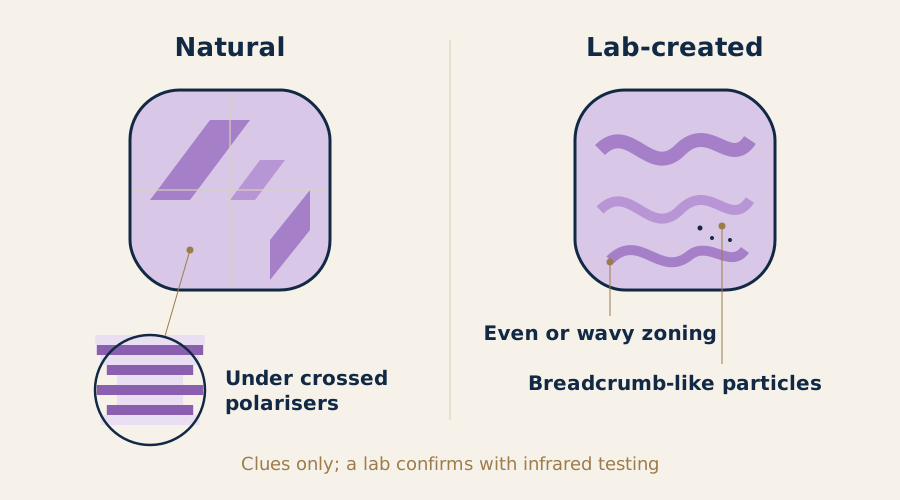
| Feature | Natural amethyst | Lab-created amethyst | Glass imitation |
|---|---|---|---|
| Material | Quartz | Quartz | Glass |
| Refractive index | 1.544–1.553, doubly refractive | 1.544–1.553, doubly refractive | About 1.50–1.70, singly refractive |
| Colour zoning | Often angular bands following crystal faces | Often uneven or wavy zoning; may be very uniform | Swirl marks, no crystal zoning |
| Typical inclusions | Liquid feathers, 'tiger stripe' or 'zebra' twinning, ripple-like fractures | Breadcrumb-like particles, seed plate remnants | Gas bubbles, swirls |
| Feel | Cool to the touch | Cool to the touch | Warms quickly |
| Price | Low to moderate | Very low | Very low |
A key gemmologist clue is Brazil-law twinning: natural amethyst often grows as interlocking left- and right-handed quartz, which shows as stripy 'zebra' or 'tiger stripe' patterns under crossed polarising filters, and sometimes as rippled 'thumbprint' fractures. Some lab-created amethyst is now also grown twinned, so these clues are suggestive, not proof. When certainty matters, a laboratory can use infrared spectroscopy, which picks up small differences in how water is held in the crystal.
For everyday amethyst jewellery, the price difference is small enough that most people simply ask for a clear disclosure. A reputable seller should state whether the stone is natural or lab-created and whether it has been heated.
How much does amethyst jewellery cost in Australia?
Amethyst is one of the most affordable precious-looking gems, because large, clean crystals are relatively common. In most finished amethyst jewellery the metal and the making cost more than the stone itself. These are broad, approximate ranges only:
| Item | Approximate price range (AUD) |
|---|---|
| Loose lab-created amethyst | about $1–$5 per carat |
| Loose natural, pale to medium colour | about $5–$30 per carat |
| Loose natural, deep 'Siberian' grade | about $30–$100+ per carat |
| Sterling silver amethyst pendant or studs | about $100–$400 |
| Gold ring with a 1–3 ct natural amethyst | about $600–$3,000+, mostly metal and labour |
Colour is the biggest price driver, followed by clarity (amethyst is usually expected to be eye-clean, meaning no inclusions visible without magnification), cut quality and size. Unlike many gems, price per carat rises only gently with size, so a 5 ct amethyst is within reach where a 5 ct sapphire would not be. That makes amethyst popular for statement rings and for February birthday gifts in amethyst.
If you are weighing amethyst against other purple or coloured stones, our overview of coloured gemstone options beyond amethyst sets them side by side.
Browse natural gemstones, including amethyst
How do you clean and care for amethyst jewellery?
Amethyst is easy to look after if you avoid heat and sudden temperature change. A simple routine every few weeks keeps it bright:
- Soak. Place the piece in warm (not hot) water with a few drops of mild dishwashing liquid for 5–10 minutes.
- Brush. Use a soft toothbrush to clean gently behind and around the stone, where soap and skin oils build up and dull the colour.
- Rinse. Rinse in lukewarm water, with the sink plugged or over a bowl.
- Dry. Pat dry with a soft, lint-free cloth.
- Skip the steam. Avoid steam cleaners. Use an ultrasonic only for stones with no visible fractures and no coatings, and if unsure, do not.
- Store it dark and separate. Keep amethyst in a fabric pouch or lined box, away from direct sun and away from diamonds and sapphires, which will scratch it.
- Check the setting. Have claws and bezels checked every 6–12 months, and ask for stones to be removed before any torch repair.
Take amethyst rings off for gardening, gym work and cleaning with abrasive powders, which can scratch or chip the stone. Household chemicals rarely harm quartz itself, but they can damage metals and any coating on treated stones. For other stones in your jewellery box, the stone-by-stone cleaning guide covers each one, and our ring care page explains how often to have claws checked.
Free consultation
Talk to a gemologist
Compare stones in person or online with Raj Sood, Graduate Gemologist (GIA), AJP (GIA).
Book a consultationShop this shape
FAQ
Common questions
Does amethyst fade over time?
In normal wear, amethyst keeps its colour for decades. Strong heat can turn it yellow or brown, and some paler stones can lose a little colour after months of direct sun, so store it out of the light.
Can I wear amethyst jewellery every day?
Yes, especially pendants and earrings. Rings are fine too in a protective setting, though facet edges can wear after several years and may need re-polishing.
Can amethyst go in an ultrasonic cleaner?
Usually, if the stone has no visible fractures and has not been coated. Steam cleaners are not recommended because sudden heat can crack quartz, and warm soapy water is always the safe choice.
Is lab-created amethyst real amethyst?
Lab-created amethyst is real quartz with the same hardness and colour cause as natural amethyst, grown in a laboratory instead of mined. It is cheaper and must be disclosed as lab-created or synthetic.
What is the difference between amethyst and citrine?
Both are quartz. Amethyst is purple; citrine is yellow to orange, and much commercial citrine is amethyst that has been heated.
Is amethyst found in Australia?
Small deposits have been found in several states, including Western Australia and Queensland, but most amethyst in Australian jewellery comes from Brazil, Uruguay and Zambia.

Ask a gemologist
Not sure which diamond to choose?
Raj Sood is a Graduate Gemologist (GIA) and master jeweller. Bring the stones you are considering, or send the reports, and he will tell you honestly which one is better and why.
Keep learning
Related guides
 GemstonesAmethyst
 GemstonesGemstone Care by StoneGemstonesFebruary Birthstone: Amethyst
 GemstonesEngagement Rings with Colour, Meaning and Personal Gemstone ChoiceGemstonesGemstones | Coloured Gemstones, Birthstones and Custom Jewellery
 GemstonesColour-Change Sapphire
 Care, Repairs & RemodellingEngagement Ring Care Guide
 GemstonesGemstone Colour Grading: Hue, Tone, Saturation
Explore more
More guides on this topic
Education