
Gemstones
Amethyst Guide: Colour, Hardness, Treatments, Origins and Value
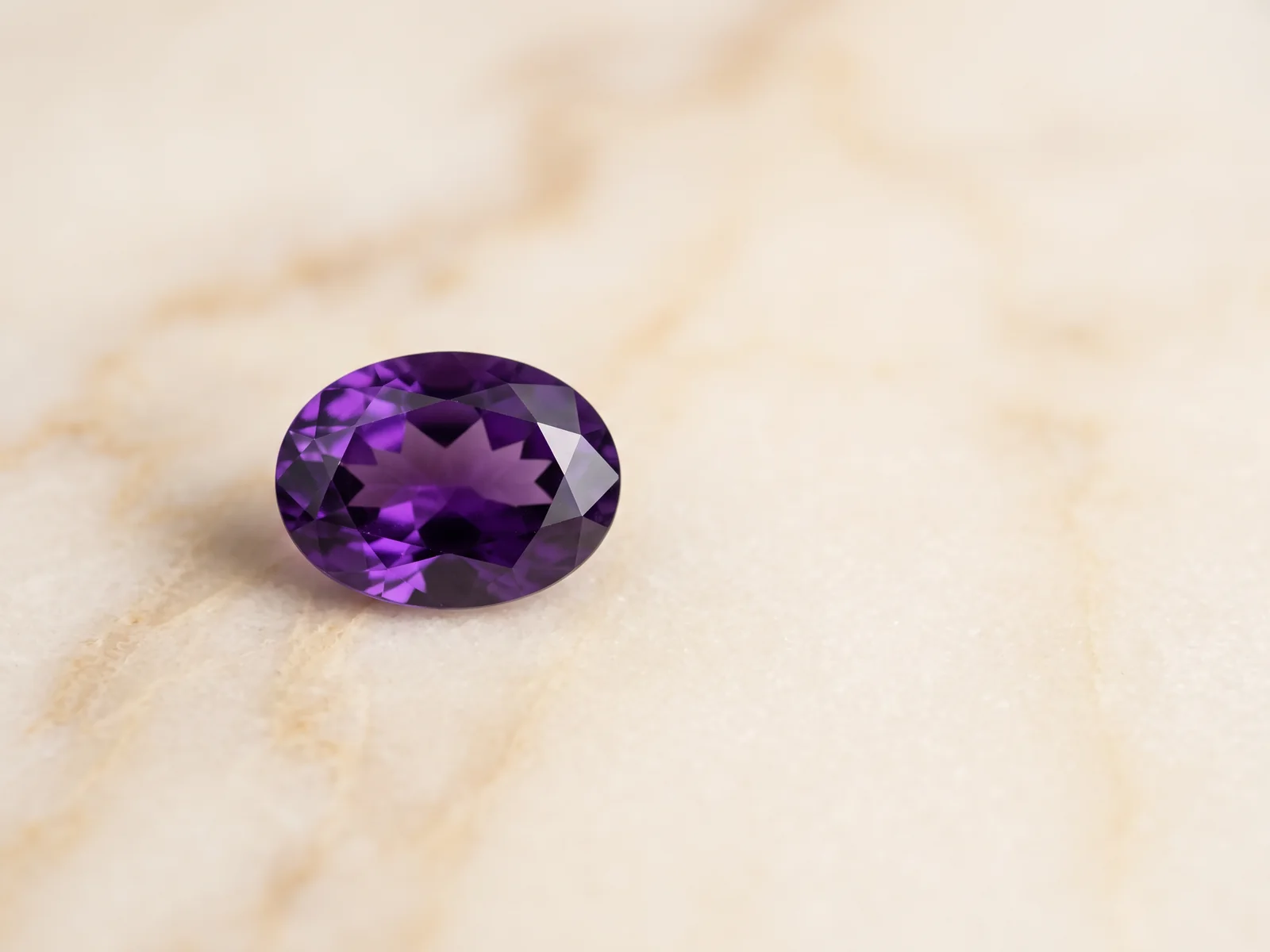
Amethyst is the most widely worn purple gemstone, and quality varies more than most people expect. Here is how a gemologist judges amethyst: its colour, durability, treatments, lab-created look-alikes and what it costs.
 Reviewed by Raj Sood, Graduate Gemologist (GIA), AJP (GIA)Master jeweller and Graduate Gemologist (GIA) · reviewed 4 November 2026
Quick answer
Amethyst is the purple variety of quartz, coloured by traces of iron and natural irradiation. It rates 7 on the Mohs scale, has no cleavage and is tough, so it suits pendants, earrings and carefully worn rings. Look for an even, saturated purple without brown tints or obvious zoning; most amethyst costs well under AUD $100 per carat.
What is amethyst?
Amethyst is the purple variety of quartz, which is silicon dioxide (SiO2). It is the same mineral as citrine, rock crystal and smoky quartz, its brown-grey cousin. What makes amethyst purple is a trace of iron built into the crystal, activated by natural gamma radiation from the surrounding rock over a very long time. That radiation creates colour centres: tiny defects in the atomic structure that absorb yellow-green light, so the light that reaches your eye looks purple.
Because the colour depends on those colour centres, it is not permanent in every circumstance. Strong heat can erase them, which is how most citrine on the market is made, and a small amount of amethyst can slowly pale under very strong, prolonged light. The name comes from the ancient Greek word amethystos, meaning not intoxicated, from an old belief that the stone protected its wearer from drunkenness.
| Property | Amethyst |
|---|---|
| Mineral | Quartz (macrocrystalline, meaning it forms visible crystals) |
| Chemical formula | SiO2 |
| Crystal system | Trigonal |
| Mohs hardness | 7 |
| Toughness | Good; no cleavage, breaks with a shell-like (conchoidal) fracture |
| Refractive index | 1.544–1.553 |
| Birefringence | 0.009 |
| Specific gravity | about 2.65 |
| Pleochroism | Weak to moderate: purple and reddish-purple |
| Lustre | Vitreous (glassy) |
Amethyst sits in the wider family of coloured gemstones and birthstones, and it is one of the few that is both affordable and available in large, clean sizes. Any term in the table you have not met before, such as birefringence (the difference between a gem's two refractive indices), is explained in our A to Z jewellery glossary.
What colours does amethyst come in?
Amethyst ranges from a pale lilac through to a deep, almost inky violet. Gemologists describe the colour by three things: hue (the basic colour, from bluish-purple to reddish-purple), tone (how light or dark it is) and saturation (how strong or vivid the colour is, as opposed to greyish or brownish). The most sought-after amethyst is a strong purple of medium-dark tone, often with flashes of red and blue as the stone moves.
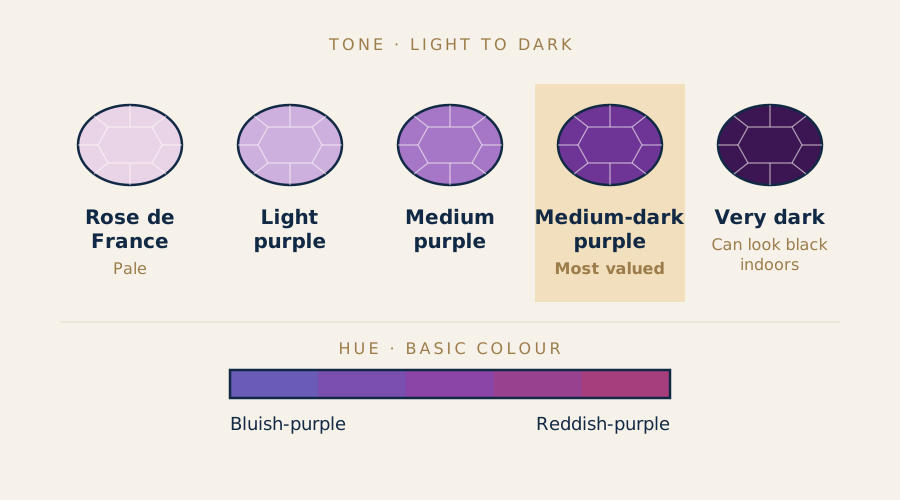
You will see trade names used to describe these colours. They describe a look, not where the stone was actually mined:
- Rose de France: pale pinkish lilac. Light and soft, popular in vintage-style jewellery and usually the most affordable.
- Medium purple: the everyday commercial colour, often from Brazil.
- Siberian or Deep Siberian: deep purple with red and blue flashes. The name began with fine material from Russia's Ural Mountains, but it is now used for that quality from any source.
- Ametrine: not pure amethyst but a natural bicolour of amethyst and citrine in one crystal, mainly from Bolivia.
Two colour problems are worth knowing. The first is colour zoning: amethyst grows in layers, so the purple often sits in angular bands or patches with paler areas between them. A skilled cutter orients the stone so the colour concentrates low in the pavilion (the lower half) and spreads evenly face-up. The second is tone: very dark amethyst can look almost black under dim or warm indoor light, so check a stone in more than one lighting. Amethyst is also the February birthstone, which is why so many pale and medium stones appear in birthstone jewellery.
How hard is amethyst, and is it tough enough for a ring?
Gem durability has two parts. Hardness is resistance to scratching, measured on the Mohs scale from 1 to 10. Toughness is resistance to chipping and breaking. Amethyst is 7 on the Mohs scale and has good toughness, because quartz has no cleavage (no flat plane along which it splits easily). That is a solid combination for jewellery.
The catch is everyday dust. Household dust and sand contain quartz, which is also 7, so over years of daily wear an amethyst ring's facet edges slowly soften and the table picks up fine scuffs. That is wear, not damage, and a jeweller can repolish it. Here is how amethyst compares with other stones people consider for rings:
| Gemstone | Mohs hardness | Toughness | Ring wear |
|---|---|---|---|
| Diamond | 10 | Good (has cleavage) | Daily wear |
| Sapphire | 9 | Excellent | Daily wear |
| Spinel | 8 | Good | Daily wear |
| Topaz | 8 | Poor (perfect cleavage) | Protective setting needed |
| Morganite | 7.5–8 | Fair to good | Daily wear with some care |
| Amethyst | 7 | Good | Careful daily or occasional wear |
| Smoky quartz | 7 | Good | Careful daily or occasional wear |
| Chrysoprase | 6.5–7 | Very good | Careful wear; cabochons suit rings |
| Tanzanite | 6–6.5 | Fair to poor | Occasional wear |
| Opal | 5.5–6.5 | Poor to fair | Occasional wear, protective setting |
| Amber | 2–2.5 | Poor | Pendants and earrings, not rings |
So amethyst sits in the middle: far harder than organic amber, a fossil resin, similar to the green chalcedony in chrysoprase, known as Australian jade, and softer than the corundum and beryl stones covered in our morganite and pink sapphire comparison. For a ring worn every day, expect a repolish every several years; for earrings and pendants, amethyst wears very well.
Is amethyst heat treated?
Most amethyst is either untreated or gently heated. Low-temperature heating is used to lighten stones that are too dark or to remove a brownish or smoky tint. This kind of heating is stable, permanent under normal wear and usually cannot be detected, so it is treated in the trade as routine. The question of whether a gem has been heated and why that matters is far more important for sapphire and ruby than it is for amethyst, where unheated stones do not usually carry a premium.
Heat at higher temperatures, roughly 400–500 °C depending on the material, does something more dramatic: it destroys the colour centres and turns amethyst yellow, orange or brown. That is where most commercial citrine comes from. Amethyst from a few deposits, such as parts of Brazil, turns green instead, which is sold as prasiolite or green amethyst.
- Heating (light): common, stable, lightens dark stones or removes brown tints.
- Heating (strong): converts amethyst to citrine or prasiolite; the stone should then be sold under that name.
- Irradiation: occasionally used to deepen or restore purple colour; less common.
- Dyeing: seen in low-cost beads, often dyed quartzite or crackled quartz rather than true amethyst.
- Fracture filling: rare in faceted amethyst but possible in lower-grade beads and carvings.
Our gemstone treatments reference, from bleaching to waxing covers each method in more depth, and if you are looking at cheaper beaded or cabochon pieces, the guide to how glass and fracture filling work explains what those fillers do to durability and cleaning.
Not sure which one is right?
Send us the stones you are looking at and our gemologist will tell you which to choose and why.
How can you tell natural amethyst from synthetic amethyst or glass?
Synthetic amethyst, also called lab-created amethyst, has been grown commercially since about the 1970s using the hydrothermal method, which grows quartz from a hot, pressurised water solution on a seed plate. It is real quartz, with the same chemistry, hardness, refractive index and specific gravity as natural amethyst, so it is not fake. It is simply laboratory-grown rather than mined, and it must always be sold as lab-created or synthetic. Because the basic numbers match, a refractometer alone cannot separate the two.
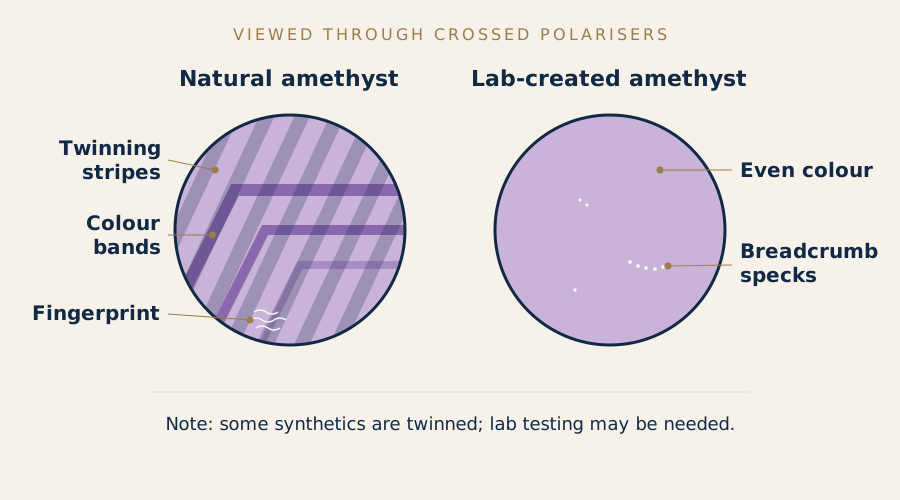
What a gemologist looks at instead is how the crystal grew:
- Brazil-law twinning: natural amethyst very often grows with alternating left- and right-handed quartz layers. Under crossed polarising filters these show as zebra or tiger stripes, and they can leave rippled fingerprint-like inclusions.
- Angular colour zoning: natural colour bands follow the crystal faces at sharp angles.
- Inclusions: natural stones show fingerprints, two-phase inclusions (tiny pockets of liquid and gas) and needles; synthetics are often very clean or show breadcrumb-like specks and seed-plate traces.
- Laboratory testing: some modern synthetics are grown twinned, so a definite answer may need infrared spectroscopy at a gem laboratory.
Glass imitations are easier. Purple glass is softer (about 5–6 on the Mohs scale), often shows round gas bubbles and swirl lines, and is singly refractive, so it does not show the doubling and pleochroism of quartz. It is the same family of imitation covered in our guide to CZ, YAG, GGG and glass simulants.
Where does amethyst come from, and is there Australian amethyst?
Amethyst forms in many parts of the world, most often inside gas cavities in volcanic rock, where it lines geodes, and in quartz veins. The main sources:
| Source | Typical material | Notes |
|---|---|---|
| Brazil (Rio Grande do Sul, Minas Gerais) | Light to medium purple, large volumes | Largest commercial source; huge geodes |
| Uruguay (Artigas) | Deep, saturated purple | Smaller crystals, strong colour |
| Zambia | Deep purple, often bluish | Important source of fine cutting material |
| Bolivia (Anahí mine) | Amethyst and ametrine | Main source of natural ametrine |
| Russia (Urals) | Deep purple with red flashes | Historic source behind the Siberian name |
| Madagascar, Sri Lanka, Namibia | Variable, some fine colour | Smaller production |
| Mexico, USA, Canada | Distinctive local material | Often collectors' or specimen material |
| Australia | Small occurrences | Mostly specimen and lapidary grade |
For amethyst, origin matters much less than it does for sapphire or ruby. It is rarely stated on a report and rarely moves the price on its own; colour is judged by eye, wherever the stone was mined. Our page on how origin affects value in Ceylon, Burma and African gems explains where origin does carry weight.
Australia has recorded amethyst in several states, including Western Australia and Queensland, but it is mostly collected as specimens or cut by hobbyists rather than mined commercially. Australia's better-known coloured stones are sapphire, covered in our guide to the Inverell, Anakie and lava plains sapphire fields, opal, and the apple-green chrysoprase mined in Queensland and Western Australia.
What affects amethyst value and price?
Colour drives amethyst value far more than anything else. After colour come clarity, cut and size, in roughly that order.
- Colour: a strong, even purple of medium-dark tone, with red or blue flashes, sits at the top. Pale, greyish, brownish or heavily zoned stones sit at the bottom.
- Clarity: amethyst is a GIA Type II gem, meaning it usually has some inclusions, but faceted stones are expected to be eye-clean. Visible fingerprints or zebra-stripe veils lower the price noticeably.
- Cut: good proportions and even colour face-up matter; a stone cut too shallow shows a washed-out window in the centre.
- Size: large clean amethyst is common, so the price per carat rises only gently with size, unlike sapphire or diamond.
Clarity expectations differ by gem, and our guide to GIA clarity Types I, II and III shows where amethyst sits against emerald and aquamarine. Lower-grade material is usually cut as beads or cabochons, while cleaner rough is faceted; see cabochon, faceted and carved gem cuts for how the cut choice follows the material.
| Quality | Approximate price per carat (AUD) |
|---|---|
| Lab-created amethyst | about $1–$10 |
| Commercial: pale, greyish or zoned | about $2–$15 |
| Good: medium purple, eye-clean, well cut | about $15–$50 |
| Fine: deep, even purple with red or blue flashes | about $50–$150 |
These are broad loose-stone ranges only and move with the market and the exact quality. In finished jewellery, the metal, setting and labour usually cost more than the amethyst itself, so the stone's quality is where small budget changes make the biggest visible difference.
Shop natural gemstones
Is amethyst good for an engagement ring or everyday ring?
Amethyst can work in an engagement ring or everyday ring if you accept that it will need a little more care than sapphire or diamond. The stone will not split easily, but its facet edges will soften over years of daily wear, and a hard knock on a tap or doorframe can chip an exposed edge. A setting that protects the girdle (the outer edge) makes a real difference.
- Bezel or half-bezel: a rim of metal around the edge; very protective and suits a modern look.
- Six claws: spreads the grip and guards the girdle better than four.
- Lower profile: a stone sitting closer to the finger is knocked less often.
- Cabochon cut: a smooth domed top has no sharp facet edges to wear, so it suits rings worn hard.
- Accent diamonds or a halo: frame the purple and also shield the edge.
Yellow and rose gold warm amethyst and suit medium and pale stones; white gold and platinum make deep purple look cooler and more violet. Whatever the metal, plan to have the claws checked about once a year, as you would for any ring worn daily.
Related guideAmethyst Jewellery: Colour, Fading and CareHow do you clean and care for amethyst jewellery?
Amethyst is easy to look after if you keep it away from heat, harsh knocks and grit. Practical rules:
- Clean with warm water, a drop of mild dishwashing liquid and a soft toothbrush, then rinse and dry with a lint-free cloth.
- Ultrasonic cleaners are generally fine for untreated, eye-clean stones, but avoid them if the stone has visible fractures or has been filled.
- Avoid steam cleaning and sudden temperature changes, which can stress inclusions, and keep amethyst away from strong heat, which can change its colour.
- Limit long exposure to strong sunlight; a small proportion of amethyst can pale over time, so do not leave pieces on a sunny windowsill.
- Store separately from diamonds and sapphires, which scratch it, and from softer gems such as amber and opal, which it can scratch.
- Take rings off for gardening, the gym, cleaning and the beach, where grit and knocks do most of the damage.
For more on why some amethyst fades and how to protect older or pale pieces, see our guide to amethyst fading, storage and cleaning.
How do you choose an amethyst? Step by step
- Decide how it will be worn. Earrings and pendants suit any quality; a daily ring calls for a protective setting and an eye-clean stone.
- Judge the colour in two lights. Look in daylight and under warm indoor light; avoid stones that turn black indoors or look brownish or grey.
- Check for zoning. Tilt the stone and look through the side for pale patches or bands that show face-up.
- Check clarity by eye. A faceted amethyst should be eye-clean at normal viewing distance.
- Confirm what it is. Ask whether the stone is natural or lab-created, and whether it has been heated or otherwise treated.
- Compare face-up size and cut. Look for even brightness without a dull window in the centre, and compare millimetre sizes, not just carats.
Free consultation
Talk to a gemologist
Compare stones in person or online with Raj Sood, Graduate Gemologist (GIA), AJP (GIA).
Book a consultationShop this shape
FAQ
Common questions
Is amethyst a precious stone?
Historically amethyst was ranked alongside the most valuable gems, but large deposits found in Brazil and elsewhere made it widely available. Today it is usually called a semi-precious or coloured gemstone, though fine deep stones are still valued.
Does amethyst fade in sunlight?
Some amethyst can slowly pale with long, strong exposure to sunlight or heat, because its colour comes from colour centres in the crystal. Normal wear is fine; just avoid leaving pieces in direct sun or near heat for long periods.
Is amethyst good for an engagement ring?
It can be, in a protective setting such as a bezel or six claws. At 7 on the Mohs scale it will show wear on facet edges over the years, so expect an occasional repolish.
What is the difference between amethyst and citrine?
Both are quartz. Amethyst is purple, and most citrine sold is amethyst that has been heated until the purple turns yellow or orange.
Is lab-created amethyst real amethyst?
Yes, lab-created amethyst is real quartz with the same chemistry and properties, grown in a laboratory rather than mined. It must be disclosed as lab-created or synthetic, and it costs less than natural amethyst.
How much is amethyst worth in Australia?
Most loose amethyst costs well under AUD $100 per carat, from a few dollars per carat for pale commercial stones to roughly $50–$150 per carat for fine deep purple. Prices vary with colour, clarity, cut and size.

Ask a gemologist
Not sure which diamond to choose?
Raj Sood is a Graduate Gemologist (GIA) and master jeweller. Bring the stones you are considering, or send the reports, and he will tell you honestly which one is better and why.
Keep learning
Related guides
 GemstonesFebruary Birthstone: AmethystGemstonesAmethyst Jewellery: Colour, Fading and Care
 GemstonesHeated vs Unheated Gemstones
 GemstonesSmoky QuartzGemstonesGemstones | Coloured Gemstones, Birthstones and Custom Jewellery
 GemstonesGemstone Treatments A to Z
 GemstonesGemstone Origins: Ceylon, Burma, Kashmir, Madagascar, Mozambique
 GemstonesDiamond Simulants: CZ, YAG, GGG and Glass
Explore more
More guides on this topic
Education