
- Education
- Lab-Grown Diamonds
- Are Lab-Grown Diamonds Sustainable? The Evidence and the Questions to Ask
Lab-Grown Diamonds
Are Lab-Grown Diamonds Sustainable? The Evidence and the Questions to Ask
Lab-grown diamonds are often sold as the green choice, but the real answer depends on electricity, evidence and wording. Here is how to tell whether lab-grown diamonds are sustainable or just well marketed, explained by a Melbourne jeweller that sells both natural and lab-grown.
 Reviewed by Raj Sood, Graduate Gemologist (GIA), AJP (GIA)Master jeweller and Graduate Gemologist (GIA) · reviewed 4 November 2026
Quick answer
Not automatically. Lab-grown diamonds avoid mining, but growing them uses a lot of electricity, so how sustainable they are depends on the power source. A diamond grown on a coal-heavy grid can match or exceed a mined diamond's carbon footprint; one grown on renewable power can be far lower. Ask for the energy source, independent certification and evidence.
What does 'sustainable' actually mean for a diamond?
'Sustainable' has no legal definition in Australia, and no single standard covers every diamond. When people ask whether a diamond is sustainable, they usually mean three different things: its carbon footprint (the greenhouse gas released to make it, measured in kilograms of CO2-e, or carbon dioxide equivalent), its local environmental impact (land, water and waste) and its social impact (workers, communities and where the money goes). A diamond can score well on one of these and poorly on another.
It helps to be clear about what a lab-grown diamond is. It is the same crystal of carbon as a mined diamond, with the same hardness (10 on the Mohs scale) and the same refractive index of about 2.42, which is why lab-grown stones are real diamond, not imitations. The difference is origin: one formed deep in the earth, mostly between one and three billion years ago, the other in a factory over a few weeks. So the sustainability question is not about what the stone is, but how it was made, and with what energy.
This page focuses on that one question. For everything else, from grading to settings, see our complete lab-grown diamonds guide, and if a term here is new, our plain-English jewellery glossary explains it.
How much energy does it take to grow a lab-grown diamond?
There are two growing methods. HPHT (high pressure, high temperature) squeezes carbon around a diamond seed in a large press at roughly 5–6 gigapascals and 1,300–1,600°C. CVD (chemical vapour deposition) builds diamond layer by layer from a carbon-rich gas, usually methane, inside a vacuum chamber heated by microwave plasma. Both run continuously for days or weeks, and both draw a lot of electricity. Our page on how HPHT and CVD diamonds are grown explains each process step by step.
Published and industry estimates usually fall somewhere around 250–750 kWh per polished carat, and some are higher. The spread is wide because growers rarely publish meter data, reactors differ, and rough diamond loses well over half its weight when it is cut, so a 1 carat polished stone may come from 2–3 carats of rough. For scale, 500 kWh is in the region of a month's electricity for an average Australian household.
Energy alone does not decide the carbon footprint. What matters is how that electricity was generated, measured as grid emission intensity (kilograms of CO2-e per kWh). The same reactor can produce a diamond with a footprint fifty times higher on coal power than on hydro.
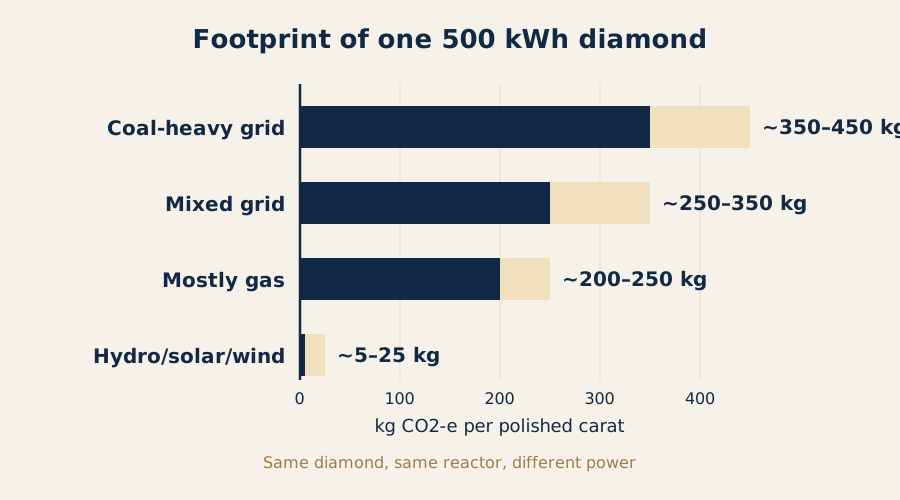
| Electricity supply | Approx. intensity (kg CO<sub>2</sub>-e per kWh) | Footprint at 500 kWh per carat |
|---|---|---|
| Coal-heavy grid | 0.7–0.9 | about 350–450 kg |
| Mixed grid (coal, gas, some renewables) | 0.5–0.7 | about 250–350 kg |
| Mostly gas | 0.4–0.5 | about 200–250 kg |
| Hydro, solar or wind | 0.01–0.05 | about 5–25 kg |
Most lab-grown diamonds are now grown in India and China, where coal still supplies a large share of grid power. Some growers in the United States and elsewhere run on hydro or contracted solar and wind. That is why the single most useful question you can ask is where the diamond was grown and on what power.
Are lab-grown diamonds sustainable compared with mined diamonds?
Mining has its own footprint. A large diamond mine burns diesel in haul trucks and generators at remote sites, uses electricity to crush and process ore, and may move tens to hundreds of tonnes of rock for every carat recovered. Published estimates for large modern mines often land somewhere around 100–200 kg CO2-e per polished carat, though figures vary a lot by mine. Studies funded by the natural and lab-grown sides of the trade have produced numbers that disagree by more than tenfold, so treat any single headline figure with caution.
| Factor | Lab-grown diamond | Natural (mined) diamond |
|---|---|---|
| Main carbon source | Electricity for growing | Diesel and electricity for mining and processing |
| Carbon per polished carat (published estimates) | Very low to several hundred kg, depending on the grid | Roughly 100–200 kg at large mines; varies widely |
| Land disturbance | Factory site only | Open pits or underground workings, waste rock and tailings that need rehabilitation |
| Water | Cooling water, often recirculated | Processing water, large volumes at some mines |
| Social impact | Factory jobs, mostly in India and China | Major income for producer countries such as Botswana and Namibia; artisanal mining can carry serious labour risks |
| Traceability | Grower can usually be identified if the seller asks | Kimberley Process covers conflict rough only, not environmental impact |
| Typical price for 1 ct | Much lower | Much higher |
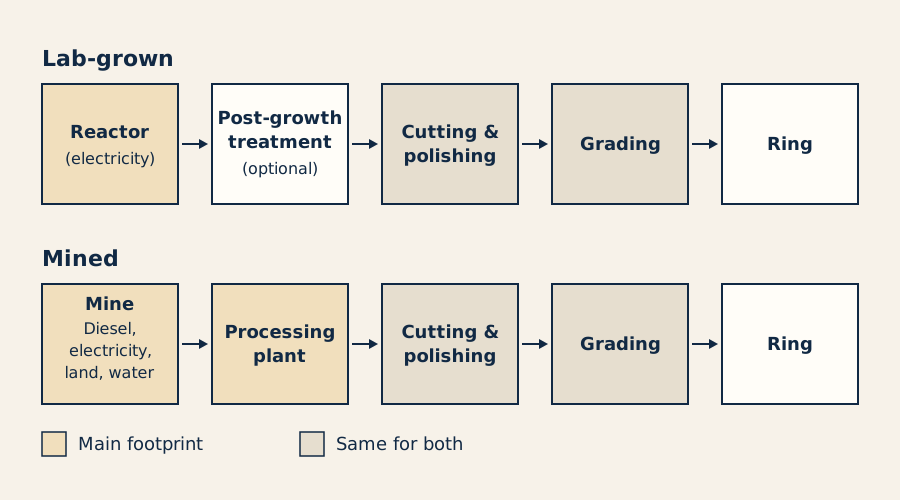
Two things are the same for both. Cutting and polishing happen in the same workshops, mostly in India, with the same equipment. And neither type is impact-free: a lab-grown diamond avoids pits and tailings, while a mined diamond supports economies that depend on it. The fair summary is that a lab-grown diamond grown on clean power has a clearly smaller footprint, and one grown on coal power may not. Our full lab-grown vs natural comparison covers appearance, grading and value as well.
If your main concern is cost rather than carbon, it is also worth knowing how lab-grown diamond differs from cubic zirconia, a simulant that only imitates the look of diamond and is far softer, at 8–8.5 on the Mohs scale.
What does a 'carbon-neutral lab-grown diamond' claim really mean?
Carbon neutral means a company has measured the emissions from making a product, reduced what it can and paid for carbon offsets (credits from projects that avoid or remove greenhouse gas elsewhere) to cover the rest. It does not mean the diamond was made with zero emissions. The claim is only as strong as the measurement behind it and the quality of the credits. Evidence worth asking for:
- What was counted: growing only, or also cutting, polishing, post-growth treatment and freight?
- The method: a named standard such as the GHG Protocol or ISO 14067 for product carbon footprints.
- Who checked it: an independent verifier, not just the grower's own figures.
- The offsets: the registry, project type and serial numbers, and proof the credits were retired (cancelled so they cannot be sold again). Removal credits are generally regarded as stronger than avoidance credits.
- The power: on-site solar, a renewable power purchase agreement or renewable energy certificates, and for what share of the year.
- The scope in time: does the claim cover this diamond or batch, or a company average from a past year?
Red flags are easy to spot once you know them: words like 'eco-friendly', 'zero impact' or '100% sustainable' with no detail, green leaf graphics doing the work of evidence, and promises to be carbon neutral 'by 2030' with no plan attached. Our wider checklist of questions for your jeweller covers grading, warranties and returns alongside these. A carbon claim also tells you nothing about the stone's quality, so judge that separately using the grading basics covered in our lab-grown guide.
Not sure which one is right?
Send us the stones you are looking at and our gemologist will tell you which to choose and why.
What do Australian rules say about green diamond claims?
Under the Australian Consumer Law, a business must not make false or misleading claims, and that includes claims about the environment. A claim about a future matter, such as reaching net zero, needs reasonable grounds at the time it is made. Penalties for companies can reach tens of millions of dollars, and the ACCC (Australian Competition and Consumer Commission) has made greenwashing an enforcement priority.
In December 2023 the ACCC published a guide for business on making environmental claims, built around eight principles:
- Make accurate and truthful claims.
- Have evidence to back them up.
- Do not hide or leave out important information.
- Explain any conditions or qualifications.
- Avoid broad and unqualified claims.
- Use clear, easy-to-understand language.
- Make sure visuals do not give the wrong impression.
- Be direct and open about sustainability transition plans.
For diamonds, that means a bare 'sustainable lab-grown diamond' label risks being a broad, unqualified claim, and 'carbon neutral' needs evidence the seller can produce. In an earlier ACCC internet sweep in 2022, more than half of the businesses reviewed made environmental claims the regulator considered concerning. When a sustainability claim is on the label, it is reasonable to ask what to ask the person selling it and expect a clear answer.
Separately, the international diamond naming standard, ISO 18323, requires lab-grown stones to be described as 'laboratory-grown', 'laboratory-created' or 'synthetic', never just 'diamond'. That rule exists so buyers can always tell the two apart, and the lab-grown vs natural comparison linked above sets out the differences that disclosure protects.
Does a grading report prove a diamond is sustainable?
No. A grading report from a laboratory such as IGI or GIA tells you what the diamond is: natural or laboratory-grown, its measurements, colour, clarity and cut. It does not record where the power came from or how much carbon was released. Here is what you will and will not find.
| Information | On a typical lab-grown grading report? |
|---|---|
| Origin stated as 'Laboratory-Grown' | Yes, clearly on the report and usually laser-inscribed on the girdle |
| Growth method (CVD or HPHT) | Often, especially on IGI reports |
| Post-growth treatment | Often noted, for example 'As Grown' or a comment on post-growth treatment |
| Colour, clarity, cut grades | Yes, though some labs now use simplified descriptions for lab-grown |
| Country or company of growth | Rarely |
| Energy source | No |
| Carbon footprint | No; only on a separate sustainability certificate |
Some growers have their diamonds independently certified to a sustainability standard, such as the SCS-007 standard for jewellery run by SCS Global Services, which looks at origin, emissions, offsets and other criteria. That is a separate document, and it is worth reading what it covers rather than relying on the badge. The grading lab's job is narrower: it uses spectroscopy and growth-pattern imaging to confirm how labs confirm a stone is diamond and where it formed.
The report still matters for the rest of your decision. It shows how colour is graded on lab-grown reports and gives the proportions that explain why cut quality varies between lab-grown diamonds. Many CVD diamonds are also heated after growth to improve colour, one of the post-growth treatments such as HPHT annealing, which adds a further processing step and a little more energy.
What else affects the footprint of an engagement ring?
The diamond is only part of the ring. Newly mined gold and platinum are energy-intensive to produce, and the metal in a band can carry a footprint that is significant next to a small diamond. Recycled metal, refined from old jewellery and industrial scrap, generally has a much lower footprint than newly mined metal, and its quality is identical once refined.
A few other choices matter more than people expect:
- Carat weight: growing energy rises roughly with weight, so a 2 carat stone uses roughly twice the electricity of a 1 carat stone, sometimes more.
- Remodelling: resetting a diamond you already own uses no new diamond at all.
- Durability: a well-made ring that lasts decades, with claws checked every year or two, avoids replacements.
- Custom work: if you are having a ring made, it is the right moment to ask about stone origin and metal together; see these questions to ask before a custom ring is made.
A smaller, well-cut stone often looks brighter than a larger, poorly cut one, so putting your budget into the cut grade rather than extra carats can lower the growing energy without making the ring look less impressive. Shape plays a part too: some outlines spread wider for their weight, as our comparison of which diamond shapes look biggest for their carat weight shows.
Is a lab-grown diamond worth it if the sustainability is unclear?
Many people who choose lab-grown do so for price and size first, and that case stands on its own. A lab-grown diamond costs much less than a natural diamond of the same grades, and the gap has widened as growing capacity has expanded.
| Round brilliant, G colour, VS clarity | Lab-grown (approx. AUD) | Natural (approx. AUD) |
|---|---|---|
| 1 ct | about $800–$2,500 | about $7,000–$15,000 |
| 2 ct | about $2,000–$6,000 | about $25,000–$60,000 |
These are broad ranges only and move with the market. Shape changes the figures as well, and our page on how price per carat differs between diamond shapes sets out the pattern. Lower prices also mean lower resale: lab-grown diamonds have little secondhand value, so read up on what lab-grown diamonds are worth if you sell before you decide. Natural diamonds hold some resale value but should not be bought as an investment either. Our page on how natural and lab-grown prices compare goes into the detail.
If lower environmental impact is part of your reason, you can have both: choose lab-grown for price, then ask the questions in the next section so the sustainability part is backed by evidence rather than assumed.
Browse lab-grown diamonds
How do you check whether lab-grown diamonds are sustainable?
- Confirm it is lab-grown. Check the report says 'Laboratory-Grown' and the inscription number on the girdle matches it.
- Ask where it was grown and by whom. Country and grower, not just 'overseas'.
- Ask about the power. Grid, on-site solar, hydro or contracted renewables, and what proof exists.
- Test any carbon-neutral claim. Ask what was measured, which standard was used, who verified it, and the registry and serial numbers of retired offsets.
- Look for independent certification. If a sustainability certificate is offered, read what it covers and which diamond it applies to.
- Get it in writing. Any environmental claim that influenced your choice should appear on the invoice or certificate.
- Think about the whole ring. Ask about the metal and whether recycled metal is an option.
If the answers are clear and documented, you can be confident about what you are buying. If they are not, the diamond may still be a good diamond, but treat any green label as unproven. For the rest of the buying decision, from cut to certification, read everything else about choosing lab-grown.
Free consultation
Talk to a gemologist
Compare stones in person or online with Raj Sood, Graduate Gemologist (GIA), AJP (GIA).
Book a consultationShop this shape
FAQ
Common questions
Are lab-grown diamonds better for the environment than mined diamonds?
They can be, but not automatically. A lab-grown diamond grown on renewable power has a much smaller carbon footprint and no mining impact, while one grown on a coal-heavy grid can have a footprint similar to or higher than a mined diamond.
Are lab-grown diamonds eco-friendly?
'Eco-friendly' is a broad term with no fixed meaning, and the ACCC warns businesses against using it without evidence. Ask what the claim is based on, such as the energy source and an independently verified carbon footprint.
What does a carbon-neutral lab-grown diamond mean?
It means the producer measured the emissions, reduced some and offset the rest with carbon credits. It is not the same as zero emissions, so ask for the footprint figure, the standard used and proof the offsets were retired.
Does the grading report show if a lab-grown diamond is sustainable?
No. Reports from labs such as IGI and GIA confirm the diamond is laboratory-grown and grade it, but they do not record energy source or carbon footprint. That needs a separate, independent sustainability certificate.
Where are most lab-grown diamonds made?
Most are now grown in India and China, where coal still supplies much of the electricity. Some are grown in the United States and other countries using hydro, solar or wind power.
Is recycled gold more sustainable for an engagement ring?
Recycled gold generally has a much lower footprint than newly mined gold and is identical in quality once refined. For a ring with a small diamond, the metal choice can matter as much as the stone.

Ask a gemologist
Not sure which diamond to choose?
Raj Sood is a Graduate Gemologist (GIA) and master jeweller. Bring the stones you are considering, or send the reports, and he will tell you honestly which one is better and why.
Keep learning
Related guides
 Lab-Grown DiamondsLab-Grown Diamonds vs Natural Diamonds
 Lab-Grown DiamondsHow Are Lab-Grown Diamonds Manufactured?
 Lab-Grown DiamondsQuestions to Ask a Jeweller Before Buying a Lab-Grown DiamondLab-Grown DiamondsLab-Grown Diamond Resale Value: Questions to Ask Before BuyingLab-Grown DiamondsLab-Grown Diamonds Guide
 Lab-Grown DiamondsAre Lab-Grown Diamonds Real Diamonds
 Lab-Grown DiamondsLab-Grown Diamond Cut QualityLab-Grown DiamondsLab-Grown Diamond Colour Grades
Explore more
More guides on this topic
Education