
- Education
- Buying Knowledge & Custom Process
- Custom Engagement Ring Questions: What to Ask Before You Order
Buying Knowledge & Custom Process
Custom Engagement Ring Questions: What to Ask Before You Order
A custom engagement ring is made once, for one person, so the questions you ask before paying a deposit decide how smoothly it goes. These are the ones that matter in Australia, from CAD approval and diamond reports to GST, the Tourist Refund Scheme and insurance.
 Reviewed by Raj Sood, Graduate Gemologist (GIA), AJP (GIA)Master jeweller and Graduate Gemologist (GIA) · reviewed 4 November 2026
Quick answer
Before ordering a custom engagement ring, ask what the quote includes, when the deposit becomes non-refundable, how many CAD revisions you get, the timeline, the metal and its purity, whether the centre stone is natural or lab-grown with a report, warranty and resizing terms, how to value and insure it, and whether a TRS GST refund applies.
What questions should you ask before ordering a custom engagement ring?
A custom engagement ring is designed from a blank page (or close to it) around your centre stone, your partner's hands and your budget. That freedom is the point, but it also means there is no finished ring in a display case to check before you pay. The questions below replace that check. If you are still deciding whether custom or ready-made suits you, or how fully custom differs from semi-custom, start there, then come back to this list.
The questions fall into five groups, and it helps to ask them in roughly the order the ring is made. Our complete engagement ring buying guide covers the four Cs and ring styles in more depth, and any unfamiliar word here is explained in our plain-English jewellery glossary.
| Stage | Questions to ask | Why it matters |
|---|---|---|
| Quote and deposit | What is included? How much is the deposit, and when does it stop being refundable? | Avoids surprise costs and disputes if plans change |
| Design | How many CAD revisions are included? Will I see a side view? Is a resin model available? | Most problems are cheapest to fix at this stage |
| Stone | Natural or lab-grown? Which lab graded it? Can I see a video of this exact stone? | Confirms you get the stone you chose |
| Making | Who makes it, and how long does each step take? | Sets a realistic date for a proposal |
| After collection | Warranty, resizing, claw checks, valuation, insurance, TRS | Protects the ring for the years after you pay |
Ask for the important answers in writing, ideally on the quote or in an email. A clear written record is fair to both sides and makes any later conversation much simpler.
How does custom engagement ring CAD approval work?
Most custom rings today start as CAD (computer-aided design): a 3D model of the ring drawn on screen to exact millimetre measurements. You usually see it as rendered images or a short rotating video. Once you approve the CAD, it is 3D-printed in resin or wax and cast in metal, so the approval is the moment the design is locked in. Our walk-through of each stage from CAD file to cast metal explains the workshop side in full.
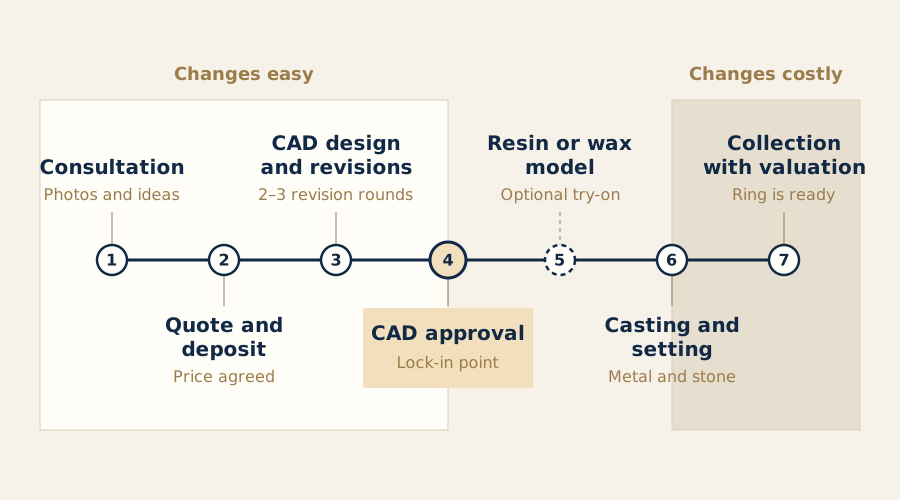
Questions to ask about the design stage:
- How many revisions are included? Two or three rounds of changes are common; ask whether extra rounds cost more.
- Will I see all angles? Top view, side view (profile) and the view from underneath the stone (the gallery).
- What are the key measurements? Band width and thickness in mm, setting height from the finger, and claw size.
- Is a physical model available? A resin or wax print lets you try the shape on the finger. See when a wax or resin model is worth it.
- Will it sit flush with a wedding band? If a matching band is planned, design them together now.
- Who keeps the design file? Ask whether the jeweller can reuse it, and whether you can order a matching band from it later.
Your first meeting shapes everything that follows, so it is worth knowing what to expect at the first consultation and bringing photos of rings you like, and ones you don't.
Related guideFrom CAD to Casting: How a Custom Ring Is MadeWhat should you ask about the diamond or centre stone?
The centre stone is usually the largest part of the cost, so be precise. The first question is whether it is a natural diamond (formed in the earth over millions of years and mined) or a lab-grown diamond (real diamond, with the same hardness of 10 on the Mohs scale and refractive index of about 2.42, grown in a laboratory). Both are genuine diamond; lab-grown costs much less. The grading report and the invoice should both say clearly which it is.
- Which lab graded it? GIA and IGI are the most common independent labs. Ask for the report number and check it on the lab's website.
- Is the report number laser-inscribed? Many diamonds have it written microscopically on the girdle (the thin outer edge), so you can match the stone to the report.
- Is this the exact stone? Ask for a video of that stone, not a sample image, and confirm it is the one set in your ring.
- Any treatments? Some lab-grown diamonds are treated after growth to improve colour, and some natural stones are treated too. Treatments should be disclosed on the report.
- Who holds the stone during making? And is it insured while it is in the workshop?
If you are comparing many stones online, our guide to building a diamond shortlist that stays manageable helps you narrow the field, and reading a loose diamond tweezer video shows what to watch for in the footage.
For lab-grown stones there is a separate set of lab-grown diamond questions for your jeweller, including how growth method is reported. It is also worth reading about what lab-grown diamonds are worth on resale, since resale prices for lab-grown are much lower than the purchase price, and about sustainability claims around lab-grown diamonds, which vary a lot between producers.
Browse natural and lab-grown diamonds for a custom ring
Which metal should you choose for a custom engagement ring?
Ask which alloy the ring will be made in and what the stamp inside the band will say. In Australia gold purity is described in carats (ct): 18ct gold is 75% pure gold, 9ct is 37.5%. Platinum is usually 950, meaning 95% platinum. The rest of each alloy is other metals that add strength and colour.
| Metal | Purity | Colour and care | Things to ask |
|---|---|---|---|
| 18ct yellow gold | 75% gold | Warm yellow; no plating needed | Suits warmer diamond colours |
| 18ct white gold | 75% gold | Usually rhodium plated for a bright white | How often re-plating is needed (often every 1–2 years) and the cost |
| 18ct rose gold | 75% gold | Pink tone from copper | Whether the shade matches any future band |
| 9ct gold | 37.5% gold | Lower cost; can dull or discolour faster | Whether it suits daily wear for your partner |
| Platinum 950 | 95% platinum | Naturally white; heavier; develops a soft patina | Price difference and resizing options |
Also ask about ring size. Australia uses letter sizes (the same system as the UK), and most solitaire bands can be resized up or down about one or two sizes. Full eternity bands and some channel-set designs cannot be resized easily, so confirm the size before casting if you choose one of those.
Not sure which one is right?
Send us the stones you are looking at and our gemologist will tell you which to choose and why.
How much is a custom engagement ring deposit, and what does the quote include?
A clear quote lists the centre stone, any side stones, the metal, labour, CAD design, any resin model, setting, finishing, the box and the valuation, if one is supplied. Australian prices shown to consumers must include GST, so the total on the quote should be the total you pay. Ask about anything listed separately, such as engraving or a matching band.
Deposits for custom work are commonly around 30–50% of the total, with the balance due on collection. The deposit usually pays for the stone to be reserved and for design time, so ask exactly when it becomes non-refundable: on payment, on CAD approval or once casting starts. Write the answer down.
- What does the setting cost on its own? A simple 18ct gold solitaire setting is often in the range of about AUD 1,500–3,500; halos, pavé, platinum and hand work add more.
- What if I change the design after approval? Ask how changes are priced once metal has been cast.
- What if I cancel? Under the Australian Consumer Law, a business does not have to refund for a change of mind, and custom work is rarely resellable, so cancellation terms matter.
- What are my rights if something is wrong? Goods must be of acceptable quality, fit for purpose and match their description, whether custom or not.
If price is the main question, compare against the cost difference between a made-to-order and a ready-made ring before you decide.
How long does a custom engagement ring take?
Most custom rings take about 4–8 weeks from first meeting to collection. The making itself is only part of it; design approval and stone sourcing often take as long as the workshop time.
| Stage | Typical time |
|---|---|
| Consultation and brief | One meeting, plus a few days to prepare options |
| CAD design and revisions | About 1–2 weeks, depending on how fast you reply |
| Resin or wax model (optional) | A few days |
| Stone sourcing, if not in stock | About 1–2 weeks |
| Casting, setting and polishing | About 2–4 weeks |
| Total | About 4–8 weeks |
Ask for a target date in writing and what could delay it. Planning a proposal around a trip or a date? Tell the jeweller at the start, and read about which steps can safely be rushed. Design decisions and stone sourcing can sometimes move faster; careful setting and finishing should not be squeezed.
Can you claim GST back on an engagement ring through the Tourist Refund Scheme?
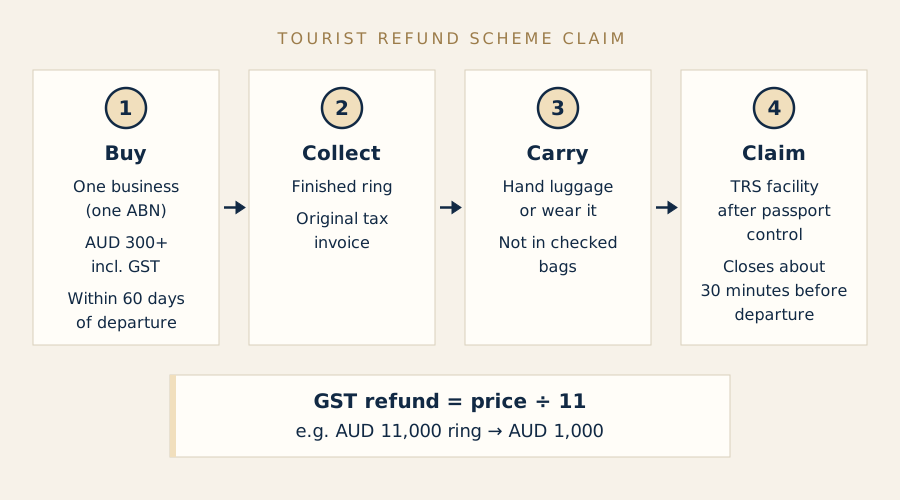
The Tourist Refund Scheme (TRS), run by the Australian Border Force, lets travellers claim back the GST on goods bought in Australia when they take them out of the country. It suits overseas visitors, and Australians buying a ring before moving or proposing abroad. The GST in a GST-inclusive price is one-eleventh of it, so on an AUD 11,000 ring it is AUD 1,000.
- Spend at least AUD 300 (GST included) with one business (one ABN); this can be across more than one tax invoice from that business.
- Buy within 60 days of leaving Australia.
- Take the ring with you as hand luggage or wear it; it cannot go in checked bags or be posted after you leave.
- Bring the original tax invoice, your passport and boarding pass, and the ring itself to the TRS facility after passport control.
- Claim in time: at airports, claims close about 30 minutes before departure.
Custom rings raise two extra questions. First, the ring must be finished and in your hands before you fly, so leave a buffer in the timeline. Second, ask how the tax invoice will be dated if you paid a deposit weeks earlier, because the purchase needs to fall within the 60-day window. Australian residents can use the TRS too, but if you bring the ring back into Australia you must declare it on return and may have to repay the GST.
| TRS refund at the airport | Jeweller ships the ring overseas | |
|---|---|---|
| GST in Australia | Paid, then refunded when you leave | Usually not charged, as an export sale |
| Who carries the ring | You, in hand luggage or worn | An insured courier |
| Import tax at destination | Depends on that country's travel allowance and rules | Usually charged by the destination country |
| Main risk | Missing the timing or invoice rules | Courier delays, duties and customs paperwork |
Either way, check the import rules of the country you are going to. Many countries charge duty and their own GST or VAT above a set allowance, which can cancel out the Australian refund.
How do you insure a custom engagement ring in Australia?
Ask your jeweller whether an insurance valuation is included. A valuation is a written document describing the ring in detail, with the stone's weight, measurements, colour, clarity and report number, the metal and a photo, and a replacement value for insurance. It is not a resale price: replacement value is what it would cost to replace the ring with a similar one at retail, which is why it usually differs from what you could sell it for. Our piece on why replacement value and resale value differ explains the gap. A lab-grown diamond must be described as lab-grown on the valuation.
| Option | How it works | Questions for the insurer |
|---|---|---|
| Home contents, unspecified | Jewellery covered up to a per-item limit, often around AUD 1,000–3,000 | Is the limit high enough? Is it covered away from home? |
| Home contents, specified item | The ring is listed by value on your policy | Do you need a valuation? Is there an extra premium? |
| Dedicated jewellery policy | Stand-alone cover for jewellery | Is loss covered as well as theft and damage? Worldwide? |
- Replacement or agreed value? Some policies replace the ring through the insurer's own suppliers; others pay an agreed amount.
- Can you choose who remakes it? Useful for a one-off design; the CAD file makes a remake much easier.
- Is it covered overseas? Important if you are proposing on holiday.
- When does cover start? Arrange it before you collect the ring, not after the proposal.
- How often should it be revalued? Every two to three years is common as prices move.
What warranty and aftercare should you ask about?
A custom ring is worn every day, so ask what happens over the next five or ten years, not just on collection day.
- Manufacturing faults: what is covered, for how long and how claims are handled.
- Claw checks: claws wear over time; a check and clean every 6–12 months catches a loose stone early.
- Resizing: whether the first resize is included, and the limits of the design.
- Rhodium re-plating: for white gold, how often and the approximate cost.
- Polishing and repairs: whether these can be done locally if you move interstate.
Keep the tax invoice, grading report, valuation and CAD images together. They are the ring's paperwork for insurance, repairs and any future remodelling.
How do you prepare for a custom engagement ring order? Step by step
- Set your budget and date. Include the setting, the centre stone and a buffer of about two weeks before any proposal or flight.
- Learn the basics. Read up on shapes, the four Cs and metals so you can compare quotes on the same terms.
- Collect references. Photos of rings you like and don't, and your partner's ring size or an existing ring that fits.
- Ask the quote and deposit questions. What is included, deposit amount, when it is non-refundable and cancellation terms, in writing.
- Choose and check the stone. Natural or lab-grown, the lab report number, a video of the exact stone.
- Review the CAD carefully. Top, side and underneath views, measurements in mm, fit with a future band.
- Plan the paperwork. Tax invoice dating if you will use the TRS, a valuation, and insurance arranged before collection.
With those answers in hand, you will know exactly what you are paying for and when. For the wider picture of styles and stones, go back to our guide to ring styles and the four Cs.
Free consultation
Talk to a gemologist
Compare stones in person or online with Raj Sood, Graduate Gemologist (GIA), AJP (GIA).
Book a consultationShop this shape
FAQ
Common questions
How much deposit do you pay for a custom engagement ring?
Deposits for custom work are commonly around 30–50% of the total, with the balance due on collection. Ask when the deposit becomes non-refundable and get the answer in writing.
Can I get a refund on a custom engagement ring if I change my mind?
Australian law does not require a refund for a change of mind, and custom pieces are hard to resell, so terms vary between jewellers. If the ring is faulty or does not match what was agreed, you have rights under the Australian Consumer Law.
How long does a custom engagement ring take to make?
Most take about 4–8 weeks from first meeting to collection. Design revisions and stone sourcing are often the slowest parts.
Can tourists claim GST back on an engagement ring in Australia?
Yes, through the Tourist Refund Scheme, if you spend at least AUD 300 with one business within 60 days of leaving and carry or wear the ring on the flight. Bring the original tax invoice to the TRS facility at the airport.
Do I need a valuation to insure an engagement ring?
Most insurers want a valuation for a specified item, especially above their unspecified jewellery limit. The valuation describes the ring and states a replacement value for insurance.
Should I ask for a resin model before my ring is cast?
It is optional but helpful for unusual designs, tall settings or wide bands, because you can try the shape on your finger. For a simple solitaire, a detailed CAD with a side view is often enough.

Ask a gemologist
Not sure which diamond to choose?
Raj Sood is a Graduate Gemologist (GIA) and master jeweller. Bring the stones you are considering, or send the reports, and he will tell you honestly which one is better and why.
Keep learning
Related guides
 Buying Knowledge & Custom ProcessWhat Happens at a Custom Engagement Ring Consultation?
 Buying Knowledge & Custom ProcessFrom CAD to Casting: How a Custom Ring Is MadeBuying Knowledge & Custom ProcessCustom vs Semi-Custom Engagement Rings
 Lab-Grown DiamondsQuestions to Ask a Jeweller Before Buying a Lab-Grown Diamond
 Lab-Grown DiamondsLab-Grown Diamond Resale Value: Questions to Ask Before Buying
 Lab-Grown DiamondsAre Lab-Grown Diamonds More Sustainable? Questions to AskBuying Knowledge & Custom ProcessDo You Need a Wax or Resin Model Before Making a Ring?
Explore more
More guides on this topic
Education