
- Education
- Lab-Grown Diamonds
- Lab-Grown Diamond Resale Value: What to Expect and What to Ask
Lab-Grown Diamonds
Lab-Grown Diamond Resale Value: What to Expect and What to Ask
Lab-grown diamond resale value is the question most people forget to ask until they want to sell or upgrade. This is an honest view from a Melbourne jeweller that sells both natural and lab-grown diamonds, with the questions to ask before you pay.
 Reviewed by Raj Sood, Graduate Gemologist (GIA), AJP (GIA)Master jeweller and Graduate Gemologist (GIA) · reviewed 4 November 2026
Quick answer
Lab-grown diamond resale value is usually very low. Most jewellers and buyers pay little or nothing for a loose lab-grown stone, because new ones keep getting cheaper and supply is unlimited. Buy one for how it looks and what it costs, ask about trade-in or upgrade policies in writing, and treat any setting metal as the main recoverable value.
What is lab-grown diamond resale value?
Resale value is what someone will actually pay you for a piece of jewellery when you sell it. It is not what you paid, and it is not the figure on an insurance valuation. For a lab-grown diamond that number is usually very low, and for a loose stone it is often close to nothing.
That is not a judgement on the stone itself. A lab-grown diamond is real diamond: the same carbon crystal structure, the same hardness of 10 on the Mohs scale and the same refractive index of about 2.42 as a mined diamond. Our guide to whether lab-grown diamonds are real diamonds explains the science, and our complete introduction to lab-grown diamonds covers the basics if you are new to the category.
The gap is about markets, not materials. Natural diamonds come from a limited supply and an established trade that buys stones back. Laboratory-grown diamonds can be produced to order in weeks, and each year the same quality tends to cost less to make. So the question is not whether a lab-grown diamond is worth buying, but whether you are buying it for the right reasons.
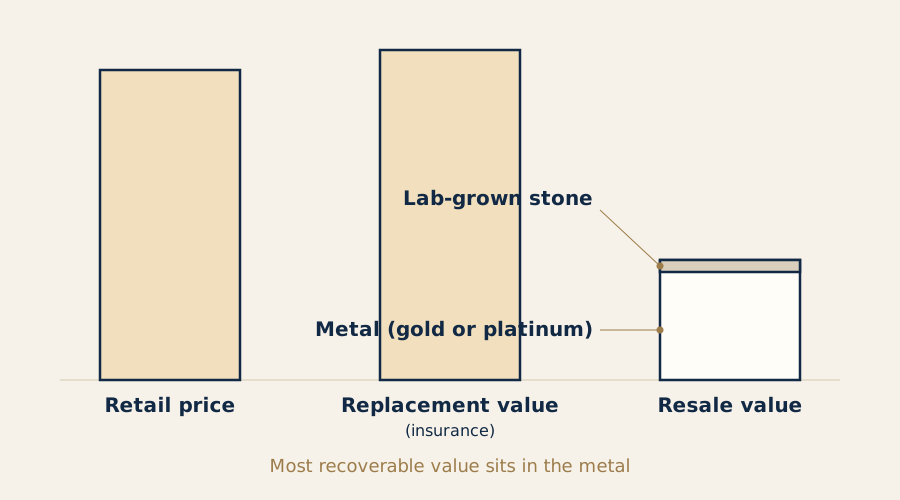
Three numbers often get mixed up: the retail price (what you pay), the replacement value (what an insurer would pay to replace it with a similar new piece) and the resale value (what a buyer offers you). The first two can be similar; the third is almost always much lower. Our page on how replacement value differs from resale value sets out why.
Why is lab-grown diamond resale value so low?
Several forces push the secondhand price of a lab-grown diamond down at the same time:
- Falling production costs: growers keep improving their equipment and yields, so the same size and quality costs less to make each year.
- Effectively unlimited supply: there is no ceiling on how many lab-grown diamonds can be produced, so there is no scarcity to support a secondhand price.
- New stones are easy to get: a buyer can order a new, freshly graded lab-grown diamond for not much more than a used one, so a used stone has to be very cheap to compete.
- Few trade buyers: most diamond dealers and jewellers do not buy secondhand lab-grown stones at all, because they can source new ones on demand.
- Retail margin: the retail price includes cutting, grading, setting, staff, rent and GST. None of that is recovered when you sell.
Production also continues to scale up, mainly in India and China, using two methods: CVD (chemical vapour deposition, where carbon from a gas builds up layer by layer on a seed plate) and HPHT (high pressure, high temperature, which recreates the conditions deep in the earth in a press). Our explainer on how CVD and HPHT growth actually works shows why output can keep rising.
How does lab-grown vs natural diamond resale compare?
| Lab-grown diamond | Natural diamond | |
|---|---|---|
| Supply | Unlimited; made to order | Limited; mined |
| Retail price trend | Has fallen sharply in recent years | Has moved up and down; softer in recent years |
| Typical offer when selling a loose stone | Often nil to a few hundred dollars | Often a fraction of retail, commonly well under half |
| Who buys secondhand | Very few dealers; some private buyers | Dealers, jewellers, auction houses, private buyers |
| Trade-in or upgrade | Only if the original seller offers it | More widely offered, terms vary |
| Insurance replacement value | Based on current new price, which may fall | Based on current new price |
Natural diamonds hold more resale value than lab-grown, but natural is not an investment either. When you sell a natural diamond you usually get well under what you paid, because of the same retail costs and because dealers buy at wholesale. Our guide to resale value for natural and lab-grown diamonds in more depth works through real-world examples.
The honest summary from a store that sells both: choose natural if rarity and a recognised secondhand market matter to you, and choose lab-grown if you want a larger or higher-grade diamond for your budget and are comfortable that you are paying for the ring you wear, not for something to sell later.
How much have lab-grown diamond prices dropped, and what is one worth later?
Lab-grown prices have fallen steeply since mass production took off in the late 2010s, and they are still moving. The ranges below are broad, approximate Australian retail figures for a well-cut 1 carat round in G–H colour and VS clarity. They are a guide only and will date quickly.
| 1 ct round, G–H, VS | Approximate retail (AUD) | Likely offer if sold later (loose) |
|---|---|---|
| Lab-grown | about $1,000–$3,000 | often $0–$300, and many buyers will not make an offer |
| Natural | about $6,000–$15,000 | commonly about 20–50% of the original retail price |
Two things follow from this. First, the money you save by choosing lab-grown is usually far larger than any resale value you give up, so for most people the trade-off still works. Second, if lab-grown prices keep falling, a stone bought today may cost less to replace in five years, which matters for insurance as well as resale.
Spending more on a lab-grown stone does not protect resale, but it does buy beauty. Cut is where your money shows most, and our page on how to judge cut quality in a lab-grown stone explains what to look for.
Browse lab-grown diamonds
Not sure which one is right?
Send us the stones you are looking at and our gemologist will tell you which to choose and why.
Can you resell a lab-grown diamond in Australia?
Yes, you can sell one, but the options are narrower than for natural diamonds, and the price depends heavily on where you sell:
| Where you sell | What to expect | Watch for |
|---|---|---|
| Original jeweller (buyback) | Some offer a fixed buyback; many do not | A low percentage, time limits, condition rules |
| Trade-in or upgrade | Credit towards a new, usually larger piece | Minimum spend on the new piece, expiry dates |
| Private sale online | Possibly the highest cash price, but slow | Scams, buyer doubts, proving it with the report |
| Pawnbroker or cash-for-gold | Often pays for the metal only | The stone may be valued at nothing |
| Consignment | A jeweller sells it for you, for a commission | Long waits and few takers for lab-grown |
| Selling the setting as scrap | Value of the gold or platinum by weight | Daily metal prices; refining deductions |
Policies vary a lot between sellers, and online retailers and showroom jewellers often handle returns, upgrades and buybacks differently. If those terms matter to you, compare them as carefully as the stone; our guide to online retailers versus showroom jewellers covers the differences.
What should you ask about lab-grown diamond resale value before buying?
Ask these before you pay, not after. A clear answer to each tells you what you can realistically get back:
- Do you buy back lab-grown diamonds you sell? If yes, at what percentage of the price paid, and for how long?
- Is there a trade-in or upgrade policy? What credit applies, does the new piece need to cost more, and does it cover lab-grown stones?
- Does the credit follow today's price or the price I paid? If lab-grown prices fall, a percentage of the current price may be worth much less.
- What condition does the stone need to be in? Chips, damage or a missing report can void a policy.
- Do I need the original report and invoice? Usually yes; keep both safe.
- Is the policy written on my invoice or in your terms? A verbal promise is hard to rely on years later.
- What happens if the business closes or changes hands? Store policies are not legal rights and may not survive.
For the wider set of questions, including growth method, treatments and certification, use our full checklist of questions for your jeweller. If you are still deciding between natural and lab-grown, our overview of the pros and cons of laboratory-grown diamonds lays them out side by side.
Related guideQuestions to Ask a Jeweller Before Buying a Lab-Grown DiamondWhat should a lab-grown diamond grading report show?
Whatever resale value a lab-grown diamond has depends on a future buyer trusting what it is. The grading report and laser inscription do that job. Reports from independent labs such as IGI and GIA clearly identify the stone as laboratory-grown. Look for:
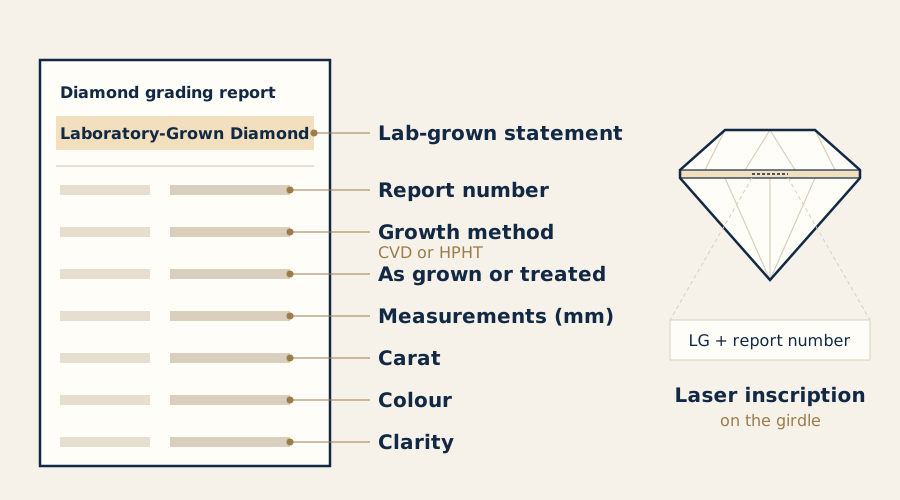
- A clear lab-grown statement, such as "Laboratory-Grown Diamond", near the top of the report.
- Growth method: CVD or HPHT.
- Post-growth treatment: many CVD diamonds are treated after growth to improve colour; the report should say whether the stone is "as grown" or treated.
- Report number and laser inscription: a tiny number (often with "LG" or "Laboratory-Grown") inscribed on the girdle, the thin outer edge, that matches the report.
- Measurements and grades: millimetre measurements, carat, colour, clarity and, for rounds, cut grade.
- A verifiable record: most labs let you check the report number online.
Grading practice for lab-grown diamonds is changing too. GIA has announced simpler, descriptive grading for lab-grown stones rather than the full colour and clarity scales it uses for natural diamonds, so reports from different years and labs may not look the same. The report should also match the growth method your jeweller describes; our guide to the growth methods named on the report helps you read that line. Any unfamiliar word is explained in our plain-English glossary of diamond terms.
What do Australian consumer rules say about resale claims?
Under the Australian Consumer Law (ACL), a business must not engage in misleading or deceptive conduct or make false or misleading representations. A claim about the future, such as "this diamond will hold its value", is treated as misleading unless the business had reasonable grounds for making it. That is why a careful jeweller will not tell you a lab-grown diamond, or a natural one, is an investment or will hold its price.
What the law does and does not give you:
- Consumer guarantees: the diamond and ring must be of acceptable quality and match their description, including being described accurately as lab-grown.
- No automatic change-of-mind refund: a store does not have to refund you if you simply change your mind, unless its own policy says so.
- No legal right to a buyback: buyback, trade-in and upgrade offers are store policies. Read the conditions, because they are what you can rely on.
- Accurate disclosure: a lab-grown diamond must be described as lab-grown, laboratory-grown or similar, so a buyer is never misled about its origin.
The same care applies to environmental claims, which are also covered by the ACL. If sustainability is part of your reason for choosing lab-grown, our guide to the questions to ask about sustainability claims helps you test them. And if a valuation is quoted as proof of value, check what kind it is: our page on insurance valuations and what they really mean explains why a replacement figure is not a resale offer.
Do lab-grown diamond rings hold any value at all?
Yes, but mostly in the parts that are not the stone. In a lab-grown engagement ring, what tends to keep value is:
- The metal: gold and platinum have a scrap value tied to daily metal prices. An 18 carat gold band weighing 4–6 grams has a metal value that does not depend on the diamond at all.
- The workmanship: a well-made setting can be reused. The stone can be reset, the ring remodelled or the metal recast into a new design.
- Personal value: most rings are never sold. They are worn, passed on or remade.
If you are having a ring made, think about how the design could be updated later: for example, a setting that can take a larger stone if you upgrade. Our guide to the questions to ask before a custom engagement ring is made covers this, and our page on wax or resin models for previewing a design explains how to check the fit and look first.
How to buy a lab-grown diamond with resale in mind: step by step
- Decide why you are buying. If getting money back later matters a lot, weigh up natural; if size and quality for your budget matter more, lab-grown suits.
- Set your budget on the assumption of no resale. Spend what you are comfortable with as money you will not see again.
- Check the report. Confirm the lab-grown statement, growth method, any post-growth treatment, and that the laser inscription matches the report number.
- Ask about buyback, trade-in and upgrade terms. Get the percentage, the basis (price paid or current price), time limits and minimum spend.
- Get it in writing. Have the terms on your invoice or in the store's written policy, and keep the invoice and report together.
- Compare policies, not just prices. Look at returns and upgrade terms across sellers, comparing returns policies online and in store.
- Insure for replacement, and update it. Ask for a valuation and review it every few years, as lab-grown replacement prices can fall.
Free consultation
Talk to a gemologist
Compare stones in person or online with Raj Sood, Graduate Gemologist (GIA), AJP (GIA).
Book a consultationShop this shape
FAQ
Common questions
Do lab-grown diamonds hold their value?
No, not in resale terms. Lab-grown prices have fallen as production has grown, and most buyers offer little or nothing for a loose secondhand lab-grown diamond.
Can you resell a lab-grown diamond in Australia?
You can, through a store buyback or trade-in if offered, a private sale or consignment. Expect a low price, and keep the grading report, because buyers will want proof of what the stone is.
Is a lab-grown diamond worth buying if it has no resale value?
For many people, yes. A lab-grown diamond is real diamond and costs much less than a natural stone of the same size and grade, so the money saved usually outweighs the resale value given up.
Do natural diamonds have better resale value than lab-grown?
Usually yes, but natural diamonds are not an investment either. Sellers commonly get well under half of the original retail price when they sell a natural diamond.
Will a jeweller buy back a lab-grown diamond?
Some will, many will not. Any buyback or trade-in is a store policy rather than a legal right, so ask for the terms in writing before you buy.
Why is my insurance valuation higher than what buyers offer?
An insurance valuation is a replacement value: what it would cost to buy a similar new piece at retail. Resale value is what a buyer will pay you, which is much lower.

Ask a gemologist
Not sure which diamond to choose?
Raj Sood is a Graduate Gemologist (GIA) and master jeweller. Bring the stones you are considering, or send the reports, and he will tell you honestly which one is better and why.
Keep learning
Related guides
 Buying Knowledge & Custom ProcessDiamond Resale Value Explained
 Lab-Grown DiamondsQuestions to Ask a Jeweller Before Buying a Lab-Grown Diamond
 Certificates & ValuationsReplacement Value vs Resale Value in JewelleryLab-Grown DiamondsLab-Grown Diamonds Guide
 Lab-Grown DiamondsAre Lab-Grown Diamonds More Sustainable? Questions to AskLab-Grown DiamondsBuying a Lab-Grown Diamond Online vs in a Showroom
 Buying Knowledge & Custom ProcessQuestions to Ask Before Ordering a Custom Engagement Ring
 Lab-Grown DiamondsAre Lab-Grown Diamonds Real Diamonds
Explore more
More guides on this topic
Education