
Gemstones
Blue Topaz Treatment and Care: Irradiation, Safety and Cleaning
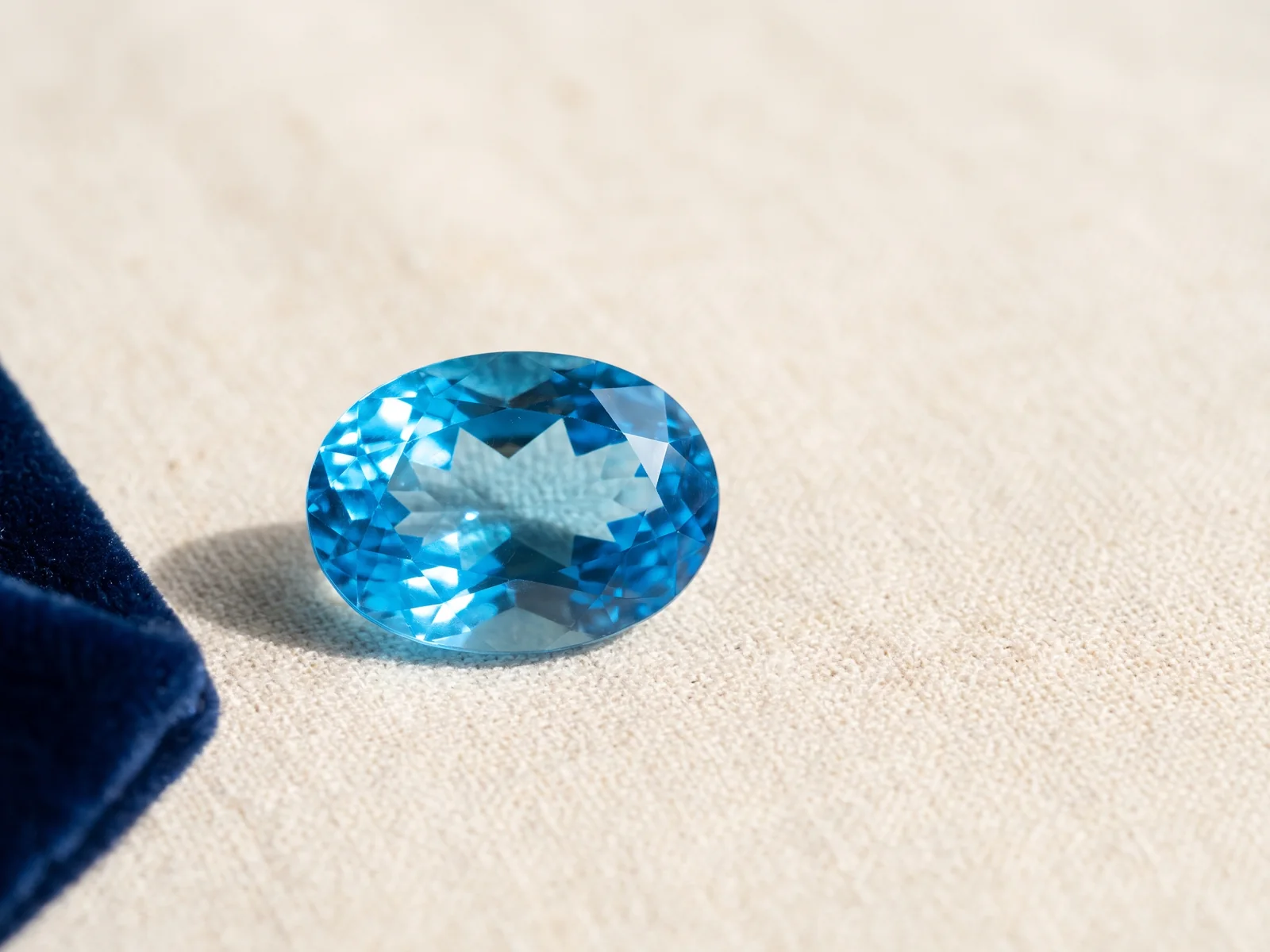
Nearly every blue topaz in a jewellery case owes its colour to treatment. Here is what blue topaz treatment involves, whether it is safe, how long the colour lasts and how to look after the stone so it stays bright for decades.
 Reviewed by Raj Sood, Graduate Gemologist (GIA), AJP (GIA)Master jeweller and Graduate Gemologist (GIA) · reviewed 4 November 2026
Quick answer
Almost all blue topaz is colourless natural topaz that has been irradiated and then heated to create a stable sky, Swiss or London blue. The treatment is long-lasting, reputable suppliers check stones for residual radioactivity before sale, and topaz rates 8 on the Mohs scale. Its weakness is cleavage: avoid hard knocks, ultrasonic cleaners, steam and torch heat.
What is blue topaz treatment?
Topaz is an aluminium silicate mineral containing fluorine and hydroxyl, with the formula Al2SiO4(F,OH)2. In nature it is most often colourless, with smaller amounts of pale blue, yellow, brown, pink and the golden-orange stones covered in our guide to imperial topaz and its rare warm colours. Strong blue topaz, the kind you see in most rings and pendants, almost never comes out of the ground that colour.
Blue topaz treatment is the two-step process that turns colourless or very pale topaz blue. First the stone is irradiated, meaning it is exposed to high-energy radiation that knocks electrons out of place in the crystal and creates tiny defects called colour centres. Those colour centres absorb some wavelengths of light, which we see as colour. Second, the stone is gently heated (also called annealing) to remove an unwanted brownish or yellowish tint and leave a clean blue.
The result is still natural topaz. Nothing is added to the stone and it is not lab-created; only its colour has been changed. That is why the correct description is "natural topaz, irradiated and heated" rather than "synthetic". Our blue topaz gemstone profile covers the stone's history and colour range, and you will find it alongside the other stones on our coloured gemstone overview. Technical words used here are all defined in the plain-English jewellery glossary.
Is blue topaz natural or treated?
Both exist, but the treated stone is far more common. Natural, untreated blue topaz does occur, usually as a pale, slightly greyish or icy blue. It has been found in Brazil, Russia, Sri Lanka and other countries, and Australia has its own topaz localities, including O'Briens Creek near Mount Surprise in north Queensland, Torrington in the New England region of New South Wales, and Flinders Island in Tasmania, where clear topaz pebbles have long been called "Killiecrankie diamonds".
Those Australian stones are mostly colourless to very pale blue. Anything with a saturated Swiss or London blue colour should be assumed treated unless an independent laboratory report says otherwise, and labs themselves often cannot prove a pale blue stone is untreated, because the treated colour centres are similar to natural ones.
- Pale, icy blue: could be natural or treated; often impossible to prove either way.
- Bright Swiss blue: treated in practice.
- Deep, inky London blue: treated in practice.
- Rainbow or metallic surface: coated, not just irradiated (see below).
Blue topaz shares the November birthstone with citrine, though December lists in some countries also include blue topaz. Either way, the treatment question is the same for every birthstone piece.
How does blue topaz treatment work: irradiation and heat?
Three types of radiation are used, and each tends to produce a different shade. The cutter or treater chooses the source, the dose and the heating temperature to aim for a target colour.
| Trade name | Colour | Usual irradiation | Notes |
|---|---|---|---|
| Sky blue | Light, bright blue | Gamma rays (usually cobalt-60), sometimes electrons | Palest of the three; closest to some aquamarine |
| Swiss blue | Vivid, medium bright blue | High-energy electrons from a linear accelerator, sometimes combined with other sources | The most widely sold shade |
| London blue | Deep, slightly greyish or inky blue | Neutrons in a nuclear research reactor, sometimes combined with electrons | Needs a holding period before sale |
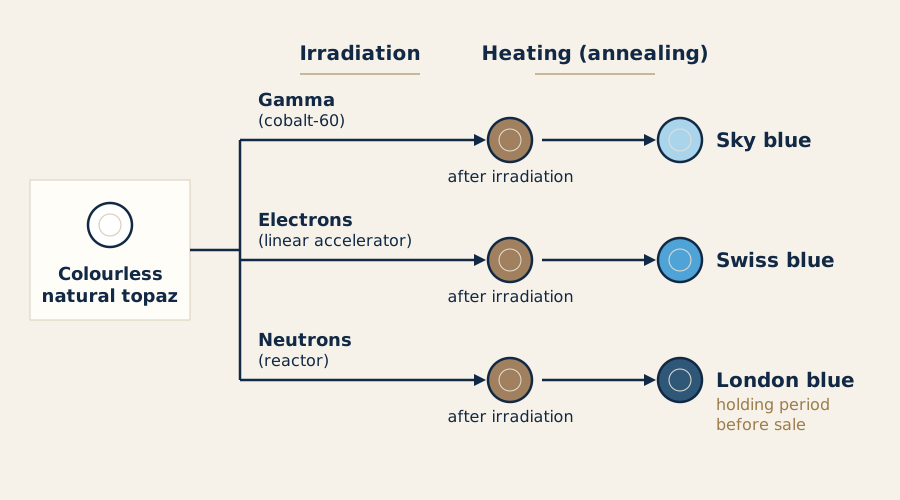
After irradiation, many stones look brown, greenish or a muddy blue. Controlled heating, typically at a few hundred degrees Celsius, clears the brown colour centres and leaves the blue ones. The finished colour is then cut and polished like any other gem. Treaters usually work with rough or pre-formed stones in bulk, which is one reason blue topaz is available in matched, calibrated sizes and in all the familiar outlines; the shapes in our overview of cut shapes and outlines apply to topaz too.
Irradiation is only one of many accepted gem treatments. Our A to Z of gemstone treatments explains how it compares with heating, fracture filling, diffusion and coatings, and which ones need special care.
Is irradiated blue topaz safe to wear?
Yes, when it has been treated and released properly. Gamma and electron treatments at the energies normally used leave little or no residual radioactivity. Neutron treatment, used for London blue, can make the stone slightly radioactive for a while, so the stones are held in storage until the radioactivity has decayed below regulatory release limits. Holding periods are commonly quoted as several months to a couple of years, depending on the dose and impurities in the crystal.
In the United States, distribution of neutron-irradiated gems is licensed by the Nuclear Regulatory Commission, and much of the world's supply passes through licensed facilities and testing before it reaches the trade. A properly released blue topaz gives off less radiation than many everyday natural sources, and wearing it daily is not considered a health risk.
What matters for you as a buyer is disclosure. A reputable seller should tell you a blue topaz is irradiated and heated, in the same way other treatments are disclosed in our guide to how treated gems should be described. If a seller claims a vivid blue topaz is untreated, ask for an independent laboratory report.
Not sure which one is right?
Send us the stones you are looking at and our gemologist will tell you which to choose and why.
What about coated, diffused and "mystic" topaz?
Not every coloured topaz is irradiated. Some is coated: a very thin film, often titanium or other metal oxides, is bonded to the back facets to create a rainbow or metallic effect, sold under names such as "mystic topaz". Other stones have a surface colour created by heating with cobalt or similar elements, a process known as diffusion, which colours only a very shallow layer.
| Treatment | Where the colour sits | Durability of colour | Care notes |
|---|---|---|---|
| Irradiation + heat (sky, Swiss, London) | Right through the stone | Stable to light in normal wear; lost with high heat | Avoid torch heat and very hot cleaning |
| Thin-film coating ("mystic") | Surface film on the facets | Can scratch or wear through on facet edges | No ultrasonic, steam, abrasives or polishing cloths with compound |
| Surface diffusion | Very shallow surface layer | Repolishing or chips can expose colourless topaz | Avoid recutting; protect from knocks |
| Untreated | Natural colour throughout | Very pale blues are generally stable | Same cleavage care as all topaz |
For everyday rings, the irradiated blues are the more durable choice, because the colour runs right through the stone. Coated stones suit earrings and pendants better, where they rub against less. If you love the vivid blue look, our comparison of sky, Swiss and London blue shades is a good place to settle on a colour before you think about the setting.
Is blue topaz good for an engagement ring or everyday ring?
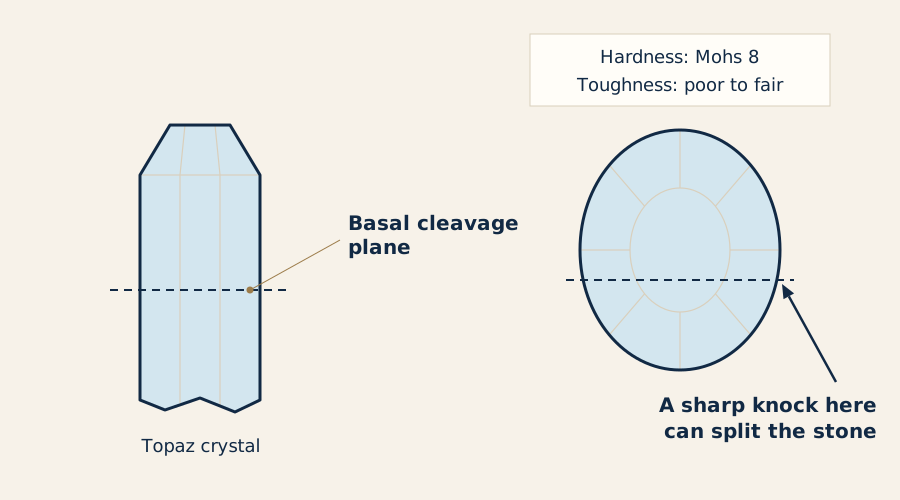
Topaz is hard, 8 on the Mohs scale, which means everyday dust (mostly quartz, about 7) will not scratch it. The catch is toughness, which is a stone's resistance to chipping and breaking. Topaz has one direction of perfect cleavage, a plane in the crystal where it can split cleanly if struck at the wrong angle. A hard knock on a doorframe or a dropped weight can cleave a topaz that would shrug off a scratch.
| Gem | Mohs hardness | Toughness | Everyday ring? |
|---|---|---|---|
| Diamond (natural or lab-grown) | 10 | Good (has cleavage, but very hard) | Yes |
| Sapphire (natural or lab-created) | 9 | Excellent | Yes |
| Spinel | 8 | Good | Yes |
| Topaz | 8 | Poor to fair (perfect cleavage) | Yes, with a protective setting and care |
| Aquamarine | 7.5–8 | Good | Yes, with care |
| Citrine (quartz) | 7 | Good | Yes, with care |
| Tanzanite | 6–6.5 | Fair to poor | Occasional wear |
| Opal | 5.5–6.5 | Poor | Occasional wear |
| Pearl | 2.5–4.5 | Fair to good | Occasional wear |
A blue topaz ring can be worn daily if it is set well. Bezel or half-bezel settings cover the girdle (the outer edge) and absorb knocks; four or six claws are fine for a ring worn with some awareness. Take it off for the gym, gardening and moving furniture. If you want a blue centre stone for a lifetime of hard wear, sapphire is the tougher option; see our notes on judging blue sapphire colour and quality and on teal and blue sapphire engagement rings. For the rarest and hardest blue of all, there are natural and lab-grown blue diamonds, at a very different price point.
How do gemmologists identify blue topaz?
Several blue stones look alike across the counter, so a gemmologist uses measurements rather than colour alone. These are the main checks:
- Refractive index (RI): how much the stone bends light. Blue topaz reads about 1.61–1.63, with birefringence (the gap between its two readings) of about 0.008–0.010.
- Specific gravity (SG): density compared with water. Topaz is about 3.53, so it feels heavy for its size and a 1 carat topaz looks smaller than a 1 carat aquamarine (about 2.72).
- Aquamarine: RI about 1.57–1.58, usually a softer, slightly greener blue, and lighter in the hand.
- Blue glass: RI commonly around 1.50–1.52 (glass varies widely), singly refractive (one reading), often with round gas bubbles and softer, rounded facet edges.
- Lab-created (synthetic) blue spinel: singly refractive with an RI around 1.73, and often an even, slightly purplish blue.
- Blue sapphire: RI about 1.76–1.77, with colour zoning or silk under magnification.
Density is why carat weight alone is a poor guide to how big a gem looks; the same idea, applied to cut outlines, is explained in our page on how shape changes face-up size for the weight. The single most common mix-up is with aquamarine, especially sky blue topaz. Our side-by-side page on telling aquamarine from blue topaz covers colour, price and wear in more detail.
Related guideAquamarine vs Blue TopazSeparating irradiated blue from natural blue is much harder and normally needs a specialist laboratory, if it can be done at all. Coatings are easier: under magnification you may see a film with iridescence and wear on the facet edges. Colour origin in other blue gems is a separate question, covered in our page on how blue diamonds get their colour.
How much does blue topaz jewellery cost in Australia?
Because treatment makes blue topaz plentiful, the stone itself is one of the most affordable gems in jewellery. Large sizes are easy to find: a 10 × 8 mm oval weighs roughly 3 carats, and stones of 10 carats or more are common in pendants and cocktail rings, while smaller stones are often cut as faceted briolette drops for earrings. In finished jewellery, the metal and the workmanship usually cost more than the topaz.
| Item | Approximate price range (AUD) |
|---|---|
| Loose commercial sky or Swiss blue, per carat | about $10–$50 |
| Loose fine London blue, per carat | about $20–$100 |
| Blue topaz ring in 9ct gold | about $300–$1,200 |
| Blue topaz ring in 18ct gold, made to order | about $1,500–$4,000 |
These are broad ranges only and move with metal prices, stone size and design. Within blue topaz, what changes the price is colour depth (London blue usually costs more), clarity (most blue topaz is eye-clean, so visible inclusions lower the value), cutting quality and size. Blue topaz is valued for wear and enjoyment, not as a store of value, and its resale price is low compared with its retail price.
If you are building a November birthstone piece and want a warm alternative, citrine, topaz's November partner sits at a similar price. For other blue options across every budget, start from our guide to coloured stones for rings and pendants.
Shop natural gemstones
How do you clean and care for blue topaz jewellery? Step by step
Blue topaz is easy to keep bright at home, as long as you avoid heat, vibration and hard knocks. This routine suits irradiated sky, Swiss and London blue; for coated stones, skip anything abrasive and keep the brush extra soft.
- Soak. Place the piece in a bowl of warm (not hot) water with a few drops of mild dishwashing liquid for 5–10 minutes.
- Brush gently. Use a soft toothbrush behind the stone, where soap and skin oils collect and dull the colour.
- Rinse. Rinse in lukewarm water, with the sink plug in. Avoid going straight from hot to cold water, as sudden temperature changes can stress the stone.
- Dry. Pat dry with a lint-free cloth and let the setting air-dry fully.
- Skip the machines. Do not use an ultrasonic cleaner or steam cleaner; vibration and heat can open the cleavage or damage coatings.
- Store separately. Keep it in its own pouch, away from diamonds and sapphires, which can scratch it, and away from softer gems such as opal and pearl, which it can scratch.
- Check the setting. Have claws and bezels checked every 6–12 months, and always tell the jeweller the stone is topaz before any repair.
Remove blue topaz jewellery before swimming in chlorinated pools, cleaning with bleach, playing sport or lifting weights. Chlorine does not harm topaz itself, but it can weaken gold alloys over time. If a stone does chip or cleave, it can often be recut slightly smaller or replaced with a matched blue topaz, and claws or a worn bezel can be rebuilt around it. Our glossary of claw, bezel and setting terms explains what each repair involves.
Free consultation
Talk to a gemologist
Compare stones in person or online with Raj Sood, Graduate Gemologist (GIA), AJP (GIA).
Book a consultationShop this shape
FAQ
Common questions
Is all blue topaz treated?
Almost all strong blue topaz is treated by irradiation and heat. Natural blue topaz exists but is usually pale, and even labs often cannot prove a pale stone is untreated.
Is irradiated blue topaz radioactive?
Properly released blue topaz is not considered a health risk. Neutron-treated London blue is held in storage until residual radioactivity falls below regulatory limits before it is sold.
Does blue topaz fade?
Irradiated blue topaz is considered stable to light in normal wear. High heat, such as a jeweller's torch or very hot cleaning, can lighten or remove the colour.
What is the difference between London blue and Swiss blue topaz?
Swiss blue is a vivid, medium-bright blue usually made with electron irradiation. London blue is deeper and slightly greyish, usually made with neutron irradiation, and tends to cost a little more.
Can I put blue topaz in an ultrasonic cleaner?
It is not recommended. Topaz has perfect cleavage, so vibration and heat can open existing fractures, and ultrasonic cleaning can also damage coated topaz.
Is blue topaz good for an engagement ring?
It can be, with a protective setting such as a bezel and some care, because it is hard (Mohs 8) but can cleave if knocked. For heavy daily wear, sapphire or diamond is tougher.

Ask a gemologist
Not sure which diamond to choose?
Raj Sood is a Graduate Gemologist (GIA) and master jeweller. Bring the stones you are considering, or send the reports, and he will tell you honestly which one is better and why.
Keep learning
Related guides
 GemstonesBlue Topaz
 GemstonesGemstone Treatments A to Z
 GemstonesAquamarine vs Blue Topaz
 GemstonesNovember Birthstone: Topaz and CitrineGemstonesGemstones | Coloured Gemstones, Birthstones and Custom Jewellery
 GemstonesImperial Topaz
 Fancy Colour DiamondsBlue Diamonds
 GemstonesHow to Judge Blue Sapphire Quality
Explore more
More guides on this topic
Education