
- Education
- Engagement Rings & Settings
- Engagement Ring Band Width Guide: 1.8 to 4 mm Compared
Engagement Rings & Settings
Engagement Ring Band Width Guide: 1.8 to 4 mm Compared
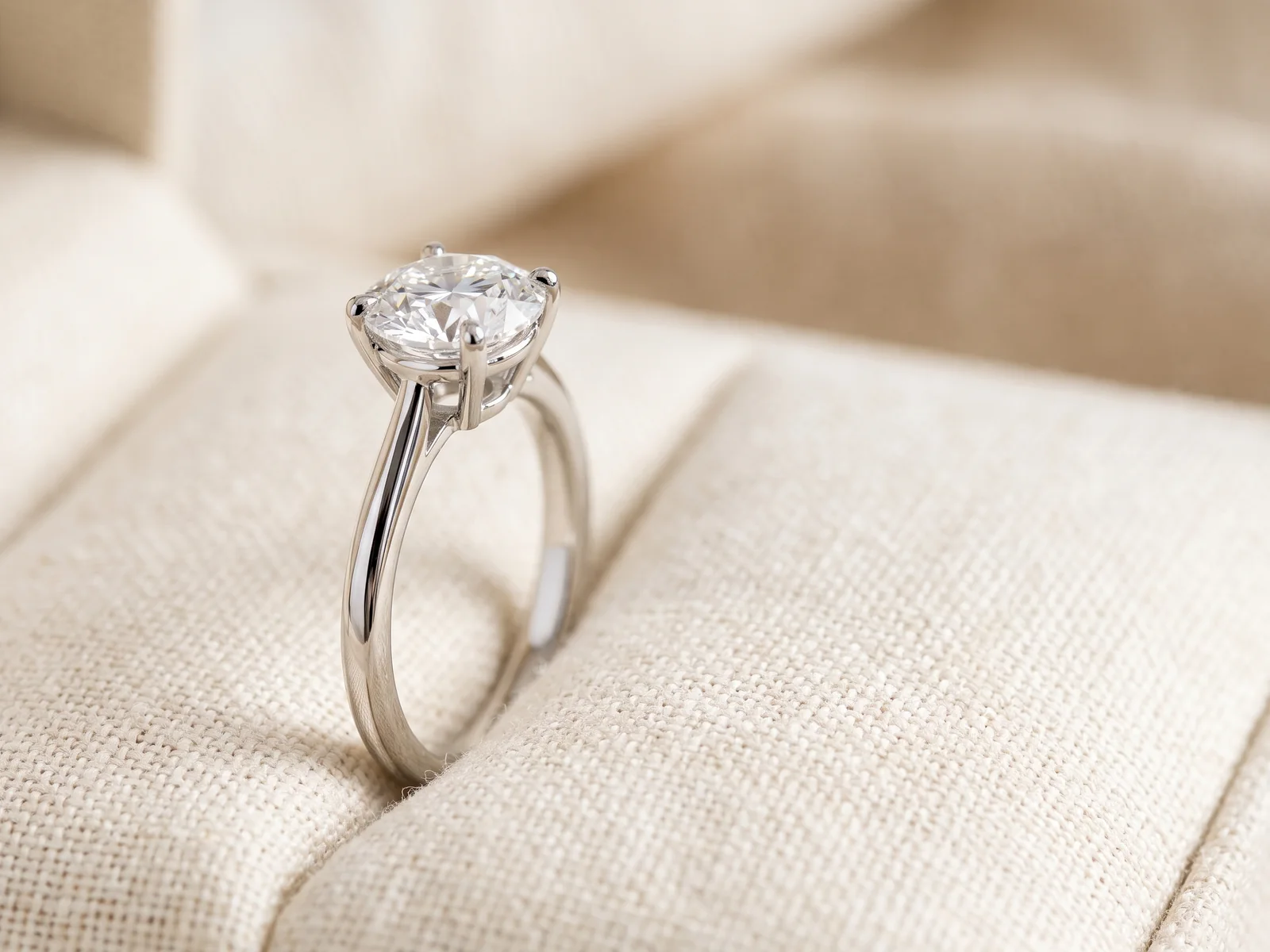
Engagement ring band width decides how big your centre stone looks, how well the setting holds up and how neatly a wedding band sits beside it. Here is what each width from 1.8 to 4 mm really does, including how it wears after years of daily use.
 Reviewed by Raj Sood, Graduate Gemologist (GIA), AJP (GIA)Master jeweller and Graduate Gemologist (GIA) · reviewed 4 November 2026
Quick answer
Most engagement ring bands are 1.8–4 mm wide. Bands of 1.8–2.2 mm make the centre stone look larger but need at least 1.5 mm depth to stay round; 2.5–3 mm suits larger stones and active hands; 3.5–4 mm looks bold. Match the width to the stone size, your hand and the wedding band beside it.
What does engagement ring band width mean?
The band, also called the shank, is the part of the ring that circles your finger. Its width is how wide it looks from above, measured across the finger. Its depth (or thickness) is the distance from the inside surface touching your skin to the outside surface. Jewellers quote both in millimetres, and you need both numbers to judge a ring properly.
Width is what you see. Depth is what keeps the ring strong. A band can look generous at 2.5 mm wide yet be only 1.2 mm deep, which is thin enough to bend. A fine 1.8 mm band can be perfectly sturdy if it is built 1.7 mm deep. If shank, profile and comfort fit are new words, our definitions of shank, profile and comfort fit cover them in plain English.
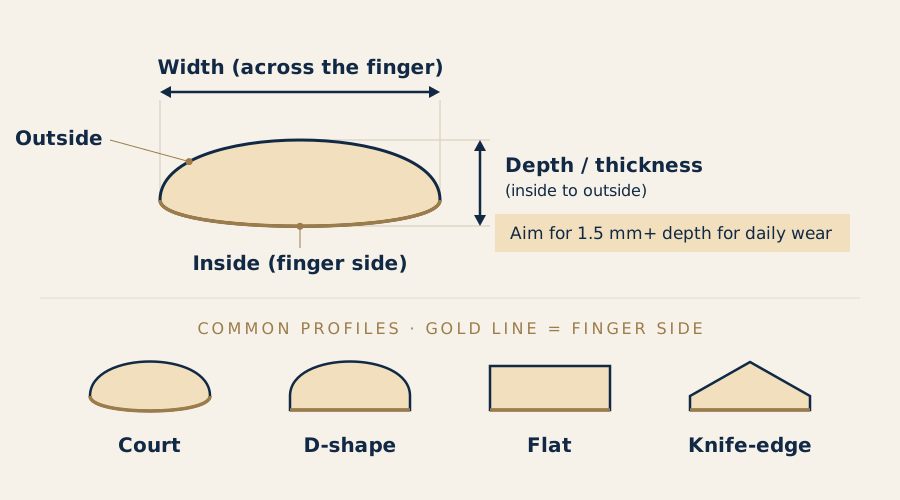
The band's profile is the shape of its cross-section. The common ones are:
- Court: rounded on the outside and the inside. Slides on easily and feels comfortable.
- D-shape: rounded outside, flat inside. A classic look, with slightly more metal touching the skin.
- Flat: squared edges and a flat top. Modern, and it shows scratches more readily.
- Knife-edge: two sloping sides meeting in a ridge on top, so it looks finer than its width.
A comfort fit band has a rounded inside edge, so it rolls over the knuckle more easily. The band is also only one part of the ring: the head (the part that holds the stone) and the shoulders (where the band meets the head) are covered in our guide to how each engagement ring setting is built.
How does engagement ring band width change the look?
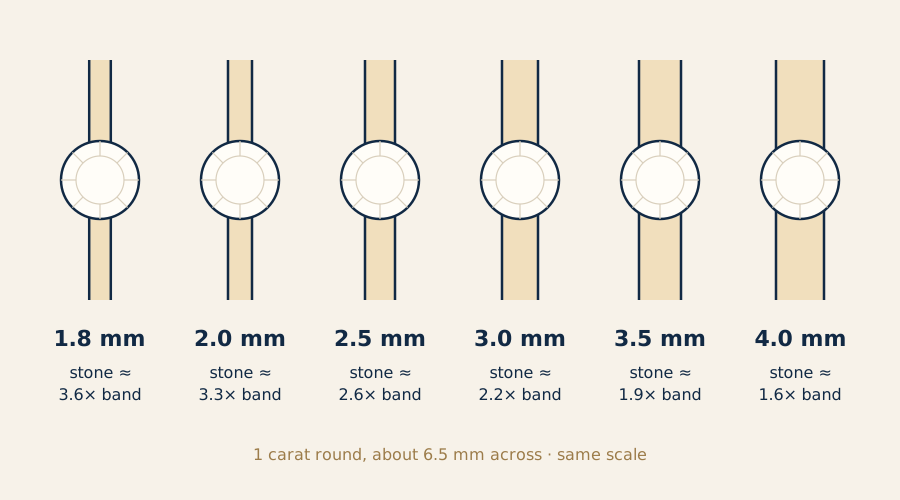
The eye judges a centre stone against the metal around it. A narrow band makes the stone look larger; a wide band makes it look smaller but gives the ring presence. A 1 carat round diamond is about 6.4–6.5 mm across. On a 1.8 mm band the stone is roughly three and a half times the band's width; on a 4 mm band it is only about one and a half times as wide.
| Width | How it looks | Strength (at 1.5 mm+ depth) | Often suits |
|---|---|---|---|
| 1.8 mm | Very fine; stone looks its largest | Adequate if deep enough; least room for wear | Small to mid stones, slim fingers, stacking |
| 2.0 mm | Fine and classic | Good | Most solitaires from 0.5 to 1.5 ct |
| 2.5 mm | Balanced; still delicate | Very good | 1–2 ct stones, pavé bands, everyday wear |
| 3.0 mm | Noticeable band, modern | Very good | 1.5 ct+ stones, larger hands, active work |
| 3.5 mm | Bold; the band becomes a feature | Excellent | Large or wide stones, cushion and emerald cuts |
| 4.0 mm | Strong, sculptural | Excellent | Big centre stones, wide-set looks, worn alone |
Width does not have to be the same all the way around. Tapered bands that narrow towards the stone start at around 3 mm at the back and slim to 1.8–2 mm under the head, giving you strength where the ring wears and a fine look where it is seen. Reverse taper bands that widen at the shoulders do the opposite, framing the stone with more metal.
Profile changes the look too. A knife-edge band with a ridged top at 2.5 mm reads finer than a flat band of the same width, because light catches the ridge and the slopes fall away into shadow. Twisted and rope-style bands usually need 2.5 mm or more so each strand is thick enough to last.
Is a 1.8 mm engagement ring band too thin?
Not on its own. A 1.8 mm band is a sensible minimum for a ring worn every day, as long as the depth is at least 1.5 mm and the metal is suited to it. Below about 1.6 mm wide, or below about 1.3 mm deep, bands are much more likely to bend out of round.
Why does that matter for the stone? When a band is squeezed out of shape, for example by carrying shopping bags, gripping gym equipment or a door closing on the hand, the stress travels up into the head. Claws can lift slightly away from the stone, and a stone that was tight can start to rattle. Thin bands also leave less metal to lose before the ring needs repair.
- Ask for the depth, not just the width. 1.5–1.8 mm deep is typical for fine bands built for daily wear.
- Check the shoulders. The band should not pinch to a thinner section where it joins the head.
- Consider the stone size. A 2 ct stone on a 1.8 mm band puts more leverage on a small amount of metal.
- Think about your hands. Gardening, nursing, trades and weight training all load a ring more than desk work.
So, 3 mm vs 2 mm engagement ring band? A 3 mm band carries about half as much metal again as a 2 mm band of the same depth, so it resists bending better and takes longer to wear thin. A 2 mm band makes the stone look larger. Both are fine for daily wear when built properly; the choice comes down to look, stone size and how hard you are on your hands.
Which metal holds up best in a thin band?
The metal matters more as the band gets thinner. In Australia, engagement rings are mostly made in 9ct, 14ct or 18ct gold (yellow, white or rose) or platinum 950 (95% platinum). Our guide on how platinum and gold compare for everyday bands goes deeper; here is the short version for band width.
- Platinum: dense and tough. When it scratches, the metal is mostly pushed aside rather than lost, so a fine platinum band keeps its weight well. It does develop a soft grey patina.
- 18ct gold: 75% pure gold. Good for 1.8–2.2 mm bands if the depth is generous. White gold is usually rhodium plated (a thin bright white coating) that wears off over time.
- 14ct and 9ct gold: harder alloys with less gold, so they resist scratching and bending a little better, but they lose metal steadily over decades.
- Mixed metals: a platinum head on a gold band is common; the band width rules still apply to the gold.
| Band (size N, about 1.6–1.7 mm deep) | 18ct gold, approximate weight | Platinum, approximate weight |
|---|---|---|
| 2.0 mm wide | about 2.5–3 g | about 3.5–4 g |
| 2.5 mm wide | about 3.2–3.8 g | about 4.4–5.2 g |
| 3.0 mm wide | about 4–4.5 g | about 5.5–6.2 g |
| 4.0 mm wide | about 5.3–6 g | about 7.3–8.3 g |
Those weights are rough guides for the band alone, not the head. They show why price rises with width: a 4 mm band uses about twice the metal of a 2 mm band, and platinum is about 35–40% heavier than 18ct gold for the same shape. Width and depth together set both the strength and the metal cost.
Not sure which one is right?
Send us the stones you are looking at and our gemologist will tell you which to choose and why.
How do different band widths wear over the years?
Every ring wears, and the band takes most of it. The underside of the shank, against the palm, rubs on every surface you touch. Where an engagement ring and wedding band sit together, the two rings also rub against each other. Over 10–20 years of daily wear, a band can lose a noticeable part of its depth at the bottom, and gold loses metal faster than platinum.
From a repair point of view, the difference between widths is the amount of reserve metal. A 3 mm × 1.7 mm band can lose several tenths of a millimetre and still be strong. A 1.8 mm × 1.4 mm band reaches the point of needing work much sooner. When the bottom of the shank gets too thin, usually somewhere around 1 mm deep, a jeweller fits a new section of band, called a re-shank (or half-shank). In Australia this typically costs about AUD $250–$700, depending on metal and width.
- Every 6–12 months: check the claws and whether the stone moves when you tap it gently.
- Every 1–2 years: re-rhodium white gold if it looks yellowish; polish out deep scratches.
- Each check: look at the band from the side. If it looks thinner at the bottom than at the shoulders, or is no longer round, ask about re-shaping or re-shanking.
- Daily habits: take the ring off for the gym, gardening and heavy lifting, especially if the band is under 2 mm.
Our yearly ring maintenance checklist goes through each check in order, and it applies to engagement rings just as much as wedding bands.
Which band width suits your stone size and shape?
Proportion is the main guide. A fine band suits a modest stone; a larger stone usually looks more settled, and is better supported, on a slightly wider band. These are starting points, not rules.
| Centre stone | Width that often looks balanced | Notes |
|---|---|---|
| Under 0.5 ct | 1.8–2.0 mm | A fine band keeps the stone from looking lost |
| 0.5–1.0 ct | 1.8–2.2 mm | The most flexible range; most looks work |
| 1.0–1.5 ct | 2.0–2.5 mm | 2.5 mm if you want pavé or a sturdier feel |
| 1.5–2.5 ct | 2.2–3.0 mm | More metal supports the head's leverage |
| 2.5 ct+ | 2.5–4.0 mm | A band under 2 mm can look out of proportion |
Shape changes the picture. Elongated shapes, such as oval, pear, marquise and elongated cushions, look longer and slimmer on a 1.8–2.2 mm band. Broader or squarer shapes such as cushion, Asscher, emerald and radiant cuts often look better on 2.5–3.5 mm, because a thin band under a wide stone can look top-heavy. A halo setting adds visual width to the centre, so many halo rings sit comfortably on 2–2.5 mm.
Stone-set bands need enough metal to hold the small stones. A pavé band (tiny diamonds set closely along the band) usually needs at least 2 mm to hold stones of about 1.0–1.3 mm, and 2.5 mm for larger accents. A channel-set band, where stones sit between two rails of metal, needs similar width. For a guided way to narrow it down, see our step-by-step help choosing your width.
Related guideWhat Engagement Ring Band Width Should You Choose?What engagement ring band width suits small or large hands?
Hand size is the other half of proportion. On small hands or short fingers, a 1.8–2.2 mm band leaves more finger showing, which makes the finger look longer and the stone look larger. On larger hands or long fingers, 2.5–3.5 mm keeps the ring from looking spindly. Long slim fingers can carry almost any width.
Width also changes how a ring feels. A wider band covers more skin, so it feels snugger than a narrow band of the same size. Across 1.8 to 3 mm the difference is small. At 3.5–4 mm, especially in a flat profile, some people find they want a quarter size larger, and comfort fit helps the band slide over the knuckle. Always try the actual width you plan to wear when you are sized, not a thin sizing ring if your band will be 4 mm.
- Small hands, short fingers: 1.8–2.2 mm, court or knife-edge profile.
- Average hands: 2–2.5 mm suits almost everything.
- Larger hands: 2.5–3.5 mm, often with a slightly heavier centre stone.
- Swollen or large knuckles: comfort fit; consider sizing bars or a slightly wider band that resists spinning.
How wide should your wedding band be to match?
Most people wear the wedding band beside the engagement ring, so think of the two as one stack. Two 2 mm bands give a combined width of 4 mm across the finger, which still looks fine on most hands. Two 3 mm bands make 6 mm, which looks bold and may need a slightly larger ring size. For typical widths on each side of the aisle, see typical women's and men's wedding band widths.
- Match the width: the simplest and most balanced look; a 2 mm engagement band with a 2 mm wedding band.
- Go slightly wider: a 2.5–3 mm wedding band beside a 2 mm engagement band gives the wedding ring its own presence.
- Match the profile: a court band beside a court band sits neatly; a flat band beside a court band leaves gaps.
- Match the metal: different alloys wear against each other at different rates, so the softer ring wears faster where they touch.
Whether a wedding band sits flush depends on the setting as much as the width. A high setting usually leaves room for a straight band underneath; a low setting or a wide head often does not. Our guide to how setting height affects the band beside it explains the clearances, and bands that suit low-profile settings covers the common fixes.
Where a straight band will not sit flush, a curved or notched band can be made to follow the engagement ring's outline; see custom fitted and curved wedding bands. If the two rings rub or the stone catches, a thin third ring can sit between them, and our page on when a spacer band helps explains when that makes sense. Couples deciding whether their rings should share a width or style can read whether couples' bands should match.
If you already have a wedding band, perhaps a family ring, it is usually easier to build the engagement ring to match its width and profile. Our guide to designing around a wedding band you already own walks through that process.
How do you choose an engagement ring band width? Step by step
- Start with the stone. Note its carat weight, shape and face-up size in millimetres, and use the stone-size table above for a starting width.
- Look at your hand. Try 2 mm and 3 mm bands on your ring finger and see which keeps the proportion you like.
- Ask for the depth. Aim for at least 1.5 mm deep for daily wear, more if the band is under 2 mm or the stone is over 1.5 ct.
- Choose the metal. Platinum or 18ct gold for fine bands; consider 14ct gold if you want a harder alloy.
- Pick the profile. Court or comfort fit for everyday comfort; knife-edge or tapered if you want a finer look at the same strength.
- Plan the wedding band now. Check the combined width and whether the setting height lets a straight band sit flush.
- Get sized in the real width. Wider bands fit tighter, so size with a band close to the width you will wear.
- Book regular checks. Have claws and band thickness looked at every 6–12 months, especially for bands under 2 mm.
Create your ring: choose a setting and band width
Free consultation
Talk to a gemologist
Compare stones in person or online with Raj Sood, Graduate Gemologist (GIA), AJP (GIA).
Book a consultationShop this shape
FAQ
Common questions
What is the most common engagement ring band width?
Most engagement ring bands are between 1.8 and 3 mm wide, and 2–2.5 mm is a popular choice for solitaires from about 0.5 to 1.5 carat. It suits most hands and leaves room for a matching wedding band.
Is a 1.8 mm band too thin for an engagement ring?
Not if it is at least 1.5 mm deep and made in a suitable metal such as platinum or 18ct gold. Bands under about 1.6 mm wide or 1.3 mm deep bend more easily and will need repair sooner.
How thick should an engagement ring band be?
For everyday wear, aim for a depth (thickness) of about 1.5–1.8 mm, whatever the width. Depth is what stops the band bending out of round and gives it metal to spare as it wears.
Does a thin band make the diamond look bigger?
Yes. The eye compares the stone with the metal around it, so a 1 carat stone on a 1.8–2 mm band looks larger than the same stone on a 3.5–4 mm band.
Should my wedding band be the same width as my engagement ring?
Matching widths gives the most balanced stack, but a wedding band 0.5–1 mm wider also looks good. Keep the combined width comfortable for your hand and check that the setting lets the band sit flush.
Can a thin band be made wider later?
Yes. A jeweller can fit a new, wider or deeper section of band, called a re-shank, which is also the usual repair when a band has worn thin. The setting and stone stay the same.
Terms in this guide

Ask a gemologist
Not sure which diamond to choose?
Raj Sood is a Graduate Gemologist (GIA) and master jeweller. Bring the stones you are considering, or send the reports, and he will tell you honestly which one is better and why.
Keep learning
Related guides
 Engagement Rings & SettingsWhat Engagement Ring Band Width Should You Choose?Engagement Rings & SettingsSetting Height and Wedding Band FitEngagement Rings & SettingsTapered Bands
 Wedding Bands & EternityFitted Wedding Bands Explained | Custom Curved BandsEngagement Rings & SettingsEngagement Ring Setting Styles Guide
 Engagement Rings & SettingsTwisted Bands
 Engagement Rings & SettingsReverse Taper BandsEngagement Rings & SettingsKnife-Edge Bands
Explore more
More guides on this topic
Education