
- Education
- Diamond 4Cs & Grading
- Etch Channels in Diamonds: What They Are, How They Form and Whether They Matter
Diamond 4Cs & Grading
Etch Channels in Diamonds: What They Are, How They Form and Whether They Matter
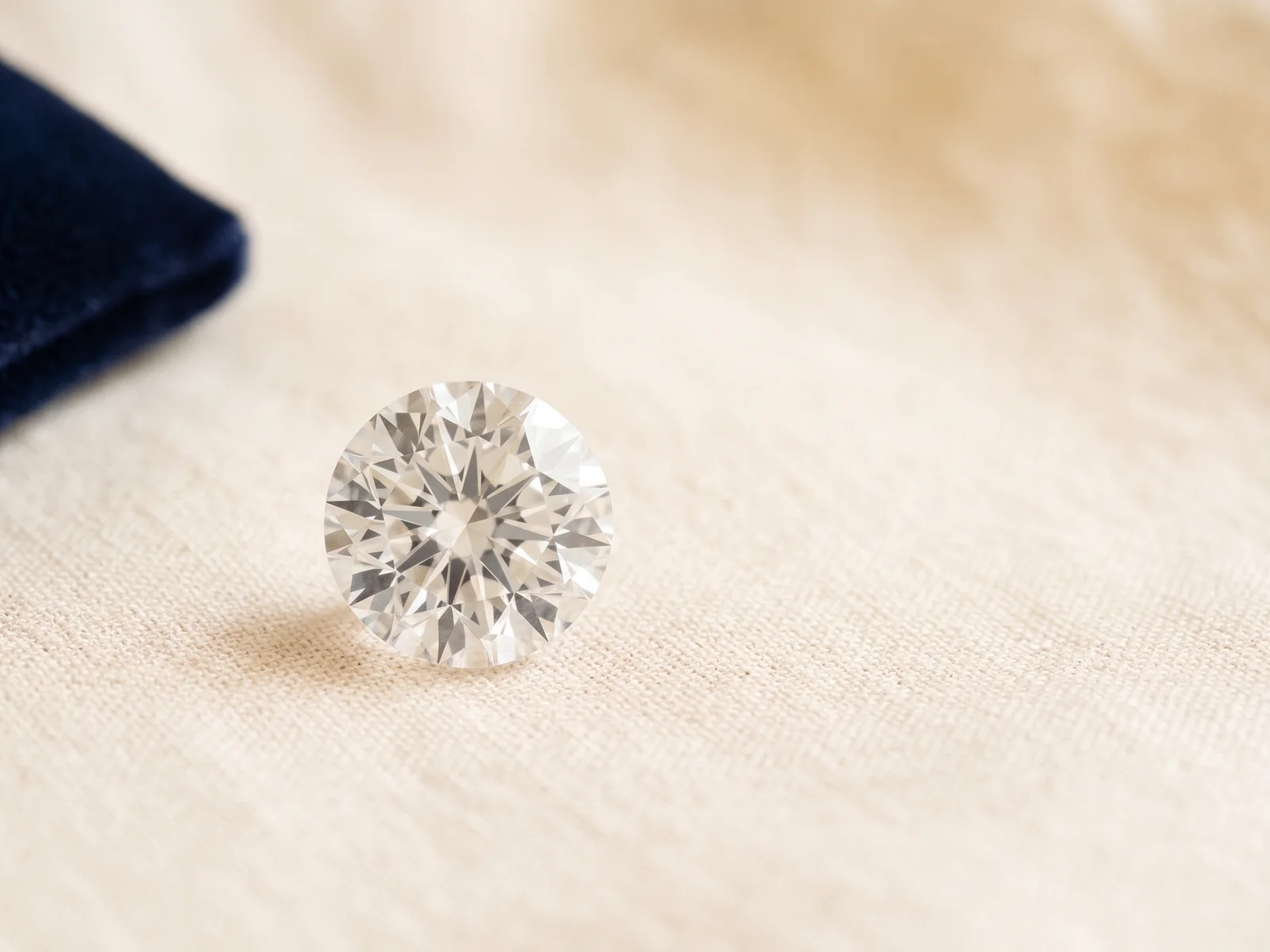
An etch channel on a grading report can sound alarming, but it is usually one of the milder inclusions. Here is how etch channels in diamonds form, how to read them on a report plot, and when they really matter.
 Reviewed by Raj Sood, Graduate Gemologist (GIA), AJP (GIA)Master jeweller and Graduate Gemologist (GIA) · reviewed 4 November 2026
Quick answer
Etch channels in diamonds are natural hollow tunnels dissolved into the crystal by hot fluids deep in the earth, usually following a line of structural weakness. They open to the surface, look like fine white or dark tubes at 10× magnification and are plotted as inclusions. Small ones are usually eye-clean and pose little durability risk.
What are etch channels in diamonds?
An etch channel is a natural, hollow tunnel that runs from the surface of a diamond into its interior. It forms when part of the crystal is dissolved away, not cracked, so the channel is simply a space where diamond used to be. Grading labs such as GIA list it as an inclusion (an internal clarity characteristic) even though it reaches the surface, because most of the feature lies inside the stone. It is one of the characteristics a grader weighs when assigning clarity, and our guide to the four Cs of diamond grading explains how clarity sits alongside cut, colour and carat.
Etch channels are far less common than crystals, feathers and pinpoints. Most are very fine, a small fraction of a millimetre across, and many can only be found with a 10× loupe, the standard magnification used for grading. They usually look like straight or slightly stepped white lines running into the stone. If dirt, polishing residue or natural staining has collected inside, they can look grey or even dark.
Etch channels belong to a group of features that follow the diamond's internal crystal structure, so it helps to know their neighbours:
- Twinning wisps: clouds and fine lines that form where the crystal changed growth direction; see how twinning wisps form along a twin plane.
- Graining: faint lines or haze from uneven crystal growth or strain; our page on internal and surface graining covers both types.
- Bearding: tiny hair-like cracks that run in from the girdle during cutting; read more about bearded girdles and why they happen.
- Naturals: patches of original crystal skin left on the girdle by the cutter; see what a natural on the girdle tells you.
Any unfamiliar term on this page, from pavilion to dislocation, is also explained in our A–Z glossary of jewellery terms.
How do etch channels form?
Natural diamonds crystallise deep in the earth's mantle, mostly somewhere around 150–200 km down, then are carried to the surface in volcanic magma called kimberlite (or, less often, lamproite). On that journey the diamond leaves the conditions it is stable in. Hot, chemically aggressive fluids in the magma start to attack it, and on rough crystals you can see the results as triangular pits called trigons and other etch marks on the faces.
Most of that etching only roughens the surface, and the cutter polishes it away. An etch channel forms where the fluid finds a dislocation: a line defect in the crystal lattice where rows of carbon atoms are slightly out of alignment, often left by squeezing and bending (plastic deformation) deep underground. Atoms along that line are held less tightly than the perfect crystal around them, so dissolution runs much faster down the line than across the surface. The fluid bores a narrow tube into the stone, a little like water finding a crack in limestone.
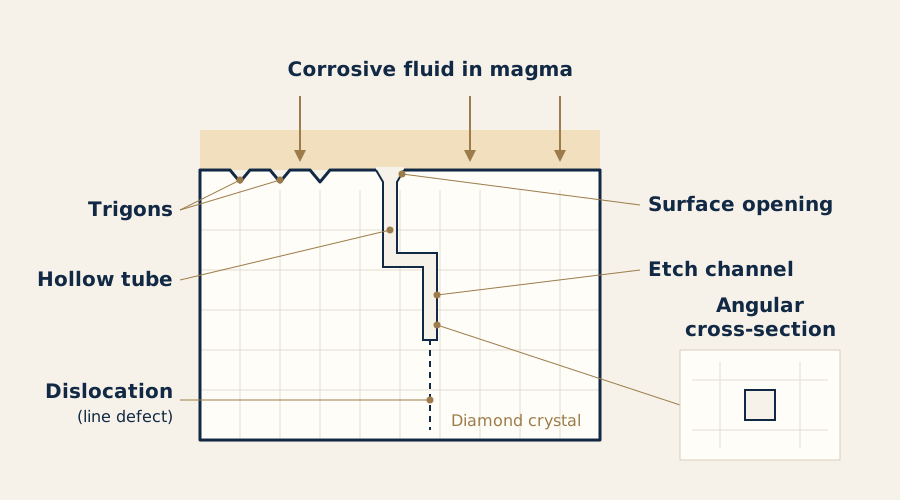
Because dislocations follow set crystal directions, etch channels are often straight with angular, roughly square or rectangular cross-sections, and they may change direction in neat steps rather than curving. Some branch, and some contain whitish or brownish residue left behind by the fluid. All of this happens after the diamond has grown and before it is mined, so the cutter inherits the channel. If it runs deep, polishing it out would cost too much weight, and it stays in the finished stone.
What does an etch channel look like under magnification?
At 10× an etch channel can be confused with several other features, so graders look for a combination of clues:
- Shape: a thin, straight or stepped tube, often with sharp corners where it changes direction, rather than the flat, feathery plane of a fracture.
- Opening: a tiny hole where the channel meets a facet. It may look angular, sometimes square or triangular, and is easiest to see by tilting the stone so light reflects off the facet.
- Colour: usually white or colourless; grey to dark if dirt, polishing compound or natural staining is trapped inside.
- Reflections: in a brilliant cut, one channel can be mirrored by the pavilion facets, so it may appear two or three times. Only one of the images is the real feature.
- Depth: it starts at the surface and fades as it runs inward, unlike a pinpoint or crystal that sits fully inside.
Etch channels are usually easier to see in magnified photos than with the naked eye. That works both ways: a strong macro image can make a harmless channel look dramatic, while a phone video at arm's length may hide it entirely. Ask for images at a known magnification and compare them with the report plot so you know which mark you are looking at.
Where do etch channels show on a diamond report plot?
Full grading reports from labs such as GIA and IGI include a plotting diagram: an outline of the diamond's crown (top) and pavilion (bottom) with symbols marking each clarity characteristic. A key beside the diagram names every symbol used. If you see "Etch channel" in that key, the lab found one and judged it significant enough to plot.
On GIA plots, internal characteristics are drawn in red and external ones (blemishes) in green. An etch channel is treated as an inclusion, so it is normally drawn in red as a line running in from the point where it opens on the surface. Smaller GIA reports, such as the Diamond Dossier for stones under about 2 carats, do not include a plot, so you may only see the clarity grade.
| Characteristic | How it appears on the plot | What it tells you |
|---|---|---|
| Etch channel | Red line running inward from a surface point | Natural dissolution tunnel; listed with inclusions |
| Laser drill hole | Red line from the surface, often to a dark inclusion | Treatment; must be disclosed, often also noted in comments |
| Feather | Red line or wavy line | A crack or fracture inside the stone |
| Pit | Green dot on a facet | A small surface cavity (blemish) |
| Natural | Green mark on the girdle | Original crystal skin left by the cutter |
Read the plot together with the rest of the report. The comments line may mention features not shown, such as clouds, and the same page records the fluorescence strength from none to very strong, which affects appearance in daylight. Check the weight too, especially on rings with several stones; our guide to carat weight terms such as ct and ctw explains why a centre stone's report weight is not the ring's total.
Not sure which one is right?
Send us the stones you are looking at and our gemologist will tell you which to choose and why.
Etch channel vs laser drill hole: how do you tell them apart?
The feature most often confused with an etch channel is a laser drill hole. Both are fine tubes that run in from the surface, but one is natural and the other is a treatment. A laser drill hole is burned into the diamond so acid can bleach a dark inclusion, which is a clarity enhancement that must be disclosed.
| Etch channel | Laser drill hole | |
|---|---|---|
| Origin | Natural dissolution in the earth | Man-made treatment after cutting |
| Path | Follows crystal directions; may step or branch | Straight line aimed at a target inclusion |
| Cross-section | Often angular, square or rectangular | Round, very even |
| End point | Fades out or stops without a target | Usually ends at a dark or bleached inclusion |
| On the report | Plotted as an inclusion | Plotted, and stated as laser drilling |
| Treatment? | No | Yes; must be disclosed |
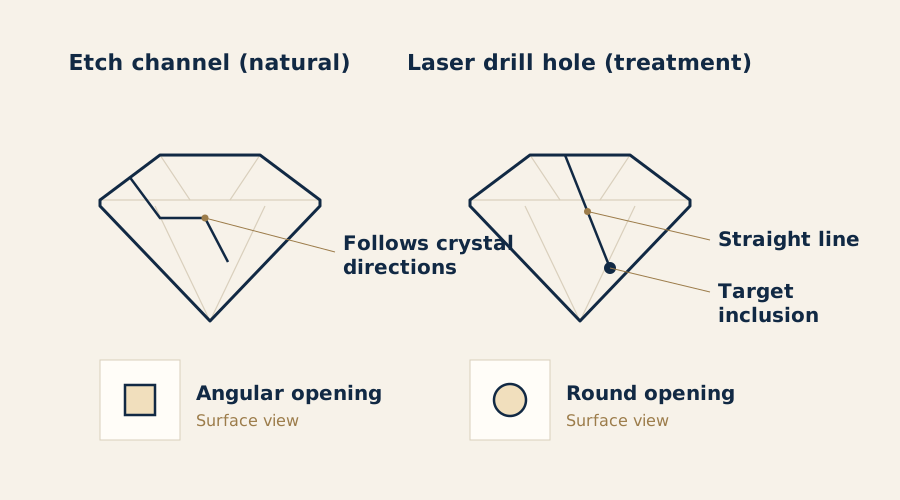
Telling them apart reliably takes magnification and experience, which is why the lab report matters. Because both features open to the surface, either can also be filled with a glassy material in a fracture-filling treatment. Our guide to clarity enhancement by drilling and fracture filling explains how treated stones are identified and disclosed.
Related guideLaser Drill Holes in DiamondsDo not confuse either with surface blemishes. Pits and extra facets sit only on the surface and do not run inward, and polishing faults such as burn marks and lizard skin are textures left on facets during cutting.
Is an etch channel eye-clean, and how does it affect clarity?
Graders judge every inclusion on five factors: size, number, position, relief (how much it contrasts with the diamond around it) and nature (what kind of feature it is, including whether it reaches the surface). An etch channel scores worse on relief if it is dark inside, and worse on position if it sits under the table, the large flat facet on top, where your eye goes first.
| Clarity grade | Typical etch channel at this grade | Eye-clean? |
|---|---|---|
| FL / IF | Not possible; an etch channel is an inclusion | — |
| VVS1–VVS2 | Tiny, very hard to find at 10× | Yes |
| VS1–VS2 | Small, found at 10× with some effort | Yes |
| SI1 | Easy to see at 10×, often white | Usually, especially in brilliant cuts |
| SI2 | Obvious at 10×, may be dark or under the table | Sometimes; check carefully |
| I1–I3 | Large or several channels, often dark | Often not |
Whether an etch channel is eye-clean (invisible without magnification at normal viewing distance, about 25–30 cm) depends heavily on the cut. Brilliant cuts such as rounds, ovals and cushions break up light into many small flashes that hide a fine white channel well. Step cuts such as emerald and Asscher cuts have large, open facets that act like windows, so the same channel can be seen far more easily. Larger stones also show inclusions more readily than small ones of the same grade.
Placement matters as much as grade. A white etch channel near the girdle of an SI1 round is often hidden by a claw, while a dark one under the table of a VS2 emerald cut may be visible. If your budget is stretched, an eye-clean SI1 with a well-placed channel can free money for size or cut; see our guide on weighing a bigger diamond against better quality and the practical ways to make a diamond look bigger on the hand.
Do etch channels in diamonds affect durability?
Usually not much. Diamond is 10 on the Mohs hardness scale, but hardness is resistance to scratching, not to breaking. Diamonds can split along their cleavage planes (directions where the crystal bonds are weakest) if they take a sharp knock. A feather is risky because it is already a crack along or near such a plane. An etch channel is different: it is a narrow hollow tube with diamond all around it, so it does not create a large flat weakness that a blow can open up.
The risk rises in a few specific situations:
- Near a thin edge: a channel opening on or near the girdle, a pointed tip (as in pears, marquises and princess corners) or the culet sits where the stone is already thinnest.
- Combined with a feather: if the plot shows a feather running from the channel, treat the pair as a fracture risk.
- Large or branching channels: several connected tubes remove more diamond and can leave a weaker zone.
- Filled channels: fracture-filling material can be damaged by a jeweller's torch or by strong cleaning, so tell your jeweller before any repair.
Because the channel is open to the surface, it can trap oils, soap and dirt, which may make it look darker over time. A gentle soak in warm water with a little detergent and a soft brush keeps it clean. Ultrasonic cleaning is generally fine for untreated diamonds, but avoid it for filled stones.
The setting style matters more for a stone with a near-edge channel than for one with a channel in the centre. Bezels and claws that wrap the girdle protect it well. Note that the "channel" in a channel setting has nothing to do with etch channels; it is a style where small stones sit in a metal groove, covered in our guide to channel-set diamonds and how they are repaired and our comparison of shared-prong and channel-set wedding bands.
Do lab-grown diamonds have etch channels?
Rarely, if ever. Etch channels form when a natural diamond is partly dissolved by magma and fluids on its way to the surface. Laboratory-grown diamonds, made by HPHT (high pressure, high temperature) or CVD (chemical vapour deposition), never make that journey. Their typical inclusions are different: metallic flux inclusions in HPHT stones and dark specks of non-diamond carbon in CVD stones, along with growth-related graining.
That does not mean an etch channel proves a diamond is natural. Only laboratory testing can confirm origin, and every report states clearly whether the stone is natural or lab-grown. Both are real diamond with the same hardness and a refractive index of about 2.42.
On price, an etch channel affects value only through the clarity grade it causes. A natural diamond graded SI1 because of a fine etch channel typically costs noticeably less than a VS2 of the same carat, colour and cut, often by somewhere around 10–20%, and the difference may be invisible once set. Lab-grown diamonds cost much less than natural at every grade, so clarity trade-offs matter less in absolute dollars.
Browse natural and lab-grown diamonds with full reports
How do you assess a diamond with an etch channel? Step by step
- Find it on the report. Check the key to symbols for "Etch channel" and note whether the diamond is natural or lab-grown.
- Locate it on the plot. Is it under the table, near the girdle, or close to a point or the culet?
- Check for neighbours. Look for a feather or a laser drill hole plotted at the same spot, and read the comments for any treatment.
- Compare with magnified images. Match the plot to photos or video at a known magnification and note whether the channel is white or dark.
- Judge it at arm's length. View the stone face-up at 25–30 cm to confirm it is eye-clean in the cut you have chosen.
- Plan the setting. If the channel is near an edge, position the stone so a claw or bezel protects that area without pressing on the opening.
Free consultation
Talk to a gemologist
Compare stones in person or online with Raj Sood, Graduate Gemologist (GIA), AJP (GIA).
Book a consultationShop this shape
FAQ
Common questions
Is an etch channel bad in a diamond?
Not usually. It is a natural hollow tunnel, not a crack, so small etch channels away from thin edges pose little durability risk. Its main effect is on the clarity grade and, if large or dark, on appearance.
Can you see an etch channel with the naked eye?
Most cannot be seen without magnification, especially in VS grades and in brilliant cuts. Larger or dark-filled channels in SI2 or I grades, or in step cuts, may be visible face-up.
What is the difference between an etch channel and a laser drill hole?
An etch channel is natural and follows the crystal structure, often with angular steps. A laser drill hole is a man-made, perfectly straight treatment channel leading to an inclusion, and it must be disclosed on the report.
How is an etch channel shown on a GIA report?
It is listed as "Etch channel" in the key to symbols and is normally plotted in red with the inclusions, drawn from the point where it reaches the surface. Reports without a plotting diagram show only the clarity grade.
Can an etch channel be filled or treated?
Yes. Because it opens to the surface, it can be fracture-filled with a glassy material to make it less visible. Any filling is a treatment and must be disclosed, and filled stones need gentler care during repairs and cleaning.
Do lab-grown diamonds have etch channels?
They are rarely, if ever, reported in lab-grown diamonds, because etch channels form during natural transport to the earth's surface. Lab-grown stones have their own typical inclusions, such as metallic flux or dark carbon specks.

Ask a gemologist
Not sure which diamond to choose?
Raj Sood is a Graduate Gemologist (GIA) and master jeweller. Bring the stones you are considering, or send the reports, and he will tell you honestly which one is better and why.
Keep learning
Related guides
 Diamond 4Cs & GradingLaser Drill Holes in Diamonds
 Diamond 4Cs & GradingClarity-Enhanced Diamonds: Laser Drilling and Fracture Filling
 Diamond 4Cs & GradingTwinning Wisps in Diamonds
 Diamond 4Cs & GradingGraining in DiamondsDiamond 4Cs & GradingDiamond 4Cs
 Engagement Rings & SettingsChannel-Set Diamonds: Pros, Cons and Repairs
 Wedding Bands & EternityShared-Prong vs Channel-Set Wedding BandsDiamond 4Cs & GradingDiamond Fluorescence Strengths: None to Very Strong
Explore more
More guides on this topic
Education