
- Education
- Diamond Shapes
- Heart Shaped Diamond Symmetry Guide: How to Judge Lobes, Cleft and Point
Diamond shapes
Heart Shaped Diamond Symmetry Guide: How to Judge Lobes, Cleft and Point
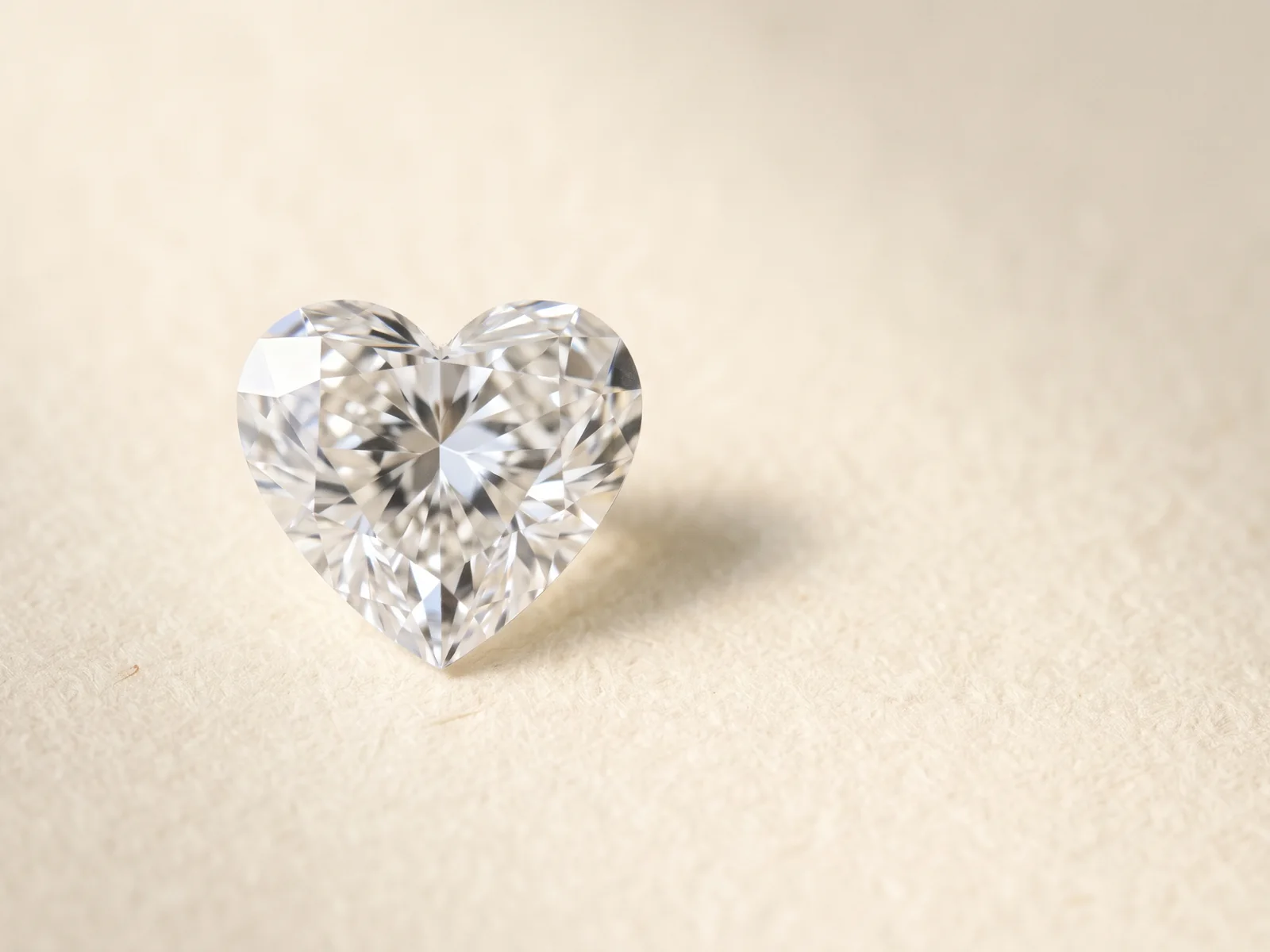
A heart is two halves mirrored down the middle, so heart shaped diamond symmetry decides whether the stone reads as a heart or as a lopsided triangle. This guide shows you exactly what to check, what the report grade does and does not tell you, and which faults matter.
 Reviewed by Raj Sood, Graduate Gemologist (GIA), AJP (GIA)Master jeweller and Graduate Gemologist (GIA) · reviewed 4 November 2026
Quick answer
Heart shaped diamond symmetry is how evenly the two halves mirror each other. Check that both lobes match in size and height, the cleft is crisp and centred, the point sits directly below the cleft, and the wings curve evenly. Aim for Very Good or Excellent symmetry on the report, then confirm the outline by eye.
What is heart shaped diamond symmetry?
Symmetry, in a diamond, means how precisely one part of the stone mirrors another. In a round brilliant there are many mirror lines. In a heart there is only one: an imaginary vertical line that runs from the centre of the cleft (the dip between the two lobes) straight down through the point. Everything to the left of that line should be a reflection of everything to the right.
That single line is why the heart is so unforgiving. With only one axis to compare against, your eye picks up small differences very quickly, especially at the top of the stone where the two lobes sit side by side. If you are new to the shape itself, start with our complete heart shaped diamond guide, which covers ratio, size, colour and settings. This page goes deeper on one thing: how to tell a well-balanced heart from one that is slightly off.
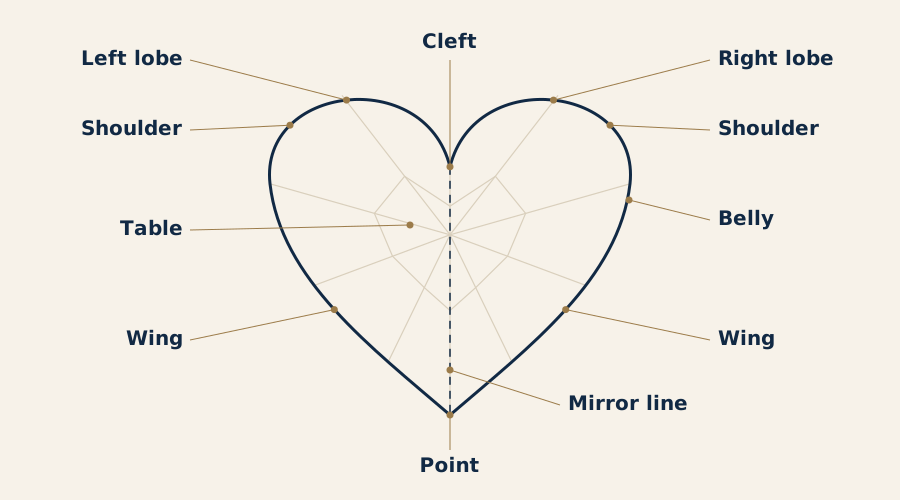
When gemmologists talk about heart symmetry, they are looking at six areas: the two lobes (the rounded tops), the cleft, the shoulders (where each lobe turns down into the side), the wings (the long curved sides), the belly (the widest part across the middle) and the point. Any of these can be uneven, and some faults matter far more than others. If a term is unfamiliar, the GemTrove jewellery glossary explains it in plain English.
The heart sits within the elongated and fancy brilliant family of cuts, alongside the pear, oval and marquise. All of them are judged partly on outline, but the heart's two lobes and cleft give it more parts that have to match than any of its relatives.
Outline, facet and optical symmetry: what is the difference?
People use the word symmetry for three different things, and a heart can be strong on one and weak on another. Knowing which is which stops you relying on the wrong number.
| Type | What it describes | Where you find it | How much it matters in a heart |
|---|---|---|---|
| Outline symmetry | Whether the silhouette matches left and right: lobes, shoulders, wings, point | Your own eye, photos, 360° video | The most visible; decides whether it looks like a heart |
| Facet symmetry | How precisely facets are shaped, placed and aligned; table and culet centred | The symmetry grade on the grading report | Affects crispness and light return; a useful filter |
| Optical symmetry | Whether the pattern of light and dark inside the stone is even on both halves | Your eye in video, or reflector images | Affects how balanced the sparkle and bow-tie look |
The symmetry grade on a report is a measure of facet symmetry. A grader looks at things like an off-centre table (the large flat top facet), an off-centre culet (the tiny facet or point at the bottom), crown and pavilion facets that do not line up, a wavy girdle (the thin edge around the stone) and extra facets. Our page on how the Excellent to Poor symmetry grades work covers each of these in detail.
Outline symmetry is a judgement of shape appeal. Grading labs do take obvious outline problems into account to some degree, but the grade is not a full verdict on whether the outline looks balanced. And optical symmetry, the even spread of light, is a separate idea again; see the difference between facet symmetry and optical symmetry for why the two do not always agree.
What do symmetry grades mean for a heart shaped diamond?
Major labs such as GIA and IGI grade symmetry on a five-step scale. For heart shapes (and other fancy shapes), GIA does not give an overall cut grade the way it does for round brilliants, so the polish and symmetry grades are the only cut-related grades you get on the report. That makes the symmetry grade more important for a heart than for a round.
| Symmetry grade | What it means | Practical view for a heart |
|---|---|---|
| Excellent | No or very minor symmetry features, hard to see at 10× magnification | Sharpest facet pattern; still check the outline by eye |
| Very Good | Minor features, difficult to see at 10× | Usually indistinguishable from Excellent face-up |
| Good | Noticeable features at 10× | Can be fine if the outline looks balanced; inspect carefully |
| Fair | Obvious features at 10×, may be visible without magnification | Often shows a lopsided pattern or uneven lobes |
| Poor | Prominent features visible to the eye | Generally avoided for an engagement ring |
Most people choosing an excellent symmetry heart diamond, or one graded Very Good, find the two indistinguishable in a ring. The step down to Good is where it pays to look harder. Some Good-symmetry hearts are lovely because the issue is a slightly misaligned facet deep in the pavilion (the lower half of the stone) that you will never notice. Others have an off-centre table that pulls the whole pattern to one side.
Natural hearts graded by GIA and lab-grown hearts graded by IGI both show a symmetry grade, and the scale reads the same way. A laboratory-grown diamond is real diamond, so the same symmetry checks apply to it in exactly the same way.
What are the common symmetry faults in heart shaped diamonds?
These are the faults gemmologists look for, roughly in order of how much they change what you see on the hand.
| Fault | How it looks | How much it matters |
|---|---|---|
| Uneven lobes | One lobe taller, wider or more rounded than the other | High: the first thing most eyes notice |
| Off-centre cleft | The dip sits closer to one side | High: makes the heart look like it leans |
| Shallow cleft | Barely any dip; lobes run together | High: reads as a rounded triangle or pear |
| Over-deep cleft | A sharp, deep notch | Medium: striking, but adds a thin area that needs protecting |
| Tilted or crooked point | Point sits left or right of the mirror line | High: the stone looks twisted in the setting |
| Uneven wings | One side bulges, the other is flatter | Medium: visible when you look at the outline |
| High or low shoulders | Lobes turn down at different heights | Medium: subtle, but makes the top look uneven |
| Off-centre table or culet | Facet pattern pulled to one side | Medium: shows as an uneven sparkle pattern |
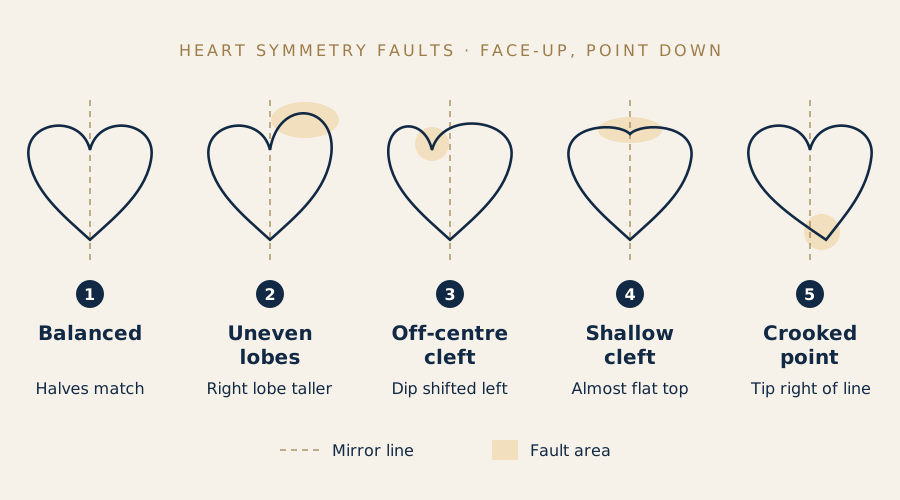
The cleft deserves extra attention. A crisp, clearly defined cleft is what separates a heart from a pear, and our guide to how a heart differs from a pear shows how quickly a shallow cleft blurs the two. At the other end, a very deep cleft looks dramatic but creates a second thin, exposed area alongside the point, which the setting needs to cover.
In a 1 carat heart (roughly 6.8 mm wide), the lobes are only a few millimetres across, so a height difference of a fraction of a millimetre can already be visible. That is why photos and video taken straight-on, not at an angle, are essential when you compare stones.
Not sure which one is right?
Send us the stones you are looking at and our gemologist will tell you which to choose and why.
How does the ratio affect how symmetrical a heart looks?
The length-to-width ratio is the stone's length (top of the lobes to the point) divided by its width (across the lobes). It is not a symmetry measure as such, but it changes how easy it is to spot asymmetry.
- Below about 0.90: a wide, squat heart. The lobes flatten and the wings get short, so an uneven lobe is very obvious against the broad top.
- About 0.90–1.10: the classic balanced heart. Lobes, wings and point are in proportion, and small faults are easiest to judge fairly.
- Above about 1.10: a slim, longer heart. The point becomes long and narrow, so a crooked point stands out more.
Size plays a part too. Under about half a carat, the lobes and cleft become so small that the outline can read as a rounded triangle no matter how well it is cut, and claws cover a larger share of the edge. Our page on the minimum size for a heart to read clearly explains why most people choose 0.50 carat or more.
One trap: two hearts can have identical length and width measurements, and therefore identical ratios, while one has matched lobes and the other does not. The ratio tells you the box the heart fits in, not whether it is balanced inside that box. Always look at the outline itself. Depth matters as well: a deep heart carries weight underneath and faces up smaller, which our comparison of which shapes face up largest for their weight puts into numbers.
Does the bow-tie show symmetry problems in a heart diamond?
Many hearts show a bow-tie: a darker band across the belly where light leaks out of the pavilion instead of returning to your eye. A faint bow-tie that shifts as the stone moves is normal and adds contrast. What matters for symmetry is whether the bow-tie is even.
If the dark area is heavier on one side, or sits off-centre, it often points to uneven pavilion angles or an off-centre culet, which is a facet symmetry problem. It can also make a heart with a perfect outline look as if it leans. This is optical symmetry at work, the idea covered in the section on the three kinds of symmetry above, and reflector images or video are the clearest way to reveal it.
- Even, faint bow-tie that comes and goes: normal and fine.
- Dark band fixed in every position: a proportion problem, whether symmetrical or not.
- Dark patch on one half only: a sign the two halves are cut differently; check the symmetry grade and the table position.
Bow-ties are rarely visible in still photos. A 360° video, watched while you keep your eye on the belly, is the most reliable way to judge it before you see the stone in person.
How does heart symmetry compare with pear and marquise symmetry?
The heart, pear and marquise are all judged on symmetry along their length, but the heart has more parts that must match.
| Heart | Pear | Marquise | |
|---|---|---|---|
| Mirror lines | One (cleft to point) | One (rounded end to point) | Two (lengthwise and crosswise) |
| Key areas to match | Lobes, cleft, shoulders, wings, point | Shoulders, wings, rounded head, point | Both points, both wings, both ends |
| Most visible fault | Uneven lobes or off-centre cleft | Crooked point, uneven shoulders | Points out of line with each other |
| Typical ratio | 0.90–1.10 | 1.45–1.75 | 1.85–2.10 |
| Thin, exposed areas | Point and cleft | Point | Two points |
Because a pear has a rounded head instead of two lobes and a cleft, it is a little more forgiving at the top. Our guide to checking symmetry in a pear diamond uses the same fold test, and the pear cut diamond guide covers the shape more broadly. A marquise is the opposite: it has two mirror lines, so both ends must line up with each other as well as left with right; see the marquise symmetry checks for how that works, and our marquise cut overview for ratio and setting advice.
Related guideHeart vs Pear Shaped DiamondsAll three belong to the fancy-shape family. For a wider view of how every cut is built and judged, start with our overview of every diamond shape.
Can a setting hide a heart's symmetry faults?
A setting can soften small faults, but it cannot fix a badly mismatched heart. It helps to know what each style does to the outline.
- Three claws with a V-claw at the point: the V-claw wraps the point and can disguise a tip that is very slightly off-line. Claws at each lobe can visually even out small differences in lobe height.
- Five claws: adds a claw either side of the cleft, which frames the cleft and can make a slightly off-centre one less obvious.
- Bezel or half-bezel: a rim of metal follows the whole outline. It is very secure but traces every curve, so uneven wings can become more noticeable.
- Halo: a ring of small diamonds makes the heart look larger, but it follows the shape closely and can exaggerate an uneven outline if the halo is made to match.
The safer path is to choose a well-balanced stone first, then design around it. For side-by-side examples, see the V-claw, bezel and halo settings that protect a heart and how each one frames the lobes. A balanced heart also makes it easier to pair a band; our guide to wedding bands that sit flush beside a heart shows contoured and straight options.
When a ring is designed in CAD (computer-aided design), the claws can be placed to suit the actual measured stone, not a generic heart template. That matters for a heart, because a claw positioned even slightly off the lobe can make an otherwise balanced stone look uneven.
Does symmetry change the price of a heart shaped diamond?
Yes, but usually less than you might expect. The symmetry grade itself tends to move the price only modestly between Excellent, Very Good and Good, while carat, colour and clarity move it far more. What pushes the price of a heart up within the same grades is shape appeal: a heart with matched lobes, a crisp centred cleft and a straight point is in more demand than one with the same report but a weaker outline. Our page on how prices differ between diamond shapes sets hearts against the other main cuts.
Hearts are cut from both natural and laboratory-grown diamond. The two look identical, have the same hardness (10 on the Mohs scale) and refractive index (about 2.42), and are judged on symmetry in exactly the same way. Lab-grown hearts cost much less, which often means you can be more selective about symmetry within the same budget. Natural hearts are rarer, so a truly well-matched one can take longer to find.
| 1 ct heart, G–H, VS, Very Good+ symmetry | Approximate price range (AUD) |
|---|---|
| Lab-grown | about $1,000–$3,000 |
| Natural | about $7,000–$15,000 |
These are broad ranges only and move with the market. Whichever you choose, ask for the grading report, a face-up photo taken straight-on and a 360° video, so you can check symmetry yourself rather than relying on the grade alone.
Browse heart-shaped diamonds: natural and lab-grown
How do you check heart shaped diamond symmetry? Step by step
- Read the report. Note the symmetry and polish grades, the measurements and whether the diamond is natural or lab-grown. Shortlist Very Good or Excellent symmetry, and look closely at any Good.
- Work out the ratio. Divide length by width; about 0.90–1.10 is where symmetry is easiest to judge fairly.
- Get a straight-on face-up image. Angled photos distort the lobes. Ask for one taken directly above, point down.
- Do the fold test. Picture a line from the centre of the cleft to the point. Compare lobe height, lobe width, shoulders and wings on each side.
- Check the cleft and point. The cleft should be crisp and centred; the point should sit directly below it, not to one side.
- Watch the 360° video. Look for an even bow-tie and a sparkle pattern that matches on both halves as the stone turns.
- Check the table and culet. In the face-up view, the table should sit centred on the mirror line, with the culet below it.
- Plan the setting around the stone. Confirm the claws or bezel will be placed to suit the measured outline and protect the point.
If a heart passes all eight checks, its symmetry grade and its look on the hand will agree. If it only passes on paper, trust your eye: the outline is what you will see every day.
Free consultation
Talk to a gemologist
Compare stones in person or online with Raj Sood, Graduate Gemologist (GIA), AJP (GIA).
Book a consultationFAQ
Common questions
What symmetry grade should a heart shaped diamond have?
Most people aim for Very Good or Excellent, which look the same face-up in a ring. A Good grade can be fine, but inspect the outline and sparkle pattern carefully before choosing it.
Does Excellent symmetry mean the heart's lobes are even?
Not necessarily. The symmetry grade mainly describes facet alignment, so a heart can grade Excellent and still have one lobe slightly fuller than the other. Always check the outline by eye or on a straight-on photo.
How can I tell if a heart diamond's lobes are uneven from a photo?
Use a photo taken directly above with the point facing down, and imagine a line from the cleft to the point. If one lobe is taller, wider or more rounded than the other, the halves are not matched.
Why does my heart diamond look like a triangle?
Usually the cleft is too shallow, the stone is under about half a carat, or the claws cover too much of the lobes. A crisp cleft and a size of 0.50 carat or more help the heart outline read clearly.
Do lab-grown heart diamonds have better symmetry than natural ones?
Not automatically. Symmetry comes from the cutting, not from whether the diamond grew in the earth or a laboratory, so both are judged with the same grades and checks.
Can a jeweller fix poor symmetry in a heart diamond?
A diamond can be recut to improve symmetry, but it loses weight and the work carries some risk, so it is rarely worthwhile for small differences. It is usually better to choose a well-balanced stone from the start.

Ask a gemologist
Not sure which diamond to choose?
Raj Sood is a Graduate Gemologist (GIA) and master jeweller. Bring the stones you are considering, or send the reports, and he will tell you honestly which one is better and why.
Keep learning
Related guides
 Diamond ShapesHeart-Shaped Diamonds
 Diamond 4Cs & GradingDiamond Symmetry Grades ExplainedEngagement Rings & SettingsBest Settings for Heart Diamonds
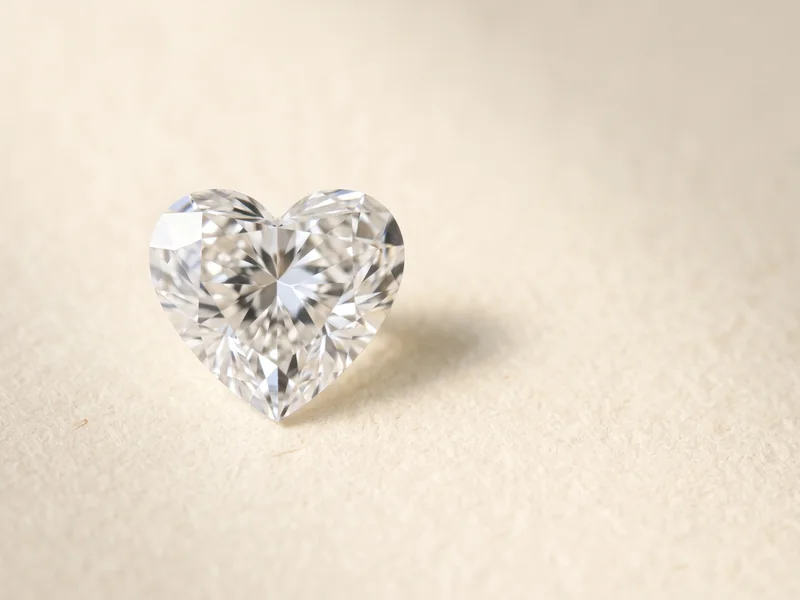 Diamond ShapesHow Big Should a Heart-Shaped Diamond Be to Show Its Shape?Diamond ShapesUnderstanding Diamond Shapes
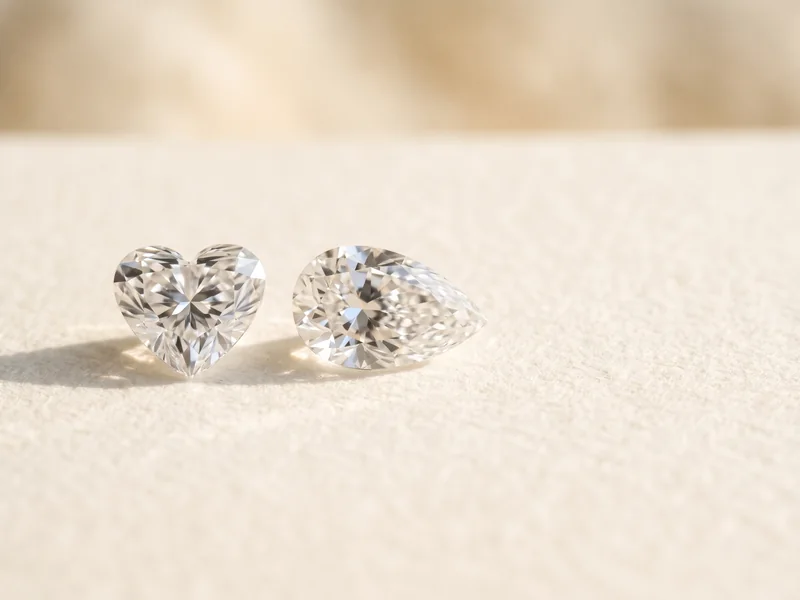 Diamond ShapesHeart vs Pear Shaped Diamonds
 Diamond Anatomy & LightDiamond Symmetry vs Optical Symmetry
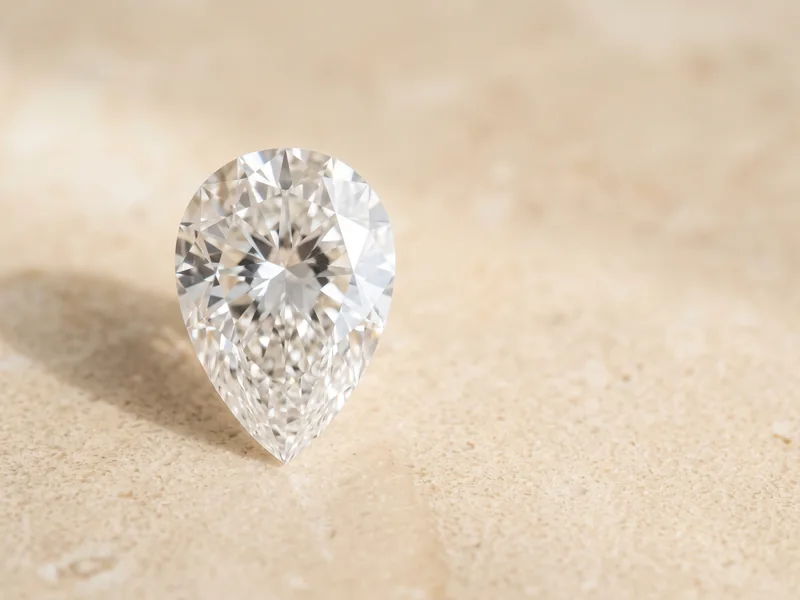 Diamond ShapesHow to Judge Pear Diamond Symmetry
Explore more
More guides on this topic
Education