
- Education
- Diamond Shapes
- How to Judge Marquise Diamond Symmetry: Points, Wings and Bow-Tie
Diamond shapes
How to Judge Marquise Diamond Symmetry: Points, Wings and Bow-Tie
A marquise has two points and a long, narrow outline, so even small errors show. Here is how to judge marquise diamond symmetry yourself, from the axis and wings to the bow-tie and the grade on the report.
 Reviewed by Raj Sood, Graduate Gemologist (GIA), AJP (GIA)Master jeweller and Graduate Gemologist (GIA) · reviewed 4 November 2026
Quick answer
Good marquise diamond symmetry means the two points line up on one axis, both wings curve equally and the facets mirror each other side to side and end to end. Check it by eye in a face-up photo or 360° video, look for Excellent or Very Good symmetry on the report, and watch for a fixed dark bow-tie.
What is marquise diamond symmetry?
A marquise is a long, boat-shaped diamond with a point at each end and gently curved sides. It is a modified brilliant cut, meaning it uses the triangular and kite-shaped facets of a round brilliant rearranged around an elongated outline, usually 56 of them. Its other name, navette, is French for 'little boat'. Our complete marquise cut diamond guide covers the history, sizes and colour choices; this page is only about symmetry.
Symmetry is how precisely the two sides and the two ends of a diamond mirror each other. A marquise has two lines of symmetry: the long axis, running from point to point, and the short axis, crossing the widest part. Good marquise diamond symmetry means the stone mirrors cleanly across both lines, in its outline and in the placement of every facet.
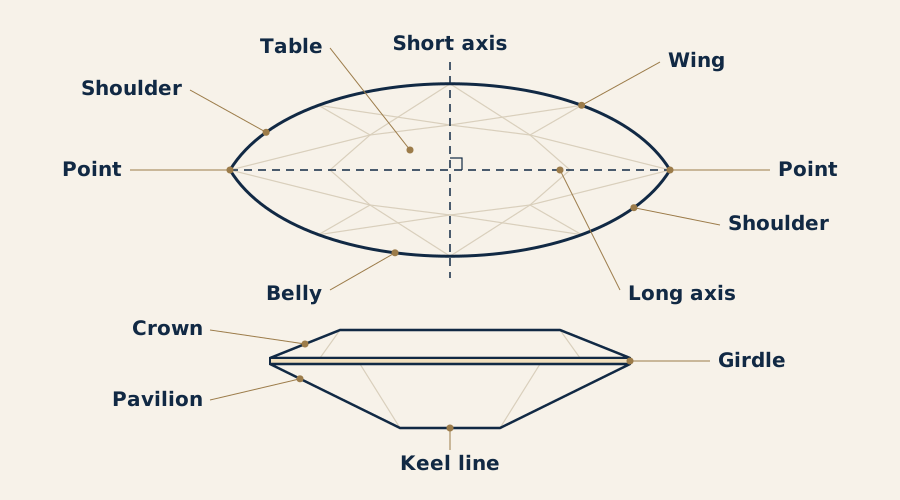
To judge it, you need names for the parts:
- Points (tips): the two sharp ends, the thinnest and most fragile parts of the stone.
- Wings: the long curved sides running between the points.
- Shoulders: the part of each wing nearest a point, where the curve starts to tighten.
- Belly: the widest section across the middle.
- Table: the large flat facet on top.
- Keel line: a ridge along the bottom of the pavilion (the lower half), used on many elongated cuts in place of a single point culet.
Why does symmetry matter more here than in a round? A round brilliant has many lines of symmetry and no ends, so small errors average out. A marquise has two points your eye compares instantly, on a long narrow outline that magnifies any bend. There is a practical side too. Diamond is 10 on the Mohs hardness scale, with a refractive index of about 2.42, but hardness is not toughness: an uneven girdle (the thin outer edge) at one point can leave a knife-thin tip that chips more easily. Any term here you have not met is explained in our plain-English jewellery glossary.
How do you judge marquise diamond symmetry by eye?
You can judge most of a marquise's symmetry yourself, face-up (looking straight down at the table), from a clear photo or video. Turn the stone so one point is at 12 o'clock and the other at 6 o'clock, then work through these checks:
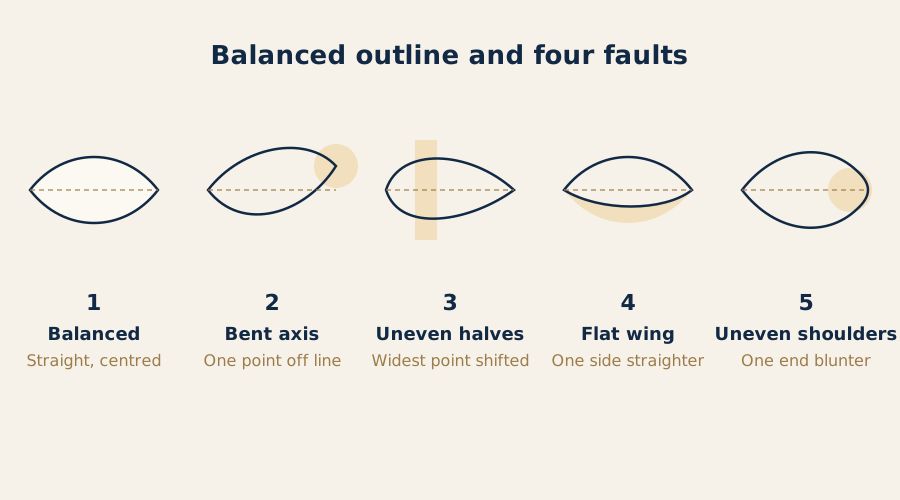
- Points on one axis: imagine a straight line from tip to tip. It should pass through the centre of the table with no curve or kink, so the stone does not look bent like a banana.
- Equal halves: the widest point should sit exactly halfway along the length. If it sits closer to one end, the stone starts to look like a stretched pear.
- Matching marquise diamond wings: both sides should curve by the same amount. A flat wing on one side and a fuller one on the other is one of the most common faults.
- Even shoulders: the curve should tighten into each point at the same rate. Uneven shoulders make one end look fatter or blunter.
- Centred table: the table should sit an even distance from both wings and both points.
- Crisp, matching tips: both points should come to a clean tip. One sharp point and one slightly rounded or thick point often means the cutter saved weight at one end.
- Level from the side: in profile, both points should sit at the same height and the keel line should run straight underneath.
Photos are taken at a single angle and can be cropped or tilted, so use a video as well. Our guide on reading a diamond's 360° video explains where to pause and what to watch as the stone rotates. The same axis idea works for other pointed shapes: the heart symmetry checklist and the pear diamond symmetry checks both start from a central line through the point.
What does a marquise diamond symmetry grade tell you?
Labs such as GIA and IGI give every polished diamond a symmetry grade: Excellent, Very Good, Good, Fair or Poor. For a round, GIA also gives an overall cut grade. For fancy shapes like the marquise it does not, so the polish and symmetry grades, plus the measurements and proportions, are the only cut information on the report.
The grade is assessed under 10× magnification and mainly looks at facet-level precision: whether the table and keel line are centred, whether crown and pavilion facets line up, whether facets are misshapen or missing, whether there are extra facets, and whether the girdle is even. Outline balance is taken into account, but the grade is a summary, not a picture. Two marquise diamonds with the same Very Good grade can look quite different on the hand.
| Symmetry grade | What it usually means in a marquise | For a centre stone |
|---|---|---|
| Excellent | Very hard to find faults at 10×; outline usually well balanced | Shortlist |
| Very Good | Small deviations, usually invisible face-up | Shortlist; often good value |
| Good | Faults visible at 10×; outline imbalance sometimes noticeable | Possible, but check carefully by eye |
| Fair / Poor | Obvious misalignment or outline faults | Usually avoid |
Treat the grade as a filter, not a final answer. Shortlist Excellent and Very Good, then judge the outline yourself. Our page on what each symmetry grade means goes through the lab criteria in more detail.
Is the bow-tie in a marquise diamond a symmetry problem?
Most marquise diamonds show a bow-tie: a darker band running across the belly, at right angles to the length. It happens because the pavilion facets under the widest part sit at angles that let some light leak out the bottom instead of returning to your eye. The bow-tie is not part of the symmetry grade. It is mainly about proportions, and partly about optical symmetry, which is how evenly the pattern of light and dark spreads across the stone.
- Faint and moving: a soft grey band that shifts as the stone tilts is normal and adds contrast.
- Dark and fixed: a black band that stays put in every position points to poor proportions. Avoid it.
- Lopsided: a bow-tie heavier on one side, or one dark wing and one bright wing, usually means the facets on each side are not mirrored. That is a real symmetry problem, even if the report says Very Good.
As a rough guide, many well-cut marquise diamonds sit at a total depth of about 58–62% and a table of about 53–63% of the width, but how the stone looks matters more than any single number. The difference between the symmetry printed on the report and the light pattern you actually see is explained in physical symmetry versus optical symmetry.
Not sure which one is right?
Send us the stones you are looking at and our gemologist will tell you which to choose and why.
How does the marquise diamond ratio affect symmetry?
The length-to-width ratio is the length (tip to tip) divided by the width (across the widest point), taken from the report's measurements. A 10.0 × 5.0 mm stone has a ratio of 2.00. Ratio is a matter of taste rather than a symmetry grade, but it changes how easily you notice symmetry faults. A slim marquise magnifies any bend along the long axis; a wide one hides small bends but starts to lose the classic boat shape.
| Ratio | How it looks | Effect on symmetry |
|---|---|---|
| Below 1.75 | Wide and full, softer points | Hides small bends; points can look blunt |
| 1.75–1.85 | Slightly full, still clearly marquise | Forgiving and easier to balance |
| 1.85–2.10 | Classic boat shape | The range most people choose; faults show clearly towards the upper end |
| Above 2.10 | Long and slim, sharp points | Any curve in the axis is obvious; points are more exposed |
For a sense of size, a 1 carat marquise at a ratio of about 2.00 measures roughly 10 × 5 mm face-up, which is why the shape looks large for its weight. Our marquise ratio guide with measured examples goes further on choosing a ratio for your hand.
What are the most common marquise symmetry faults?
These are the faults that come up most often when you compare marquise diamonds, roughly in order of how much they show once the stone is set:
| Fault | What you see | How much it matters |
|---|---|---|
| Bent axis | Points not on one straight line; the stone looks curved | High: very visible on the hand |
| Uneven halves | Widest point closer to one end; one half longer | Medium to high |
| Flat or bulging wing | One side straighter or fuller than the other | Medium |
| Uneven shoulders | One end looks fatter or blunter | Medium |
| Tilted points | In profile, one tip sits higher than the other | Medium; complicates setting |
| Off-centre table | Table slides towards one wing or one point | Low to medium |
| Off-centre keel line | Uneven light pattern; seen at 10× or in video | Low to medium |
| Very thin girdle at a point | A knife-edge tip | High for durability |
Many of these faults come from the cutter keeping weight. Leaving one wing a little fuller or one point a little thicker saves carat weight from the rough crystal, and carat weight drives price. The thin-point fault is the one to take most seriously, because it affects durability, not just looks. Check the girdle description on the report: 'extremely thin' at the points is a warning. Our guide to keeping marquise points safe explains girdle thickness and the settings that shield the tips.
How does marquise symmetry compare with pear and heart diamonds?
| Marquise | Pear | Heart | Oval | Round | |
|---|---|---|---|---|---|
| Lines of symmetry | 2 | 1 | 1 | 2 | Many |
| Points | 2 | 1 | 1, plus a cleft | None | None |
| Check first | Both tips on one axis | Point centred below the round end | Even lobes, centred cleft | Even ends, no flat sides | Facet alignment |
| Typical ratio | 1.85–2.10 | 1.45–1.75 | 0.90–1.10 | 1.30–1.50 | 1.00 |
| Bow-tie | Common | Common | Possible | Common | No |
The marquise is the only common shape with two points, so it is the only one where you check two tips against each other. A pear has just one point, so its check is about that point sitting directly below the centre of the rounded head; our marquise and pear compared side by side page covers the trade-offs in looks and wear. If you like the length of a marquise but want softer ends, the marquise versus moval comparison looks at the newer moval cut, and the guide to every diamond shape puts all the outlines together.
Related guideMarquise vs Pear DiamondsCan the setting hide poor marquise symmetry?
A setting cannot fix symmetry, but it changes how much you notice. V-claws (V-shaped claws that wrap each point) cover the very tips, so a slightly blunt or uneven point shows less, and they protect the thinnest parts of the stone. They do not hide a bent axis or a flat wing: those show in the outline between the claws.
- Six claws: a V-claw at each point and two claws on each wing. The most common choice and the most forgiving of small outline differences.
- Bezel: a rim of metal following the full outline. Very secure, but it traces every curve, so any imbalance between the wings is emphasised.
- Halo: a frame of small diamonds that makes the centre look larger. It also outlines the shape, so uneven shoulders become easier to see.
- East-west: the marquise set sideways across the finger. The eye judges left-right balance very readily, so matched wings matter even more.
Side profile matters to the setter too. If one point sits higher than the other, the claws have to be adjusted so the stone sits level and neither tip is left exposed. See marquise setting styles with examples for how each one looks on the hand.
Is Excellent symmetry worth paying more for? Natural vs lab-grown marquise diamonds
Marquise diamonds are cut from both natural and laboratory-grown diamond. Lab-grown diamonds are real diamond, with the same hardness and refractive index, grown in a laboratory rather than mined. They cost much less than natural diamonds and are easy to find in larger sizes. The symmetry checks are identical for both, and both should come with an independent grading report from a lab such as GIA or IGI that states whether the stone is natural or lab-grown.
| 1 ct marquise, G–H, VS | Approximate price range (AUD) |
|---|---|
| Lab-grown | about $800–$2,500 |
| Natural | about $5,000–$12,000 |
These are broad ranges only, and prices move with the market and the exact grades. Marquise diamonds usually cost less per carat than rounds of the same weight, colour and clarity. Within marquise stones, carat, colour and clarity move the price far more than the symmetry grade, so stepping up from Good to Very Good or Excellent symmetry is usually a modest difference. For a centre stone, Very Good symmetry with a balanced outline by eye is a sensible target; pay extra for Excellent only if the stone also looks better. A Good-symmetry stone can still suit side stones or cluster designs, where small differences do not show. Our marquise sizes and prices in Melbourne page has more on what drives the cost.
Shop marquise diamonds: natural and lab-grown
How to check marquise diamond symmetry step by step
- Read the report. Confirm the shape, measurements, polish and symmetry grades, girdle description, and whether the diamond is natural or lab-grown.
- Shortlist by grade. For a centre stone, start with Excellent or Very Good symmetry.
- Work out the ratio. Divide length by width; most people prefer about 1.85–2.10.
- Check the axis. On a face-up photo, lay a ruler tip to tip and another across the widest part. They should cross in the centre at a right angle.
- Compare the wings and shoulders. Both sides should curve equally and both ends should taper at the same rate.
- Watch the video. Use the tips on what to pause on in a diamond video to check for a fixed or lopsided bow-tie.
- Check the points. Avoid an extremely thin girdle, chips or inclusions (internal features) near either tip.
- Plan the setting. Make sure both points will be protected by V-claws or a bezel before you commit to the stone.
Free consultation
Talk to a gemologist
Compare stones in person or online with Raj Sood, Graduate Gemologist (GIA), AJP (GIA).
Book a consultationFAQ
Common questions
What is a good symmetry grade for a marquise diamond?
Excellent or Very Good for a centre stone. Then check the outline by eye, because the grade alone cannot show whether the two points line up on one axis.
Why does my marquise diamond look crooked?
Usually because the points are not on the same axis or one wing is flatter than the other. Sometimes it is the setting: a stone held at a slight angle can look bent, which a jeweller can check and adjust.
Is the bow-tie in a marquise diamond a defect?
Not on its own. A faint bow-tie that moves as the stone tilts is normal; a dark band that never moves, or one heavier on one side, is worth avoiding.
Does symmetry affect marquise diamond price in Australia?
A little. Carat, colour and clarity move the price much more, so stepping up from Good to Very Good or Excellent symmetry is usually a modest difference.
Are lab-grown marquise diamonds cut with better symmetry?
Not automatically. Lab-grown and natural marquise diamonds are cut the same way and graded on the same symmetry scale, so each stone needs to be judged on its own.
Can a marquise diamond be recut to improve its symmetry?
Sometimes. A cutter can rebalance the wings or straighten the axis, but it costs carat weight and is not always worthwhile, so the specific stone needs to be assessed first.

Ask a gemologist
Not sure which diamond to choose?
Raj Sood is a Graduate Gemologist (GIA) and master jeweller. Bring the stones you are considering, or send the reports, and he will tell you honestly which one is better and why.
Keep learning
Related guides
 Diamond ShapesMarquise Diamond Length-to-Width Ratio
 Diamond 4Cs & GradingDiamond Symmetry Grades ExplainedDiamond ShapesProtecting Marquise Diamond Points
 Diamond ShapesHow to Judge Pear Diamond SymmetryDiamond ShapesUnderstanding Diamond Shapes
 Diamond ShapesMarquise Cut Diamonds MelbourneDiamond ShapesMarquise vs Pear Diamonds
 Diamond Anatomy & LightDiamond Symmetry vs Optical Symmetry
Explore more
More guides on this topic
Education