
- Education
- Diamond Shapes
- How to Judge Pear Diamond Symmetry: A Gemmologist's Checklist
Diamond shapes
How to Judge Pear Diamond Symmetry: A Gemmologist's Checklist
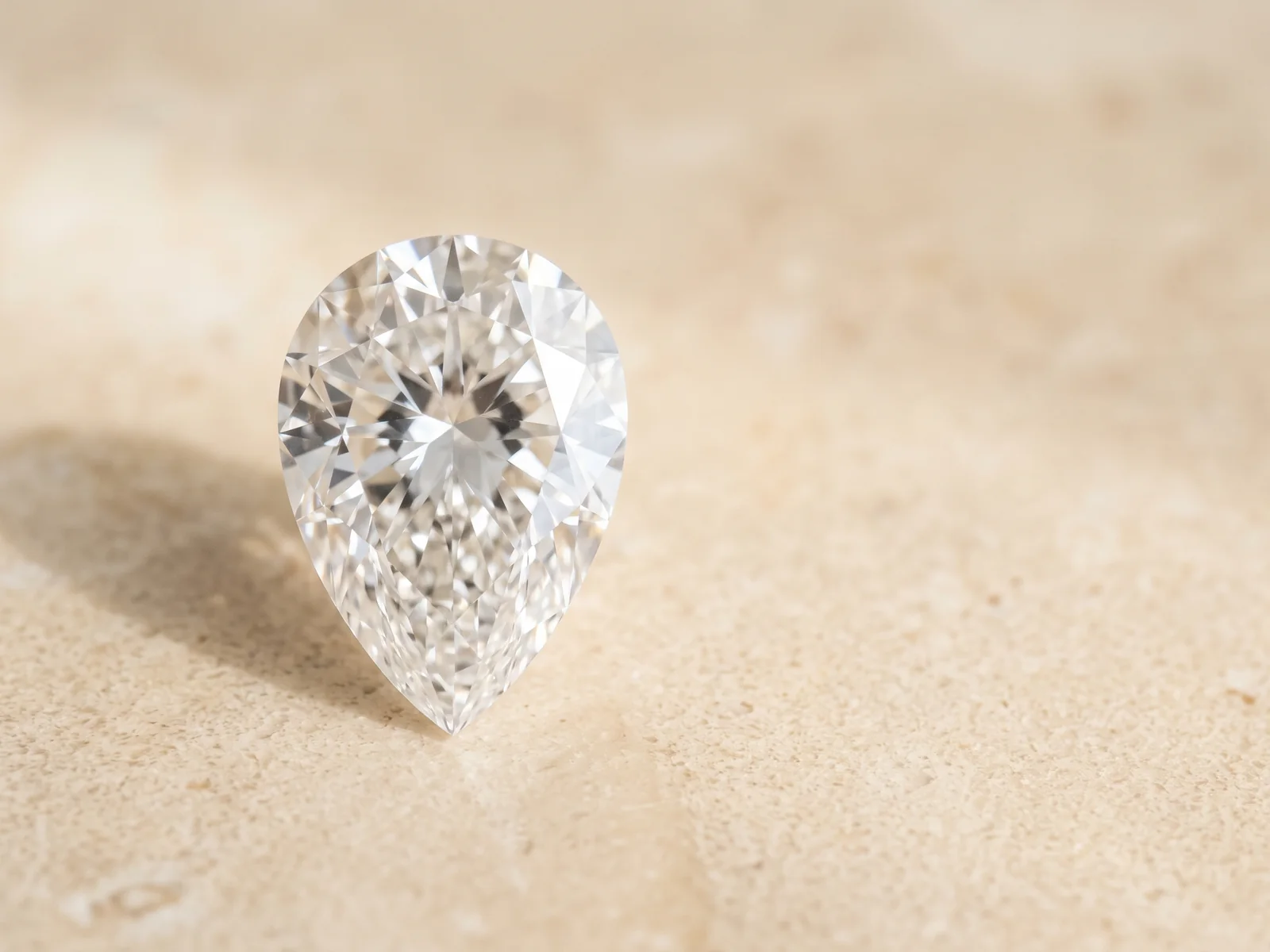
A pear is two mirrored halves, so small symmetry faults are easy to see once it is on a hand. This guide shows how to judge pear diamond symmetry, from the report grade to the shoulders, tip and bow-tie.
 Reviewed by Raj Sood, Graduate Gemologist (GIA), AJP (GIA)Master jeweller and Graduate Gemologist (GIA) · reviewed 4 November 2026
Quick answer
Pear diamond symmetry is how well the two halves of a pear mirror each other along a line from the tip to the centre of the head. Check that the tip sits on that line, both shoulders are level, the wings curve evenly and any bow-tie is centred. Aim for Excellent or Very Good symmetry, then confirm by eye.
What is pear diamond symmetry?
Pear diamond symmetry is how closely the left and right halves of a pear shaped diamond mirror each other. Picture a straight line running from the tip, through the middle of the stone, to the centre of the rounded end. In a well-balanced pear, everything on one side of that line has a matching partner on the other side: the same curve, the same width, the same facet pattern.
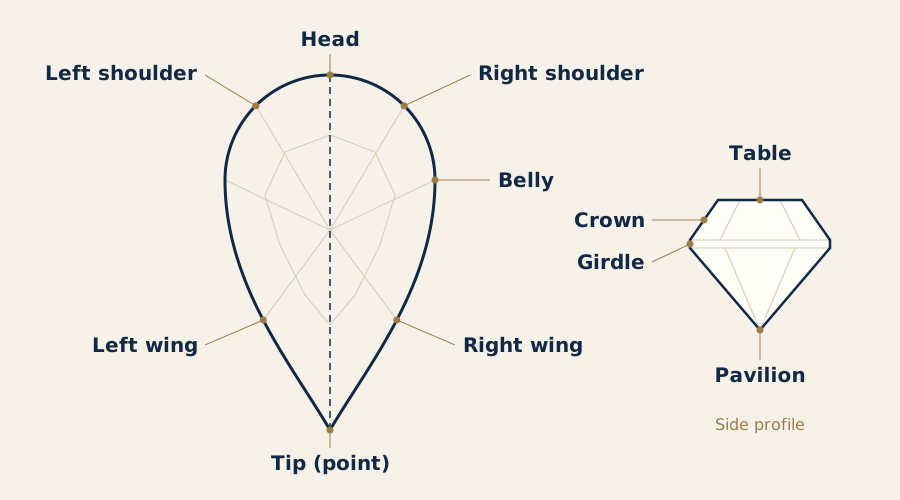
A pear has five parts worth knowing by name. The head is the rounded end. The shoulders are where the head curves into the sides. The wings are the long sides that sweep down to the point. The belly is the widest area across the middle, and the tip (or point) is the sharp end. Symmetry is really a question of whether each of these parts matches its twin.
The pear is a modified brilliant cut: it uses the triangular and kite-shaped facets of a round brilliant, rearranged around a teardrop outline. Most pears have about 56–58 facets, depending on the cutter and whether there is a culet (a tiny flat facet at the bottom). Diamond's high refractive index of about 2.42 gives pears strong sparkle, but it also means any misplaced facet shows up as an uneven flash pattern.
If you are still deciding on the shape itself, our complete pear cut diamond guide covers colour, clarity and size, and our overview of how the pear fits among every diamond shape puts it in context. The pear also belongs to the wider family of elongated diamond cuts, which share many of the same symmetry checks. Any unfamiliar word on this page is also explained in the GemTrove jewellery glossary.
Does the symmetry grade on a report tell you if a pear is balanced?
Only partly. Labs such as GIA and IGI give every diamond a symmetry grade: Excellent, Very Good, Good, Fair or Poor. That grade mainly measures the precision of the faceting: whether facets meet neatly at their points, whether the table (the large flat top facet) and culet are centred, whether facets are the right shape, and whether there are extra facets. It is a technical judgement of how accurately the stone was cut.
| Symmetry grade | What the lab is saying | What it means for a pear |
|---|---|---|
| Excellent | Facet alignment is very precise under 10× magnification | A strong start; still check the outline by eye |
| Very Good | Minor deviations, hard to see without magnification | Usually looks identical to Excellent face-up |
| Good | Noticeable deviations under magnification | Can be fine, but inspect the tip and shoulders closely |
| Fair | Obvious deviations, sometimes visible to the eye | Often shows a tilted tip or uneven flash pattern |
| Poor | Major deviations | Usually looks lopsided; most people avoid it |
The catch is that the grade is not a full verdict on whether the outline looks balanced. A pear can grade Excellent for symmetry and still have one shoulder slightly higher, or wings that are a touch flatter on one side. GIA also gives no overall cut grade to fancy shapes like the pear, so the judgement of shape is left to you. Our page on what each symmetry grade on a report means goes into the lab criteria in detail.
There is also a difference between the facet symmetry a lab grades and the way light actually patterns through the stone. That second idea, often called optical symmetry, explains why two pears with the same grade can look different. See the difference between facet symmetry and optical symmetry for the full picture.
How do you check pear diamond symmetry by eye?
Look at the stone face-up, tip pointing down, and imagine the centre line from the tip to the middle of the head. Then work through these checks:
- Tip alignment: the tip sits exactly on the centre line. If it drifts left or right, the pear looks as if it leans.
- Shoulders: both shoulders sit at the same height and curve the same way. One higher shoulder makes the head look tilted.
- Wings: both sides sweep down in a smooth, even curve. Watch for one wing that bulges while the other runs straight.
- Belly: the widest point is the same distance from the tip on both sides, so the stone does not look pinched on one side.
- Head: a smooth semicircle, not flattened, squared off or slightly pointed.
- Facet pattern: the flashes and dark facets on one half mirror the other, including any bow-tie across the middle.
Photos are taken under controlled light and can flatter a stone, so a moving view is more honest. A 360° video shows the facet pattern changing as the stone turns, which is where uneven halves become obvious. Our guide to reading a diamond from a 360-degree video explains where to pause and what to look for frame by frame.
What do high, low or uneven shoulders do to a pear diamond?
The shoulders decide much of a pear's personality, and they are the area where asymmetry most often hides. Cutters sometimes leave extra weight in the shoulders to keep the carat figure up, which can make them bulky or uneven. Here is how the common shapes read:
| Shoulder shape | How it looks | Verdict |
|---|---|---|
| Rounded and level | Smooth head flowing evenly into the wings | The classic, balanced pear |
| High (full) shoulders | Broad, round head; stone can look chunky | A taste choice if both sides match |
| Low (narrow) shoulders | Head looks small, wings droop | Can look thin or tired |
| Flat or squared shoulders | Head looks boxy rather than round | Usually a cutting compromise |
| Uneven shoulders | One side higher or fuller than the other | A true symmetry fault; most visible of all |
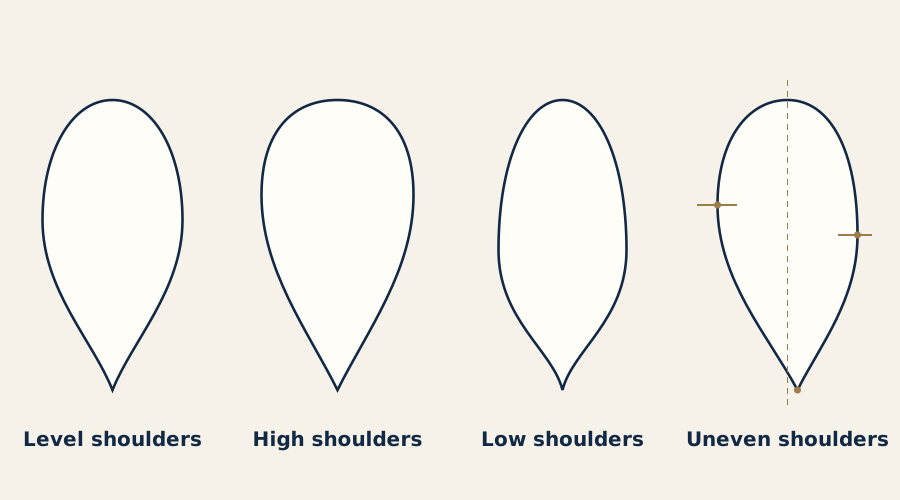
High or low shoulders are a matter of preference, as long as both sides match. Uneven shoulders are not a preference, they are a flaw in the outline. On a ring, the claws usually sit at or near the shoulders, so a mismatch can become more obvious once the stone is set and the eye compares claw positions.
Not sure which one is right?
Send us the stones you are looking at and our gemologist will tell you which to choose and why.
What pear diamond ratio looks most balanced?
The length-to-width ratio is the length (tip to the top of the head) divided by the width (across the belly). Ratio is not symmetry, but it changes how symmetry reads: a very slim pear exaggerates any lean in the tip, while a very wide one exaggerates differences between the shoulders.
| Ratio | How it looks | Symmetry watch point |
|---|---|---|
| Below 1.45 | Short and wide, close to an oval with a point | Check that the shoulders are not flat or bulky |
| 1.45–1.55 | Full, rounded pear | Shoulder height and belly width |
| 1.55–1.65 | The classic teardrop | All five checks equally |
| 1.65–1.75 | Slim and elegant | Tip alignment and straight-looking wings |
| Above 1.75 | Long and narrow, closer to a marquise feel | Any lean in the tip is very visible |
As a rough guide, many well-cut pears sit at a total depth of about 58–64% and a table of about 53–63% of the width. Too deep and the stone looks smaller face-up for its weight; too shallow and it can lose brightness. If you are weighing a pear against a smoother outline, our oval vs pear comparison shows how the two shapes differ at similar ratios.
How does the pear diamond bow-tie relate to symmetry?
Most pears show a bow-tie: a darker band across the belly, shaped a little like a bow tie, where light leaks out instead of returning to your eye. Some contrast is normal and gives a pear its depth. What matters for symmetry is the shape and position of that band.
- Centred and even: both halves of the bow-tie are the same size and meet on the centre line. This is a sign of good optical balance.
- Lopsided: one side of the bow-tie is bigger or darker, which usually means the pavilion facets (the lower facets) are not mirrored.
- Fixed and black: a dark band that stays put in every position points to poor proportions, whatever the symmetry grade.
- Faint and moving: a bow-tie that comes and goes as the stone tilts is generally acceptable.
Pears do not show a hearts and arrows pattern the way some ideal-cut rounds do, so the bow-tie and the overall flash pattern are your main clues to optical balance. We explain how optical symmetry shapes light return in more depth on a separate page.
How does pear symmetry compare with heart, marquise and oval diamonds?
Every shape with a centre line can be judged the same basic way, but each one has its own weak spots.
| Pear | Heart | Marquise | Oval | |
|---|---|---|---|---|
| Mirror line | Tip to centre of head | Point to cleft | Tip to tip, plus side to side | Lengthwise and crosswise |
| Typical ratio | 1.45–1.75 | 0.90–1.10 | 1.85–2.10 | 1.30–1.50 |
| Main symmetry fault | Tilted tip, uneven shoulders | Uneven lobes, off-centre cleft | Tips not on one line | Flat or bulging sides |
| Bow-tie | Common | Possible | Common | Common |
| Fragile points | One tip | Point and cleft | Two tips | None |
The pear sits between the heart and the marquise. Like a heart, it has one rounded end that must be balanced; our heart symmetry checklist uses a similar fold test on the lobes, and the guide to heart and pear shapes compared point by point shows how the two outlines differ. Like a marquise, it has a sharp tip that must sit dead centre; the guide to judging marquise symmetry tip to tip shows how a marquise adds a second point to line up. For the look and feel of the two shapes, see marquise and pear diamonds side by side.
Related guideHow to Judge Marquise Diamond SymmetryCan a setting hide small pear symmetry faults?
A setting can soften a minor fault, but it cannot correct a badly lopsided stone. It is also the first line of defence for the tip, the thinnest and most exposed part of the pear. Diamond is 10 on the Mohs hardness scale, but hardness is not toughness: a thin tip can still chip if it takes a knock.
- V-claw at the tip: a V-shaped claw wraps and protects the point. It also covers the very end, so a slight lean in the tip is less obvious.
- Claw placement: claws set symmetrically around the head make the shoulders look level. Claws placed to suit an uneven stone draw attention to it.
- Halo: a ring of small diamonds frames the outline and can disguise small shoulder differences, though it will show a strongly tilted tip.
- Bezel: a thin metal rim traces the outline exactly, so it tends to highlight any asymmetry rather than hide it. Choose a very well-matched stone for a bezel.
Our guide to pear diamond settings that protect the tip shows each style with examples, and the main pear guide's colour and clarity advice helps you match the stone to the metal.
Does pear diamond symmetry affect price, natural or lab-grown?
Yes, though less than carat, colour and clarity. Two pears with the same weight and grades can differ in price depending on how well the outline is cut, and stones with a Good or Fair symmetry grade are usually priced below Excellent or Very Good equivalents. A well-balanced pear often weighs a little less than a chunkier one from the same rough, because the cutter has given up weight to get the shape right.
Symmetry is judged in exactly the same way for natural and laboratory-grown diamonds. Lab-grown diamonds are real diamond with the same hardness and refractive index, grown in a laboratory rather than mined, and they cost much less than natural. Neither type is automatically better cut, so apply the same checks to both. The grading report will state whether the stone is natural or lab-grown.
| 1 ct pear, G–H, VS, EX/VG symmetry | Approximate price range (AUD) |
|---|---|
| Lab-grown | about $1,000–$3,000 |
| Natural | about $6,000–$15,000 |
These are broad ranges only; prices move with the market and with the exact grades and proportions. A pear usually costs less per carat than a round of the same weight, colour and clarity; our page on how price per carat varies between diamond shapes sets out the pattern across the main cuts.
Browse pear diamonds: natural and lab-grown
How to judge a pear diamond's symmetry: step by step
- Read the report. Note the symmetry and polish grades, the measurements and whether the diamond is natural or lab-grown. Aim for Excellent or Very Good symmetry.
- Work out the ratio. Divide the length by the width; most people prefer about 1.45–1.75.
- Draw the centre line. On a face-up photo, run a line from the tip through the middle of the head and check the tip sits on it.
- Compare the halves. Check shoulder height, wing curves and belly width on each side. Flip the image to make differences easier to see.
- Watch a 360° video. Look for a bow-tie that is lopsided or stays dark, and for flash patterns that differ between halves.
- Think about the setting. Plan a V-claw, halo or bezel that protects the tip and suits how closely the stone's halves match.
Free consultation
Talk to a gemologist
Compare stones in person or online with Raj Sood, Graduate Gemologist (GIA), AJP (GIA).
Book a consultationFAQ
Common questions
What symmetry grade should a pear diamond have?
Excellent or Very Good is what most people aim for, as the two usually look the same face-up. Good can be acceptable if the outline looks balanced by eye, but check the tip and shoulders carefully.
Can a pear diamond with Excellent symmetry still look lopsided?
Yes. The symmetry grade mainly measures facet precision, not whether the outline looks balanced. A pear can grade Excellent and still have one shoulder slightly higher or a tip that leans a little.
What are shoulders on a pear diamond?
The shoulders are where the rounded head curves into the long sides, or wings. They should sit at the same height and curve the same way on both sides.
Is a bow-tie bad in a pear diamond?
Not necessarily. A faint, centred bow-tie that changes as the stone moves is normal; a dark band that stays fixed or sits more on one side suggests poor proportions or uneven facets.
Which way should a pear diamond point on a ring?
Traditionally the tip points towards the fingertip, which tends to make the finger look longer. Some people prefer it reversed; symmetry checks are the same either way.
Do lab-grown pear diamonds have better symmetry than natural ones?
Not as a rule. Both are cut by the same methods and graded on the same symmetry scale, so judge each lab-grown or natural pear on its own report and video.
Terms in this guide

Ask a gemologist
Not sure which diamond to choose?
Raj Sood is a Graduate Gemologist (GIA) and master jeweller. Bring the stones you are considering, or send the reports, and he will tell you honestly which one is better and why.
Keep learning
Related guides
 Diamond ShapesPear Cut Diamonds
 Diamond ShapesHow to Judge Marquise Diamond Symmetry
 Diamond Anatomy & LightDiamond Symmetry vs Optical Symmetry
 Engagement Rings & SettingsBest Settings for Pear DiamondsDiamond ShapesUnderstanding Diamond Shapes
 Diamond 4Cs & GradingDiamond Symmetry Grades ExplainedDiamond ShapesOval vs Pear DiamondsDiamond ShapesMarquise vs Pear Diamonds
Explore more
More guides on this topic
Education