
- Education
- Diamond 4Cs & Grading
- Polish and Symmetry: How These Diamond Grades Work
Diamond 4Cs & Grading
Polish and Symmetry: How These Diamond Grades Work
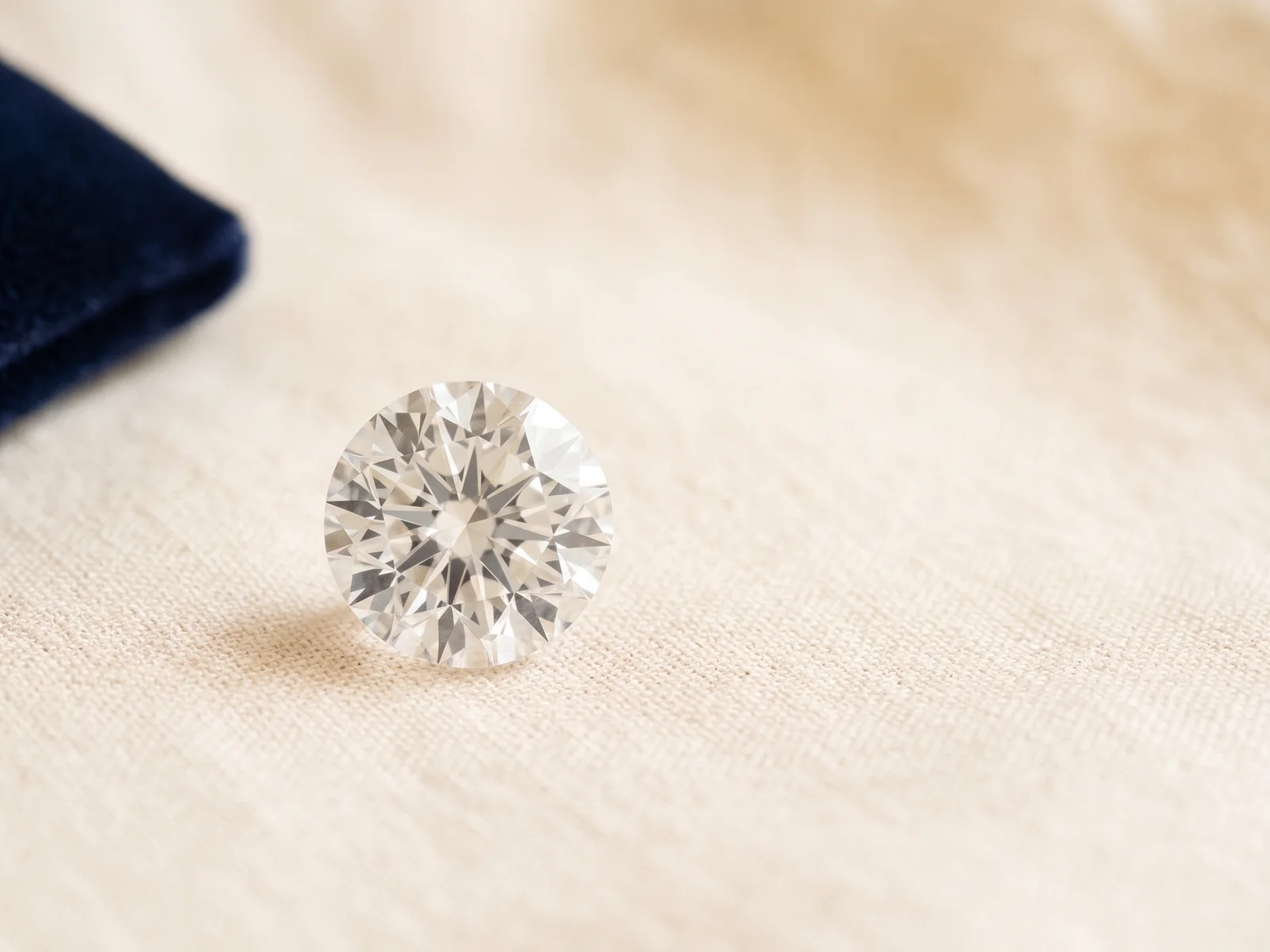
Polish and symmetry are the two finish grades on every diamond report, and they quietly shape the cut grade and the price. Here is what they measure, what you can actually see, and where the grade is worth paying for.
 Reviewed by Raj Sood, Graduate Gemologist (GIA), AJP (GIA)Master jeweller and Graduate Gemologist (GIA) · reviewed 4 November 2026
Quick answer
Polish and symmetry are two finish grades on a diamond report. Polish rates the smoothness of the facet surfaces; symmetry rates how precisely the facets are shaped, aligned and placed. Both run from Excellent to Poor, judged under 10× magnification. Very Good or Excellent in both is a sensible target; Good or lower can start to dull sparkle.
What do polish and symmetry mean on a diamond report?
When a diamond is cut, the cutter does two separate jobs: they shape the facets (the flat, polished surfaces) into a pattern, and they polish each facet smooth. A grading laboratory such as GIA or IGI then grades how well each job was done. Polish describes the condition of the facet surfaces. Symmetry describes the precision of the facet shapes, their alignment and the overall outline.
Together they are called the finish grades. They are not one of the four headline grades in the 4Cs of colour, clarity, cut and carat, but they sit right below the cut grade on the report and feed into it. On a round brilliant they help decide the overall cut grade; on fancy shapes such as ovals, pears and emerald cuts, where GIA gives no overall cut grade, they are among the few cut-related grades you get at all.
Both are graded by a trained grader looking at the stone under a 10× loupe or microscope. That matters: a feature that only shows at 10× usually cannot be seen with the naked eye. If any of the terms on a report are new to you, our jewellery glossary defines them in plain English.
| Polish | Symmetry | |
|---|---|---|
| What it measures | Smoothness and condition of facet surfaces | Shape, alignment and placement of facets and outline |
| Typical faults | Polish lines, burn marks, abrasions, nicks, pits | Off-centre table or culet, misaligned facets, wavy girdle, uneven outline |
| Caused by | Polishing wheel, heat, handling | Planning and cutting accuracy, saving weight from the rough |
| Can it be fixed? | Often, by a light repolish with small weight loss | Only by recutting, usually with more weight loss |
| Effect on look | Rarely visible above Good | Can show as uneven sparkle or a lopsided outline at Good and below |
What are the diamond polish grades?
GIA and IGI use the same five words for polish: Excellent, Very Good, Good, Fair and Poor. The grade depends on how many polish features the grader sees at 10×, how large they are and where they sit. A feature on the table (the large top facet) counts for more than one tucked near the girdle (the thin outer edge).
| Polish grade | What the grader sees at 10× | Visible to the eye? |
|---|---|---|
| Excellent | No polish features, or only minute ones that are very hard to find | No |
| Very Good | A few small features, hard to see | No |
| Good | Features that are noticeable at 10× | Almost never |
| Fair | Obvious features at 10×; may slightly affect brightness | Sometimes, as faint haze |
| Poor | Prominent features; brilliance can be affected | Possibly |
The common polish features you will see listed in a report's comments or key to symbols are:
- Polish lines: fine parallel grooves left by the polishing wheel, usually invisible without magnification.
- Burn marks: a hazy patch where the surface overheated during polishing.
- Abrasions: tiny scuffs along facet junctions, often from stones rubbing together in a parcel.
- Nicks and pits: small chips or pinpoint holes on the surface.
- Lizard skin: a wavy, bumpy texture where a facet was polished across the grain of the crystal.
- Rough girdle: a grainy, uneven girdle surface.
- Surface grain lines: traces of the crystal's growth structure reaching the surface, related to internal and surface graining.
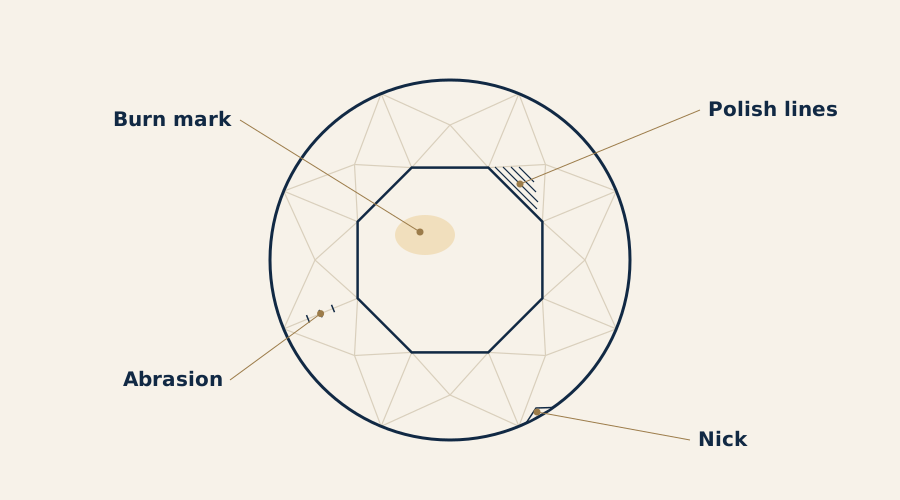
Our guide to each polish grade in detail shows how graders weigh these features. The short version: Excellent and Very Good polish look identical to the eye, and even Good polish is very rarely the reason a diamond looks dull.
What are the diamond symmetry grades?
Symmetry uses the same five-step scale, Excellent to Poor. Where polish is about surfaces, symmetry is about geometry: whether the facets meet where they should, whether the top and bottom halves line up, and whether the outline is even. The grader looks for these symmetry features:
- Off-centre table: the table sits closer to one edge than the other.
- Off-centre culet: the tiny point or facet at the bottom is not under the centre of the stone.
- Table and culet not parallel: the stone is slightly tilted, so one side is deeper.
- Crown and pavilion misaligned: the top and bottom facets do not line up at the girdle.
- Wavy or uneven girdle: the girdle rises and falls, or is thicker on one side.
- Out of round or uneven outline: a round is slightly oval, or the two halves of a fancy shape do not match.
- Misshapen, pointing or extra facets: facets that are the wrong shape, do not meet at a point, or were added to remove a flaw.
- Natural: a small patch of the original crystal surface left on the girdle to save weight.
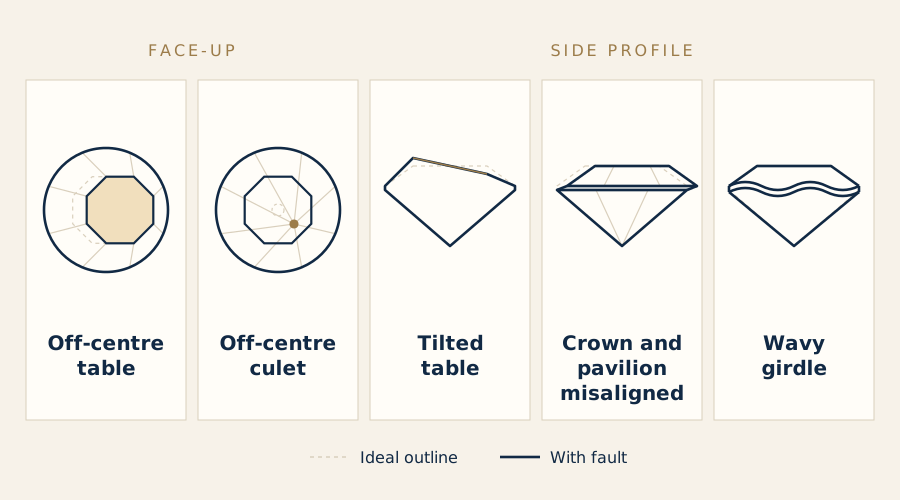
Many symmetry faults happen for a commercial reason. Cutters plan each stone to keep as much weight as possible from the rough crystal, and a slightly off-centre culet or a natural on the girdle can keep a stone above a weight point such as 1.00 carat. For a grade-by-grade symmetry breakdown, with examples of what each fault does to the face-up pattern, see our dedicated guide.
Related guideDiamond Symmetry Grades ExplainedDoes symmetry affect diamond sparkle?
It can, but less than most people expect, and polish affects it even less. Sparkle depends mainly on the cut proportions: the crown angle, pavilion angle, table size and depth. Those decide how much light returns to your eye. Symmetry decides how evenly that light is spread across the face of the stone.
Between Excellent and Very Good symmetry there is no difference most people can see, even side by side. At Good, a trained eye may notice that the pattern of light and dark looks a little uneven, or that one side of the stone flashes more than the other. At Fair and Poor, faults such as a tilted table or a badly off-centre culet can create a dull area or make the stone look slightly lopsided.
Polish works the same way at a smaller scale. A heavy burn mark or lizard skin can scatter light and look like a faint haze, but those stones rarely reach retail. Excellent, Very Good and Good polish are, for practical purposes, the same to the eye.
There is also a second idea called optical symmetry: how precisely the facets line up to create a crisp, repeating pattern, such as the hearts and arrows pattern seen through a special viewer in some round brilliants. A report's symmetry grade is not the same thing. Our guide to the difference between report symmetry and optical symmetry explains why two stones with Excellent symmetry can still show different patterns.
Not sure which one is right?
Send us the stones you are looking at and our gemologist will tell you which to choose and why.
How do polish and symmetry affect the cut grade?
For a standard round brilliant, GIA's overall cut grade (Excellent to Poor) is based on proportions, polish and symmetry together. Polish and symmetry act as a ceiling: a round with beautiful proportions but only Good symmetry cannot receive an Excellent cut grade. In practice, almost every round graded Excellent cut has Very Good or Excellent polish and symmetry.
When all three grades are Excellent, the trade calls it Triple Excellent or 3EX. It is a useful shorthand for a well-finished round, but it does not automatically mean the most attractive stone. Two 3EX rounds can still look different, because the cut grade covers a range of proportions. Treat 3EX as a good starting filter, then look at the stone or a 360° video.
Other labs use similar scales. IGI grades polish and symmetry from Excellent to Poor, and its reports for lab-grown rounds often carry an overall cut grade too. AGS reports, which you may still see on older stones, use a numbered 0 to 10 system in which 0 is called Ideal. Always compare grades within the same lab rather than across labs, because graders and standards are not identical.
Why symmetry matters more in fancy shape diamonds
For fancy shapes, the symmetry grade carries more weight for two reasons. First, there is no GIA overall cut grade, so polish and symmetry are the only cut-related grades printed on the report. Second, an uneven outline in a fancy shape is much easier to see than a tiny facet misalignment in a round.
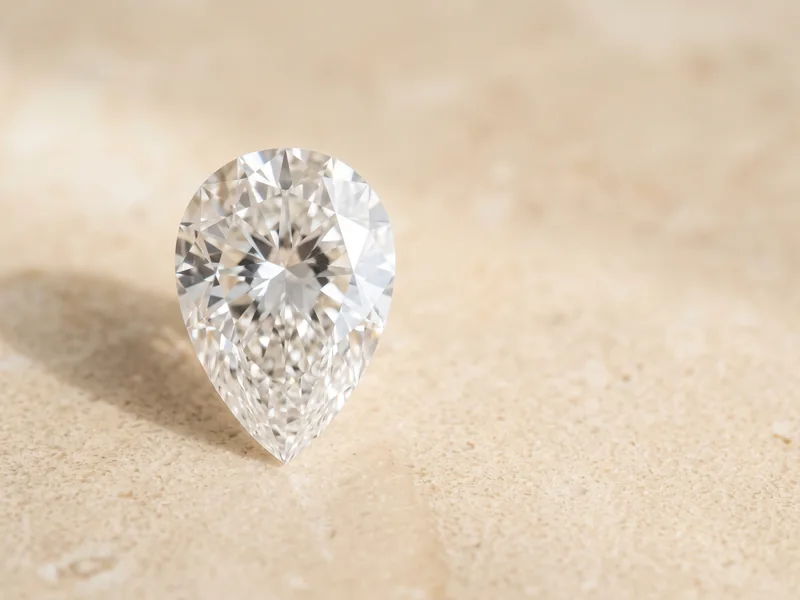
The catch is that the report's symmetry grade looks mostly at facet alignment and outline at 10×, not at whether the shape looks balanced on the hand. A pear can carry Excellent symmetry and still have one shoulder slightly higher than the other. For that reason you should judge the outline yourself:
- Pear: the point should sit directly in line with the centre of the rounded end, with matching shoulders. See our guide to judging symmetry in a pear.
- Marquise: both points should line up along one axis, with evenly curved wings. Our marquise symmetry checks walk through it.
- Heart: the two lobes should be the same size and height, with a centred cleft. Read about matching the lobes of a heart.
- Emerald, Asscher, cushion and radiant: corners should be even, and the step or brilliant pattern should look the same from side to side.
In a fancy shape, Very Good symmetry with an outline that looks balanced is usually a better choice than Excellent symmetry with an outline that does not.
Is Excellent polish and symmetry worth paying for?
Usually only up to a point. The price step between finish grades is real but modest compared with the steps in colour, clarity and carat. As a rough guide for a natural 1 carat round in the G to H, VS range, moving from Very Good to Excellent symmetry often adds somewhere around AUD 200 to 1,000, depending on the stone and the market at the time. In lab-grown diamonds the difference in dollars is much smaller, because the stones cost much less overall.
| Polish / symmetry | What it usually means | When it makes sense |
|---|---|---|
| Excellent / Excellent | Top finish; most likely to sit with an Excellent cut grade | Large rounds, or if you simply want every grade at the top |
| Excellent / Very Good or Very Good / Excellent | No visible difference from 3EX | The sweet spot for most rounds |
| Very Good / Very Good | Still looks the same to the eye | Good value, especially in fancy shapes |
| Good in either | Usually limits a round to Very Good cut or lower | Only after viewing the stone; often fine in small sizes |
| Fair or Poor | Faults may show as haze or uneven sparkle | Rarely sensible for a centre stone |
If you are working to a budget, the money saved by accepting Very Good finish is better spent on the grades you can see. Our guide on whether to spend on colour or clarity helps you decide where it goes. For diamonds between 0.25 and 0.4 carat, finish differences are even harder to see, so Very Good or Good can be perfectly reasonable.
Polish and symmetry in natural and lab-grown diamonds
Natural and laboratory-grown diamonds are cut and polished on the same equipment and graded on the same scale, so the grades mean exactly the same thing. The difference is in what you tend to find. Many lab-grown diamonds are cut for appearance rather than to save weight, because the rough is less costly, so Excellent polish and symmetry are very common. In natural diamonds, where every point of weight carries more value, you will see a wider spread of finish grades, including more Very Good and Good stones.
That does not make either one better. It simply means that in lab-grown you can usually have Excellent finish without much trade-off, while in natural you can often save by accepting Very Good. Our stock filters let you search natural and lab-grown stones separately by polish and by symmetry.
Browse diamonds by polish and symmetry grade
Side stones are a different story. The small diamonds in a halo, pavé band or cluster are usually sold as a group described by total carat weight terms like ctw and tcw, and they are not individually graded for polish or symmetry. Ask the jeweller about the quality of the side stones instead.
Polish and symmetry vs clarity and metal polish
Two mix-ups come up often. The first is between finish and clarity. Clarity grades inclusions (features inside the diamond) and blemishes (features on the surface). Polish features are a type of surface feature, and the boundary can be fine. Some features that sound like polish problems are actually clarity characteristics:
- Bearding along the girdle: tiny hair-like feathers running into the stone from the girdle, caused when it was rounded. Heavy bearding can lower clarity.
- Twinning wisps: streaks of pinpoints, clouds or feathers formed where the crystal changed direction as it grew.
- Etch channels: narrow tunnels dissolved into a natural diamond, usually along the grain.
- Graining: lines from the crystal structure that can show inside the stone or reach the surface, where they may affect the polish grade.
The second mix-up is the word polish itself. On a ring, polish describes the finish of the metal, such as a high-polish finish on a ring band, compared with brushed or hammered finishes. That has nothing to do with the polish grade on a diamond report.
How to check polish and symmetry: step by step
- Find the finish grades on the report. They sit under the cut grade, or near the top of the grading results for fancy shapes. Check the report number with the lab online.
- Set your floor. For most rounds, aim for Very Good or Excellent in both. For small stones under about 0.40 carat, Good can be acceptable.
- Read the comments and key to symbols. Look for notes such as extra facets, naturals or minor polish details, and where they are plotted.
- Compare like with like. Only compare grades from the same lab, and compare stones of similar colour, clarity and carat so the price step reflects finish alone.
- Look at the stone or a 360° video. Check that the sparkle looks even across the face and, for fancy shapes, that the outline is balanced.
- Put the rest of the budget where you can see it. Once finish is Very Good or better, weigh it against the rest of the grading report: colour, clarity and size.
Free consultation
Talk to a gemologist
Compare stones in person or online with Raj Sood, Graduate Gemologist (GIA), AJP (GIA).
Book a consultationFAQ
Common questions
What is the difference between polish and symmetry in a diamond?
Polish grades how smooth and clean the facet surfaces are. Symmetry grades how precisely the facets are shaped, aligned and placed, and how even the outline is.
Is Very Good symmetry good enough?
Yes, for most diamonds. Very Good and Excellent symmetry look the same to the naked eye, and a Very Good grade is often a little less expensive.
What does triple excellent mean?
Triple Excellent, or 3EX, means a round diamond has Excellent cut, Excellent polish and Excellent symmetry on its report. It is a useful filter, but stones within 3EX can still look different.
Can you see polish and symmetry with the naked eye?
Not at Excellent, Very Good or usually Good. Fair and Poor grades can sometimes show as a faint haze or uneven sparkle.
Can polish be improved after cutting?
Often, yes. A cutter can repolish facets to remove polish lines or burn marks with very little weight loss, but correcting symmetry usually means recutting and losing more weight.
Do lab-grown diamonds have better polish and symmetry?
Not inherently, as both are cut and graded the same way. Many lab-grown diamonds are cut to Excellent finish because saving weight matters less, so high grades are very common.
Terms in this guide

Ask a gemologist
Not sure which diamond to choose?
Raj Sood is a Graduate Gemologist (GIA) and master jeweller. Bring the stones you are considering, or send the reports, and he will tell you honestly which one is better and why.
Keep learning
Related guides
 Diamond 4Cs & GradingDiamond Polish Grades Explained
 Diamond 4Cs & GradingDiamond Symmetry Grades ExplainedDiamond Anatomy & LightDiamond Symmetry vs Optical SymmetryDiamond 4Cs & GradingDiamond 4Cs
 Diamond ShapesHow to Judge Pear Diamond Symmetry
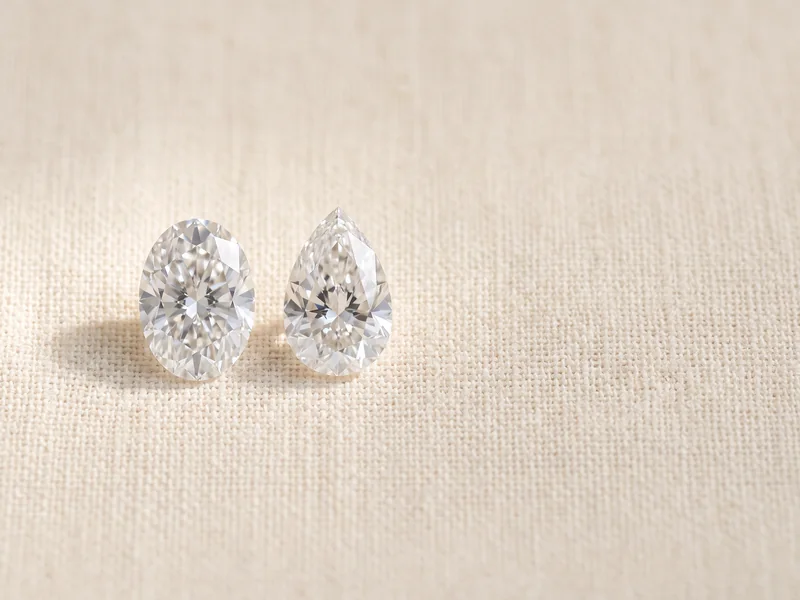 Diamond ShapesHow to Judge Marquise Diamond Symmetry
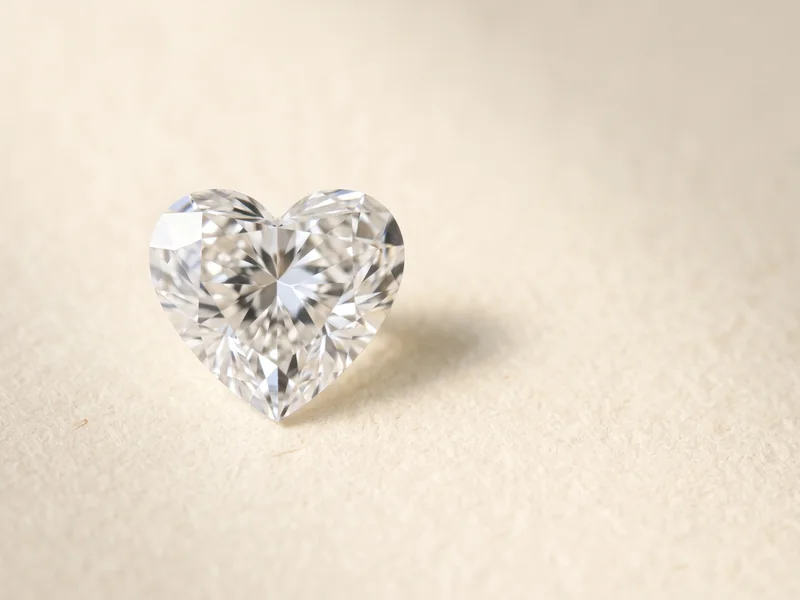 Diamond ShapesHeart-Shaped Diamond Symmetry Guide
 Wedding Bands & EternityHigh Polish Ring Finish
Explore more
More guides on this topic
Education