
- Education
- Buying Knowledge & Custom Process
- Surprise Proposal Ring Size: How to Estimate It Without Asking
Buying Knowledge & Custom Process
Surprise Proposal Ring Size: How to Estimate It Without Asking
A close guess at the surprise proposal ring size keeps the moment smooth, and you rarely need more than that. Here is how to work out the size quietly, which guesses are safe, and what resizing, the Tourist Refund Scheme and insurance mean for you in Australia.
 Reviewed by Raj Sood, Graduate Gemologist (GIA), AJP (GIA)Master jeweller and Graduate Gemologist (GIA) · reviewed 4 November 2026
Quick answer
To estimate ring size for a surprise proposal, borrow a ring your partner wears on their left ring finger and have a jeweller measure it, or trace its inside diameter. If you can't, ask a trusted friend, then go half to one size larger. Most plain bands can be resized one to two sizes after the proposal.
Why does ring size matter for a surprise proposal?
Ring size is the one detail of an engagement ring you can't judge by eye. A ring that is half a size out will still slide on. A ring two sizes too small won't pass the knuckle, which is an awkward moment halfway through a proposal. The good news is that a close estimate is all you need. Most rings can be adjusted, and plenty of couples have the fit checked within a few weeks of the proposal anyway.
In Australia, ring sizes are letters from A to Z, following the UK system, with half sizes in between. Each full letter adds roughly 1.25 mm to the inside circumference, or about 0.4 mm to the inside diameter. That sounds tiny, but one full size is the difference between a ring that spins and one that leaves a mark. Our complete Australian ring size guide explains the system in detail, and any unfamiliar word here is in the plain-English jewellery glossary.
For a surprise, aim to land within about half a size either way. Inside that window, the ring is comfortable enough to wear home and simple to fine-tune later. Outside it, you are still fine, but plan for a resize before it is worn every day.
How do Australian ring sizes work?
A ring size describes the inside of the ring, not the outside. Jewellers measure it two ways: the inside diameter (straight across the opening) and the internal circumference (all the way around the inside). A ring mandrel, a tapered steel rod marked with letter sizes, is the quickest way to read a finished ring. The table shows the sizes most engagement rings fall within.
| Australian size | Inside diameter | Inside circumference | Approx. US size |
|---|---|---|---|
| J | about 15.5 mm | about 48.8 mm | 4¾ |
| K | about 15.9 mm | about 50.0 mm | 5¼ |
| L | about 16.3 mm | about 51.3 mm | 5¾ |
| M | about 16.7 mm | about 52.5 mm | 6¼ |
| N | about 17.1 mm | about 53.8 mm | 6¾ |
| O | about 17.5 mm | about 55.0 mm | 7¼ |
| P | about 17.9 mm | about 56.3 mm | 7¾ |
| R | about 18.7 mm | about 58.8 mm | 8¾ |
| T | about 19.5 mm | about 61.3 mm | 9¾ |
| V | about 20.3 mm | about 63.8 mm | 10¾ |
Overseas websites usually quote US numbers, which is where many surprise sizing mistakes start. A US size 6 is about an Australian L½, not a letter F. Before you trust a chart from an overseas brand, check how Australian letters line up with US, UK and EU sizes, or put your measurement into our ring size converter.
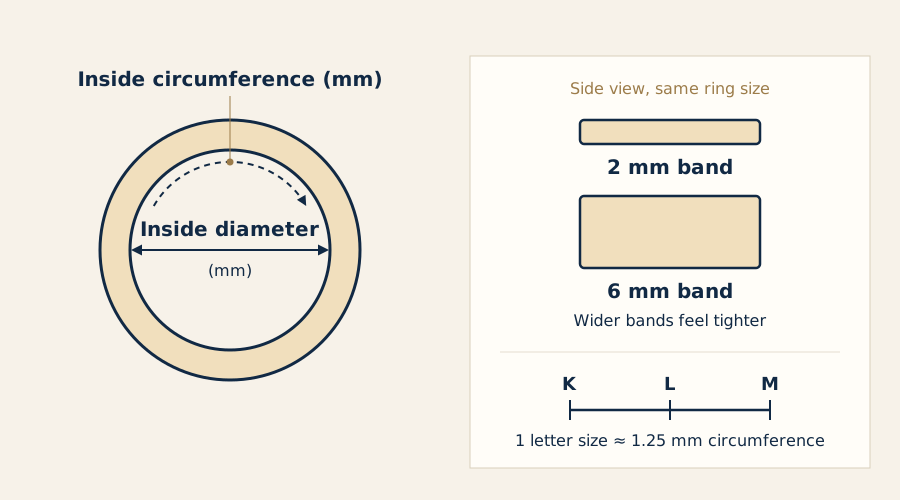
Band width changes the fit as well. A wide band, roughly 6 mm or more, covers more skin and feels tighter than a slim 2 mm band of the same size, so jewellers often suggest about a quarter to half a size larger for wide bands. A comfort-fit band, gently rounded on the inside, can feel slightly looser than a flat-sided band of the same letter.
What is the safest way to work out a surprise proposal ring size?
There are only a handful of ways to find out a ring size secretly, and they range from close to exact to little better than a guess. Pick the most accurate one you can pull off without being noticed.
| Method | Accuracy | Risk of being found out | Notes |
|---|---|---|---|
| Borrowed ring measured on a mandrel | High, if it is worn on the ring finger | Medium | Return it the same day, exactly where it was |
| Borrowed ring measured at home (diameter or tracing) | Medium | Medium | Measure the inside edge only, in two directions |
| Friend or family member finds out | High, if they size the right finger | Depends on their discretion | A pretend shopping trip works well |
| Ring pressed into soap or putty | Medium | Low | Press the full ring in to leave a clear circle |
| Borrowed ring slid onto your own finger and marked | Low to medium | Low | Only a rough guide; fingers taper |
| String or paper around a sleeping finger | Low | High | String stretches and knuckles are easy to miss |
| Guess from averages | Low | None | Use only with a plan to resize |
If none of these are possible, you can still propose on time. Some people propose with a simple stand-in proposal ring and choose or size the real ring together afterwards. Others propose with the ring and treat the first fitting as part of the fun. Neither is a failure of planning.
How do you measure a borrowed ring without your partner knowing?
The ring you borrow matters more than how you measure it. In Australia, engagement rings are traditionally worn on the ring finger of the left hand, so the ideal ring is one your partner already wears there. A ring from another finger can still help, but you need to adjust for it:
- Right ring finger: for a right-handed person, this is often about half a size larger than the left ring finger, because the dominant hand is usually bigger.
- Middle finger: usually one to two sizes larger than the ring finger.
- Index finger: often about half to one size larger.
- Little finger: usually several sizes smaller, so it is a poor guide.
- Thick or chunky fashion rings: these are often worn looser or tighter than a fine band would be, so treat them as a rough guide only.
Once you have the right ring, measure it in one of these ways. Our page on at-home ring measuring methods covers each in more detail.
- Take it to a jeweller: the most accurate option. A mandrel reading takes minutes.
- Measure the inside diameter: use a millimetre ruler or digital callipers across the inside edge, then measure again at right angles. Older rings are often slightly oval; use the average.
- Trace the inside: draw around the inside edge on paper with a fine pen, holding the pen upright. Tracing around the outside adds the band thickness and gives a size that is too large.
- Press it into soap or putty: push the whole ring in flat to leave a clean circle a jeweller can measure.
- Slide it onto your own finger: mark with a pen where it stops. This is the least precise of the four.
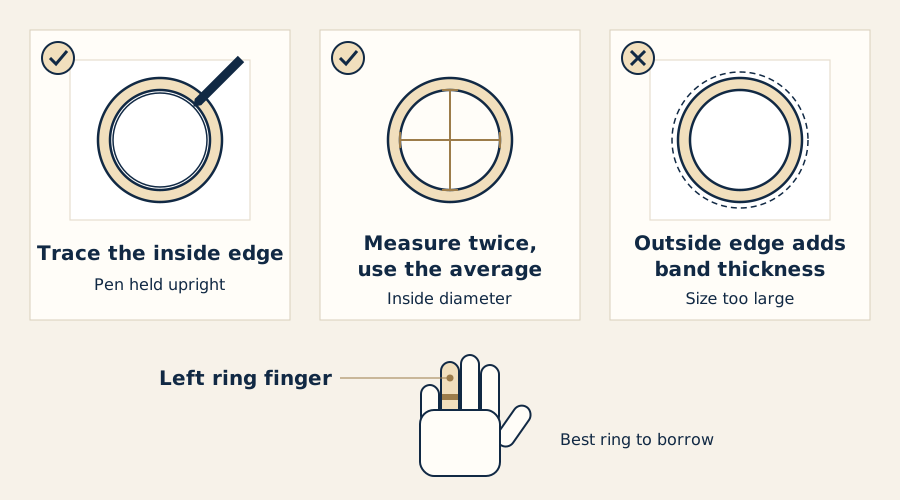
With an inside diameter in millimetres, you can convert a millimetre measurement to a letter size in a few seconds. If the ring sits between two sizes, note both and choose the larger for the engagement ring.
Not sure which one is right?
Send us the stones you are looking at and our gemologist will tell you which to choose and why.
What if your partner doesn't wear rings?
Then you need help or clues. The most reliable option is a friend, sibling or parent who can find out without making it obvious, for example by suggesting a casual browse in a jewellery shop and trying rings on for fun. Make sure they ask about the left ring finger and pass on the size exactly as it was read, including any half size.
Averages are the last resort. As a broad picture, many women in Australia wear somewhere around J to N, and many men wear around R to V, but individual fingers vary far more than that range suggests. If you are proposing to a man, our guide to ring sizes for men covers the wider range and heavier band styles. Clues that help you place your partner within the range:
- Hold hands: compare their ring finger with yours, then size your own finger and adjust up or down.
- Knuckles: if their knuckles are noticeably larger than the base of the finger, the ring has to pass the knuckle, so lean larger.
- Build and height: taller people and people with broader hands generally have larger fingers, though there are many exceptions.
- Watches and bracelets: someone who wears a small bracelet size often has slimmer fingers.
- Season: fingers swell in heat and shrink in the cold. In a Melbourne summer a ring can feel up to about half a size tighter than in winter.
If you are relying on averages, plan the proposal around resizing rather than hoping to be exact. That might mean choosing a ring style that is easy to resize, covered in the next section.
Is it better to guess ring size bigger or smaller?
Guess larger, by about half to one size. A ring that is slightly big still goes on during the proposal, can be worn safely on the middle finger or with a temporary sizer until it is adjusted, and is usually easy to make smaller. A ring that is too small can't be tried on at all, and making a ring larger generally takes more work than making it smaller.
Not every ring can be resized equally, which matters a lot when you are guessing. The ring's shank (the band part that goes around the finger) needs plain metal at the base where a jeweller can cut, add or remove metal.
| Ring style | How easily it resizes | Typical range |
|---|---|---|
| Plain gold or platinum band, solitaire | Straightforward | About 1–2 sizes up or down |
| Claws or pavé part way down the band | Possible with care; small stones can loosen | About 1 size |
| Half eternity band | Usually possible through the plain lower half | About 1 size |
| Full eternity or channel set all the way round | Usually can't be resized | Order the correct size or remake |
| Tension setting | Usually needs remaking | Very limited |
| Titanium, tungsten, ceramic | Can't be resized | Replace instead |
| Engraved inside the band | Possible, but engraving near the join may be affected | Depends on position |
If you are unsure of the size, a solitaire or a design with a plain lower band keeps your options open. Hold off on full eternity bands or inside engraving until you know the exact size. When you are choosing the design itself, our guide to choosing the engagement ring itself covers metal, settings and stones, and our overview of every diamond shape helps you settle on a centre stone without needing the finger size first.
Finger size also changes how a centre stone looks: the same diamond appears larger on a slim size J finger than on a size P. You can see how a centre stone looks on different finger sizes before you commit, and our comparison of which diamond shapes face up largest for their weight explains why elongated shapes cover more of the finger. If budget is part of the decision, the price pattern across diamond shapes is worth a look too.
What if the surprise proposal ring size is wrong?
It is a common situation and an easy fix. Resizing an engagement ring is routine bench work for a jeweller, and when done properly the join is invisible. To make a ring smaller, the jeweller cuts a small section from the base of the shank, closes the gap, solders it and polishes it. To make it larger, a plain band can be stretched by up to about half a size, or a small piece of matching metal is added for bigger changes.
As a rough guide, a simple resize takes a few days to two weeks and costs about AUD $60–$250, depending on the metal, how many sizes it moves and whether stones are set near the base. Platinum and larger changes sit at the higher end. Things a good resize also covers:
- Checking every claw and stone: resizing changes the shape of the band slightly, so settings should be checked and tightened.
- White gold plating: most white gold is plated with rhodium for a brighter white; the plating is redone after a resize.
- Round shape: the ring is reshaped on a mandrel so it stays perfectly round.
- Temporary sizers: if the ring is only a little loose, a clear plastic sizer clipped inside the band can keep it secure for a few days until the resize.
Create your ring or book a ring resize
The smoothest plan is to leave room in your timeline. Our page on how much lead time to allow before the proposal shows how custom making, collection and a possible resize fit around your date.
Can you claim GST back on an engagement ring if you propose overseas?
If you are buying the ring in Australia and proposing on an overseas trip, you may have heard of the Tourist Refund Scheme (TRS). It lets travellers claim back the GST, which is one-eleventh of a GST-inclusive price, on goods bought in Australia and taken out of the country. The main conditions:
- You spend AUD $300 or more (including GST) with a single business, with one ABN, on one or more tax invoices.
- You buy the goods within 60 days before you leave Australia.
- You carry the ring with you on the plane as hand luggage or wear it. Jewellery packed in checked luggage does not qualify.
- You claim at the TRS facility in the international departure area, with your passport, boarding pass, original tax invoice and the ring itself. The TRS app lets you enter details in advance.
There is an important catch for Australian residents. If you claim a TRS refund and then bring the ring back into Australia, it counts towards your duty-free concession. If it is over that limit, as most engagement rings are, you need to declare it when you return and may have to repay the GST. In practice, an Australian couple who propose overseas and come home wearing the ring usually won't keep the refund. The scheme mainly helps visitors and people moving overseas.
Sizing matters here too. If the ring needs resizing before you fly, collect it in time and keep the original tax invoice. A resize after you return is a separate service and doesn't affect the TRS claim. For everything else to check before paying, see our engagement ring buying checklist.
Do you need to insure an engagement ring before the proposal?
Yes, ideally from the day you collect it. The weeks between collecting a ring and proposing are when it is most likely to be hidden somewhere unusual, carried in a pocket or taken on a trip. Engagement ring insurance in Australia usually comes in one of three forms:
- Home contents insurance: often covers jewellery inside your home, but many policies cap a single item at a fixed amount unless it is listed separately.
- Specified portable valuables: an add-on to a contents policy that lists the ring by value and covers it away from home, including while travelling in many policies.
- Standalone jewellery insurance: a separate policy for the ring alone, often with options to repair or replace it through a jeweller of your choice.
Insurers generally ask for an insurance valuation: a written description of the ring, its metal, stones, grading report numbers and a replacement value. Keep the tax invoice and valuation together, and a copy somewhere other than where the ring is hidden. If a resize adds or removes metal, the change in value is usually small, but let your insurer know if anything else about the ring changes.
Travel insurance is rarely enough on its own. Many travel policies set a low limit for any single valuable item and exclude jewellery left unattended or packed in checked luggage. If you are proposing overseas, read the policy wording and keep the ring in your hand luggage.
How to estimate ring size for a surprise proposal: step by step
- Find the right ring to borrow. Ideally one your partner wears on the left ring finger; note which finger it actually lives on.
- Measure it accurately. Have a jeweller read it on a mandrel, or measure the inside diameter in two directions and convert it to a letter size.
- Adjust for the finger. Allow about half a size smaller if the ring came from the right ring finger, and one to two sizes smaller if it came from the middle finger.
- If there is no ring, get help. Ask a trusted friend or family member to find out, or use clues and averages as a last resort.
- Round up. Choose half to one size larger than your estimate, and allow extra for a band wider than about 6 mm.
- Choose a resizable design. A plain lower band keeps resizing simple; avoid full eternity bands and inside engraving until the size is confirmed.
- Insure it on collection. Arrange cover and an insurance valuation before the proposal, especially if you are travelling.
- Book the fitting. After the yes, have the ring checked and resized so it slides over the knuckle with slight resistance and doesn't spin.
Keep the letter-by-letter size chart handy while you measure, and check when to order so there is time for a resize before you set the date.
Free consultation
Talk to a gemologist
Compare stones in person or online with Raj Sood, Graduate Gemologist (GIA), AJP (GIA).
Book a consultationShop this shape
FAQ
Common questions
How can I find out my partner's ring size secretly?
Borrow a ring they wear on their left ring finger and have a jeweller measure it on a mandrel, then return it the same day. If that isn't possible, ask a trusted friend or family member to find out for you.
Is it better for an engagement ring to be too big or too small?
Slightly too big. It still goes on at the proposal, can be held in place with a temporary sizer, and is usually simpler to make smaller than to make larger.
What is the average ring size in Australia?
Many women wear around J to N and many men around R to V, but individual fingers vary widely. Use averages only if you have no other way to estimate and plan for a resize.
How much does it cost to resize an engagement ring in Australia?
A simple resize usually costs about AUD $60–$250, depending on the metal, how far the size moves and whether stones are set near the base. It typically takes a few days to two weeks.
Can every engagement ring be resized?
No. Plain gold and platinum bands usually resize one to two sizes, but full eternity bands, tension settings and rings in titanium, tungsten or ceramic generally can't be resized and may need remaking.
Can I claim the GST back on an engagement ring if I propose overseas?
You may be able to through the Tourist Refund Scheme if you spend AUD $300 or more with one business within 60 days of leaving and carry the ring with you. Australian residents who bring the ring back must declare it if it exceeds their duty-free concession and may have to repay the GST.

Ask a gemologist
Not sure which diamond to choose?
Raj Sood is a Graduate Gemologist (GIA) and master jeweller. Bring the stones you are considering, or send the reports, and he will tell you honestly which one is better and why.
Keep learning
Related guides
 Buying Knowledge & Custom ProcessRing Size Guide Australia
 Buying Knowledge & Custom ProcessHow to Measure Your Ring Size at HomeBuying Knowledge & Custom ProcessProposal Ring vs Engagement Ring
 Buying Knowledge & Custom ProcessPlanning a Proposal: When Should You Order the Engagement Ring?Buying Knowledge & Custom ProcessEngagement Ring Buying Guide
 Buying Knowledge & Custom ProcessMen's Ring Size Guide
 Buying Knowledge & Custom ProcessRing Size Converter (Tool)
 Buying Knowledge & Custom ProcessDiamond Size Visualiser by Shape (Tool)
Explore more
More guides on this topic
Education