
- Education
- Buying Knowledge & Custom Process
- Men's Ring Size Guide: Australian Letter Sizes, Fit and Resizing
Buying Knowledge & Custom Process
Men's Ring Size Guide: Australian Letter Sizes, Fit and Resizing
A men's ring size is harder to get right than most people expect, because wider bands, bigger knuckles and metals that can't be resized all change the answer. Here is how to find the right Australian letter size, and what it means for fit, price and resizing later.
 Reviewed by Raj Sood, Graduate Gemologist (GIA), AJP (GIA)Master jeweller and Graduate Gemologist (GIA) · reviewed 4 November 2026
Quick answer
Australia uses letter ring sizes, the same as the UK. Most Australian men wear between R and W, with T to U the most common, about 19.6–20.0 mm inside diameter. Size wider bands (6 mm and up) about half to one letter larger, measure when your hands are warm, and make sure the ring slides over your knuckle.
What is the average men's ring size in Australia?
Australia sizes rings with letters, from A (very small) to Z, then Z+1, Z+2 and so on for larger fingers. It is the same system the UK uses, and it is different from the US, which uses numbers. Our full Australian ring size guide covers the system for every finger and every age; this page focuses on men.
Most Australian men wear a ring finger size between R and W. The most common sizes are T and U, which is an inside diameter of about 19.6–20.0 mm, or roughly a US 9¾ to 10¼. Men who work with their hands, such as tradespeople or farmers, often sit a letter or two higher, and it is not unusual to see Y, Z or Z+1 at the counter.
An average is only useful as a starting point. Finger size is only loosely linked to height or hand size, and the knuckle, not the base of the finger, often decides the size a man can actually wear. If you are buying from an overseas website, see how Australian letter sizes line up with US, UK and EU sizes before you order.
Men's ring size chart: Australian letters, mm and US sizes
Every ring size is really a measurement: the inside diameter (the distance straight across the inside of the ring) or the inside circumference (the distance around it). Each full Australian letter adds about 1.25 mm of circumference, or about 0.4 mm of diameter. Half sizes, such as T½, sit in between.
| Australian / UK | US | Inside diameter | Inside circumference | EU (approx.) |
|---|---|---|---|---|
| P | 7¾ | about 18.0 mm | about 56.6 mm | 56–57 |
| Q | 8¼ | about 18.4 mm | about 57.8 mm | 58 |
| R | 8¾ | about 18.8 mm | about 59.1 mm | 59 |
| S | 9¼ | about 19.2 mm | about 60.3 mm | 60 |
| T | 9¾ | about 19.6 mm | about 61.6 mm | 61–62 |
| U | 10¼ | about 20.0 mm | about 62.8 mm | 63 |
| V | 10¾ | about 20.4 mm | about 64.1 mm | 64 |
| W | 11¼ | about 20.8 mm | about 65.3 mm | 65 |
| X | 11¾ | about 21.2 mm | about 66.6 mm | 66–67 |
| Y | 12¼ | about 21.6 mm | about 67.8 mm | 68 |
| Z | 12¾ | about 22.0 mm | about 69.1 mm | 69 |
| Z+1 | 13¼ | about 22.4 mm | about 70.3 mm | 70 |
Conversions between systems are close but not exact, because each country rounds its steps differently. For a size outside this table, or a quick check between systems, use our ring size converter for any letter or number. If a term on a sizing chart is new to you, our plain-English jewellery glossary explains it.
How do you measure a men's ring size accurately?
The most reliable way is with a jeweller's ring sizer: a set of metal or plastic rings, one for each half size. Try them on the right finger, of the right hand, and choose the one that slides over the knuckle with a little resistance and sits snugly without spinning. A sizer of the same width as the band you plan to wear gives the most accurate reading.
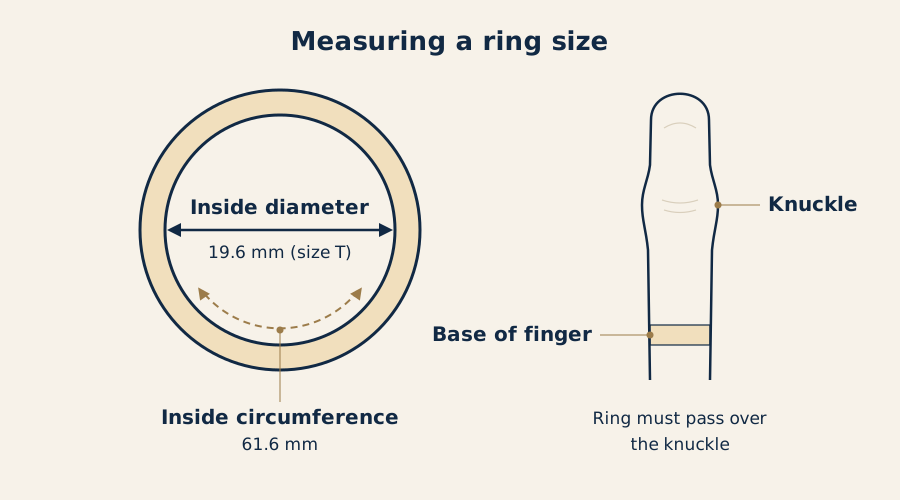
At home, the two common methods are measuring an existing ring that fits and wrapping a strip of paper around the finger. Measuring a ring is more accurate: lay a ruler across the inside at its widest point and read the diameter in millimetres, then match it to the chart above. A paper strip tends to stretch or sit loosely and often reads half a letter or more out. Our step-by-step at-home measuring methods show how to reduce those errors.
- Measure late in the day. Fingers are usually largest in the afternoon and evening.
- Avoid extremes of temperature. Cold fingers shrink; hot, humid days and exercise make them swell.
- Measure more than once. Take three readings on different days and go with the one that repeats.
- Measure the hand you will wear it on. The dominant hand is often around half a letter larger.
Does band width change your ring size?
Yes, and this is where many men's ring sizes go wrong. Men's bands are usually wider than women's, often 5–8 mm compared with 2–4 mm. A wider band covers more of the finger, touches more skin and has to pass over the knuckle as a solid block, so it feels tighter than a narrow band of exactly the same size.
| Band width | Typical adjustment from a narrow sizer | Why |
|---|---|---|
| 2–4 mm | Wear your measured size | Narrow bands feel close to a standard sizer |
| 5–6 mm | Same size, or up about half a letter | Slightly more contact with the finger |
| 7–8 mm | Up about half to one letter | Noticeably tighter over the knuckle |
| 9 mm and wider | Up about one letter; try a wide sizer | Covers much of the finger segment |
The inside shape of the band matters too. A standard fit (sometimes called flat fit) band is flat on the inside. A comfort fit band is gently domed on the inside, so it touches less skin and rolls over the knuckle more easily. Because of that, some men find a comfort fit band of the same size feels a little looser, and choose half a letter smaller. The honest rule is to try the same profile and width you plan to buy.
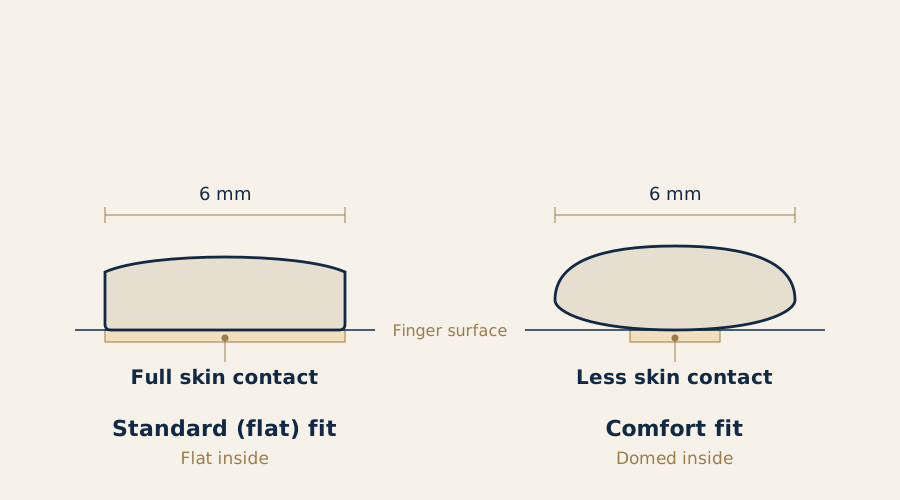
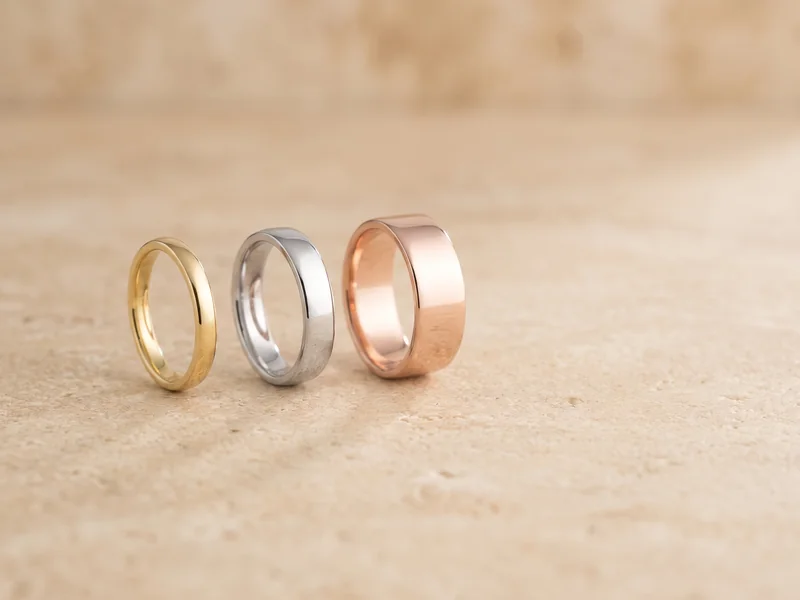
Width also affects the look. On a man's hand, 5–6 mm is the most common choice, with 4 mm reading as slim and 8 mm as bold. If you are choosing a ring with a stone, our guide to men's engagement ring styles shows how band width and stone size balance on a larger finger.
Not sure which one is right?
Send us the stones you are looking at and our gemologist will tell you which to choose and why.
How should a men's ring fit?
A well-fitted ring goes on with a little push over the knuckle, sits comfortably at the base of the finger, and comes off with a gentle twist. It should not spin freely, leave a deep mark, or need soap to remove. If you can slide it off without any resistance, it is too big and could be lost in cold water or while playing sport.
Large knuckles are common in men and can make sizing tricky. If the knuckle is much larger than the base of the finger, a ring that passes over the knuckle will spin and drop to one side once it is on. There are practical answers: a comfort fit profile, a slightly heavier band that stays upright, or small sizing beads or a sizing bar added inside the ring by a jeweller to stop it turning.
Fit changes with the seasons, weight and age, and that is normal. Plan for a ring you can wear all year, and remember that a ring which can be resized later (see the next section) gives you room to adjust. Wrists change in a similar way, which is why our guide to measuring wrists for bracelets uses the same allowances for warm and cool days. For watches, chains and cufflinks, see other types of men's jewellery, from cufflinks to chains.
Can men's rings be resized? Metals compared
Whether a ring can be resized depends almost entirely on the metal and the design. Precious metals such as gold, platinum and silver can be cut and soldered, so a jeweller can usually take them up or down by about one to two letters. Beyond that, the shape and thickness of the band start to suffer, and a larger change may mean replacing part of the shank (the band of the ring).
| Metal | Hardness (Mohs) | Can it be resized? | Notes |
|---|---|---|---|
| 9ct gold | about 2.5–3 | Yes, usually 1–2 letters | Durable, lower gold content |
| 18ct gold | about 2.5–3 | Yes, usually 1–2 letters | Richer colour, softer and heavier than 9ct |
| Platinum | about 4–4.5 | Yes, usually 1–2 letters | Dense and heavy; specialist soldering |
| Sterling silver | about 2.5–3 | Yes | Soft; marks and bends more easily |
| Titanium | about 6 | Rarely; very small changes only | Light; hard to solder |
| Tungsten carbide | about 8.5–9 | No | Very scratch resistant but can crack if dropped on tile |
| Ceramic | about 8–9 | No | Cannot be cut or stretched |
Mohs hardness measures scratch resistance, not toughness. Tungsten carbide resists scratches far better than gold, but it is brittle, and in an emergency it cannot be cut off with a standard ring cutter; it has to be cracked off. Gold and platinum are softer but bend rather than break, which is one reason many men choose them for a band they will wear every day.
Design matters too. A plain band is the easiest to resize. A band with stones set all the way around, such as a full eternity or channel-set band, usually cannot be resized without resetting stones, so it needs to be made in the right size first time. Patterned or engraved bands can be resized, but the pattern may need to be re-cut where the band was joined.
How does ring size affect the price of a men's ring?
A larger ring uses more metal, so size affects price more than most people expect. Each full letter adds about 1.25 mm of circumference, which near size T is roughly 2% more metal. Going from a P (about 56.6 mm around) to a Z (about 69.1 mm) adds about 22% more metal to the same band design. In 18ct gold or platinum, that difference shows up in the price.
Metal density matters as well. Platinum is about 21.4 g per cubic centimetre, 18ct yellow gold about 15.5 g and titanium about 4.5 g, so the same size and shape weighs very differently. The same idea applies to stones, as explained in how density changes the weight of the same size.
| Plain band, 6 mm wide, about size T | Approximate weight | Approximate price range (AUD) |
|---|---|---|
| Titanium or tungsten carbide | about 3 g (titanium) to 11 g (tungsten) | about $150–$600 |
| 9ct gold | about 6–8 g | about $600–$1,400 |
| 18ct gold | about 9–11 g | about $1,500–$3,500 |
| Platinum | about 12–15 g | about $2,000–$4,500 |
These are broad ranges only. Gold and platinum prices move with the metal markets, and the profile, thickness, finish and any engraving or stones all change the total. If the ring includes a diamond, the stone usually becomes the larger cost; our millimetre-to-carat chart for set diamonds and the tool to visualise diamond sizes by shape help you see how a stone will look on a larger finger. For grading and value, read the four Cs in our diamond buying guide.
Resizing has a cost too. As a rough guide, taking a plain gold band down a size is often in the region of $60–$150, while going up, which needs extra metal, is often $80–$250 or more. Platinum, stone-set bands and large changes cost more. The cost is usually far less than replacing a ring, so getting the size close first time and fine-tuning later is a sensible approach.
Create your ring or arrange a ring resize
How do you find his ring size for a surprise?
Measuring a man's finger without him noticing is hard, but there are reliable shortcuts. The easiest is to borrow a ring he already wears on the same finger and measure its inside diameter. A ring worn on a different finger can still help: the ring finger is usually several letters larger than the little finger and a letter or so smaller than the middle finger, though this varies.
- Borrow a ring: measure its inside diameter with a ruler, or trace the inside onto paper.
- Ask a friend or family member: a sibling may know his size from a past ring.
- Compare with your own fingers: if his ring slides onto your thumb or index finger, a jeweller can measure where it stops.
- Plan for resizing: choose a plain precious-metal band that can be adjusted afterwards.
Our guide to estimating a ring size for a surprise proposal goes through each method in detail. Some couples avoid the problem altogether with a stand-in proposal ring and then size the real ring together, and many now prefer choosing the ring together from the start.
Related guideHow to Estimate Ring Size for a Surprise ProposalHow to get your men's ring size right: step by step
- Choose the band first. Decide on width (for example 5, 6 or 8 mm), profile (standard or comfort fit) and metal, because all three affect the size you need.
- Measure with a matching sizer. Use a sizer of similar width and profile, on the correct finger of the correct hand.
- Measure when warm. Check your size in the afternoon or evening, not after cold weather, exercise or a hot shower.
- Test the knuckle. The ring should push over the knuckle with slight resistance and come off with a gentle twist.
- Repeat on another day. Take two or three readings and go with the size that repeats.
- Adjust for width. For bands 6 mm and wider, allow about half to one letter larger than a narrow sizer.
- Check resizing options. If you choose tungsten carbide, ceramic or a fully stone-set band, be sure of the size before ordering, as it usually cannot be changed.
Once you know your size, the rest of the decision is about style and stones. Our wider engagement ring buying checklist covers metals, settings and budgets for both partners.
Free consultation
Talk to a gemologist
Compare stones in person or online with Raj Sood, Graduate Gemologist (GIA), AJP (GIA).
Book a consultationShop this shape
FAQ
Common questions
What is the most common men's ring size in Australia?
T and U are the most common, which is about 19.6–20.0 mm inside diameter. Most Australian men fall somewhere between R and W.
Should a men's wedding band be a size bigger?
For wide bands, often yes. Bands 6 mm or wider usually need about half to one letter larger than a narrow sizer, because they feel tighter over the knuckle.
What is a men's size T ring in US sizes?
An Australian size T is roughly a US 9¾, with an inside diameter of about 19.6 mm. Conversions are close but not exact, so check the millimetre measurement.
Can a tungsten ring be resized?
No. Tungsten carbide is too hard to cut and solder, so the ring would need to be replaced. Gold, platinum and silver bands can usually be resized by one to two letters.
Is comfort fit a different ring size?
The size is measured the same way, but a comfort fit band has a domed inside that can feel slightly looser. Some men choose half a letter smaller, so try the same profile before deciding.
Is it better for a men's ring to be slightly tight or slightly loose?
Slightly snug is safer, as long as it passes over the knuckle without force. A loose ring can slip off in cold water, while a ring that is far too tight can cause swelling.

Ask a gemologist
Not sure which diamond to choose?
Raj Sood is a Graduate Gemologist (GIA) and master jeweller. Bring the stones you are considering, or send the reports, and he will tell you honestly which one is better and why.
Keep learning
Related guides
 Buying Knowledge & Custom ProcessRing Size Guide Australia
 Buying Knowledge & Custom ProcessHow to Measure Your Ring Size at Home
 Buying Knowledge & Custom ProcessAustralian Ring Sizes vs US, UK and EU
 Engagement Rings & SettingsMen's Engagement RingsBuying Knowledge & Custom ProcessEngagement Ring Buying GuideBuying Knowledge & Custom ProcessRing Size Converter (Tool)
 Buying Knowledge & Custom ProcessDiamond Size Visualiser by Shape (Tool)
 Buying Knowledge & Custom ProcessHow to Estimate Ring Size for a Surprise Proposal
Explore more
More guides on this topic
Education