
- Education
- Buying Knowledge & Custom Process
- Diamond Size Visualiser by Shape: See Carat Weight in Millimetres
Buying knowledge
Diamond Size Visualiser by Shape: See Carat Weight in Millimetres
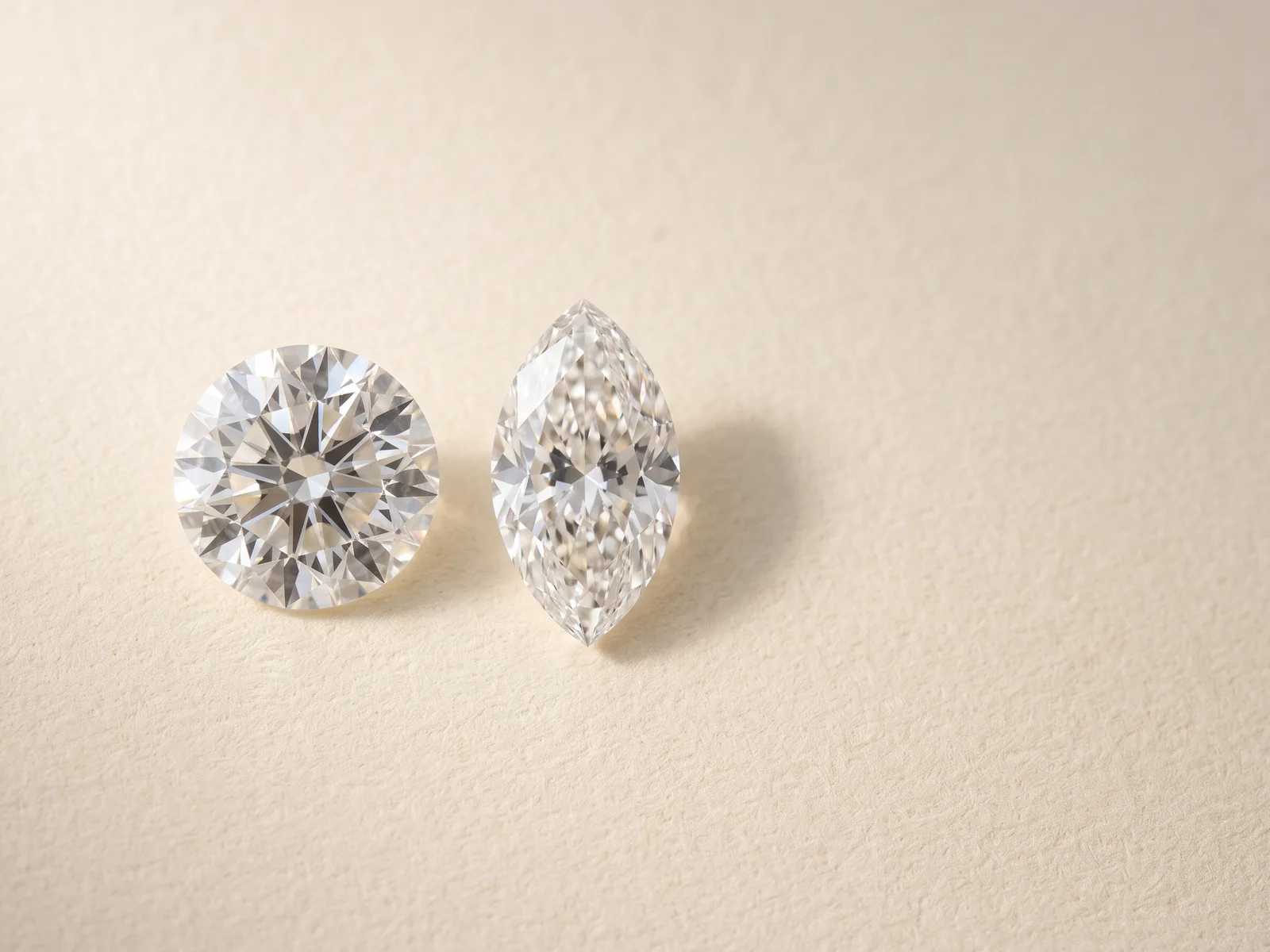
Carat is a weight, not a size, so the number on a grading report tells you surprisingly little about how big a diamond will look on your hand. This diamond size visualiser draws every main shape to scale in millimetres, on your ring size, so you can see the difference before you choose.
 Reviewed by Raj Sood, Graduate Gemologist (GIA), AJP (GIA)Master jeweller and Graduate Gemologist (GIA) · reviewed 4 November 2026
Quick answer
A diamond size visualiser shows how big a diamond of a given carat weight and shape looks face-up, drawn to scale in millimetres on a finger of your ring size. A 1 carat round measures about 6.4 mm; elongated shapes such as oval, marquise and pear cover more surface, so they look larger at the same weight.
What is a diamond size visualiser?
A diamond size visualiser is a tool that draws diamonds to true scale so you can see how big a stone really looks before you buy. You pick a shape, a carat weight and your ring size, and it shows the diamond's outline in real millimetres on a finger, next to other weights and shapes for comparison. It answers the question a grading report can't: what does a 1.2 carat oval actually look like on my hand?
Carat (ct) is a unit of weight. One carat equals 0.2 grams and is divided into 100 points, so a 0.75 ct diamond is often called a 75-pointer. Two diamonds of the same weight can look quite different face-up (the view from above, which is how everyone sees a ring), depending on the shape and how deeply the stone is cut. That gap between weight and appearance is the whole reason the visualiser exists. If you would rather read the raw numbers, our carat-to-millimetre chart for every shape lists them in table form, and the plain-English jewellery glossary explains any term you have not met before.
Most online size charts use generic textbook proportions. The outlines in this tool are drawn from the average measurements of diamonds GemTrove has measured in its own natural and lab-grown stock, so a 1 ct oval on screen reflects what a typical 1 ct oval actually measures, rather than an idealised drawing.
How do you use the diamond size visualiser?
The tool has six controls. You can change any of them and the drawing updates straight away:
- Shape: round, oval, princess, cushion, emerald, pear, marquise, radiant, Asscher and heart.
- Carat weight: from 0.25 ct to 3.00 ct in 0.05 ct steps.
- Ratio: for elongated shapes, a slider for the length-to-width ratio (length divided by width), so you can compare a slim oval at 1.50 with a fuller one at 1.30.
- Ring size: Australian letter sizes, with US equivalents shown beside them.
- Setting overlay: four claws, six claws, bezel or halo, to see how metal and small diamonds change the overall look.
- Compare mode: up to three diamonds side by side on the same finger.
Screens differ in size and pixel density, so the first step is calibration. Hold a standard bank card (85.60 × 53.98 mm, the same size worldwide) flat against your screen and drag the on-screen card until the edges match. From then on, 1 mm on screen is 1 mm in real life. You can also print the page at 100% scale (turn off 'fit to page'), cut out the outlines and hold them on your hand or on a ring you already own.
You need a ring size for the finger drawing to be accurate. If you do not know yours, you can measure your ring size at home with paper or an old ring, or use the ring size converter if you only know a US or European size.
How does carat weight translate to millimetres?
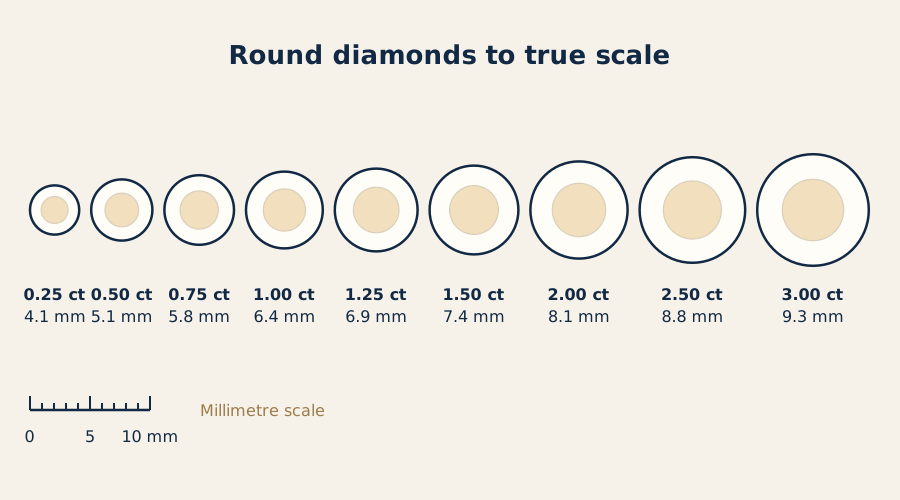
Weight follows volume, and volume grows with the cube of the diameter. In practice that means size grows much more slowly than carat weight. Double the weight of a round diamond and its diameter grows by only about 26%, while the face-up area grows by about 59%. So a 2 ct round is about 8.1 mm across, not double the 6.4 mm of a 1 ct.
| Round brilliant | Typical diameter | Approx face-up area |
|---|---|---|
| 0.25 ct | about 4.1 mm | about 13 mm² |
| 0.50 ct | about 5.1 mm | about 20 mm² |
| 0.75 ct | about 5.8 mm | about 26 mm² |
| 1.00 ct | about 6.4 mm | about 32 mm² |
| 1.25 ct | about 6.9 mm | about 37 mm² |
| 1.50 ct | about 7.4 mm | about 43 mm² |
| 2.00 ct | about 8.1 mm | about 52 mm² |
| 2.50 ct | about 8.8 mm | about 61 mm² |
| 3.00 ct | about 9.3 mm | about 68 mm² |
How deeply a stone is cut matters too. A well-proportioned round usually has a total depth of about 59–63% of its width. A diamond cut deeper carries extra weight below the girdle (the thin outer edge), where you cannot see it, so it faces up like a lighter stone. A deep 1 ct round might measure 6.2 mm, about the size of a typical 0.90 ct. That is why the visualiser lets you enter a stone's actual millimetre measurements from its grading report as well as its weight. Stones that face up larger than average for their weight are said to have good spread.
Which diamond shape looks biggest for its carat weight?
Shape changes face-up size more than most people expect. Elongated shapes put more of their weight into length and surface, while deep, square cuts such as the Asscher and cushion hold more weight underneath. The table shows typical 1 ct measurements.
| Shape (1 ct) | Typical measurements | Approx face-up area | Looks vs a round |
|---|---|---|---|
| Round | 6.4 mm diameter | about 32 mm² | The reference point |
| Oval (ratio ~1.35) | 7.7 × 5.7 mm | about 34 mm² | A little larger, and longer |
| Pear | 8.5 × 5.5 mm | about 34 mm² | A little larger, and longer |
| Marquise | 10.0 × 5.0 mm | about 33 mm² | Looks longest of all shapes |
| Emerald | 7.0 × 5.0 mm | about 33 mm² | Similar area, very different look |
| Radiant | 6.5 × 5.5 mm | about 33 mm² | Similar to a round |
| Heart | 6.8 × 6.3 mm | about 32 mm² | Similar to a round |
| Princess | 5.5 × 5.5 mm | about 30 mm² | Slightly smaller, but corners add presence |
| Cushion | 5.5 × 5.5 mm | about 28 mm² | Slightly smaller |
| Asscher | 5.5 × 5.5 mm | about 27 mm² | Smallest face-up for its weight |
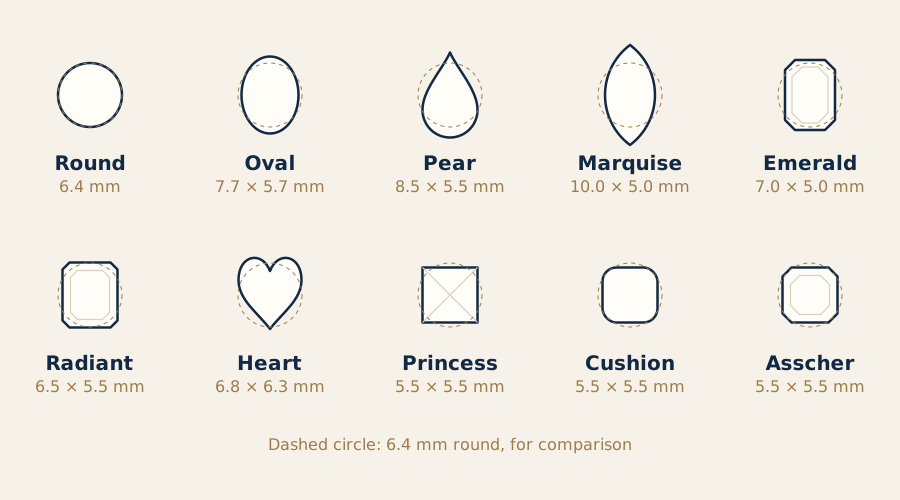
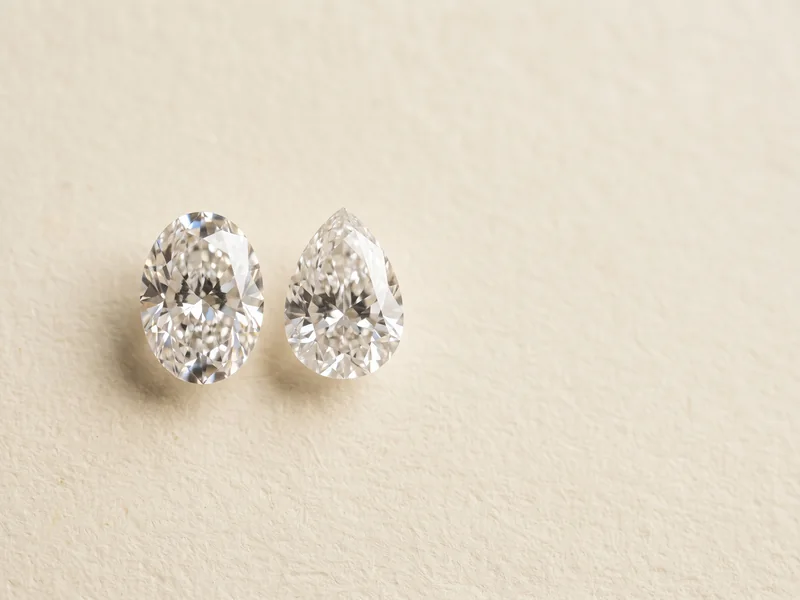
Area is only part of the story. Your eye reads length strongly, so a 10 mm marquise looks bigger than a 6.4 mm round even though their areas are close. Long shapes also make fingers look slimmer, which is why many people with shorter fingers lean towards ovals and pears; our guide to shapes that flatter small hands and long fingers goes into this. A princess looks smaller by area, but its four corners stretch to about 7.8 mm diagonally, so it can still look substantial on the hand.
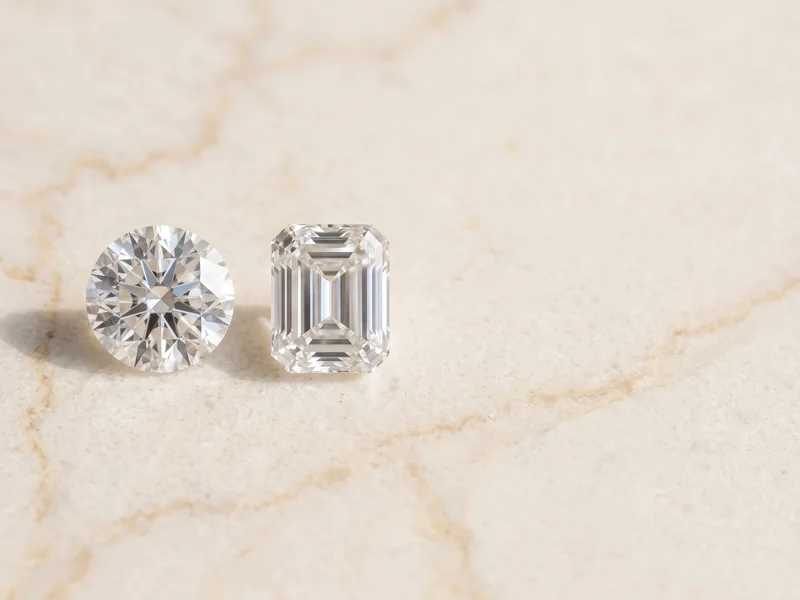
Shape also moves price. Rounds usually cost the most per carat because so much rough crystal is lost cutting them, so a fancy shape that faces up larger can be a sensible trade. Our price comparison across diamond shapes sets out the pattern.
Not sure which one is right?
Send us the stones you are looking at and our gemologist will tell you which to choose and why.
How big will a diamond look on my finger size?
The same diamond looks bigger on a slimmer finger, because it covers more of the width. The visualiser uses the inside diameter of your ring size as an approximate finger width. Australian sizes use letters, close to the UK system, and each full letter adds roughly 0.4 mm to the inside diameter.
| Australian size | Approx inside diameter | 1 ct round covers | 2 ct round covers |
|---|---|---|---|
| H (smaller) | about 14.9 mm | about 43% of the width | about 54% |
| L | about 16.5 mm | about 39% | about 49% |
| N (common women's size) | about 17.3 mm | about 37% | about 47% |
| Q | about 18.5 mm | about 35% | about 44% |
| T | about 19.8 mm | about 32% | about 41% |
| W (common men's size) | about 20.9 mm | about 31% | about 39% |
So a 0.75 ct round on a size H finger covers about as much of the width as a 1.50 ct on a size S. If you have a size in mind already, our guide to Australian ring sizes explains how the letters work, and how Australian sizes line up with US, UK and EU sizes helps if you are comparing with an overseas retailer.
Men's rings with a centre diamond follow the same maths, but larger finger sizes make stones look smaller, so men often choose a wider stone or a flush setting; see the ring sizing guide for men. Planning a surprise? Use your best estimate in the tool and read our tips on guessing a ring size without giving the game away.
Do settings and halos make a diamond look bigger?
Yes, and often by more than a jump in carat weight would. Switch on the setting overlay to see each of these effects to scale:
- Halo: a ring of small diamonds, called melee (usually 1.0–1.5 mm each), around the centre stone adds roughly 2–3 mm to the overall width. A 1 ct round in a halo can read from a distance like a 9 mm stone.
- Claws: four thin claws show more of the diamond than six; six claws make a round look slightly rounder and more secure.
- Bezel: a rim of metal around the edge adds about 0.5–1 mm of outline. In white gold or platinum it blends with the diamond; in yellow gold it frames it.
- Band width: a slim band of about 1.6–2 mm makes the centre stone look larger than a 3 mm band does.
- Metal colour: white metals let the edge of the diamond disappear into the claws; yellow and rose gold give a crisp outline.
A halo's shape can follow the centre stone or contrast with it, such as a round halo around a cushion. Our guide to halo shapes and styles shows how each one changes the look. Earrings and bracelets work differently again: studs of 0.25–0.50 ct per ear are a common starting point, and in a tennis bracelet the total weight is shared across many stones, so length matters more than any one diamond; the bracelet sizing guide covers that.
How much does a bigger-looking diamond cost, natural or lab-grown?
Natural diamonds are mined; lab-grown diamonds (also called laboratory-grown) are real diamond grown in a laboratory, with the same hardness (10 on the Mohs scale) and the same refractive index of about 2.42. They look identical to the eye, and the visualiser draws them the same way. The difference is price: lab-grown costs much less, so for the same budget you can usually move a long way up the carat scale.
| Round, G–H colour, VS clarity | Lab-grown (approx AUD) | Natural (approx AUD) |
|---|---|---|
| 0.50 ct (about 5.1 mm) | about $500–$1,500 | about $2,000–$4,500 |
| 1.00 ct (about 6.4 mm) | about $1,000–$3,000 | about $7,000–$15,000 |
| 2.00 ct (about 8.1 mm) | about $2,000–$6,000 | about $25,000–$55,000 |
These are broad ranges only; prices move with the market, the exact grades and the cut. One pattern is reliable: prices jump at 'magic' weights such as 0.50, 1.00, 1.50 and 2.00 ct. A 0.95 ct round measures about 6.3 mm against 6.4 mm for a 1.00 ct, a difference you cannot see on the hand, but it often costs noticeably less. Try both in compare mode and you will see why.
Whichever you choose, buy the size you want to wear. Neither natural nor lab-grown diamonds should be bought expecting to sell them later for a profit, and our page on what diamonds are worth if you resell them explains why.
Browse natural and lab-grown diamonds by size and shape
How accurate is an on-screen diamond size chart?
Once calibrated, the outlines are accurate to within a fraction of a millimetre for a typical stone of each shape. What a screen cannot show is how the diamond behaves in light. A bright, well-cut stone looks larger than a dull one of the same size, because your eye reads sparkle as size. Your own finger, skin tone and the metal you choose all change the impression too.
- Use real measurements: once you have a shortlist, type each stone's millimetres from its report into the tool rather than relying on carat weight.
- Watch for zoom: product photos and videos are magnified many times; the visualiser shows true size.
- Check at arm's length: look at the screen or print-out from about 40–60 cm, the distance people usually see a ring.
The tool is a starting point, not a replacement for seeing stones. Our guide to the trade-offs of buying online or in a store covers when it is worth seeing a diamond in person, and if you are deciding as a couple, choosing a ring together has practical ideas for using the visualiser side by side.
Related guideDiamond MM to Carat Size Chart (All Shapes)How to choose a diamond size with the visualiser: step by step
- Calibrate your screen. Match the on-screen bank card to a real one so 1 mm on screen equals 1 mm in life.
- Enter your ring size. Use an Australian letter size; convert from US or EU if needed.
- Pick two or three shapes. Compare a round with one elongated shape and one square shape at the same weight.
- Move the carat slider. Find the smallest weight that looks right, then check the weight just below each magic number (0.90, 1.40, 1.90 ct).
- Add a setting. Turn on claws, a bezel or a halo and see how the overall width changes.
- Check real stones. Enter the millimetre measurements of shortlisted diamonds from their grading reports, and confirm whether each is natural or lab-grown.
- Print and wear. Print at 100%, cut out your favourite and wear it for a day before you decide.
For everything else that goes into the decision, from cut quality to setting styles and budgets, our complete engagement ring buying guide takes you through it in order.
Free consultation
Talk to a gemologist
Compare stones in person or online with Raj Sood, Graduate Gemologist (GIA), AJP (GIA).
Book a consultationShop this shape
FAQ
Common questions
What does a 1 carat diamond look like in mm?
A 1 carat round brilliant is about 6.4 mm across. A 1 carat oval is about 7.7 × 5.7 mm, a pear about 8.5 × 5.5 mm and a marquise about 10 × 5 mm, so elongated shapes look larger and longer.
How big is a 2 carat diamond compared with a 1 carat?
A 2 carat round is about 8.1 mm across, roughly 26% wider than a 1 carat at 6.4 mm. Its face-up area is about 59% larger, not double, because the extra weight is spread through the depth of the stone.
Which diamond shape looks biggest for its carat weight?
Marquise, pear and oval usually look largest because they cover more surface and the eye reads their length. Cushion and Asscher cuts tend to look smallest for their weight because they carry more depth.
Is the diamond size visualiser accurate on a phone?
Yes, once you calibrate it with a standard bank card. Without calibration, screens show sizes that can be noticeably too large or too small.
Do lab-grown diamonds look the same size as natural diamonds?
Yes. A lab-grown and a natural diamond with the same measurements look the same size, because they are both real diamond with the same optical properties. The lab-grown stone usually costs much less.
Does a halo make a diamond look bigger?
Yes. A halo of small diamonds adds roughly 2–3 mm to the overall width, so a 1 carat centre can read like a much larger stone from a distance.
Terms in this guide

Ask a gemologist
Not sure which diamond to choose?
Raj Sood is a Graduate Gemologist (GIA) and master jeweller. Bring the stones you are considering, or send the reports, and he will tell you honestly which one is better and why.
Keep learning
Related guides
 Diamond 4Cs & GradingDiamond MM to Carat Size Chart (All Shapes)
 Buying Knowledge & Custom ProcessRing Size Guide Australia
 Diamond ShapesDiamond Shape Price Comparison
 Diamond ShapesBest Diamond Shapes for Small Hands and Long FingersBuying Knowledge & Custom ProcessEngagement Ring Buying Guide
 Buying Knowledge & Custom ProcessRing Size Converter (Tool)
 Buying Knowledge & Custom ProcessMen's Ring Size Guide
 Buying Knowledge & Custom ProcessHow to Measure Your Ring Size at Home
Explore more
More guides on this topic
Education