
- Education
- Buying Knowledge & Custom Process
- Ring Size Converter: Australian, US, UK and EU Ring Sizes in mm
Buying Knowledge & Custom Process
Ring Size Converter: Australian, US, UK and EU Ring Sizes in mm
A ring that doesn't fit usually means a trip back to the bench. This ring size converter and chart show how Australian letter sizes line up with US, UK, EU and Japanese sizes, and where conversions tend to go wrong.
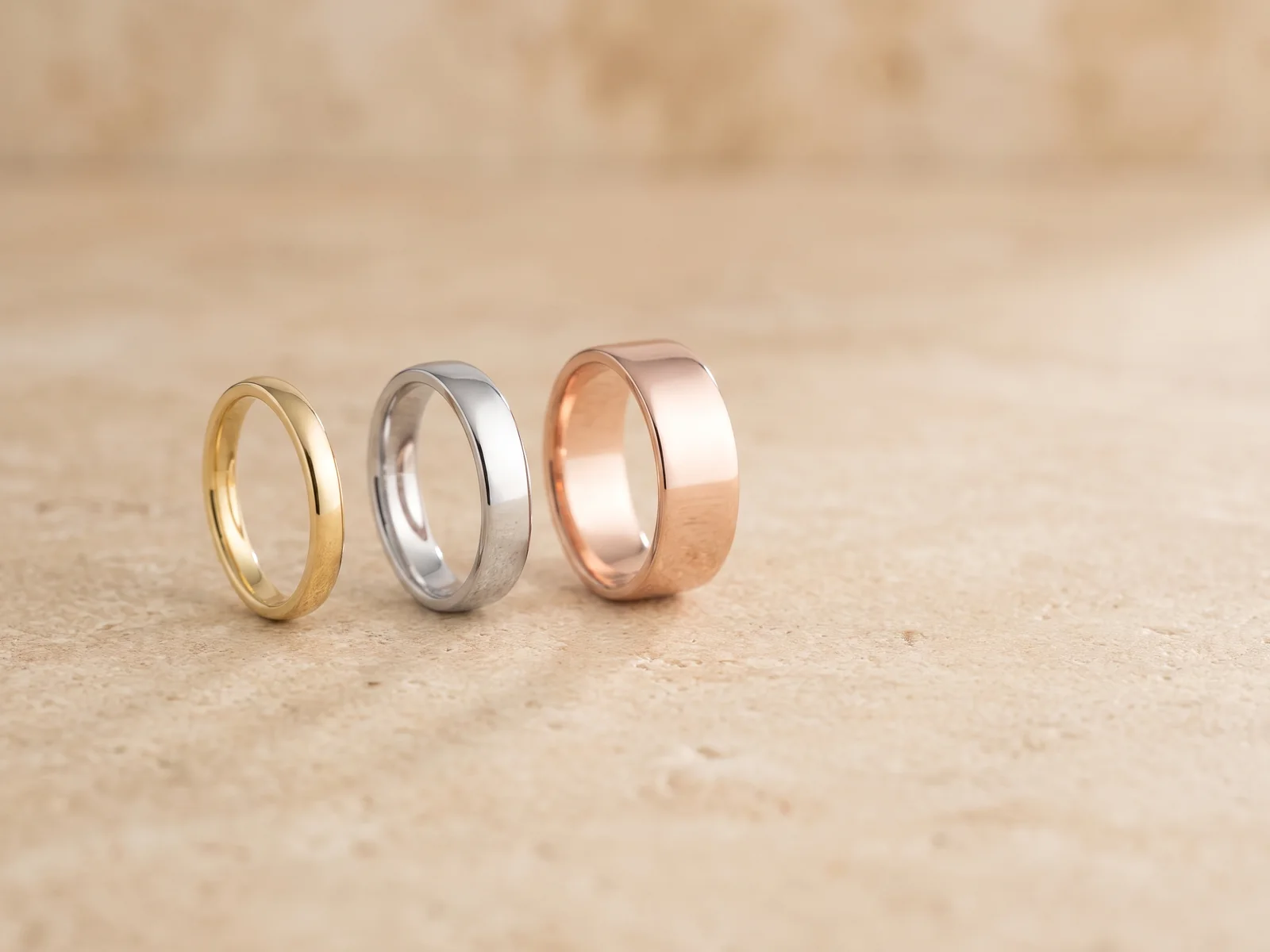
 Reviewed by Raj Sood, Graduate Gemologist (GIA), AJP (GIA)Master jeweller and Graduate Gemologist (GIA) · reviewed 4 November 2026
Quick answer
A ring size converter turns one sizing system into another using the ring's inside measurement. Australia uses the same letter sizes as the UK, so an Australian N½ is a US 7, an EU 54 and about 17.3 mm across inside. Enter a letter, number or millimetre measurement and the converter gives every equivalent.
What does a ring size converter do?
Every ring sizing system in the world is really describing one thing: the inside of the ring. Some systems describe it as the inner diameter (the distance straight across the inside of the band), some as the inner circumference (the distance all the way around the inside) and some simply give it a letter or a number on a fixed scale. A ring size converter works out that inside measurement from whatever you enter, then shows the matching size in every other system.
That matters in Australia because we use the same letter system as the UK (A to Z, with half sizes), while most international websites, ring designs and reviews quote US numeric sizes. If you have seen a ring overseas, inherited one from Europe or been told your size by a friend in the US, the converter turns it into an Australian letter you can give any local jeweller.
Our complete Australian ring size guide explains sizing in more depth, from how jewellers measure to how sizes change across a lifetime. If a term on this page is new to you, our plain-English jewellery glossary defines it.
How do you use the ring size converter?
The converter accepts four kinds of input. Choose whichever you actually have in front of you:
- An Australian or UK letter, such as L, M½ or R. Use this if a jeweller has sized you before.
- A US or Canadian number, such as 6, 6½ or 6¾. Common on overseas websites.
- An EU or ISO size, which is simply the inner circumference in millimetres, such as 52 or 54.
- A measurement in millimetres: either the inside diameter of a ring that already fits, or the circumference of your finger measured with paper or string.
The result shows the Australian, UK, US, EU, Swiss and Japanese equivalents, plus the inner diameter and circumference to one decimal place. If your entry falls between two sizes, the converter shows both neighbours so you can see how close you are. Because each Australian letter is only about 1.25 mm of circumference, small measuring errors move you a full letter, so it pays to measure carefully. Our walkthrough on measuring your ring size at home with string or paper covers the right technique.
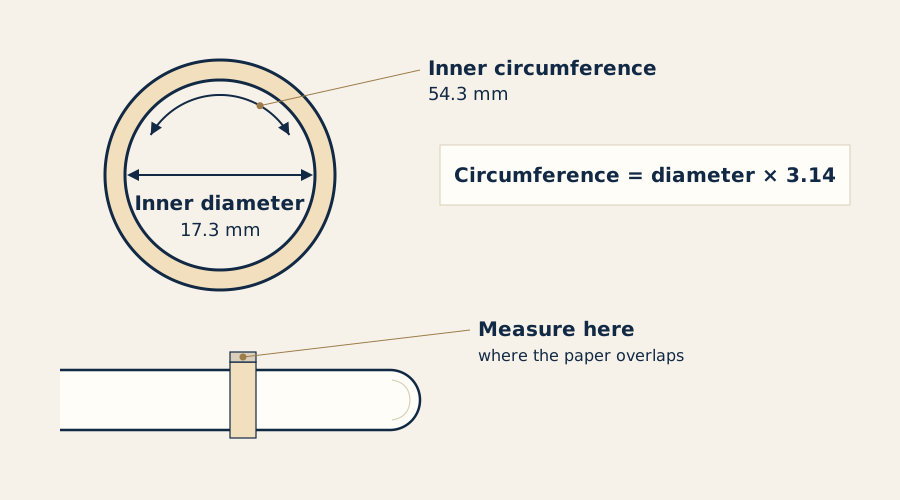
If you are measuring a ring you already own, measure the inside diameter across the widest point with a ruler or callipers, not the outside. A typical band is 1.5–2 mm thick, so measuring the outside by mistake adds 3–4 mm of diameter and can overstate your size by around eight to ten letters.
Ring size conversion chart: Australian, US, UK and EU
This ring size conversion chart covers the sizes most Australians wear. Australian and UK sizes are identical. EU sizes are rounded to the nearest whole millimetre of circumference, which is how they are usually sold.
| AU / UK | US / Canada | EU (ISO) | Inside diameter (mm) | Inside circumference (mm) |
|---|---|---|---|---|
| H½ | 4 | 47 | 14.9 | 46.8 |
| I½ | 4½ | 48 | 15.3 | 48.0 |
| J½ | 5 | 49 | 15.7 | 49.3 |
| K½ | 5½ | 51 | 16.1 | 50.6 |
| L½ | 6 | 52 | 16.5 | 51.9 |
| M½ | 6½ | 53 | 16.9 | 53.1 |
| N½ | 7 | 54 | 17.3 | 54.4 |
| O½ | 7½ | 56 | 17.7 | 55.7 |
| P½ | 8 | 57 | 18.1 | 57.0 |
| Q½ | 8½ | 58 | 18.5 | 58.3 |
| R½ | 9 | 60 | 19.0 | 59.5 |
| S½ | 9½ | 61 | 19.4 | 60.8 |
| T½ | 10 | 62 | 19.8 | 62.1 |
| U½ | 10½ | 63 | 20.2 | 63.4 |
| V½ | 11 | 65 | 20.6 | 64.6 |
| W½ | 11½ | 66 | 21.0 | 65.9 |
| Y | 12 | 67 | 21.4 | 67.2 |
Notice the pattern: one full US size equals roughly two Australian letters. That is why a whole US size usually lands on an Australian half size. Converting an Australian ring size to US is therefore a matter of counting letters, and going from US to Australian ring size means stepping two letters for every whole US number. For sizes above Z, Australian and UK jewellers continue with Z+1, Z+2 and so on.
For a fuller look at the history behind each system and the small differences between national standards, read how Australian sizes compare with US, UK and EU systems.
Why are Australian ring sizes letters, and how do other systems work?
Australia inherited the British system, which labels sizes with letters stepping up by about 1.25 mm of circumference (about 0.4 mm of diameter) each time. The US system uses numbers, with each whole size adding about 0.81 mm of diameter, or about 2.55 mm of circumference. Europe took the most literal approach: the EU size, set out in the international standard ISO 8653, is the inner circumference in millimetres.
| System | Where it is used | How it is defined | Step between sizes | Same finger example |
|---|---|---|---|---|
| Letters | Australia, UK, NZ, Ireland | Letter scale A to Z, then Z+1 | About 1.25 mm circumference per letter | N½ |
| Numbers | US, Canada | Number scale, often in quarter sizes | About 2.55 mm circumference per size | 7 |
| ISO / EU | France, Germany, most of Europe | Inner circumference in mm | 1 mm | 54 |
| Swiss | Switzerland, some watch and ring makers | Circumference minus 40 | 1 mm | 14.4 |
| Japanese | Japan, often China | Number scale 1 to 27 or so | About 1 mm circumference | 14 |
The table shows why EU ring size conversion is the simplest: if you can measure a circumference in millimetres, you already have the EU size. Letters and US numbers need a chart or a converter because their steps do not line up neatly with whole millimetres.
This matters most when you buy abroad. A ring bought in Europe or Asia will be marked in that country's system, and a jeweller here will re-measure it on an Australian mandrel (a tapered steel rod marked with sizes). If you are weighing up a purchase on holiday, our guide to buying a ring overseas versus at home covers sizing, warranties and returns, and visitors leaving Australia may want to read about the Tourist Refund Scheme for jewellery.
Related guideAustralian Ring Sizes vs US, UK and EUNot sure which one is right?
Send us the stones you are looking at and our gemologist will tell you which to choose and why.
How accurate is a ring size converter?
The arithmetic is exact; the inputs are not. Conversions between systems are accurate to a fraction of a millimetre, but real fingers and real rings bring their own variation. The usual sources of error are:
- Temperature and time of day. Fingers swell in heat, after exercise and late in the day, and shrink in cold weather. The difference can be half a size or more.
- Knuckles. If your knuckle is wider than the base of your finger, the ring must slide over the knuckle and will sit a little loose behind it.
- Band width. A wide band covers more of the finger and feels tighter than a thin band of the same size.
- Inside shape. A comfort-fit band (one with a gently domed inside) can feel looser than a flat-inside band of the same size.
- Measuring tools. String stretches, paper slips and printable sizers are only accurate if your printer prints at exactly 100% scale.
- Sizer differences. Jewellers' mandrels and finger sizers from different makers can differ slightly, usually well under half a size.
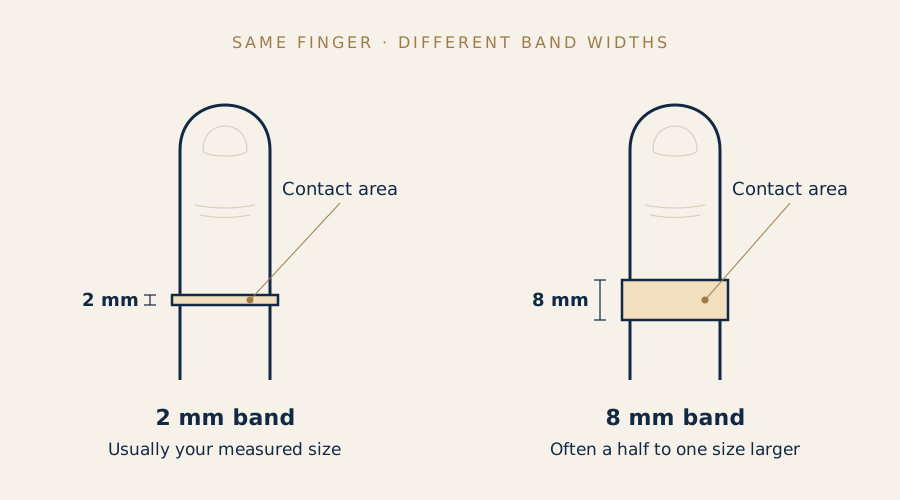
As a rough guide, bands up to about 4 mm wide usually follow your measured size. From about 6 mm upwards, many people need a half size larger, and very wide bands of 8 mm or more can need a full size. This comes up most with men's wedding rings; see our advice on ring sizing for men's wider bands.
What is the average ring size in Australia?
There is no official national data on ring sizes, but jewellers see clear patterns. Many Australian women wear somewhere between about K and O (roughly US 5½ to 7½), with L and M among the most common. Many men wear between about R and V (roughly US 9 to 11). Engagement and wedding rings are usually worn on the ring finger of the left hand, and the dominant hand is often half a size larger.
Averages are useful as a fallback, not as a size to order. Two women of the same height can differ by four or five letters. If you are planning a proposal and cannot ask, our guide to estimating a ring size without asking covers borrowing a ring, asking a friend and choosing a design that is easy to resize. For the wider question of who usually chooses and pays for what, see engagement ring etiquette, including who sizes the ring.
What ring size should you choose for an engagement ring?
For an engagement ring, size it to the finger it will be worn on, with the band width and the stack you plan to wear. If a wedding band will sit beside it, the two rings together cover more of the finger, so some people go up a half size on both or keep the engagement ring at their measured size and size the band separately once they try them together.
Finger size also changes how big a diamond looks. A 1 carat round brilliant is about 6.4–6.5 mm across. On a size L½ finger (about 16.5 mm inside) it spans roughly 39% of the ring's inside width; on a T½ finger (about 19.8 mm) it spans about 33%, so the same stone looks noticeably smaller on a larger hand. Our diamond size visualiser by shape lets you see different carat weights in millimetres, and comparing two diamonds side by side helps when the choice comes down to two stones.
Size is one decision among many. Our step-by-step engagement ring buying guide puts sizing in order with the stone, setting and metal, and if budget is on your mind, the three-month salary rule looks at where that old idea came from and why it is only a starting point.
Can a ring be resized if the size is wrong?
Most plain gold and platinum rings can be resized. To go up, a jeweller cuts the band at the base and adds metal or stretches it slightly; to go down, a small section is removed and the join is soldered and polished. Whether it is easy depends on the design:
| Ring type | Can it be resized? | Typical limit |
|---|---|---|
| Plain gold or platinum band | Yes, usually straightforward | About 1–2 sizes up or down |
| Solitaire engagement ring | Usually; claws are checked afterwards | About 1–2 sizes; larger changes can stress the setting |
| Shoulder-set or half-eternity | Sometimes, in small amounts | Often half to one size |
| Full eternity band | Rarely; stones run all the way round | Usually remade in the new size |
| Patterned or engraved band | Possible, but the pattern may need recutting | Depends on the design |
| Tungsten, titanium, ceramic or tension-set | Generally not | Usually replaced |
As a broad guide, a simple resize on a gold ring often costs somewhere around AUD $60–$250, with platinum, large changes and stone-set shanks costing more. Allow anywhere from a few days to a couple of weeks, and longer around December. If you are ordering a new ring, our breakdown of how long each step of a ring order takes shows where sizing fits in.
After any resize, update the ring's description with your insurer if the valuation lists the size or weight. Our guide to jewellery insurance in Australia explains what valuations should include.
Create your ring or book a ring resize
How to find and convert your ring size: step by step
- Pick the finger and hand. Measure the exact finger the ring will be worn on; left and right hands often differ.
- Measure when your hands are warm. Late afternoon or evening at room temperature gives the most reliable reading.
- Get a millimetre figure. Wrap a strip of paper around the base of the finger, mark where it overlaps and measure the length in mm, or measure the inside diameter of a ring that fits.
- Check it over the knuckle. If your knuckle is broad, make sure the size will slide over it.
- Enter the figure in the converter. Note the Australian letter and the US and EU equivalents.
- Adjust for the band. Add about a half size for bands 6 mm or wider, and consider the stack if a wedding band will sit beside it.
- Confirm with a jeweller. Before ordering a ring that is hard to resize, such as a full eternity band, have your finger measured on a proper sizer.
Free consultation
Talk to a gemologist
Compare stones in person or online with Raj Sood, Graduate Gemologist (GIA), AJP (GIA).
Book a consultationShop this shape
FAQ
Common questions
Are Australian and UK ring sizes the same?
Yes. Australia, the UK, New Zealand and Ireland all use the same letter system, so an Australian M is a UK M. Small differences between individual makers' sizers are usually well under half a size.
What is an Australian ring size N in US sizes?
An Australian N is about a US 6¾, and N½ is a US 7. Each whole US size is roughly two Australian letters.
How do I convert an EU ring size to Australian?
An EU size is the inner circumference in millimetres. Find that circumference in the conversion chart; for example, EU 54 is an Australian N½ and EU 52 is about L½.
Can I measure my ring size with a phone or printable sizer?
You can, but check the printout with a ruler first, because printers often shrink pages slightly. Treat any home measurement as a guide and confirm it with a jeweller before ordering a ring that is hard to resize.
Should I size up for a wide band?
Often, yes. Bands about 6 mm and wider usually need a half size larger than your measured size, and very wide bands of 8 mm or more can need a full size.
Is it better for a ring to be slightly big or slightly small?
Both can usually be corrected. Sizing down is often slightly simpler and cheaper, because a small section is removed rather than metal added. A ring that is too loose can slip off, though, so wear it carefully until it is resized.

Ask a gemologist
Not sure which diamond to choose?
Raj Sood is a Graduate Gemologist (GIA) and master jeweller. Bring the stones you are considering, or send the reports, and he will tell you honestly which one is better and why.
Keep learning
Related guides
 Buying Knowledge & Custom ProcessRing Size Guide Australia
 Buying Knowledge & Custom ProcessHow to Measure Your Ring Size at Home
 Buying Knowledge & Custom ProcessAustralian Ring Sizes vs US, UK and EU
 Buying Knowledge & Custom ProcessMen's Ring Size GuideBuying Knowledge & Custom ProcessEngagement Ring Buying Guide
 Buying Knowledge & Custom ProcessDiamond Size Visualiser by Shape (Tool)
 Buying Knowledge & Custom ProcessHow to Estimate Ring Size for a Surprise Proposal
 Buying Knowledge & Custom ProcessEngagement Ring Timeline: How Long Each Step Takes
Explore more
More guides on this topic
Education