
- Education
- Wedding Bands & Eternity
- How to Prevent Rings From Rubbing Each Other: Metals, Fit and Shape-by-Shape Fixes
Wedding Bands & Eternity
How to Prevent Rings From Rubbing Each Other: Metals, Fit and Shape-by-Shape Fixes
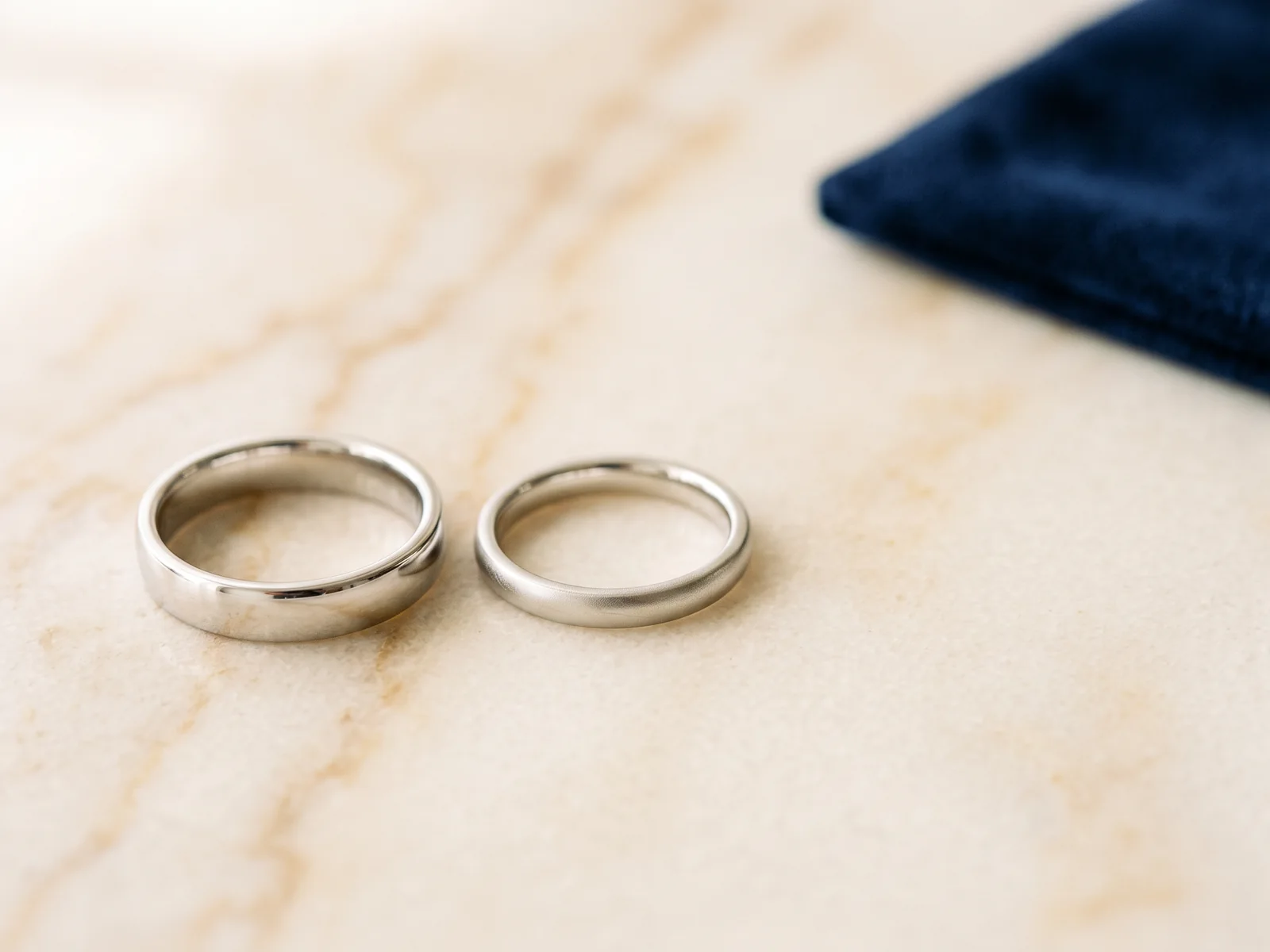
An engagement ring and a wedding band on one finger touch thousands of times a day. Here is how to prevent rings from rubbing, so both still fit well and hold their stones safely decades from now.
 Reviewed by Raj Sood, Graduate Gemologist (GIA), AJP (GIA)Master jeweller and Graduate Gemologist (GIA) · reviewed 4 November 2026
Quick answer
To prevent rings from rubbing, match the metals and widths, choose a band that sits flush (straight, contoured or notched) or leave a deliberate gap with a spacer, make sure no stones grind against the other ring, and have claws checked every 6–12 months. Soldering the rings together stops movement completely.
Why do rings rub against each other?
When you wear an engagement ring and a wedding band on the same finger, you have two separate pieces of metal sitting side by side. Every time you grip a steering wheel, type, carry shopping or make a fist, they shift a fraction of a millimetre against each other. Each movement is tiny, but it happens thousands of times a day for decades, and the contact points slowly wear, much like a step worn into an old stone staircase.
Rubbing is worse in some combinations than others. The main causes are:
- Profiles that don't match: a curved or raised setting beside a straight band touches at only one or two points, so all the wear concentrates there.
- Metals of different hardness: the harder ring grinds away at the softer one.
- Different widths: a 3 mm band beside a 1.8 mm engagement ring shank leaves a ledge that catches and rocks.
- Rings that are too loose: a ring that spins moves further with each motion and can roll its stones into the neighbouring band.
- Stones or claws at the edge: claws, halo diamonds or eternity stones that reach the side of a ring rub metal on metal, or diamond on diamond.
The shank is the band part of a ring, the circle that goes around your finger. If any other term on this page is new, our plain-English jewellery glossary explains it. If you are still choosing the pair, the complete wedding ring buying guide covers widths, profiles and metals before you commit, which is the easiest time to avoid rubbing altogether.
What damage does rings rubbing together cause?
Wear from rubbing is slow and easy to miss, because it happens on the sides of the rings where you rarely look. These are the signs a jeweller looks for:
- Thinning shanks: the band gets narrower or thinner where it meets the other ring, and eventually can crack or need a new section.
- Flat spots and grooves: a notch worn into the band exactly where a claw or setting edge sits against it.
- Worn claws: the small metal prongs holding a stone get shorter and thinner. A claw worn too far can let the diamond fall out.
- Yellow patches on white gold: white gold is usually plated with rhodium, a bright white metal, and the plating wears through first at contact points.
- Chipped girdles: the girdle is the thin outer edge of a diamond. Where two diamond-set rings touch, stone can knock against stone.
- Lost detail: milgrain (tiny beaded edges) and engraving flatten out where the rings meet.
- Loose stones: in eternity bands, the side pressure can slowly open settings.
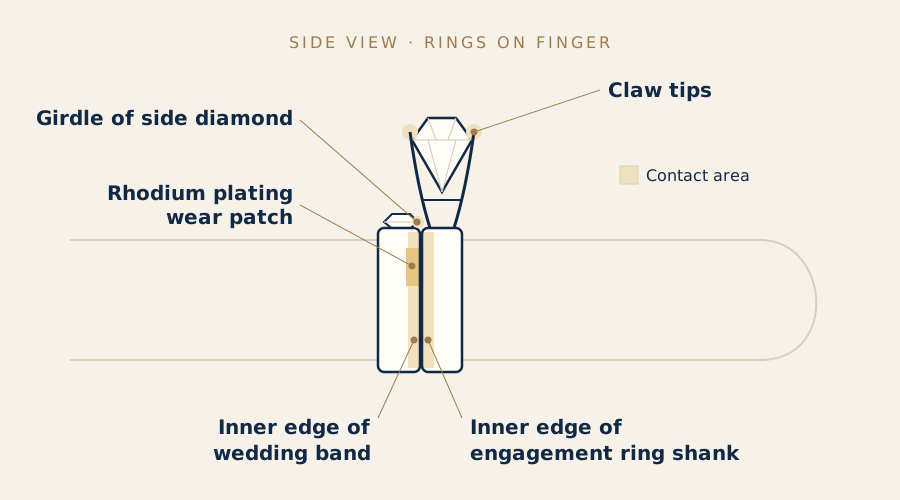
Hardness explains most of this. Diamond sits at 10 on the Mohs hardness scale (a 1–10 scale of scratch resistance) and gold at about 2.5–3, so a diamond rubbing on gold cuts the gold, and the gold cannot scratch the diamond back. Diamond is hard but not especially tough, though: it can chip along its cleavage planes, so a thin girdle edge knocked by another diamond's edge can break. That is why diamond-to-diamond contact needs as much care as metal wear.
Does mixing platinum and gold rings make rubbing worse?
It can. When two different metals rub, the harder or harder-wearing one usually wins, and the other ring takes most of the wear. Here is how the common ring metals behave:
| Metal | Approx. Mohs hardness | How it wears | Pairing note |
|---|---|---|---|
| 18ct yellow or rose gold | about 2.5–3 (alloys a little harder) | Loses metal as fine dust; polish dulls quickly | Pair with the same carat and colour where possible |
| 9ct gold | about 3 (varies with alloy) | Often harder than 18ct but can tarnish | An 18ct ring beside 9ct may wear faster |
| 18ct white gold | about 2.5–3 under the plating | Rhodium plating wears at contact points | Re-plating every 12–24 months keeps it white |
| Platinum (950) | about 4–4.5 | Metal is mostly pushed aside rather than lost, forming a soft patina | A gold ring beside platinum usually wears faster |
| Palladium | about 4.75 | Similar to platinum, lighter in weight | Pair with palladium or platinum |
| Titanium | about 6 | Hard surface, hard to resize | Can grind a softer gold ring |
| Tungsten carbide | about 8.5–9 | Very scratch resistant, cannot be resized | Will wear down gold and platinum next to it |
The simplest fix is to wear rings in the same metal and the same carat. A platinum engagement ring with a platinum band, or 18ct white gold with 18ct white gold, wear at roughly the same rate, so neither one is sacrificed to the other. Mixing colours of the same carat, such as 18ct yellow beside 18ct white, is usually fine, because the alloys are close in hardness.
If you love the look of mixed metals, it is still possible; just expect more maintenance on the softer ring and consider one of the gap or join options below. Our guide to comparing wedding ring metals side by side goes further into colour, weight and allergy considerations.
Flush fit or gap: which stops a wedding band rubbing an engagement ring?
There are two ways to stop grinding. Either the rings sit so closely that they move as one (a flush fit), or they sit far enough apart that they barely touch (a deliberate gap). The trouble starts in between, where a ring touches at a single point and rocks.
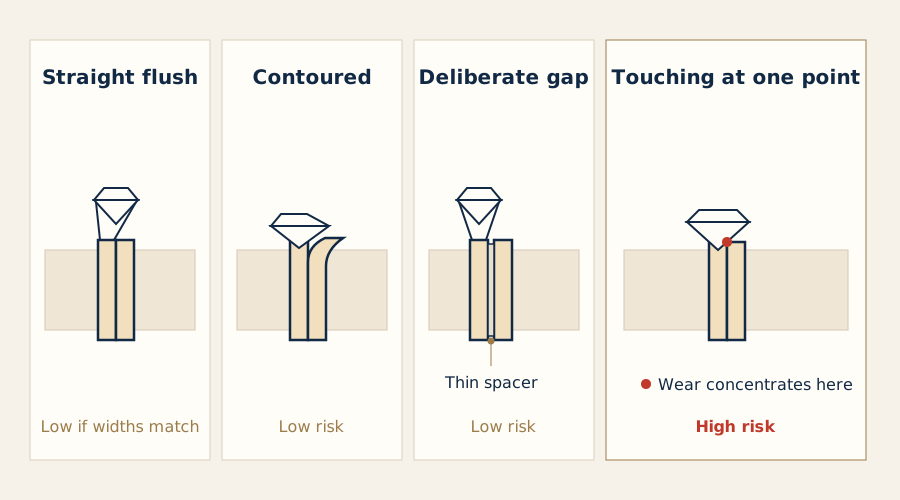
| Fit | How it works | Rubbing risk | Trade-off |
|---|---|---|---|
| Straight flush | A plain band sits tight against a low-set ring whose setting clears the band | Low if widths match | Only works if the setting sits above the band line |
| Contoured or curved | The band is shaped to follow the outline of the centre stone or halo | Low | Usually made to order; the band may look odd worn alone |
| Notched | A small cut-out in the band makes room for the setting's base | Low to medium | The notch edges can wear and need checking |
| Deliberate gap | A raised setting or a thin spacer band keeps the rings apart | Low | A visible space between rings |
| Touching at one point | A straight band beside a setting that dips to the shank | High | All wear focuses on one claw or edge |
| Soldered set | Both rings joined permanently | None between the rings | Cannot wear them separately; resizing is more complex |
Width and height matter too. Most engagement ring shanks are about 1.8–2.5 mm wide, and a band within about half a millimetre of that width sits most evenly. A band much wider leaves a ridge that catches. If you plan to add more rings later, our guide to stacking order and spacing for several rings explains how a stack spreads the load.
Not sure which one is right?
Send us the stones you are looking at and our gemologist will tell you which to choose and why.
How do you prevent rings from rubbing with each diamond shape?
The shape of the centre stone decides where the setting reaches down towards the band, and therefore where rubbing starts. Here is how each common shape behaves, and the fit that usually works:
| Centre stone | Where it rubs | Fit that usually works |
|---|---|---|
| Round solitaire, low set | Lower claws or gallery touch the band's top edge | Straight flush band if the gallery clears; otherwise slightly curved |
| Round solitaire, cathedral | Arches of the shank rise above a straight band | Straight band, which slips under the arches |
| Oval | Wide sides overhang the shank | Gentle curve or a small deliberate gap |
| Pear | The point overhangs and its V-claw touches the band | Contoured or V-shaped band, or wear the band on the round end's side |
| Marquise | Two points and two V-claws reach the band | Contoured band; check both claw tips yearly |
| Heart | The point and V-claw | Contoured or notched band |
| Princess, emerald, Asscher, radiant | Corner claws stick out sideways | Notched band, or straight band if the setting sits high |
| Cushion | Claws at the rounded corners | Straight band with a raised setting, or a slight curve |
| Halo (any shape) | Halo diamonds are often wider than the shank | Contoured band or a small gap; avoid diamond-set bands touching the halo |
| Bezel (any shape) | Smooth metal rim; lower risk | Often sits flush; check the rim edge for wear |
| Three-stone (trilogy) | Side stones are wide and sit low | Curved band shaped to the side stones |
Elongated and pointed shapes need the most care, because their points are both the most likely to touch the band and the most fragile part of the stone. A pear cut centre stone has one exposed point, while a marquise with its two pointed ends has two, so both usually suit a contoured band. Hearts behave in a similar way; our guide to bands shaped to sit beside a heart diamond shows the options. With rounds and bezels, a simple flush fit is usually possible. To see how each outline sits on the hand, start with our overview of the main diamond shapes.
The wedding band also sits right next to the centre stone, so the contrast between them shows: a bright white band beside a warmer diamond makes the tint more obvious. Our guide to colour and clarity choices for each diamond shape explains how much warmth each shape shows.
Will an eternity ring rub against my engagement ring?
An eternity ring has diamonds set along the band, and a diamond-set band beside a diamond-set engagement ring is where stone-to-stone contact happens. Diamond against diamond is the one rubbing combination that can chip a stone rather than just wear metal. How much risk there is depends on how the stones are set:
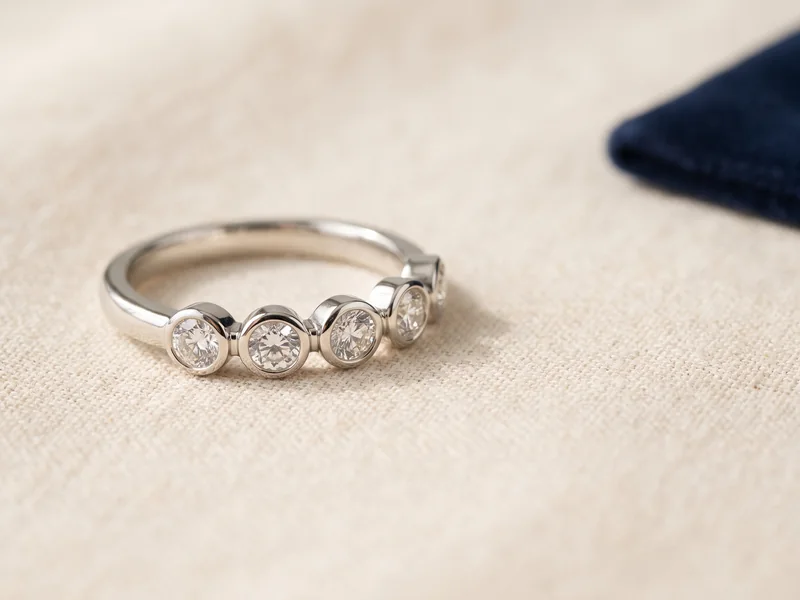
- Claw-set and shared-claw bands: small claws sit at the sides of the band, so they rub against the neighbouring ring and wear quickly. The stones' girdles can also touch the other ring.
- Channel-set bands: stones sit between two walls of metal, so only metal meets metal. Much lower risk to the diamonds.
- Bezel-set or flush-set bands: each stone is surrounded or sunk into metal. Also low risk.
- Pavé bands: many tiny stones held by tiny beads of metal. Attractive, but the beads wear fast where rings touch.
Coverage matters too. A full eternity ring has stones all the way around, including underneath, where your fingers press the rings together hardest when you grip. A half eternity ring has stones across the top only, leaving plain metal at the sides and base. See half vs full eternity rings compared for the practical differences, including resizing.
If you wear an eternity band alongside an engagement ring and a wedding band, putting the plain wedding band in the middle as a buffer is a simple way to keep diamond-set rings apart. Our guide on wearing an eternity band in a stack shows common orders.
Related guideHalf Eternity vs Full Eternity RingsWhich ring finishes hide rubbing marks?
Rubbing is partly about metal loss and partly about appearance. A high-polish finish shows every scuff, because a scratch breaks up the mirror surface. Textured finishes hide fine marks much better, though they wear smooth at the contact points over time and need refreshing:
- Brushed or satin: fine parallel lines that disguise light scratches. Our page on brushed and satin finishes explains how often they need redoing.
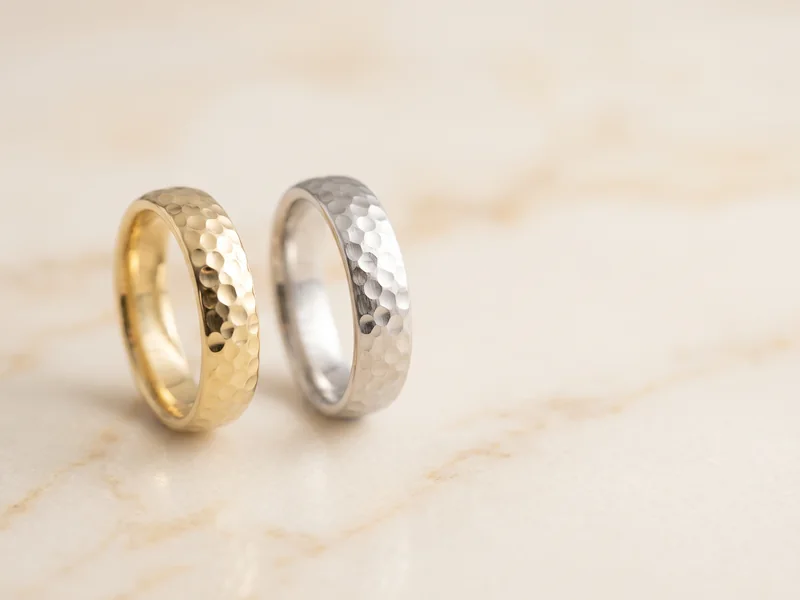
- Hammered: small dents across the surface make new marks almost invisible; see how a hammered texture is made and maintained.
- Sandblasted: a soft frosted look that hides scratches but can polish up where rings touch; read more about sandblasted ring surfaces.
- Milgrain and engraving: fine beaded edges and patterns look lovely but flatten first where rings rub. Our guide to milgrain edges and engraved patterns covers placement.
If you want milgrain on a band that sits against an engagement ring, ask for it on the outer edge only, away from the contact side. Most textured finishes can be refreshed by a jeweller every one to three years, depending on how hard you are on your hands. Keeping detail on one edge only means the side that rubs can simply be polished when it is serviced.
Can you solder rings together or add a spacer to stop rubbing?
Yes. If your rings already rub, or you are choosing a pair and want to rule it out, these are the main fixes:
- Soldering: a jeweller joins the two rings permanently at the base of the shanks. They can no longer move against each other, so rubbing stops. The downside is that you cannot wear one without the other, and resizing has to treat both as one piece.
- Spacer or guard band: a thin plain band (often 1–1.5 mm) worn between two rings, or a shaped guard that wraps the engagement ring, takes the wear instead of your main rings.
- A new contoured band: a band made to follow the exact outline of your engagement ring, so they sit together without rocking.
- Raising or reshaping the setting: sometimes a setting can be lifted slightly so a straight band slides underneath.
- Maintenance: re-tipping worn claws (adding new metal to the tips), re-plating white gold and rebuilding thin shanks restore what rubbing has taken.
| Fix | What it involves | Approximate price (AUD) |
|---|---|---|
| Soldering two rings together | Joining shanks, then polishing | about $100–$250 |
| Re-plating white gold | Cleaning, polishing and rhodium plating | about $60–$150 |
| Re-tipping a claw | Adding metal to a worn claw tip | about $50–$120 per claw |
| Contoured band made to fit | Design, CAD model, casting and finishing | about $900–$3,500 depending on metal and stones |
These are broad ranges only; the metal, the ring's condition and the number of stones change the final figure. A band made to fit takes longer than buying a ready-made one, so if you are planning a wedding date, see how long each step of a custom ring takes.
Create a matching wedding band or eternity ring, or book a repair
How to prevent rings from rubbing: step by step
- Match the metal. Choose the same metal and carat for rings worn on one finger, or accept extra maintenance on the softer ring.
- Match the width. Keep the band within about half a millimetre of the engagement ring's shank width; our notes on choosing band width and profile help here.
- Pick a fit. Decide between a flush fit (straight, contoured or notched) and a deliberate gap. Avoid rings that touch at one point.
- Test the pair. Wear them together, close your hand into a fist and listen for clicking or rocking.
- Keep diamonds apart. Put a plain band between diamond-set rings, or choose channel or bezel settings for bands that touch.
- Get the size right. Rings that spin rub more. A snug fit keeps them aligned.
- Plan ahead. If you need a contoured band, order early; allowing time for a band made to fit avoids a rush before the wedding.
- Check regularly. Have claws, shanks and plating checked every 6–12 months, and take rings off for the gym, gardening and heavy lifting.
Free consultation
Talk to a gemologist
Compare stones in person or online with Raj Sood, Graduate Gemologist (GIA), AJP (GIA).
Book a consultationFAQ
Common questions
Is it normal for an engagement ring and wedding band to rub?
Some contact is normal when two rings share a finger. It only becomes a problem when they touch at one point, differ in hardness, or put diamonds against each other, so the wear concentrates in one place.
Should I solder my engagement ring and wedding band together?
Soldering stops rubbing completely, so it suits people who always wear both rings together. The trade-off is that you cannot wear them separately, and resizing has to be done on both rings as one piece.
Can I wear a platinum ring next to a gold ring?
Yes, but the gold ring will usually wear faster. If you want mixed metals, expect to have the gold ring checked more often, or use a spacer band or deliberate gap.
Will a diamond eternity ring damage my engagement ring?
It can if claw-set stones or claws touch the engagement ring, because diamond scratches metal and can chip other diamonds. Channel or bezel-set bands, or a plain band between the two, reduce the risk.
What is a contoured wedding band?
A contoured band is shaped to follow the outline of an engagement ring's centre stone or halo, so the two sit together without a gap. It is common with pear, marquise, heart, halo and three-stone rings.
How often should I have my rings checked for wear?
Every 6–12 months is a sensible interval for rings worn daily. A jeweller checks the claws, shank thickness, plating and any loose stones before small wear becomes a lost diamond.
Terms in this guide

Ask a gemologist
Not sure which diamond to choose?
Raj Sood is a Graduate Gemologist (GIA) and master jeweller. Bring the stones you are considering, or send the reports, and he will tell you honestly which one is better and why.
Keep learning
Related guides
 Wedding Bands & EternityHow to Stack Rings
 Wedding Bands & EternityHalf Eternity vs Full Eternity RingsWedding Bands & EternityWedding Ring Buying Guide
 Wedding Bands & EternityBrushed and Satin Ring Finishes
 Diamond 4Cs & GradingBest Colour and Clarity Combination for Each Shape
 Buying Knowledge & Custom ProcessEngagement Ring Timeline: How Long Each Step Takes
 Wedding Bands & EternityHammered Ring Finish
 Wedding Bands & EternitySandblasted Ring Finish
Explore more
More guides on this topic
Education