
- Education
- Wedding Bands & Eternity
- Hammered Ring Finish: How It Looks, Wears and Is Refinished
Wedding Bands & Eternity
Hammered Ring Finish: How It Looks, Wears and Is Refinished
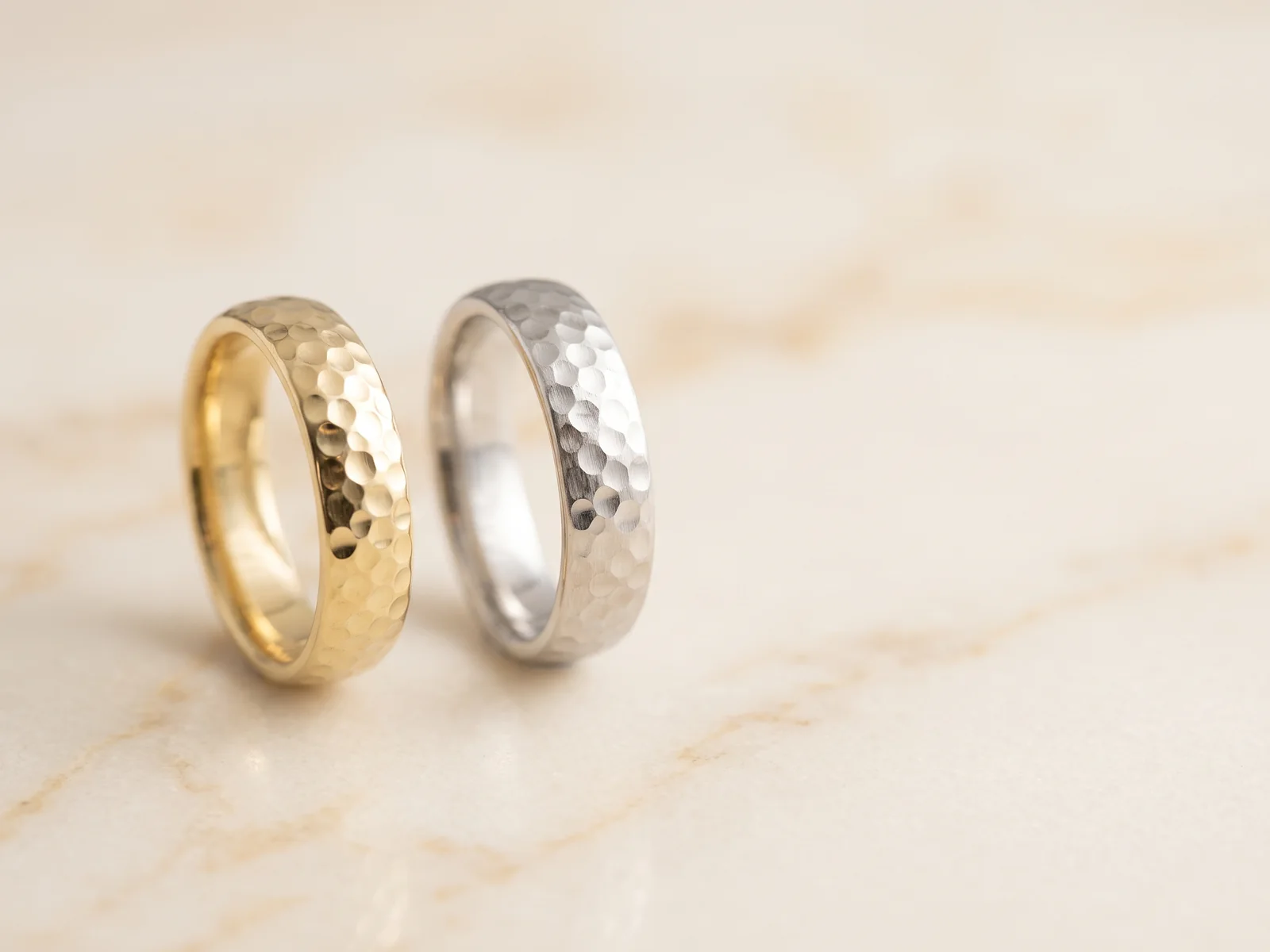
A hammered ring finish gives a wedding band a hand-made surface that catches light from many angles and copes well with everyday knocks. Here is how it is made, how it changes over years of wear, and what it takes to clean, resize and refinish one.
 Reviewed by Raj Sood, Graduate Gemologist (GIA), AJP (GIA)Master jeweller and Graduate Gemologist (GIA) · reviewed 4 November 2026
Quick answer
A hammered ring finish is a surface texture of small dimples or facets, struck into the metal with a hammer or cast from a textured model. It hides everyday scratches better than high polish, slowly softens as the high points wear smooth, and a jeweller can re-hammer and polish it, provided the band is still thick enough.
What is a hammered ring finish?
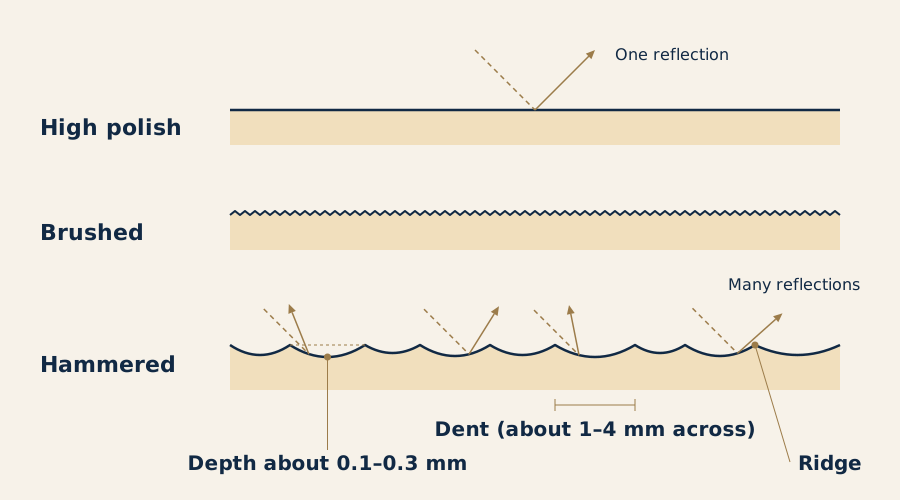
A hammered ring finish is a texture made of many small, overlapping dents across the outside of a band. Each strike of the hammer leaves a shallow, rounded or flat-bottomed mark, usually 1–4 mm across and about 0.1–0.3 mm deep. Where the marks meet, they form soft ridges. The result looks a little like beaten copper or the surface of water, and it catches light in dozens of small flashes instead of one long reflection.
It is one of the oldest ways to decorate metal. Before rolling mills and lathes, many bands were forged by hand, so hammer marks were part of how a ring was made. Today the finish is chosen on purpose, mostly for wedding bands, because it looks hand-made, suits both narrow and wide rings, and is forgiving of the scratches every band collects.
A few terms come up often. A mandrel is the tapered steel rod a ring sits on while it is shaped. Planishing means smoothing or texturing metal with light, overlapping hammer blows. Work hardening is the way metal becomes slightly harder each time it is struck or bent. If any other word is new, our jewellery glossary of ring terms explains it, and the complete wedding ring buying guide puts finish choice alongside metal, width and profile.
How is a hammered finish made?
There are two main ways, and they give slightly different results.
- Hand hammered: the finished band is slipped onto a steel mandrel and struck with a polished hammer face, often a ball-peen (rounded) or a planishing hammer (slightly domed). The jeweller turns the ring a little after each strike so the marks overlap evenly. No two rings come out exactly alike.
- Cast from a textured model: the hammered pattern is carved or modelled into a wax or a CAD (computer-aided design) file, then the ring is cast in metal. This gives a very consistent pattern and is useful for matching pairs, or for bands with set stones where hammering afterwards could loosen them.
- Hybrid: a cast band is given a final round of hand hammering to sharpen and vary the marks.
Hand hammering has two side effects worth knowing. First, it work-hardens the surface, so a freshly hammered gold band is a little more resistant to light scuffs than the same band left annealed (softened by heat). Second, striking a ring on a tapered mandrel stretches it. A jeweller usually hammers before the final sizing, or starts the ring slightly small so it ends up at the right Australian letter size.
Hammering is often combined with other details. Polished rails (narrow smooth borders at each edge), a milgrain beaded edge or engraving inside the band all sit happily beside it. Our guide to milgrain edges and engraving patterns shows how those details are made and how they wear.
What styles of hammered finish are there?
"Hammered" covers a family of looks. The hammer face, the spacing of the blows and what happens to the surface afterwards all change the character of the ring.
| Style | How it looks | How it is made |
|---|---|---|
| Small pebble | Fine, even dimples about 1–2 mm across | Small ball-peen face, close blows |
| Large facet | Bigger, flatter planes about 3–4 mm across, more like a cut gem | Flat or slightly domed face, wider spacing |
| Polished hammered | Each dimple bright and mirror-like | Hammered, then polished |
| Frosted hammered | Dimples with a soft matt sheen | Hammered, then sandblasted or bead-blasted |
| Hammered with polished rails | Textured centre, smooth edges | Hammered, then the edges are filed and polished |
| Bark or organic | Long, irregular grooves like tree bark | Usually made with gravers, files or a textured model rather than a hammer |
Polished hammered bands are the most common. The frosted version pairs the hammer pattern with a sandblasted, or frosted, finish, which gives a soft, quiet glow. If you like texture but want something more regular, the brushed and satin textures use fine parallel lines instead of dents.
Related guideBrushed and Satin Ring FinishesHow does a hammered ring finish wear over time?
All jewellery metals are fairly soft. Gold is about 2.5–3 on the Mohs hardness scale (a 1–10 scale where diamond is 10), and platinum about 4–4.5. So every band picks up scratches; the question is how visible they are. On a hammered ring, scratches and small dents land among hundreds of existing marks and mostly disappear into the pattern.
What does change is the shape of the texture. The ridges between dents stand proud of the surface, so they take most of the contact with benches, steering wheels, gym equipment and your other rings. Over time those ridges round off and flatten, the dimples look shallower, and the contrast between bright and shadowed facets softens.
| Time in daily wear | What you typically see |
|---|---|
| New | Crisp ridges, strong contrast, many separate flashes of light |
| 6–12 months | Ridges slightly rounded, fine scratches in the dimples, still clearly hammered |
| 2–5 years | Softer, "pillowy" look; on the palm side the texture may be noticeably flatter |
| 10+ years | Palm side may be close to smooth; the back of the finger usually keeps more texture |
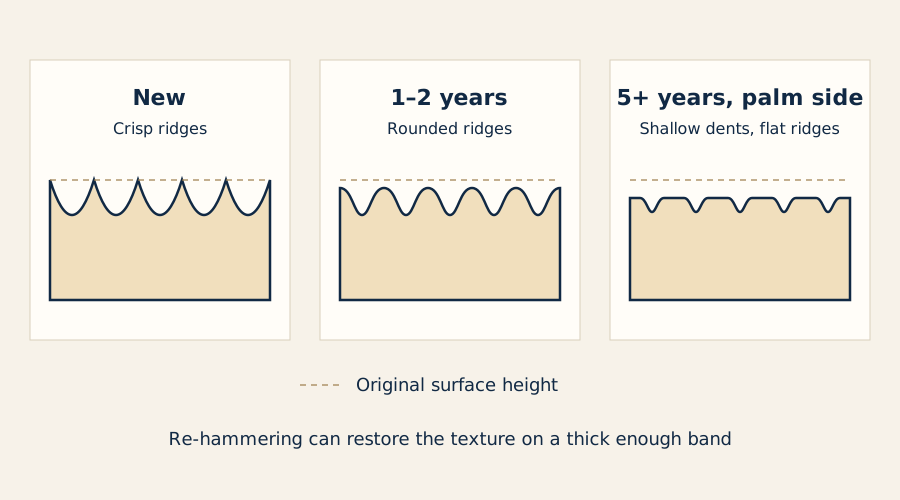
The palm side wears fastest because it grips things. Heavy manual work, rock climbing or weight training speed everything up. Many people find the softened look appealing, because it reads as a ring that has been lived in. Compare that with how a high polish ring ages: a mirror surface shows each fine scratch from day one and turns hazy within months.
Not sure which one is right?
Send us the stones you are looking at and our gemologist will tell you which to choose and why.
Which metals suit a hammered wedding band?
Any metal that can be struck without cracking takes a hammered finish, but each one ages a little differently.
| Metal | How the hammer marks wear | Worth knowing |
|---|---|---|
| 9ct yellow or rose gold | Harder alloy, so ridges stay crisp a little longer | Paler colour than 18ct; easy to re-hammer |
| 18ct yellow or rose gold | Softer, so ridges round off sooner | Rich colour; refreshes very well |
| 18ct white gold (rhodium plated) | Rhodium wears off the ridges first, showing a warmer tone | Needs re-plating every 1–2 years to stay bright white |
| Platinum 950 | Metal is pushed aside rather than lost, giving a soft grey patina | Holds its weight well over decades; re-hammers well |
| Palladium 950 | Similar to platinum, lighter on the hand | Fewer jewellers work it; check before choosing |
| Titanium, tungsten, ceramic | Texture is machined or cast, not hammered | Cannot be re-hammered; tungsten and ceramic cannot be resized |
Thickness matters as much as the metal. Re-hammering removes and moves a small amount of metal each time, so a band about 1.5–2 mm thick has room for several refreshes over its life, while a thin 1.2 mm band has little to spare. Width changes the look too: a narrow 2 mm band shows only a row or two of marks, while a 6–8 mm band shows the full pattern. Our guides to choosing a wedding band width and typical widths for women's and men's bands cover the sizes most people choose.
Hammered vs brushed, polished and sandblasted: which hides scratches best?
For hiding everyday marks, hammered is the most forgiving of the common finishes. Here is how they compare.
| Hammered | High polish | Brushed / satin | Sandblasted | |
|---|---|---|---|---|
| Look | Textured, many small flashes | Mirror-bright | Fine lines, soft sheen | Even matt frost |
| Scratch visibility | Low; marks blend into the pattern | High; fine scratches show quickly | Medium; cross-scratches show | Medium; scuffs show as shiny spots |
| How it ages | Ridges soften and flatten | Turns hazy, then evenly scratched | Lines fade towards a worn polish | Polishes on high points |
| Refresh | Re-hammer and polish | Re-polish | Re-brush | Re-blast |
| Refresh frequency | Every 2–5 years for most | Whenever you want the mirror back | Every 1–2 years | Every 1–2 years |
If you wear your wedding band next to an engagement ring, think about how they touch. A textured band rubbing against a polished engagement ring can slowly mark the smoother ring, and matching metals help, because a harder alloy wears a softer one faster. Our page on stacking rings without them rubbing explains the spacing and metal choices, and curved and straight band shapes shows how a band can sit around a centre stone.
Hammered texture also pairs well with fancy-shaped centre stones, because its organic look softens a gap beside a curved outline. See bands to pair with a heart engagement ring and band options for a toi et moi ring for shape-specific advice.
Can you resize a hammered ring?
Yes, a plain hammered band in gold, platinum or palladium can usually be resized by about one or two sizes. The jeweller cuts the band, adds or removes metal, solders or welds the join, then re-hammers around the whole ring so the new section blends in. Expect the pattern to change a little, because the texture is redone rather than repaired.
- Going up slightly: a plain band can sometimes be stretched about half a size on a mandrel without cutting, and the hammering itself does part of the stretching.
- Going up more: a piece of matching metal is added, then hammered to match.
- Going down: a section is removed and the join is hidden under fresh hammer marks.
- Not resizable: tungsten and ceramic bands, and most full eternity bands.
Hammered bands with diamonds need more care. Stones are usually flush set (sunk into drilled holes so they sit level with the metal) after the texture is made, and the band cannot be struck hard near them afterwards. On a band with stones all the way round there is nowhere to cut, which is one of the main points in our comparison of half versus full eternity designs. If you are thinking about a textured band with stones for a milestone, read about eternity and anniversary rings, the difference between an anniversary and an eternity ring, and diamond sizes by points so the stones suit the band width.
How do you clean and care for a hammered ring?
The dimples that hide scratches also hold soap, lotion and skin oils, so a hammered ring can look dull long before the texture is worn. Cleaning fixes most of that.
- Weekly or as needed: soak for 10–15 minutes in warm water with a few drops of mild dishwashing liquid, scrub gently with a soft toothbrush, rinse and dry with a lint-free cloth.
- Polishing cloth: brightens the facets, but it also polishes the ridges and smooths them over time, so use it lightly.
- Ultrasonic cleaners: generally fine for plain metal bands; check with your jeweller first if the band has set stones.
- Avoid: toothpaste and abrasive powders, which dull the surface, and chlorinated pools and spas, which can harm gold alloys over time.
- Take it off: for heavy lifting, gardening, rock climbing and building work, where the palm side takes the most wear.
For white gold, the first sign of wear is usually a faint warm tone on the ridges where the rhodium plating has worn through. That is normal, not a fault, and re-plating restores the bright white.
How to refinish a hammered ring finish: step by step
Refinishing a hammered ring usually costs about AUD $80–$250 for a plain band, depending on the metal, width and whether re-plating or resizing is included. This is what a jeweller does:
- Inspect and measure. Check the band's thickness with callipers. About 1.5 mm or more leaves room to re-hammer; thinner bands may be refreshed by polishing only.
- Clean thoroughly. Remove dirt from the dimples so the true wear pattern is visible.
- Resize first, if needed. Any cutting, adding or soldering happens before the texture, so the join is hidden under new marks.
- Anneal if required. Heating the band relieves work hardening so the metal moves evenly and does not crack.
- Re-hammer on the mandrel. The ring is struck in overlapping rows, matching the original hammer face and spacing or changing to a new style if you prefer.
- Check the size again. Hammering stretches the band, so the jeweller confirms the letter size and corrects it.
- Finish the surface. Polish for bright facets, or frost them, then polish any rails. White gold is re-rhodium plated.
Bring both your engagement ring and wedding band when you book a refresh, so the jeweller can match the texture and check how the two sit together.
Create your own hammered wedding band
Free consultation
Talk to a gemologist
Compare stones in person or online with Raj Sood, Graduate Gemologist (GIA), AJP (GIA).
Book a consultationShop this shape
FAQ
Common questions
Does a hammered finish wear off?
It softens rather than disappears. The ridges between hammer marks round off over a few years, especially on the palm side, but most bands keep visible texture for many years and can be re-hammered.
Is a hammered ring good for everyday wear?
Yes. It is one of the most forgiving finishes because new scratches blend into the existing pattern. It suits people who work with their hands and do not want to re-polish often.
Can you resize a hammered wedding band?
A plain gold, platinum or palladium hammered band can usually be resized by one or two sizes, then re-hammered so the join disappears. Tungsten, ceramic and most full eternity bands cannot be resized.
Is a hammered finish better than a brushed finish?
Neither is better; they suit different tastes. Hammered hides scratches more effectively and ages into a soft look, while brushed is more regular and needs re-brushing every year or two to stay even.
How do you clean a hammered ring?
Soak it in warm water with mild dishwashing liquid, scrub the dimples gently with a soft toothbrush, rinse and dry. Avoid toothpaste and use a polishing cloth only lightly.
Does a hammered ring cost more?
Hand hammering adds labour, so a hammered band often costs a little more than the same band in plain polish. The difference depends on the width, metal and whether the texture is hand made or cast.

Ask a gemologist
Not sure which diamond to choose?
Raj Sood is a Graduate Gemologist (GIA) and master jeweller. Bring the stones you are considering, or send the reports, and he will tell you honestly which one is better and why.
Keep learning
Related guides
 Wedding Bands & EternityBrushed and Satin Ring Finishes
 Wedding Bands & EternityHigh Polish Ring Finish
 Wedding Bands & EternitySandblasted Ring FinishWedding Bands & EternityWedding Ring Buying Guide
 Wedding Bands & EternityHow to Stack Rings
 Wedding Bands & EternityHalf Eternity vs Full Eternity Rings
 Wedding Bands & EternityAnniversary Ring vs Eternity RingWedding Bands & EternityEternity Rings & Anniversary Rings
Explore more
More guides on this topic
Education