
- Education
- Buying Knowledge & Custom Process
- Engagement Ring Timeline: How Long Each Step Takes, From Research to Insurance
Buying Knowledge & Custom Process
Engagement Ring Timeline: How Long Each Step Takes, From Research to Insurance
Most people underestimate how long a ring takes. This engagement ring timeline breaks down each step, from the first research to insurance and the Tourist Refund Scheme, so the ring is ready before the moment, not after it.
 Reviewed by Raj Sood, Graduate Gemologist (GIA), AJP (GIA)Master jeweller and Graduate Gemologist (GIA) · reviewed 4 November 2026
Quick answer
A realistic engagement ring timeline is about 2–3 months from first research to having the ring in hand. Allow 2–6 weeks to research and set a budget, 1–2 weeks to choose and source a diamond, 4–6 weeks for a custom ring to be designed and made, plus a buffer for insurance, resizing or travel.
What is a realistic engagement ring timeline?
Most engagement rings take somewhere between two weeks and three months from the first serious look to the day you collect them. Where you land depends mainly on one decision: a ready-made ring (a design that already exists, with the centre diamond already set or set to order) or a custom ring designed and made for you. Our step-by-step engagement ring buying guide covers what to choose; this page is about how long each choice takes.
| Stage | Ready-made ring | Custom ring |
|---|---|---|
| Research and budget | 2–6 weeks | 2–6 weeks |
| Finding the ring size | A day to 2 weeks | A day to 2 weeks |
| Choosing the diamond | 1–2 weeks | 1–2 weeks |
| Diamond arriving for viewing | 0–10 working days | 3–10 working days |
| Design and CAD approval | Not needed | 1–2 weeks |
| Making and setting | 2–7 working days to set the stone | 3–5 weeks |
| Valuation and insurance | A few days to 2 weeks | A few days to 2 weeks |
| Decision to collection | About 1–3 weeks | About 6–10 weeks |
These are typical working ranges, not promises. Working days matter: a jeweller's '10 working days' is two calendar weeks, and public holidays plus the Christmas and January shutdown many workshops and suppliers take can add a week or more. The lead-up to Christmas and Valentine's Day is a busy time for engagement rings, so if your date falls in December or February, start earlier than you think you need to.
Terms such as CAD, casting and grading report are explained as they come up below, and you will find all of them in our jewellery terms explained in plain English.
When should you start looking for an engagement ring?
If you want a custom ring, start looking for an engagement ring about three months before the proposal date. For a ready-made ring, four to six weeks is usually enough. Most of that early time is not spent with a jeweller at all; it is spent working out what you like and what you want to spend. People who arrive with a shape, a metal and a budget range usually finish the whole process weeks sooner than people who arrive with a folder of photos and no numbers.
- Budget (a few days to a week): set a range, not a single figure. Our guide to diamond prices in Australia shows what different sizes and grades cost, natural and lab-grown.
- Diamond basics (1–2 weeks of reading): learn how cut, colour, clarity and carat trade off against each other with our introduction to the 4Cs and grading reports.
- Shape (1–2 weeks): look at photos of each shape on real hands. Our page on which shapes flatter small hands or long fingers helps narrow it down.
- Style of sparkle: decide whether you prefer the broad, mirror-like flashes of a step cut or the scattered sparkle of a brilliant; step cuts and brilliant cuts compared shows the difference.
- Metal and setting: platinum, white, yellow or rose gold, and whether you want a solitaire, halo, three-stone or bezel setting.
A useful test: if you can describe the ring in one sentence, for example 'an oval of about 1 carat in a four-claw platinum solitaire, budget $5,000 to $8,000', you are ready to look at actual stones. If you cannot, another week of research will save you more than a week later on.
How long does it take to find out their ring size?
Ring size is the step most likely to stall a surprise proposal. Allow anything from a day to two weeks, depending on how discreet you need to be. The usual options are borrowing a ring they already wear on the ring finger, asking a close friend or family member, or measuring a ring at home. Our guide to measuring ring size at home with a ring or paper strip explains how to do it without being caught.
Australia uses the same letter scale as the UK, running from about F to Z with half sizes in between. Each full letter is roughly 1.25 mm of inside circumference, so a size out by one letter is noticeable but easy to fix. If you are working from an American or European size, our Australian, US, UK and EU ring size conversion chart will translate it. In Australia the engagement ring is worn on the left hand; a ring borrowed from the right hand may be half a size or so different, because the dominant hand is often slightly larger.
If you truly cannot find out, it is common to order a middle size and resize after the proposal. A plain band can usually go up or down by about two sizes. Full eternity bands, tension settings and some patterned shanks (the band part of the ring) cannot be resized easily, so guess more carefully with those designs, or choose a simpler band for a surprise.
How long does it take to choose and source a diamond?
Choosing the centre diamond usually takes one to two weeks. Most people look at three to five shortlisted stones before deciding. Comparing them properly means checking the grading report (the independent laboratory document listing the stone's grades and measurements), the millimetre size and a 360° video or an in-person viewing. Our walkthrough on how to compare two diamonds side by side gives a checklist, and the colour and clarity grades that make sense for each shape helps you avoid paying for grades you will never see.
Shape affects how long the search takes. Round brilliants are the easiest to find. Emerald, Asscher and other step cuts have long, open facets that show inclusions (internal features) and body colour more clearly, so finding an eye-clean stone, one with no inclusions visible without magnification, at the right price can take longer. Matched pairs for three-stone rings, fancy coloured diamonds and natural stones above about 2 carats can take several weeks to find.
Sourcing is the time it takes for the chosen diamond to arrive so you can see it. Many diamonds are held by suppliers in Australia or in trading centres such as India, Belgium, Israel and the United States. Allow about 3–10 working days for a stone to arrive for viewing. Nearly all of these stones are already graded by an independent laboratory such as GIA or IGI; a stone that still needs grading can add a few weeks.
Natural and laboratory-grown diamonds follow much the same timeline. Lab-grown diamonds are real diamond, grown in a laboratory rather than mined. They cost much less than natural diamonds and larger sizes are easier to find, which can shorten the search if you want a bigger stone. Natural diamonds are rarer, so a very specific natural stone can take longer to track down. Whichever you choose, the grading report states whether the diamond is natural or lab-grown.
Buying the stone overseas yourself rarely saves time. Shipping, customs and GST on imports add steps, and returns are slower and more expensive. Our page on the pros and cons of buying a diamond overseas or in Australia sets out the costs and risks.
Browse natural and lab-grown diamonds
Not sure which one is right?
Send us the stones you are looking at and our gemologist will tell you which to choose and why.
How long does a custom engagement ring take to make?
A typical custom engagement ring timeline is 4–6 weeks from the first design meeting to collection when the diamond is already chosen, and 6–10 weeks if you are choosing the diamond at the same time. Here is where the time goes:
| Stage | What happens | Typical time |
|---|---|---|
| Design consultation | Talk through shape, metal, setting style and finger size; look at examples | One meeting, about 45–90 minutes |
| CAD design | The ring is modelled in computer-aided design (CAD) software and you see 3D renders | 3–7 working days for first renders |
| Revisions | Changes to claws, band width, setting height or profile | 1–3 working days per round |
| Resin model (optional) | A 3D-printed copy of the design you can try on | 2–5 working days |
| Casting | The model is turned into metal by lost-wax casting, then cleaned up | About 1 week |
| Setting | The centre diamond and any side stones are set | 2–5 working days; longer for pavé or halos |
| Finishing | Polishing, rhodium plating for white gold, stamping, final check | 2–4 working days |
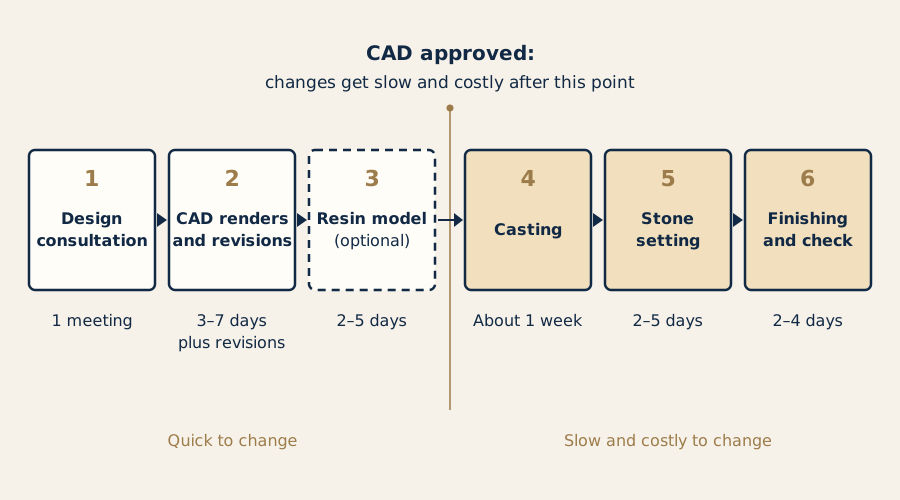
The biggest variable is you. Each round of CAD changes adds a few days, and most people need one to three rounds. Once the design is approved and cast, changing it is slow and costly because it often means recasting. Designs with many small stones take longer: a halo or pavé band (rows of tiny diamonds set close together) may need extra days at the setter's bench. Platinum is denser and harder to work than gold, which can add time to finishing. Engraving inside the band adds a few working days.
Ready-made or custom: which engagement ring timeline suits you?
| Factor | Ready-made ring | Custom ring |
|---|---|---|
| Decision to collection | About 1–3 weeks | About 6–10 weeks |
| What you see before paying | The actual ring, or a sample of the same design | CAD renders and often a resin model |
| Design freedom | Choose from existing designs and metals | Shape, profile, claws, band and details chosen by you |
| Choosing the diamond | Set stones or a selection that suits the setting | Any shape or size the design allows |
| Changes after making | Usually resizing only | Easy before casting, slow and costly after |
| Suits | Proposals within about a month | Proposals two or more months away |
If time is short and you still want a custom ring, there is a middle path. Some people propose with the loose diamond, a simple placeholder ring or a box holding a design sketch, then design the setting together afterwards. Opinions differ on this; our page on proposal and ring etiquette, including placeholder rings covers how couples handle it. It removes the deadline pressure and means your partner chooses the setting, which also removes the risk of a wrong size or style.
When should you insure an engagement ring in Australia?
Arrange cover from the day you collect the ring, not after the proposal. The weeks in between, when the ring sits in a drawer, a pocket or a suitcase, are a real risk. Most insurers want a recent valuation (a written document describing the ring and its replacement value) or the tax invoice before they will list it as a specified item. A valuation from the jeweller who made the ring can usually be prepared within a few days of collection; an independent valuer may take one to two weeks.
- Home contents policies often cover jewellery only up to a set amount per item, commonly somewhere around $1,000–$3,000, unless you list the ring as a specified item.
- Specified item cover names the ring on your policy, often with cover away from home, and usually needs a valuation or invoice.
- Stand-alone jewellery insurance covers just your jewellery and may offer agreed-value cover and repair or replacement through a jeweller you choose.
- Travel insurance often has low limits for jewellery and may exclude items left in checked luggage, so check before an overseas proposal.
Read how the policy settles a claim. Agreed value means an amount fixed when the cover starts, while some replacement policies replace the ring through the insurer's own suppliers rather than paying cash. Our explainer on jewellery insurance in Australia, from valuations to claims goes through each type. Update the valuation every two to three years, as metal and diamond prices change.
Can you claim GST back on an engagement ring with the Tourist Refund Scheme?
If you are proposing overseas, you may be able to claim back the 10% GST through the Tourist Refund Scheme (TRS), and its rules affect your timeline. GST is one-eleventh of a GST-inclusive price, so on an $8,800 ring the GST is $800. Both overseas visitors and Australian residents can claim, as long as the conditions are met:
- You spend at least $300 (including GST) with one business, shown on a tax invoice with that business's ABN.
- You bought the goods within 60 days before you leave Australia.
- You wear the ring or carry it in your hand luggage, and can show it with the original tax invoice, your passport and your boarding pass.
- You claim at the TRS facility at the international airport after passport control, no later than 30 minutes before your flight. Entering your details in the TRS app beforehand can speed this up.
The 60-day window matters for custom rings, where a deposit may be paid weeks or months before collection. Ask your jeweller how and when the final tax invoice will be issued so it falls inside the window. Australian residents should also know that when they bring the ring home, it counts towards the duty-free allowance (currently $900 per adult for general goods); goods above that must be declared, which can mean repaying the GST. Our page on how the Tourist Refund Scheme works for jewellery covers the details, including what happens on your return.
Related guideTourist Refund Scheme on Jewellery ExplainedHow long do resizing, engraving and wedding bands take after the proposal?
Resizing usually takes 3–10 working days. Going up or down one or two sizes on a plain gold or platinum band is routine. Larger changes, rings with stones set part-way around the band, and white gold that needs re-plating take longer. If the fit is close, wear the ring for a few days first: fingers swell in heat and shrink in cold, so a ring that feels tight on a hot Melbourne afternoon may be right in winter.
Engraving inside the band, by hand or laser, usually adds 2–5 working days. You can have it done while the ring is being made or after the proposal, once you know the wording.
Wedding bands are worth starting about two to three months before the wedding. A straight band beside a simple solitaire may be ready within a couple of weeks; a contoured or shaped band made to sit around a low setting or a halo is effectively a small custom job of 3–6 weeks. If the two rings will be worn together every day, think about the fit early. Our guide to keeping an engagement ring and wedding band from wearing against each other explains matched profiles, setting heights and spacers.
How do you plan an engagement ring timeline backwards from the proposal?
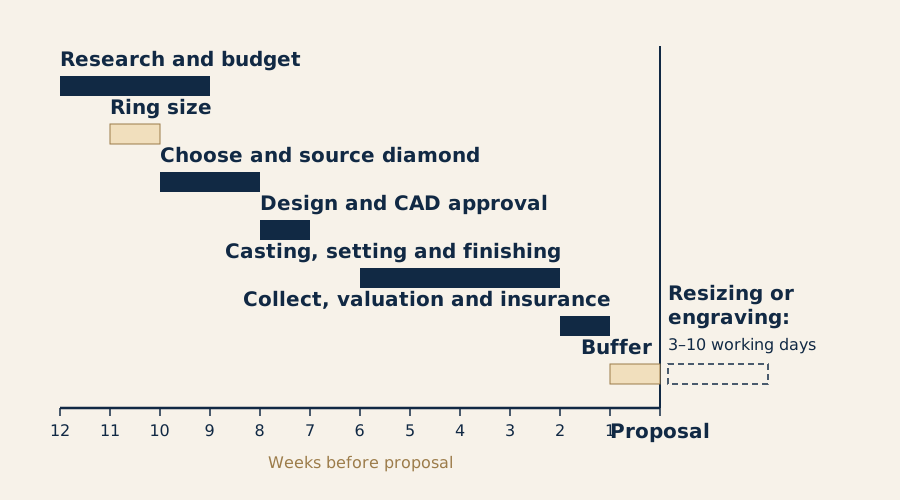
Count back from the date. This plan suits a custom ring with a sensible buffer; for a ready-made ring, do the first three steps, then allow about three weeks for the ring to be set, checked and insured.
- 12 weeks out: set the budget and research. Decide the shape, metal, setting style and whether you want a natural or lab-grown diamond.
- 10 weeks out: find the ring size. Borrow, ask or measure, and write the size down as an Australian letter size.
- 9 weeks out: shortlist and compare diamonds. Check the grading reports and millimetre measurements, and ask for stones to be brought in for viewing.
- 8 weeks out: hold the design meeting. Bring photos, the size and the chosen diamond or your shortlist.
- 7 weeks out: approve the CAD. Finish every change before casting starts.
- 6 to 2 weeks out: the ring is made. Casting, setting and finishing usually take 3–5 weeks.
- 2 weeks out: collect, check and insure. Match the diamond to its report, get the valuation and list the ring on your policy.
- Travelling? Check the TRS window. The tax invoice must fall within 60 days of departure, and the ring travels in your hand luggage.
- After the proposal: resize and engrave if needed. Allow 3–10 working days.
Free consultation
Talk to a gemologist
Compare stones in person or online with Raj Sood, Graduate Gemologist (GIA), AJP (GIA).
Book a consultationShop this shape
FAQ
Common questions
How long does it take to make an engagement ring?
A custom engagement ring usually takes 4–6 weeks from the design meeting to collection once the diamond is chosen, or 6–10 weeks if you are choosing the diamond as well. A ready-made ring can often be ready in 1–3 weeks.
When should I start looking for an engagement ring?
About three months before the proposal for a custom ring, and four to six weeks for a ready-made one. Add extra time if your date falls around Christmas, the January shutdown or Valentine's Day.
Can an engagement ring be made in two weeks?
Sometimes, if the design is simple, the diamond is available locally and you approve the CAD quickly, but there is little room for changes. A ready-made ring, or proposing with the loose diamond and designing the setting together, is less stressful on a tight deadline.
How long does engagement ring resizing take?
Usually 3–10 working days. Plain bands can be resized by a size or two routinely, while full eternity bands, tension settings and some patterned designs may not be resizable.
Do I need to insure the ring before I propose?
It is sensible to arrange cover from the day you collect it, because the ring is often carried around or travelled with before the proposal. Most insurers ask for a valuation or the tax invoice to list it as a specified item.
Can Australians claim GST back on an engagement ring bought before an overseas trip?
Yes, through the Tourist Refund Scheme, if you spend at least $300 with one business within 60 days of departure and wear or carry the ring onboard. If it is over your duty-free allowance when you return, you may need to declare it and repay the GST.

Ask a gemologist
Not sure which diamond to choose?
Raj Sood is a Graduate Gemologist (GIA) and master jeweller. Bring the stones you are considering, or send the reports, and he will tell you honestly which one is better and why.
Keep learning
Related guides
 Buying Knowledge & Custom ProcessTourist Refund Scheme on Jewellery Explained
 Buying Knowledge & Custom ProcessHow Jewellery Insurance Works in AustraliaBuying Knowledge & Custom ProcessEngagement Ring Buying Guide
 Buying Knowledge & Custom ProcessHow to Measure Your Ring Size at Home
 Diamond ShapesBest Diamond Shapes for Small Hands and Long Fingers
 Diamond ShapesStep Cut Diamonds: Emerald, Asscher, Baguette, Carré and More
 Diamond 4Cs & GradingBest Colour and Clarity Combination for Each Shape
 Diamond ShapesStep Cuts vs Brilliant Cuts Explained
Explore more
More guides on this topic
Education