
- Education
- Wedding Bands & Eternity
- Sandblasted Ring Finish: How It Looks, Wears and Is Refinished
Wedding Bands & Eternity
Sandblasted Ring Finish: How It Looks, Wears and Is Refinished
A sandblasted ring finish gives a wedding band a soft, frosted look that a mirror polish cannot, but it changes as you wear it. Here is how it is made, how it ages and how to care for it or restore it.
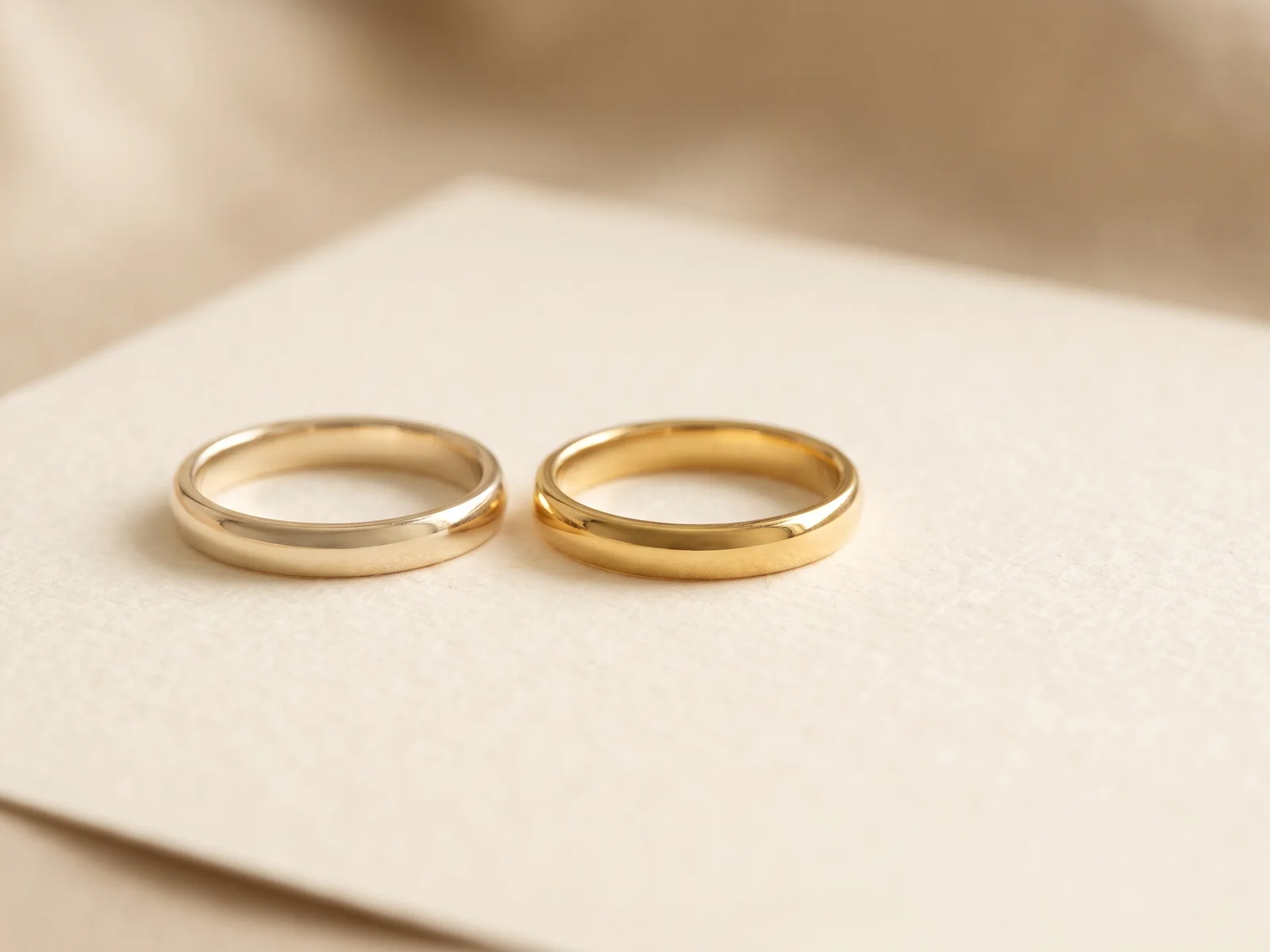
 Reviewed by Raj Sood, Graduate Gemologist (GIA), AJP (GIA)Master jeweller and Graduate Gemologist (GIA) · reviewed 4 November 2026
Quick answer
A sandblasted ring finish is a matte, frosted texture made by firing fine abrasive grit at the metal with compressed air. It hides fine scratches well, but the high points and edges slowly polish to a shine with daily wear, usually over one to two years. A jeweller can re-blast it in a short workshop job.
What is a sandblasted ring finish?
A sandblasted ring finish is a matte, evenly frosted surface made by abrasive blasting. The jeweller holds the ring inside a sealed blasting cabinet and fires a fine stream of grit at it with compressed air, usually somewhere around 2–6 bar (roughly 30–90 psi). Each particle leaves a tiny crater in the metal. Millions of overlapping craters make a surface that scatters light in every direction instead of reflecting it like a mirror.
The grit is called the media. Two are used most in jewellery. Aluminium oxide is a sharp, angular grit that cuts a crisp, slightly grey frost. Glass beads are round, so they peen (lightly hammer) the surface rather than cut it, giving a smoother, brighter frost. Strictly, the second is called bead blasting, but most jewellers and customers call both sandblasting. Real sand is rarely used in modern workshops because its silica dust is a serious health risk.
What sets sandblasting apart from other matte looks is that it has no direction. A brushed or satin finish is made with abrasive wheels or pads that leave fine parallel lines running around the band. A sandblasted surface looks the same from every angle, a bit like frosted glass or fine-grained stone. Compared with a mirror high polish, it shows far less of the fine scratching every ring picks up. If any term here is new to you, our plain-English jewellery glossary explains it.
What does a sandblasted wedding band look like?
Up close, a sandblasted wedding band has a soft, velvety surface. Because it does not mirror its surroundings, you see the colour of the metal itself rather than reflections of the room, so yellow gold looks deeper and more buttery, rose gold looks more even, and platinum takes on a calm, pale grey. From a metre away the band reads as quietly modern rather than shiny.
The texture can be fine or coarse. Your jeweller chooses the media, its grit size (a higher number means finer particles) and the pressure to suit the look you want:
| Texture | Typical media | How it looks | Wear notes |
|---|---|---|---|
| Fine frost | Glass bead or fine aluminium oxide (around 180–320 grit) | Smooth, bright, almost satin-like | Softens gradually; scratches blend in well |
| Medium frost | Aluminium oxide (around 120–180 grit) | Classic sandblasted look, even and matte | The most common choice for wedding bands |
| Coarse frost | Coarse aluminium oxide (around 60–120 grit) | Grainy, stone-like, noticeably rough to touch | Holds texture longer but traps more dirt |
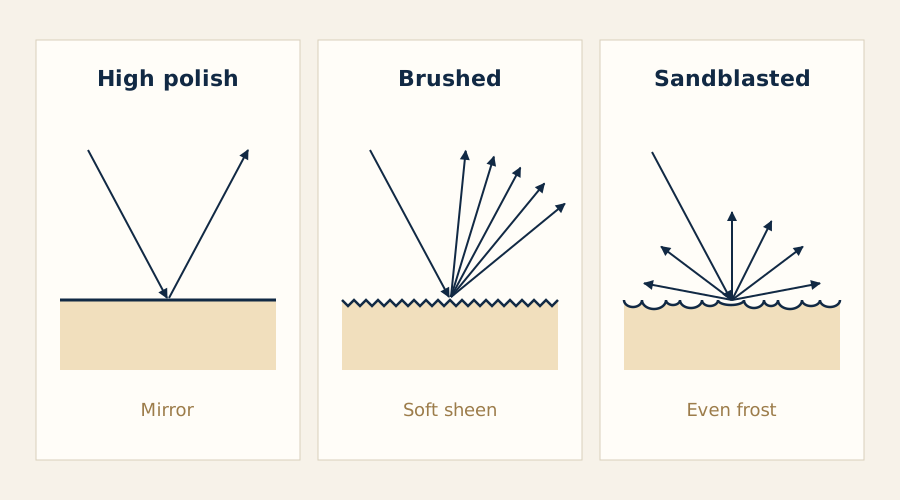
One thing people notice in the first weeks: skin oil and hand cream darken a fresh frost slightly, and fingerprints show for a moment before they fade. That is normal and washes off. A sandblasted band also makes a strong contrast beside a polished engagement ring or a row of diamonds, which is why many couples choose it as the plainer half of a pair.
Sandblasted vs brushed, hammered and high polish: what is the difference?
Every finish trades looks against how it ages. This table compares the four most common band finishes for everyday wear:
| Sandblasted | Brushed / satin | High polish | Hammered | |
|---|---|---|---|---|
| Surface | Even frost, no direction | Fine parallel lines | Mirror-smooth | Small dimples or facets |
| Light | Scatters evenly, soft glow | Soft sheen along the lines | Bright reflections | Flashes off each dimple |
| Hides fine scratches | Very well at first | Well, if scratches run with the lines | Poorly; every mark shows | Well; the texture breaks them up |
| How it changes | High spots and edges turn shiny | Lines blur and soften | Builds a scratched patina | Dimples soften; high points polish |
| Refinishing | Quick re-blast | Re-brush by hand or wheel | Re-polish (removes some metal) | Re-hammer and polish, more work |
| Fingerprints | Show briefly on a new frost | Show a little | Show clearly | Barely noticeable |
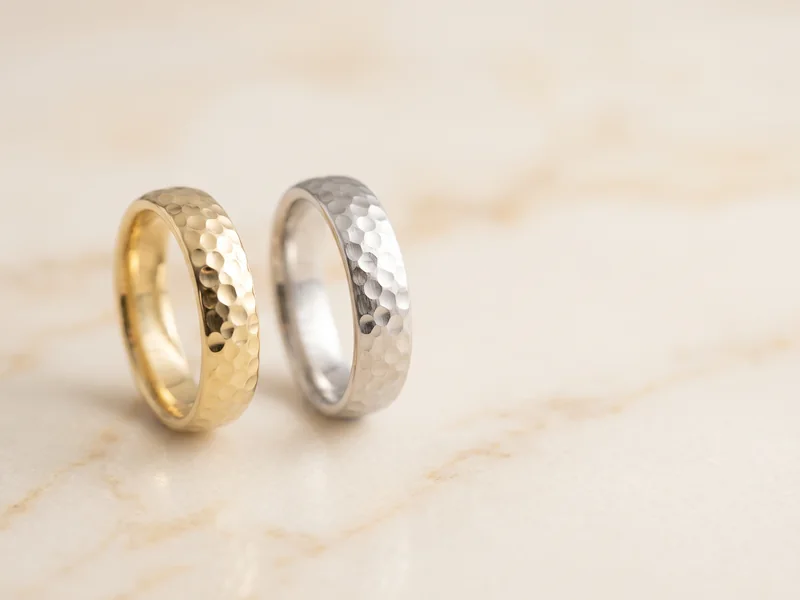
The sandblasted vs brushed finish question comes up most often, because both are matte. Brushing has a grain you can see and feel, and the grain tends to hide scratches that run the same way. Sandblasting has no grain, so it looks more uniform and a little more modern, but it shows polished high spots sooner. If you want texture that lasts with less upkeep, the dimpled hand-hammered finish is a good one to compare, because its dents are deep enough to keep their character for years.
Related guideBrushed and Satin Ring FinishesDoes a sandblasted ring finish wear off over time?
Yes, gradually, and in a predictable way. The frost is a surface texture only microns deep. Every time your ring brushes a door handle, a steering wheel or the ring beside it, the tops of those tiny craters are rubbed smooth. Rubbed-smooth metal reflects light, so the parts that touch things most start to shine first. The rest of the band stays matte for much longer.
| Time in daily wear | What you will usually see |
|---|---|
| New | An even, flat frost across the whole band |
| First few weeks | Tiny bright specks on the highest points; slight darkening from skin oils |
| 3–6 months | Shine starting on the edges and on the side that touches your engagement ring |
| 12–24 months | A soft, semi-matte patina (the worn surface character), with polished scuffs scattered through the frost |
| 2 years and beyond | Mostly satin-like, with the original frost left in protected areas; a good time to re-blast if you want it crisp |
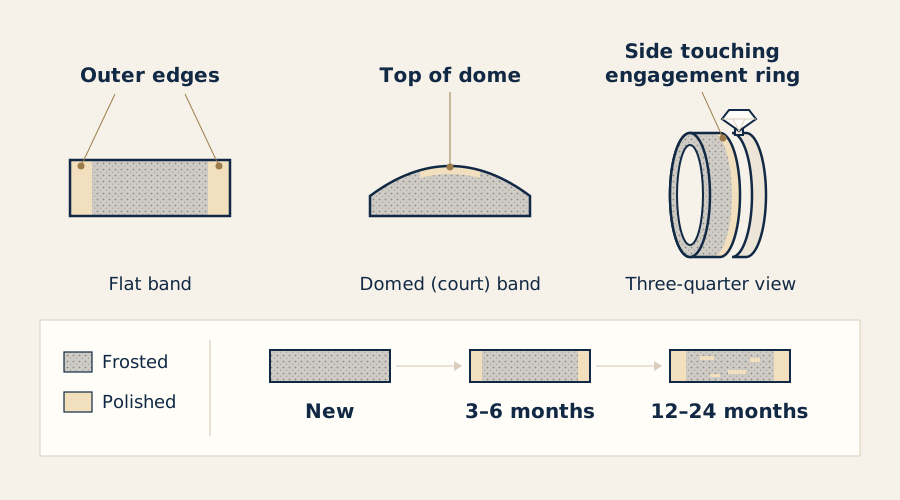
How fast this happens depends on a few things:
- Your hands: gym work, gardening, trades and rock climbing wear the frost far faster than office work.
- Profile: on a domed (court) band the top of the curve polishes first; on a flat band the edges go first and the centre lasts.
- Neighbouring rings: an engagement ring or eternity ring worn alongside rubs the side of the band, often within weeks.
- Metal: harder alloys hold the frost a little longer; softer high-purity metals burnish (smooth by rubbing) sooner.
- Grit: a coarse frost has deeper craters, so it takes longer to wear smooth than a fine frost.
Not sure which one is right?
Send us the stones you are looking at and our gemologist will tell you which to choose and why.
Which metals suit a matte sandblasted finish?
Almost any ring metal can be sandblasted, but each one looks and ages a little differently:
- Yellow gold: the frost deepens the colour and suits both 9ct and 18ct. 9ct gold is harder than 18ct, so it holds the texture a little longer, while 18ct has the richer colour.
- Rose gold: the matte surface makes the pink tone look more even and less coppery under bright light.
- White gold: most white gold is rhodium plated (coated in a thin layer of a bright white platinum-group metal). A sandblasted white gold ring is usually blasted first and plated afterwards. As the plating wears on the high spots, the slightly warmer gold underneath shows, so re-blasting is often paired with re-plating.
- Platinum: a sandblasted platinum ring has a soft grey frost and needs no plating. Platinum tends to push metal aside when scratched rather than losing it, so it develops a satin patina rather than looking worn out.
- Palladium: similar in look to platinum but lighter in weight; it blasts well and needs no plating.
Pure gold sits around 2.5–3 on the Mohs scale and pure platinum around 4–4.5 (ring alloys are a little harder), so every precious metal will pick up marks; the finish only changes how those marks look. Width matters too. A wider band shows more frost and makes the texture the main feature, while a slim band reads more as a soft line. Our guide to choosing the right wedding band width covers comfort and proportion, and our comparison of typical widths for women's and men's bands shows the common ranges in millimetres.
Can you sandblast an eternity ring or combine it with polish and milgrain?
Yes, and combinations are where sandblasting really earns its place. Because the jeweller can mask (cover) parts of the ring with tape or a rubber resist before blasting, the frost can go exactly where you want it. Common designs include a frosted centre with polished edges, a polished centre line between two frosted halves, or a frosted outside with a polished inner surface for comfort. Fine beaded edges and hand-cut patterns also work well next to a frost; see our guide to milgrain edges and engraving patterns for ideas.
Stones need more care. The aluminium oxide grit used for most sandblasting is about 9 on the Mohs scale, harder than almost every gem except diamond, and ruby and sapphire share that hardness. A blast that reaches an emerald, tanzanite, opal or pearl can frost or pit its surface. So on a stone-set band the metal is either blasted before the stones are set, or the stones are carefully masked. Diamonds survive the grit, but the blast can still catch fine claws and the edges of settings.
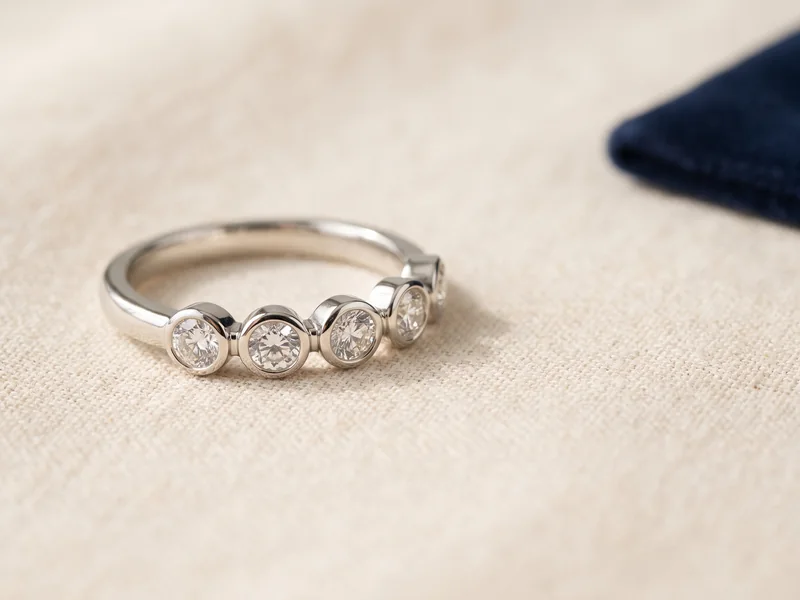
On eternity bands, a frosted metal surface makes the diamonds look brighter by contrast. That works for a half or full eternity band, where the frost can sit on the plain lower half or on the outer walls between stones, and it pairs especially well with smaller stones; our pointer guide to eternity ring stone sizes explains how stone size changes the look.
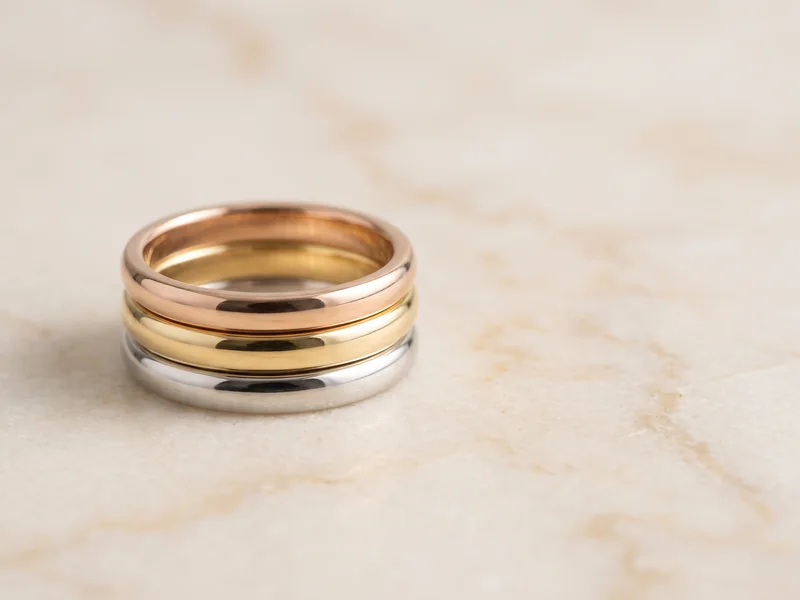
A sandblasted band also stacks well, because a matte texture between two shiny rings separates them visually. Our article on stacking rings with mixed finishes goes through combinations. Shape matters as much as texture beside an engagement ring: read curved versus straight wedding bands, and if your centre stone is unusual, see the advice on bands that sit beside a heart shaped ring and on wedding bands for two-stone toi et moi rings. Remember that a band rubbing against an engagement ring will polish on that side first.
How do you clean a sandblasted ring?
A frosted surface has far more nooks than a polished one, so soap, hand cream and skin oil settle into it and make the frost look grey or patchy. Cleaning is simple, but some habits that suit polished rings work against a matte one:
- Wash gently: soak in warm water with a drop of mild dishwashing liquid for 10–15 minutes, then brush with a soft toothbrush.
- Rinse well: soap residue left in the texture dulls it, so rinse thoroughly under warm running water.
- Pat dry: dab with a soft cloth rather than rubbing hard.
- Skip polishing cloths: treated jewellery cloths are designed to put shine back and will burnish the frost.
- Ultrasonic cleaners: generally fine for a plain gold or platinum band; ask your jeweller first if the ring has stones, especially softer or treated gems.
- Take it off for hard work: gym weights, gardening and building work are the quickest way to polish the frost.
- Avoid chlorine: pool and spa chlorine can weaken gold alloys over time, whatever the finish.
- Store it separately: a soft pouch stops harder rings and gems rubbing shiny patches into it.
You cannot stop a sandblasted ring finish from changing, and many people come to like the soft, lived-in patina it develops. If you prefer it crisp, plan on an occasional re-blast instead.
How is a sandblasted ring refinished, and what does it cost?
Refinishing is one of the real advantages of this finish. A jeweller cleans the ring, removes any deep scratches or dents with fine files and abrasive papers, masks any polished areas or stones, then re-blasts the surface. White gold is then rhodium plated again. Blasting takes off only a microscopic layer of metal, far less than a full re-polish, so a band can be re-blasted many times over its life.
| Workshop job | Approximate price range (AUD) |
|---|---|
| Re-blast a plain gold, platinum or palladium band | about $40–$100 |
| Re-blast and rhodium plate a white gold band | about $80–$160 |
| Re-blast with masking for polished edges or stones | about $60–$150 |
| Resize, then re-blast to match | about $80–$200 or more, depending on the size change and metal |
These are broad ranges only and vary with the ring, the metal and the workshop. Turnaround is often a few days. Any work that heats or reshapes the metal, such as resizing or soldering, disturbs the frost, so the band is always re-blasted at the end. You can also change your mind: a sandblasted band can be polished to a mirror, brushed, or blasted again with a finer or coarser grit.
Many couples time a refresh with a milestone, re-blasting their bands when they add a new piece. If you are thinking about that, our overview of eternity and anniversary rings and the comparison of anniversary rings versus eternity rings explain the difference between the two.
How do you choose a sandblasted wedding band? Step by step
- Pick the metal first. Decide between yellow, rose or white gold, platinum or palladium, keeping in mind that white gold will need re-plating along with re-blasting.
- Choose the frost. Ask to see fine, medium and coarse samples in person; photos flatten the difference.
- Decide where the frost goes. Fully blasted, or masked with polished edges, a polished centre line or a polished inside.
- Match the profile to your hands. Flat bands keep the centre matte longer; domed bands polish on top first.
- Check it beside your engagement ring. Look at the contrast, and expect the touching side to shine within months.
- Plan for stones. If the band is set, confirm the metal will be blasted before setting or the stones masked.
- Ask about upkeep. Find out the likely re-blast interval and cost so the finish fits the way you live.
For metal, profile, comfort fit and sizing beyond the finish itself, our complete wedding ring buying guide puts every decision in order.
Create your ring or wedding band with a sandblasted finish
Free consultation
Talk to a gemologist
Compare stones in person or online with Raj Sood, Graduate Gemologist (GIA), AJP (GIA).
Book a consultationShop this shape
FAQ
Common questions
Does a sandblasted finish wear off?
It softens gradually rather than disappearing. The edges and high points usually start to shine within a few months of daily wear, and after one to two years most bands have a softer, semi-matte patina. A jeweller can re-blast it to look new.
Is sandblasted the same as brushed?
No. Both are matte, but a brushed finish has fine parallel lines with a visible grain, while a sandblasted finish is an even frost with no direction. Sandblasting looks more uniform; brushing hides scratches that run with its lines.
Can you sandblast a ring that is already polished?
Yes. Most plain gold, platinum and palladium bands can be sandblasted at any time, and the change can be reversed later by polishing. Rings set with stones need the stones masked, because the grit can frost most gems.
How often does a sandblasted ring need refinishing?
With everyday wear, many people re-blast every one to three years. Some never do, because they like the satin patina the band develops.
How much does it cost to re-sandblast a ring in Australia?
As a broad guide, about $40–$100 for a plain band, and more if a white gold band needs rhodium plating or polished areas need masking. Prices vary with the ring and the workshop.
Does a sandblasted ring get dirty more easily?
The frosted surface holds soap, cream and skin oil more than a polished one, which can make it look grey. Regular washing in warm soapy water with a soft brush, followed by a thorough rinse, brings it back.

Ask a gemologist
Not sure which diamond to choose?
Raj Sood is a Graduate Gemologist (GIA) and master jeweller. Bring the stones you are considering, or send the reports, and he will tell you honestly which one is better and why.
Keep learning
Related guides
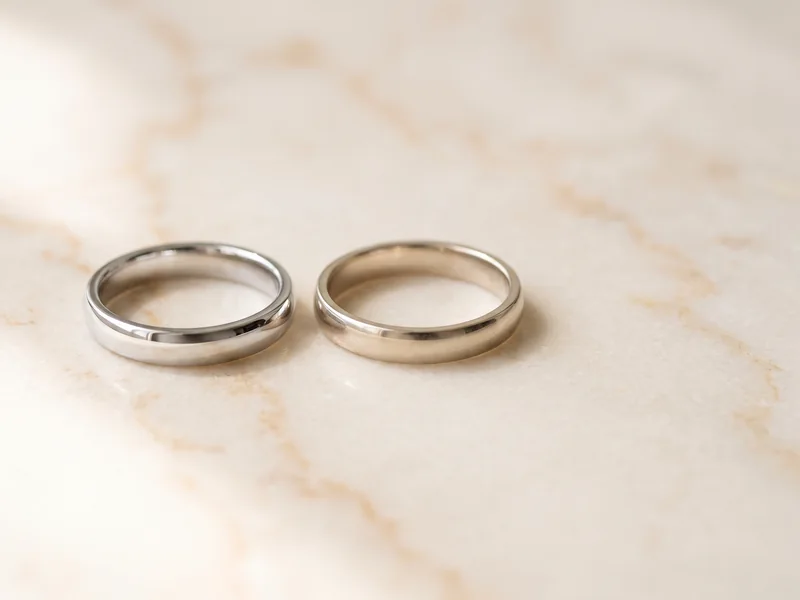 Wedding Bands & EternityBrushed and Satin Ring Finishes
 Wedding Bands & EternityHammered Ring Finish
 Wedding Bands & EternityHigh Polish Ring FinishWedding Bands & EternityWedding Ring Buying Guide
 Wedding Bands & EternityHow to Stack Rings
 Wedding Bands & EternityMilgrain and Engraving Patterns
 Wedding Bands & EternityHalf Eternity vs Full Eternity Rings
 Wedding Bands & EternityAnniversary Ring vs Eternity Ring
Explore more
More guides on this topic
Education