
- Education
- Wedding Bands & Eternity
- Half Eternity vs Full Eternity Rings: A Guide to Eternity Band Settings
Wedding Bands & Eternity
Half Eternity vs Full Eternity Rings: A Guide to Eternity Band Settings
Half and full eternity rings look similar in a photo but wear very differently. Here is how the two eternity band settings compare on comfort, resizing, stone size, stacking and cost, so you choose the one that suits your hand.
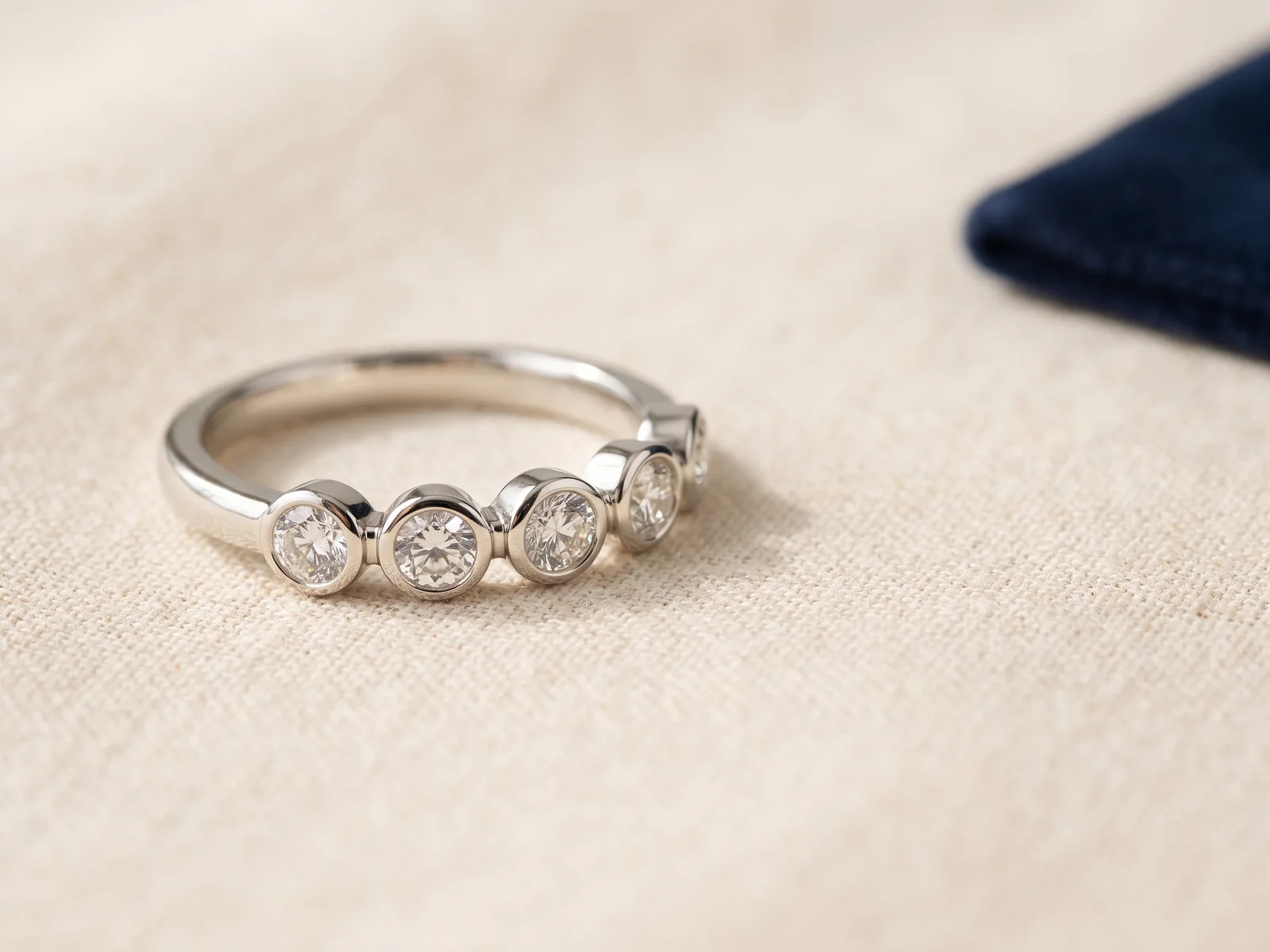
 Reviewed by Raj Sood, Graduate Gemologist (GIA), AJP (GIA)Master jeweller and Graduate Gemologist (GIA) · reviewed 4 November 2026
Quick answer
A half eternity ring has stones across roughly the top half of the band, with plain metal underneath; a full eternity ring has stones all the way around. Half eternity is more comfortable beside other rings, can usually be resized and costs less. Full eternity shows stones from every angle but must be made to an exact size.
What is the difference between a half eternity and full eternity ring?
An eternity ring is a band set with a continuous line of matching stones, usually diamonds of the same size. The unbroken row is meant to stand for lasting love, which is why eternity rings are often given as wedding bands, at an anniversary or after the birth of a child. Our guide to eternity rings and anniversary rings covers the traditions behind them.
The difference between the two types is simply how far the stones go around the band:
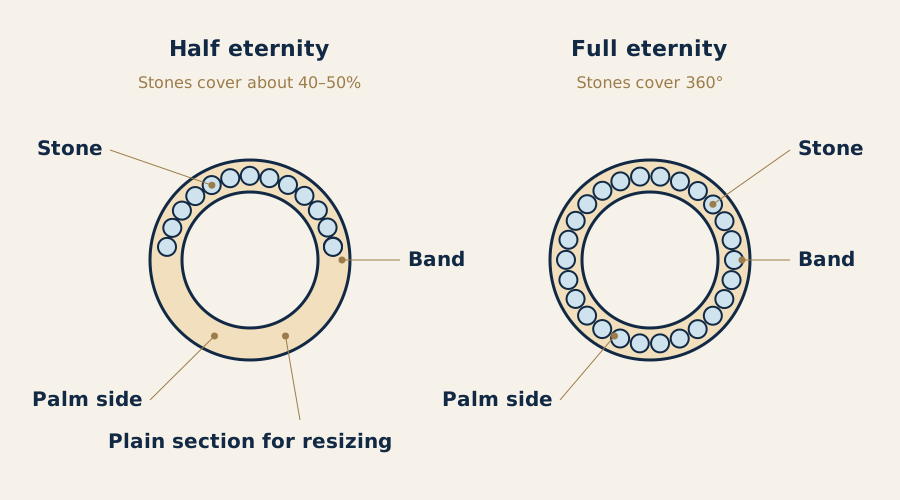
- Half eternity: stones across the top of the band, usually covering about 40–50% of the circumference. The underside is plain metal. Rings with stones covering about three-quarters of the band are sometimes called three-quarter eternity.
- Full eternity: stones set all the way around, 360°, with no plain section. Whichever way the ring turns on your finger, you see stones.
The names are a little loose in the trade. Some jewellers call any band of stones an eternity ring, and some reserve the word for full eternity only. If you are deciding whether a ring for a milestone counts as one or the other, our page on how an anniversary ring differs from an eternity ring untangles the terms. Any setting words below that are new to you are also explained in our plain-English jewellery glossary.
What are the main eternity band settings?
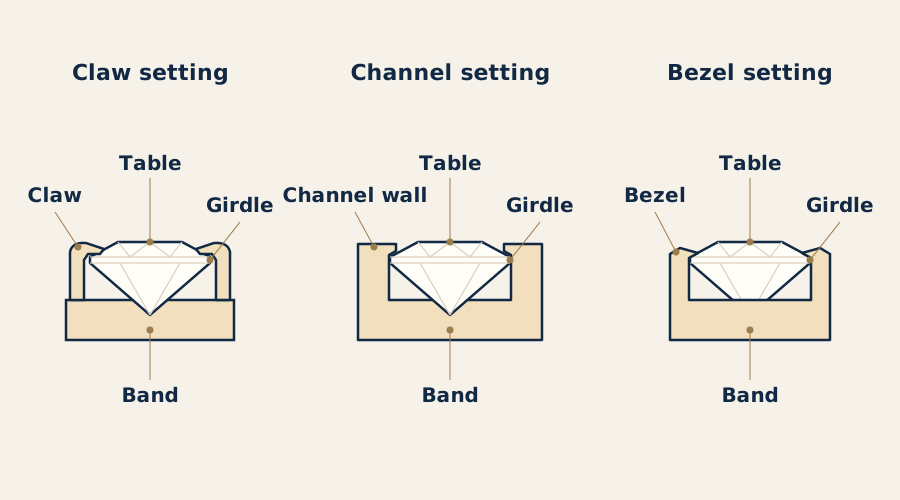
The setting is the way the metal holds each stone. The same choices apply to both half and full eternity rings, and each changes how much stone you see, how the band feels and how it wears over the years.
| Setting | How it holds the stones | Look | Wear notes |
|---|
These are the five settings you will meet most often.
- Claw (or shared-claw) setting: small metal claws (prongs) grip each stone; in a shared-claw band, one claw holds the edges of two neighbouring stones. This shows the most diamond and lets in the most light, but the claws can catch on knits and wear down over 10–20 years.
- U-cut or scalloped setting: a variation of shared-claw where the metal under each stone is cut into a U shape, so you see the side of each diamond. Very bright, slightly more delicate.
- Channel setting: stones sit in a groove between two walls of metal, edge to edge, with nothing raised above them. Smooth, snag-free and suited to active hands, though a little less light reaches each stone.
- Bezel setting: a thin rim of metal surrounds each stone. The most protective option and very modern-looking, but it hides more of each diamond and uses more metal.
- Pavé or micro-pavé: many very small stones (often 1.0–1.5 mm) held by tiny beads of metal raised from the band. Gives a fine glittering surface rather than a row of distinct diamonds.
Details on the edge of the band change the character too. A row of fine metal beads along each side, called milgrain, gives a vintage feel; see our guide to milgrain and engraving patterns for examples. A plain, mirror-bright edge suits most modern settings, and our page on the high polish ring finish explains how it wears.
Half eternity vs full eternity ring: how do they compare?
Here is the half eternity vs full eternity ring decision side by side, based on the same stone size and metal.
| Half eternity | Full eternity | |
|---|---|---|
| Stone coverage | About 40–50% of the band | 100% of the band |
| Stones in a size N with 2.5 mm stones | About 9–12 | About 20–24 |
| Comfort beside other rings | Plain underside sits more easily | Stones on the underside can rub fingers and other rings |
| Resizing | Usually 1–2 sizes, through the plain section | Very limited; often not possible |
| Looks from every angle | Stones may rotate underneath | Always shows stones |
| Underside wear | Plain metal takes the knocks | Claws and stones take the knocks |
| Cleaning | Easier | Dirt collects in the underside stones |
| Relative cost | Lower (fewer stones, less labour) | Roughly 1.6–2× a matching half eternity |
Neither is better in general. Full eternity suits people who want a band that looks the same wherever it turns, often worn on its own or as the only ring on that finger. Half eternity suits people who wear it beside an engagement ring every day, who work with their hands, or whose finger size changes with the seasons.
Is a full eternity ring comfortable for everyday wear?
For many people, yes, but it is the main thing to think about before you choose one. With stones all the way around, the underside of a full eternity ring sits between your fingers. Claws there can press on the neighbouring finger when you grip a steering wheel or a pen, and the stones take the knocks when you carry shopping bags or hold a rail.
A few practical points from the workbench:
- Wear on the underside: claws on the palm side wear thinner faster than those on top. Have them checked about every 12 months.
- Dirt build-up: soap and hand cream collect under the stones on the palm side, dulling them. A soft brush in warm water with a drop of detergent clears it.
- Rubbing against an engagement ring: two diamond-set rings worn together can grind each other's metal, because diamond (10 on the Mohs scale of hardness) is far harder than gold or platinum. Our guide on stopping rings from rubbing each other covers spacers, contours and setting choices.
- Half eternity spinning: a half eternity that is a touch loose can rotate so the stones sit underneath. A snug fit, or a slightly squared-off lower band, keeps the stones on top.
Channel and bezel settings feel smoother than claws on the underside, so if you love the full eternity look but worry about comfort, a channel-set full eternity is often a good middle path.
Not sure which one is right?
Send us the stones you are looking at and our gemologist will tell you which to choose and why.
Can you resize a half or full eternity ring?
Resizing a ring usually means cutting the band, adding or removing metal, then soldering and polishing. On a half eternity, the jeweller works in the plain lower section, so most can be resized about 1–2 sizes up or down without touching the stones. Beyond that, the stones start to spread apart or crowd together, and the setting can loosen.
A full eternity has no plain metal to work on. Stretching it even half a size can open the settings and loosen stones, and cutting it means removing or adding a stone. In practice, most full eternity rings are not resized; if your size changes a lot, the ring is remade. Our article on whether a full eternity ring can be resized explains the exceptions and the costs.
That makes sizing far more important for a full eternity. Australian ring sizes run in letters (for example, a size N is about 54 mm around the inside, roughly 17.2 mm across). Fingers are larger in warm weather and at the end of the day, and smaller in the cold, so measure more than once. Wider bands also fit more snugly than narrow ones of the same size, so measure with a sizer of similar width.
What stone size suits eternity band settings?
Eternity band stones are usually described in points, where 100 points equals 1 carat. A 0.05 carat stone is a 5-pointer. Our eternity ring stone size and pointer guide has the full chart; here are the common sizes for round brilliant diamonds.
| Stone diameter | Approx. weight each | Approx. total, half eternity (size N) | Approx. total, full eternity (size N) |
|---|---|---|---|
| 1.5 mm | 0.015 ct | 0.20–0.25 ct | 0.50–0.60 ct |
| 2.0 mm | 0.03 ct | 0.30–0.40 ct | 0.75–0.90 ct |
| 2.5 mm | 0.06 ct | 0.55–0.70 ct | 1.20–1.45 ct |
| 3.0 mm | 0.10 ct | 0.80–1.00 ct | 1.80–2.20 ct |
| 3.5 mm | 0.15 ct | 1.10–1.40 ct | 2.50–3.00 ct |
Stone count, and therefore total carat weight, rises with ring size, so a size Q full eternity holds a few more stones than a size L. Larger stones also need a wider, deeper band: a ring with 3.5 mm stones is usually about 3.5–4 mm wide and sits higher on the finger.
For a band worn beside an engagement ring, 1.5–2.5 mm stones are the most common choice because they keep the band between about 2 and 3 mm wide. For help matching widths, see our guide to choosing a wedding band width and the differences between women's and men's band widths. Diamonds can also be swapped for coloured gemstones; sapphire and ruby (both 9 on the Mohs scale) wear well in full eternity, while softer stones such as emerald (7.5–8) are better kept to half eternity for everyday wear. Lab-created sapphires and lab-grown diamonds are both widely used and have the same hardness as their natural counterparts.
Which eternity ring sits well with an engagement ring?
Most eternity bands are worn beside an engagement ring, and how the two meet matters as much as the band itself. A pair can sit flush, touching all the way along, or with a small gap where the engagement ring's centre stone or setting holds the band away.
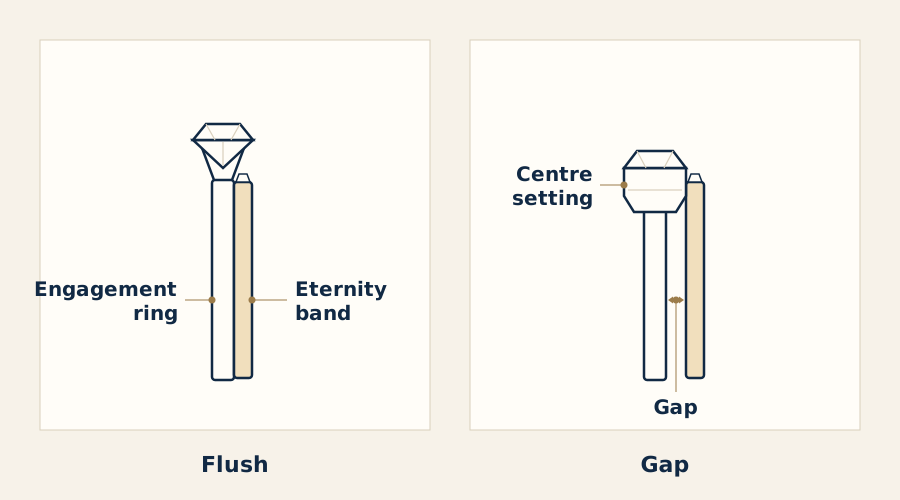
- Low-set solitaires: the setting may sit lower than the band's stones, leaving a gap. A half eternity with a slight curve, or a higher setting, closes it.
- Halo engagement rings: the halo is wide, so a straight eternity band often leaves a gap; see our notes on bands that suit halo engagement rings.
- Heart and pear centres: the point can sit over the band. Our guide to wedding bands for heart engagement rings shows the options.
- Toi et moi (two-stone) rings: the two centre stones sit off-centre, so the band needs to clear both; see band pairings for toi et moi rings.
If you plan to add bands over the years, a half eternity leaves more room for comfort as the stack grows. Our guide on how to stack rings well covers proportions and metal mixing, and the page below on building a stack over the years shows how couples add a band at each milestone.
Related guideBuilding an Anniversary Ring StackWhich metals and finishes work for eternity band settings?
Because eternity bands rely on many small claws or channel walls, the metal needs to hold up to years of wear. The usual choices:
- Platinum (950): dense and hard-wearing; claws tend to bend rather than snap. Heavier and usually more expensive.
- 18ct gold: white, yellow or rose. 75% pure gold, firm enough for claws. White gold is often rhodium-plated and may need replating every 1–3 years.
- 9ct gold: 37.5% gold, harder but less rich in colour. Fine for channel or bezel bands; some prefer 18ct for fine claws.
Textured finishes work well on the plain underside of a half eternity or on the sides of a channel band. A hammered finish adds soft facets that hide scratches, and a matte sandblasted finish contrasts with the brightness of the stones. Both can be re-applied when the ring is serviced.
How much does an eternity ring cost in Australia?
Price depends on total carat weight, whether the diamonds are natural or lab-grown, their colour and clarity, the metal and the setting labour. A full eternity uses roughly twice the stones of a half eternity of the same size, and every stone has to match, so it costs considerably more. Lab-grown diamonds are real diamond grown in a laboratory; they look the same as natural diamonds and cost much less.
| 18ct gold, G–H colour, VS–SI clarity | Lab-grown diamonds (AUD) | Natural diamonds (AUD) |
|---|---|---|
| Half eternity, about 0.50 ct total | about $1,200–$2,500 | about $2,000–$4,500 |
| Full eternity, about 1.00 ct total | about $2,000–$4,500 | about $4,500–$10,000 |
| Full eternity, about 2.00 ct total | about $3,500–$7,000 | about $9,000–$20,000 |
These are broad ranges only. Platinum usually adds to the cost, and micro-pavé or U-cut settings take more labour than channel settings. Our complete wedding ring buying guide covers how to compare quotes and what a valuation should list.
Design your eternity ring or wedding band
How do you choose between half and full eternity? Step by step
- Decide how you will wear it. Daily beside an engagement ring, or on its own? Half eternity is more forgiving beside other rings.
- Think about your work and hobbies. If your hands take knocks, choose half eternity or a channel or bezel full eternity.
- Get sized carefully. Measure at different times of day with a sizer of similar width, especially for full eternity.
- Choose the stone size. 1.5–2.5 mm suits most stacks; larger stones need a wider band.
- Pick the setting. Claw for most light, channel for smoothness, bezel for protection.
- Check the fit with your engagement ring. Look for a flush fit or a deliberate, even gap.
- Confirm the details in writing. Metal, total carat weight, colour, clarity, and whether the diamonds are natural or lab-grown.
Free consultation
Talk to a gemologist
Compare stones in person or online with Raj Sood, Graduate Gemologist (GIA), AJP (GIA).
Book a consultationShop this shape
FAQ
Common questions
Is a half or full eternity ring better for a wedding band?
Neither is better for everyone. Half eternity is more comfortable beside an engagement ring and can be resized, while full eternity shows stones from every angle but must be made to an exact size.
Can a full eternity ring be resized?
Usually not by more than a tiny amount, because there is no plain metal to cut. If your size changes significantly, the ring generally has to be remade.
Does a half eternity ring spin on the finger?
It can if it is slightly loose, bringing the stones underneath. A snug fit or a slightly squared lower band keeps the stones on top.
How many diamonds are in a full eternity ring?
It depends on the stone size and ring size. A size N with 2.5 mm stones usually holds about 20–24 diamonds, while a half eternity in the same size holds about 9–12.
Which eternity band setting is most secure?
Bezel and channel settings protect the stones best because metal surrounds the edges. Claw settings show more diamond but need the claws checked about once a year.
Can I get a lab-grown diamond eternity ring?
Yes. Lab-grown diamonds are real diamond with the same hardness and sparkle, cost much less than natural diamonds, and are widely used in both half and full eternity rings.

Ask a gemologist
Not sure which diamond to choose?
Raj Sood is a Graduate Gemologist (GIA) and master jeweller. Bring the stones you are considering, or send the reports, and he will tell you honestly which one is better and why.
Keep learning
Related guides
 Wedding Bands & EternityCan a Full-Eternity Ring Be Resized?
 Wedding Bands & EternityEternity Ring Stone Sizes (Pointer Guide)
 Wedding Bands & EternityEternity Rings & Anniversary Rings
 Wedding Bands & EternityHow to Prevent Rings From Rubbing Each OtherWedding Bands & EternityWedding Ring Buying GuideWedding Bands & EternityAnniversary Ring vs Eternity Ring
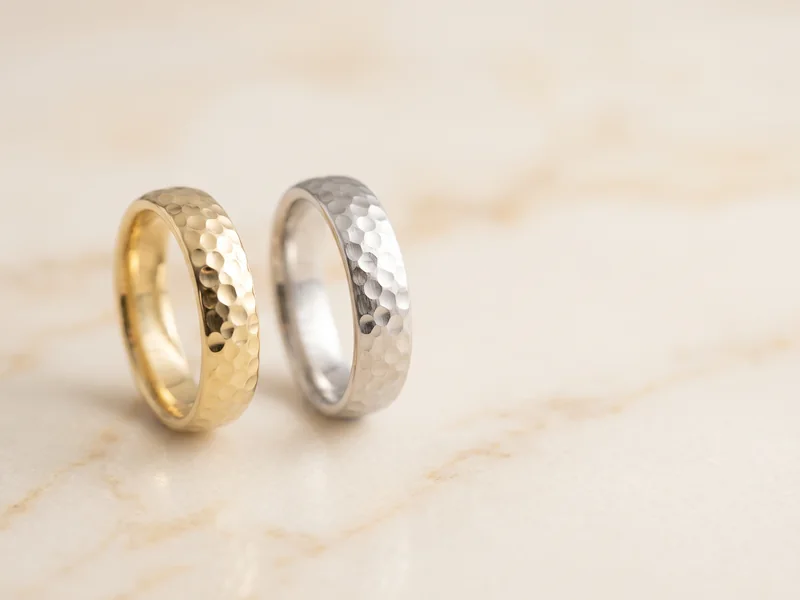 Wedding Bands & EternityHammered Ring Finish
 Wedding Bands & EternitySandblasted Ring Finish
Explore more
More guides on this topic
Education